How to Start Affiliate Marketing
Complete affiliate marketing guide • Step-by-step process • Profit calculator
Affiliate Marketing Overview:
Calculate EarningsAffiliate marketing is a performance-based marketing strategy where you earn commissions by promoting other companies' products. As an affiliate marketer, you earn a percentage of sales for each customer you refer to the merchant's website.
Key affiliate marketing components:
- Niche Selection: Choose a profitable market to target
- Affiliate Programs: Join programs that align with your niche
- Content Creation: Develop content that attracts and converts visitors
- Traffic Generation: Drive visitors to your affiliate links
- Conversion Optimization: Maximize earnings per visitor
- Scaling: Expand your efforts for increased income
Success in affiliate marketing requires patience, consistent effort, and strategic thinking, but can provide substantial passive income over time.
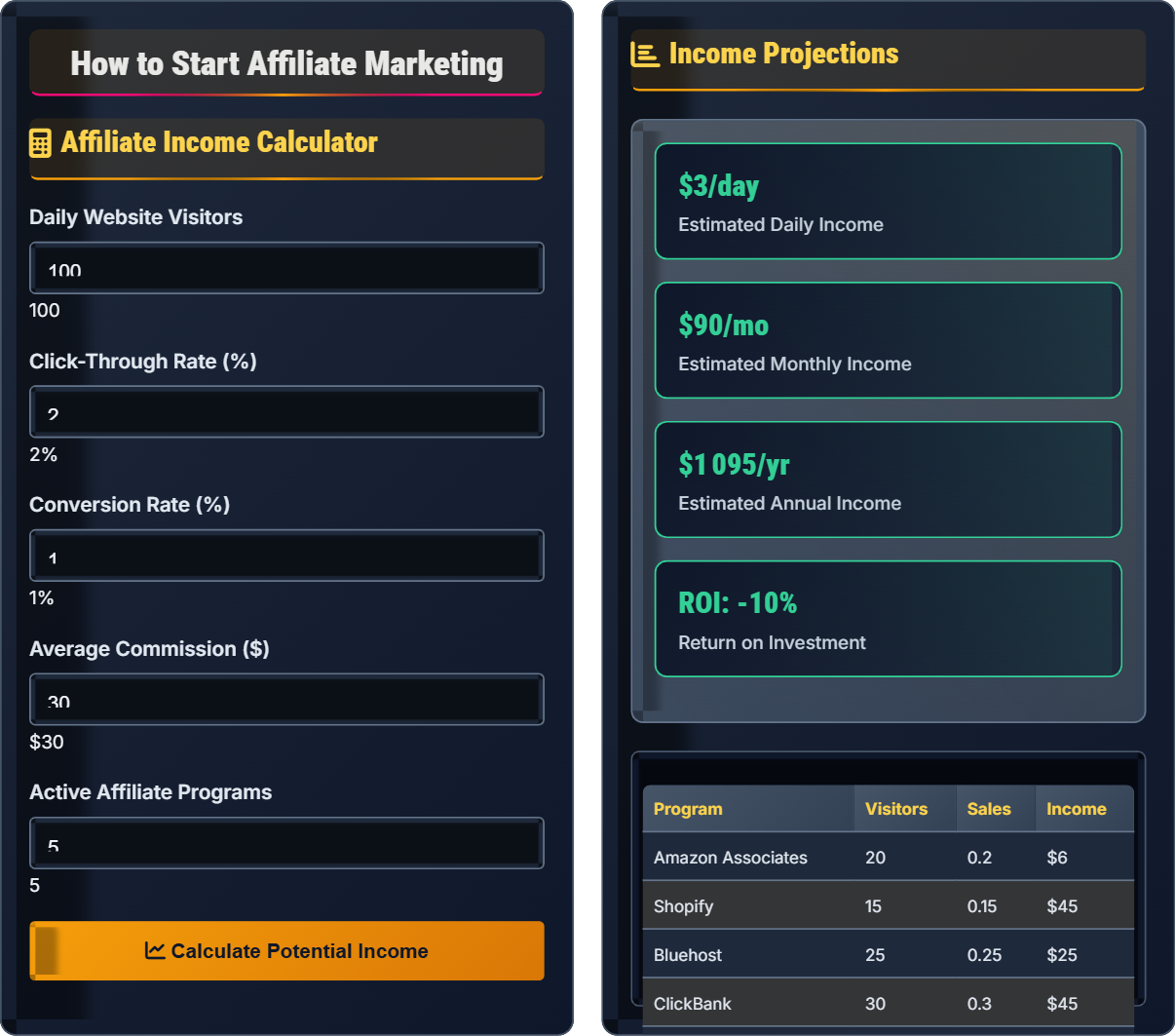
Affiliate Income Calculator
Income Projections
| Program | Visitors | Sales | Income |
|---|---|---|---|
| Amazon Associates | 20 | 0.2 | $6 |
| Shopify | 15 | 0.15 | $45 |
| Bluehost | 25 | 0.25 | $25 |
| ClickBank | 30 | 0.3 | $45 |
| ShareASale | 10 | 0.1 | $10 |
Affiliate Marketing Explained
Affiliate marketing is a performance-based marketing strategy where a business rewards affiliates for bringing in customers or visitors through their own marketing efforts. Affiliates earn commissions when they successfully promote and sell products or services.
Key areas where affiliate marketing provides value:
- Product Reviews: Honest reviews with affiliate links
- Comparison Sites: Product comparisons with purchase links
- Educational Content: Tutorials with relevant product recommendations
- Social Media: Promoting products through social platforms
- Email Marketing: Including affiliate links in newsletters
- YouTube Videos: Product showcases with affiliate links
- Pay-Per-Sale: Earn commission when someone makes a purchase
- Pay-Per-Click: Earn for each click on your affiliate link
- Pay-Per-Lead: Earn when someone completes a form or signs up
- Recurring Commissions: Ongoing payments for subscription services
- Two-Tier Programs: Earn commissions on your referrals' sales
- Physical Products: Promote tangible goods
How to Get Started
Select a profitable niche you're passionate about. Good niches have high search volume, purchasing power, and are evergreen.
- Health & Fitness
- Personal Finance
- Technology Reviews
- Home & Garden
- Beauty & Skincare
- Travel & Lifestyle
Create a website or blog where you'll publish content and place affiliate links. Choose a memorable domain name and reliable hosting.
- WordPress (self-hosted)
- Squarespace
- Wix
- Ghost (blogging platform)
- Medium (for beginners)
- Social Media (YouTube, Instagram)
Apply to relevant affiliate programs in your niche. Start with established programs and gradually add more as you grow.
- Have a website with quality content
- Explain your marketing strategy
- Show your audience size and engagement
- Highlight your social media presence
- Provide traffic statistics
- Demonstrate expertise in your niche
Popular Affiliate Programs
Affiliate Income Growth Path
Success Milestones:
- Month 1-3: Learn basics, set up platform, join programs
- Month 4-6: Publish consistent content, drive traffic, make first sales
- Month 7-12: Scale content, optimize conversions, expand programs
- Year 2+: Diversify income, build team, create courses/products
Find Your Profitable Niche
Niche Selection Criteria:
- High search volume (use Google Keyword Planner)
- Good purchasing power among audience
- Evergreen content potential
- Your genuine interest and knowledge
- Available affiliate programs
- Low to moderate competition
Affiliate Marketing Quiz
Which affiliate program typically offers the highest commission rates?
ClickBank typically offers the highest commission rates, often ranging from 50-75% for digital products. This is because digital products have lower overhead costs and higher profit margins compared to physical products sold through Amazon or other networks.
The answer is B) ClickBank.
Commission rates vary based on product type, profit margins, and business model. Physical products typically have lower commission rates (3-10%) due to manufacturing and shipping costs. Digital products can offer higher rates (50-75%) because there are no physical inventory costs. Understanding these differences helps affiliates choose programs that align with their income goals.
Commission Rate: Percentage of sale paid to affiliate
Digital Product: Electronic items with no physical inventory
Physical Product: Tangible items requiring shipping
• Higher commission doesn't always mean more income
• Conversion rate affects total earnings
• Product quality impacts reputation
• Balance commission rate with conversion probability
• Focus on products you believe in
• Test different products to find winners
• Chasing highest commission without testing
• Promoting low-quality products
• Not tracking performance metrics
Explain how to develop an effective content strategy for affiliate marketing, including content types, frequency, and integration with affiliate links.
Content Types: Product reviews, comparison articles, buying guides, tutorials, listicles, and case studies. Each type serves different stages of the buyer's journey.
Content Frequency: Consistency matters more than quantity. Aim for 2-4 quality posts per week initially, then scale based on audience engagement and available time.
Link Integration: Place affiliate links naturally within content, focusing on providing value first. Use contextual links, call-to-action boxes, and product tables.
SEO Optimization: Research keywords using tools like Google Keyword Planner, optimize titles and meta descriptions, and build quality backlinks.
Performance Tracking: Monitor clicks, conversions, and earnings to identify top-performing content and optimize accordingly.
Successful affiliate content balances value provision with promotional material. Readers come for information and stay for the solutions you provide. When your content genuinely helps solve problems, affiliate links feel natural rather than forced. This approach builds trust and increases conversion rates.
Buyer's Journey: Stages customers go through before purchasing
Contextual Linking: Placing links within relevant content
Conversion Rate: Percentage of visitors who make purchase
• Always disclose affiliate relationships
• Only promote products you believe in
• Focus on value before promotion
• Use comparison tables for easy decision making
• Include pros and cons in reviews
• Share personal experiences with products
• Over-promoting without providing value
• Not disclosing affiliate relationships
• Promoting irrelevant products
A beginner affiliate marketer has $1,000 to invest in starting their business. They need to purchase a domain ($15/year), hosting ($100/year), premium WordPress theme ($60), SEO tools ($100/year), and content creation tools ($50). Should they invest in paid traffic immediately or focus on organic growth first? Justify your recommendation with a budget breakdown.
Recommendation: Focus on organic growth first
Budget Breakdown:
Essential Setup: $175 (domain + hosting + theme)
Tools & Resources: $150 (SEO + content tools)
Remaining Budget: $675
Organic Strategy: Use remaining budget for high-quality content creation, graphic design tools, and learning resources. This builds a foundation of organic traffic that continues to grow over time.
Why Organic First: Paid traffic requires significant experience to be profitable. Without understanding your audience and conversion rates, paid traffic can be expensive and ineffective. Organic traffic compounds over time, while paid traffic stops when you stop paying.
Timeline: After 3-6 months of organic growth and understanding your audience, allocate part of future earnings to paid traffic for accelerated growth.
Beginning affiliate marketers should prioritize building a sustainable foundation before investing in paid traffic. Organic strategies like SEO, content marketing, and social media take longer to show results but provide lasting value. Paid traffic amplifies existing success rather than creating it, making it more effective after establishing baseline performance.
Organic Traffic: Visitors from unpaid sources
Compound Growth: Growth that builds upon itself
Baseline Performance: Minimum acceptable results• Master organic methods before paid traffic
• Track ROI on all investments
• Scale only after proving success
• Use free tools initially to learn
• Focus on one strategy at a time
• Document everything you learn
• Investing in paid traffic too early
• Not tracking expenses carefully
• Diversifying too quickly
An experienced affiliate marketer wants to expand from their primary tech review niche into 2-3 additional niches. They currently earn $2,000/month and have 10,000 monthly visitors. Propose a strategic expansion plan that maintains quality while increasing income potential.
Expansion Strategy:
Phase 1 (Months 1-3): Identify related niches that complement tech reviews, such as home office equipment, productivity tools, or digital marketing software. This leverages existing audience interests.
Phase 2 (Months 4-6): Create dedicated sections/pages for each new niche. Develop 10-15 high-quality pieces of content per niche. Use existing email list to announce new content areas.
Phase 3 (Months 7-9): Cross-promote between niches where appropriate. Create content that bridges niches (e.g., "Tech Tools for Home Office"). Monitor performance metrics for each niche.
Phase 4 (Months 10-12): Optimize content and strategies based on performance data. Consider creating separate websites for top-performing niches if they diverge significantly.
Expected Results: With proper execution, aim for 50-100% income growth over 12 months while maintaining quality and audience satisfaction.
Successful niche expansion requires strategic thinking about audience overlap and resource allocation. Related niches allow leveraging existing authority and audience trust while reducing content creation costs. The key is maintaining quality across all niches rather than spreading too thin and compromising standards.
Niche Expansion: Adding complementary markets
Audience Overlap: Shared interests between markets
Authority Building: Establishing expertise in niche
• Maintain quality across all niches
• Focus on audience needs, not just profit
• Monitor performance metrics closely
• Start with audience-requested niches
• Use content calendars to organize
• Leverage existing traffic for new content
• Expanding into unrelated niches
• Diluting content quality
• Not tracking niche-specific metrics
Which metric is most important for determining affiliate marketing success?
While all metrics matter, the conversion rate of affiliate links is most directly tied to income generation. It measures how effectively you're turning visitors into buyers, which is the ultimate goal of affiliate marketing.
High traffic with low conversion means you're not monetizing effectively. Similarly, joining many programs without promoting them effectively won't generate income. Content without conversions is just content.
The answer is B) Conversion rate of affiliate links.
Success in affiliate marketing is measured by income generation, not activity. While traffic, content, and program diversity are important, they're means to an end. The conversion rate directly impacts your bottom line and indicates the effectiveness of your marketing efforts, trust-building, and product selection.
Conversion Rate: Percentage of visitors who make purchase
Bottom Line: Net profit/income generated
Monetization: Converting traffic to revenue
• Focus on income-generating metrics
• Track conversion rates by program
• Optimize for profitability, not activity
• Use A/B testing for optimization
• Monitor program-specific performance
• Focus on high-converting products
• Focusing on vanity metrics
• Not tracking conversion rates
• Chasing traffic without monetization
Affiliate Marketing FAQ
Q: How long does it typically take to start earning money with affiliate marketing?
A: The timeline varies significantly based on your approach:
Realistic Expectations:
Months 1-3: Learning, setting up, creating content (often $0-50/month)
Months 4-6: First sales, modest income ($50-200/month)
Months 7-12: Consistent income ($200-1,000/month)
Year 2+: Significant income potential ($1,000+/month)
Success requires patience, consistent effort, and continuous learning. Those who treat it as a serious business and persist through the initial slow period typically see success. The key is focusing on providing value rather than just making sales.
Q: What's the minimum investment needed to start affiliate marketing successfully?
A: You can start with minimal investment:
Free Options: Use free blogging platforms, social media, YouTube, or forums
Basic Setup ($50-100): Domain name, basic hosting, free WordPress theme
Professional Setup ($150-300): Premium hosting, professional theme, essential plugins
Recommended Approach: Start with free methods to learn the basics, then invest in a professional setup once you're committed. Many successful affiliates started with free platforms and upgraded as they grew. The most important investment is your time and effort in learning and executing strategies.