What is Content Marketing?
Complete content marketing guide • Strategy • Implementation
Content Marketing Overview:
Plan ContentContent marketing is a strategic marketing approach focused on creating and distributing valuable, relevant, and consistent content to attract and retain a clearly defined audience — and, ultimately, to drive profitable customer action. It's about telling your brand's story through various forms of content.
Key content marketing elements:
- Valuable Content: Provides genuine value to your audience
- Consistent Publishing: Regular content schedule builds audience
- Targeted Audience: Creates content for specific personas
- Multi-Format Approach: Uses various content types and channels
- Measurable Results: Tracks engagement and conversions
- Long-Term Strategy: Builds brand authority over time
Effective content marketing establishes trust, demonstrates expertise, and guides prospects through the buyer's journey toward conversion.
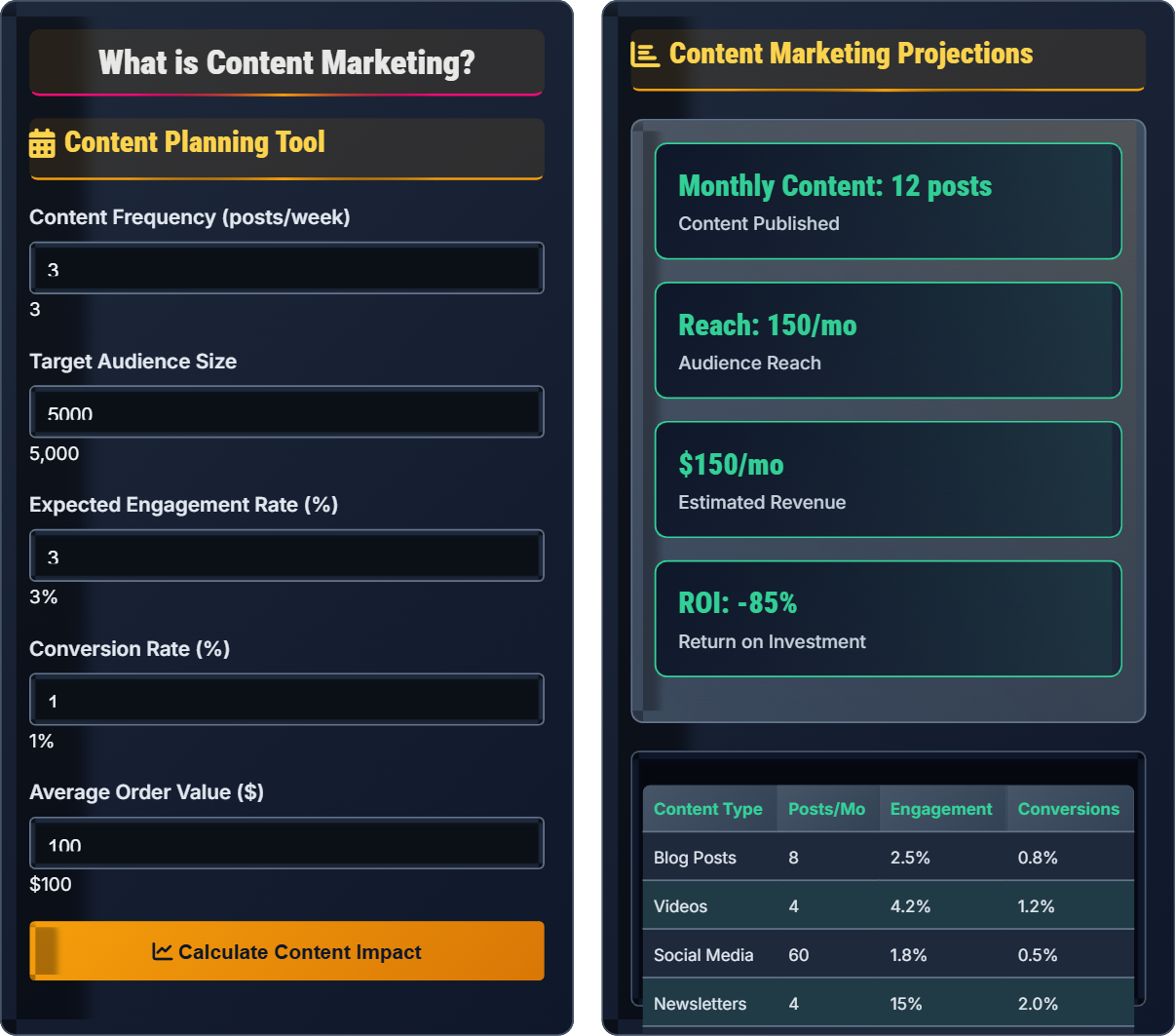
Content Planning Tool
Content Marketing Projections
| Content Type | Posts/Mo | Engagement | Conversions |
|---|---|---|---|
| Blog Posts | 8 | 2.5% | 0.8% |
| Videos | 4 | 4.2% | 1.2% |
| Social Media | 60 | 1.8% | 0.5% |
| Newsletters | 4 | 15% | 2.0% |
| Podcasts | 8 | 3.0% | 1.0% |
Content Marketing Explained
Content marketing is a strategic marketing approach focused on creating and distributing valuable, relevant, and consistent content to attract and retain a clearly defined audience — and, ultimately, to drive profitable customer action. Unlike traditional advertising, content marketing aims to provide value before asking for anything in return.
Key areas where content marketing provides value:
- Brand Awareness: Increase visibility and recognition
- Lead Generation: Attract and nurture prospects
- Customer Education: Help customers understand products
- Thought Leadership: Establish industry expertise
- SEO Benefits: Improve search engine rankings
- Customer Retention: Keep customers engaged
- Written Content: Blog posts, articles, guides, ebooks
- Visual Content: Infographics, images, slideshows
- Video Content: Tutorials, webinars, product demos
- Audio Content: Podcasts, audio books, interviews
- Interactive Content: Quizzes, calculators, surveys
- Live Content: Webinars, live streams, events
Content Marketing Strategies
Develop a comprehensive content strategy that aligns with business goals and audience needs. This includes audience research, content themes, and distribution channels.
- Define your target audience and buyer personas
- Identify content themes and topics
- Create an editorial calendar
- Choose appropriate content formats
- Select distribution channels
- Establish success metrics
Produce high-quality, valuable content that addresses audience pain points and interests. Focus on quality over quantity to build authority and trust.
- Research and outline content
- Create first draft
- Add visual elements
- Optimize for SEO
- Edit and proofread
- Review and approve
Effectively distribute content across multiple channels to maximize reach and engagement. This includes owned, earned, and paid media channels.
- Publish on owned channels first
- Share across social media platforms
- Send to email subscribers
- Engage with relevant communities
- Consider paid promotion for key content
- Repurpose content across formats
Content Format Analysis
Content Marketing Funnel
Funnel Content Strategy:
- Awareness: Educational content, industry insights, problem-solving articles
- Interest: How-to guides, case studies, comparison content
- Consideration: Product demos, testimonials, detailed comparisons
- Conversion: Free trials, special offers, purchase guides
Content Calendar Planning
Calendar Best Practices:
- Plan content 30-90 days in advance
- Maintain consistent publishing schedule
- Balance content types and topics
- Align with seasonal events and holidays
- Reserve space for timely opportunities
- Include content promotion activities
Content Marketing Quiz
What is the primary goal of content marketing?
The primary goal of content marketing is to provide value to your audience and build long-term relationships. Unlike direct response marketing, content marketing focuses on educating, entertaining, or inspiring the audience before asking for anything in return.
The answer is B) Provide value and build relationships with audience.
Content marketing operates on the principle of "attraction marketing." By consistently providing valuable content, brands establish trust and authority with their audience. This trust eventually leads to sales, but the focus remains on value provision rather than immediate conversion. This approach builds stronger, more sustainable customer relationships.
Attraction Marketing: Drawing customers through value provision
Relationship Building: Creating long-term customer connections
Trust-Based Marketing: Earning customer confidence over time
• Focus on audience needs, not business goals
• Provide value before asking for anything
• Build trust through consistency
• Solve problems your audience faces
• Share expertise and knowledge freely
• Be authentic and transparent
• Being too promotional in content
• Not understanding audience needs
• Inconsistent publishing schedule
Explain how to develop a comprehensive content marketing strategy, including audience research, content planning, and performance measurement.
Audience Research: Identify your target audience through surveys, social listening, and analytics. Create detailed buyer personas including demographics, pain points, content preferences, and decision-making factors.
Content Planning: Based on audience research, develop content themes and topics. Create an editorial calendar with publishing dates, content types, and distribution channels. Plan for seasonal content and special events.
Content Creation: Develop a content creation process with clear roles and responsibilities. Ensure all content aligns with brand voice and provides value to the target audience.
Performance Measurement: Define KPIs such as website traffic, engagement rates, lead generation, and conversion rates. Use tools like Google Analytics, social media insights, and CRM data to track performance.
Optimization: Regularly review performance data and adjust strategy based on what works. A/B test content formats and distribution methods.
A successful content marketing strategy requires understanding your audience deeply and creating content that addresses their specific needs and interests. The strategy should be data-driven, with clear metrics for success and regular optimization based on performance insights. Consistency in publishing and quality is crucial for building audience trust.
Buyer Persona: Fictional representation of ideal customer
KPI: Key Performance Indicator for measuring success
Editorial Calendar: Schedule for content creation and publishing
• Know your audience inside and out
• Maintain consistent publishing schedule
• Measure and optimize continuously
• Use audience feedback to guide content
• Repurpose successful content into new formats
• Stay updated on industry trends
• Creating content without audience research
• Inconsistent publishing schedule
• Not tracking performance metrics
A small business with a $5,000 monthly marketing budget wants to implement content marketing. They can hire a content writer ($2,000/month), invest in content creation tools ($500/month), or hire a social media manager ($1,500/month). How should they allocate their budget for maximum content marketing ROI, and why?
Recommended Allocation:
Content Writer: $2,000/month - Creates high-quality content
Content Tools: $500/month - Improves content quality and efficiency
Social Media Manager: $1,500/month - Distributes and promotes content
Remaining Budget: $1,000/month - Reserved for paid promotion of top-performing content
Why This Approach: Content marketing requires both quality creation and effective distribution. Having a dedicated writer ensures consistent, quality content. Tools improve efficiency and output quality. A social media manager handles distribution and engagement. The remaining budget allows amplifying high-performing content.
Effective content marketing requires a balanced approach between creation and distribution. Quality content without distribution reaches few people, while distribution without quality content fails to engage. The budget allocation should support both aspects equally, with room for optimization based on performance data.
ROI: Return on Investment from marketing efforts
Content Distribution: Sharing content across channels
Amplification: Boosting high-performing content
• Balance creation and distribution budgets
• Invest in quality over quantity
• Reserve budget for content amplification
• Start with essential roles and expand gradually
• Use tools to improve efficiency
• Track ROI by content type and channel
• Focusing only on content creation
• Not investing in distribution
• Not tracking content performance
A B2B software company wants to use content marketing to generate leads. They have a blog, LinkedIn, YouTube, and email newsletter. Propose a coordinated content strategy that maximizes reach and lead generation across all channels.
Content Hierarchy: Create comprehensive blog posts as primary content. These serve as cornerstone content for all other formats.
Repurposing Strategy: Transform blog posts into YouTube videos, LinkedIn articles, and email newsletter content. Each format adapts the core message for the specific platform.
Channel-Specific Approach:
Blog: Detailed guides and case studies with lead magnets
LinkedIn: Thought leadership articles and industry insights
YouTube: Product demos and tutorial videos
Email: Curated content with personalized recommendations
Lead Generation: Use lead magnets in blog posts, LinkedIn polls, YouTube end screens, and email CTAs to capture leads across all touchpoints.
Multi-channel content marketing maximizes reach by meeting the audience where they are. Each channel serves a different purpose in the buyer's journey. The key is creating one primary piece of content and adapting it for each platform's unique characteristics and audience expectations.
Content Hierarchy: Primary content adapted for various formats
Buyer's Journey: Stages customers go through before purchasing
Lead Magnet: Content offered in exchange for contact info
• Create one primary content piece
• Adapt for each platform's audience
• Include lead capture opportunities
• Repurpose content across multiple formats
• Tailor tone and style for each platform
• Cross-promote content between channels
• Creating different content for each channel
• Not adapting content for platform norms
• Missing lead capture opportunities
Which content format typically generates the highest engagement rates on social media platforms?
Video content typically generates the highest engagement rates on social media platforms. Video captures attention more effectively than static content and encourages more shares, comments, and reactions.
The answer is B) Video content.
Video content engages multiple senses and tells stories more effectively than text alone. Social media algorithms favor video content, leading to higher organic reach. However, the effectiveness varies by platform and audience preferences, so it's important to test different formats and measure engagement.
Engagement Rate: Percentage of audience interacting with content
Algorithm Preference: Platform's tendency to promote certain content
Organic Reach: Unpaid content visibility
• Test different content formats regularly
• Adapt to platform-specific preferences
• Measure engagement by content type
• Use video for storytelling and demonstrations
• Include captions for accessibility
• Keep videos concise and engaging
• Not optimizing video for each platform
• Making videos too long or boring
• Not including calls-to-action
Content Marketing FAQ
Q: How long does it typically take to see results from content marketing?
A: Content marketing results typically follow this timeline:
Month 1-3: Setting up processes, creating initial content, building audience
Month 4-6: Seeing initial engagement and traffic growth
Month 7-12: Significant traffic increases and lead generation
Year 2+: Substantial ROI and business growth
Content marketing is a long-term strategy that builds momentum over time. The compound effect of consistently valuable content creates lasting business value, but requires patience and persistence to see significant results.
Q: What's the difference between content marketing and traditional advertising?
A: Key differences between content marketing and traditional advertising:
Traditional Advertising: Interruptive, focused on immediate sales, pays for attention
Content Marketing: Permission-based, focused on value provision, earns attention
Approach: Traditional advertising pushes messages to audiences, while content marketing pulls interested audiences to your brand.
Timeline: Traditional advertising delivers immediate results but stops when budget stops. Content marketing builds long-term assets that continue to generate value.
Relationship: Traditional advertising often feels impersonal, while content marketing builds relationships through value exchange.