How Can AI Help with Mental Health Support?
Complete mental health AI guide • Step-by-step explanations
AI Mental Health Support:
Show AI Support ToolsAI is revolutionizing mental health support by providing accessible, scalable, and personalized assistance. Through natural language processing, machine learning, and behavioral analysis, AI can offer therapeutic conversations, mood tracking, crisis intervention, and early warning systems. These technologies complement traditional therapy by providing 24/7 support and helping identify patterns that might be missed by human observation.
AI applications in mental health include chatbots for therapy, emotion recognition systems, predictive analytics for suicide prevention, and personalized treatment recommendations. While AI cannot replace human therapists, it can enhance mental health services by providing preliminary support, monitoring symptoms, and connecting users to appropriate resources.
Key applications:
- Therapeutic Chatbots: Conversational agents for basic support
- Mood Tracking: Continuous monitoring and pattern recognition
- Crisis Intervention: Automated emergency response systems
- Predictive Analytics: Early warning for mental health episodes
AI mental health tools offer unprecedented accessibility to support services while maintaining privacy and reducing stigma associated with seeking help.
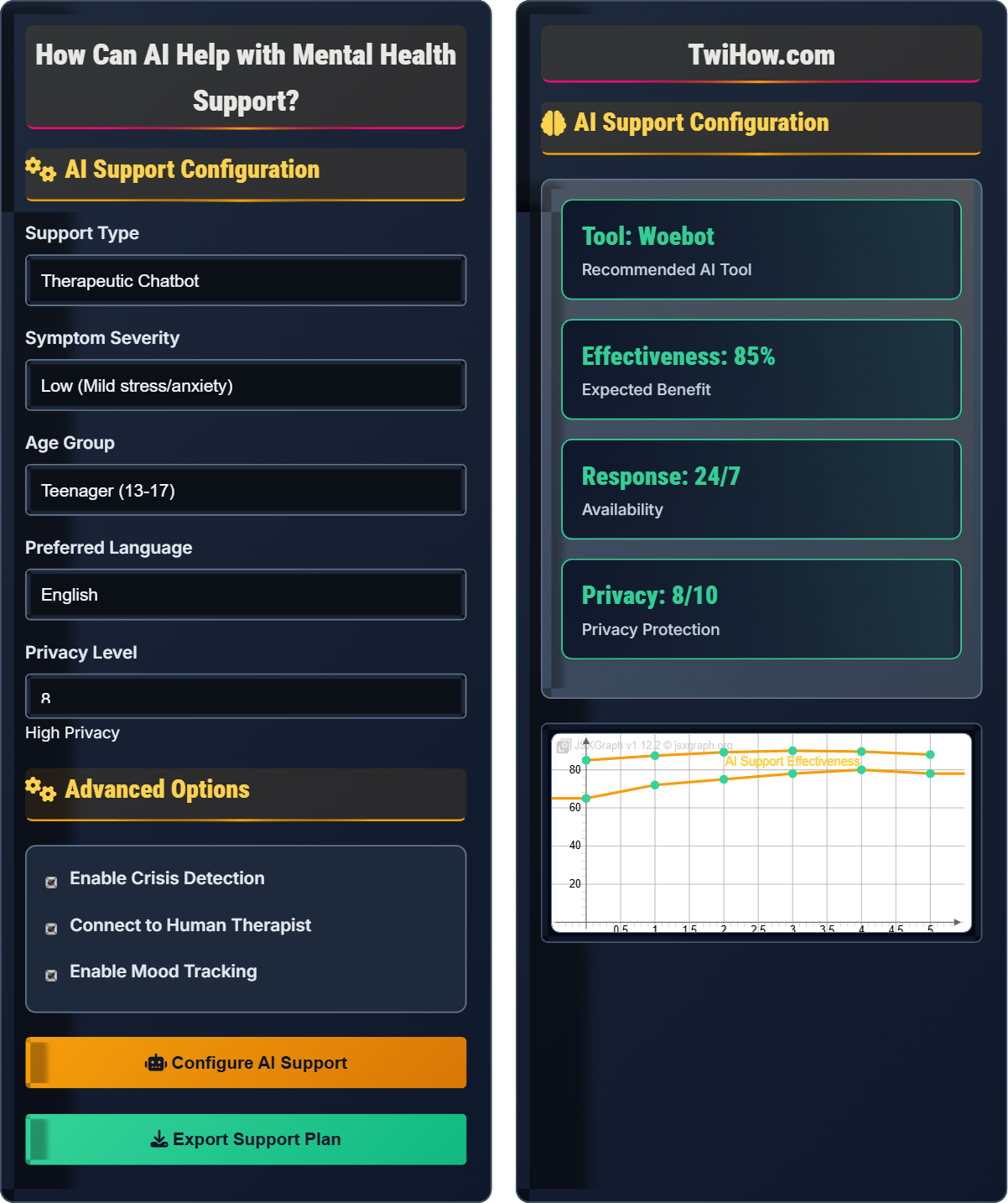
AI Support Configuration
Advanced Options
AI Support Configuration
| Feature | Enabled | Priority | Impact |
|---|---|---|---|
| Crisis Detection | Yes | High | Life-saving |
| Therapeutic Chat | Yes | High | Emotional support |
| Mood Tracking | Yes | Medium | Pattern recognition |
| Therapist Connection | Yes | Medium | Professional care |
| Privacy Controls | Yes | High | Data protection |
Personalized Support Plan:
• Daily check-ins with AI therapist
• Mood tracking with pattern analysis
• Crisis intervention protocols
• Progress monitoring and reporting
• Connection to human professionals when needed
User → AI Support → Professional Care
AI Mental Health Support Framework
AI mental health support refers to the use of artificial intelligence technologies to provide mental health services, including therapeutic conversations, mood tracking, crisis intervention, and personalized recommendations. These systems use natural language processing, machine learning, and behavioral analysis to understand and respond to users' mental health needs in real-time.
AI mental health support follows this fundamental framework:
Where:
- Input: User expressions, mood data, behavioral patterns
- Context: Demographics, history, environmental factors
- Intervention: Therapeutic response, coping strategies
- Follow-up: Progress tracking, adjustment of support
Key applications of AI in mental health:
- Therapeutic Chatbots: Provide CBT-based conversations
- Mood Monitoring: Track emotional patterns over time
- Crisis Intervention: Detect and respond to emergencies
- Medication Reminders: Support treatment adherence
- Sleep Analysis: Monitor sleep patterns affecting mood
- Social Support: Facilitate peer connections
- Privacy Protection: Secure handling of sensitive data
- Crisis Protocols: Emergency response procedures
- Human Oversight: Professional supervision requirements
- Bias Mitigation: Fair treatment across demographics
- Transparency: Clear communication about AI capabilities
AI Mental Health Applications
Therapeutic chatbots, mood tracking, crisis intervention, assessment tools, sleep analysis.
AI Support = f(Input, Context, Intervention, Follow-up)
Where each component contributes to the overall therapeutic effectiveness.
- AI supplements but doesn't replace human therapists
- Privacy and data security are paramount
- Crisis detection must be reliable
Implementation Guidelines
User engagement, crisis protocols, privacy measures, effectiveness monitoring.
- Needs assessment and user profiling
- Tool selection and customization
- Privacy and security setup
- Integration with professional services
- Continuous monitoring and improvement
- Regulatory compliance requirements
- Validation and testing protocols
- Integration with healthcare systems
- Training for healthcare providers
AI Mental Health Learning Quiz
Which of the following is NOT a current application of AI in mental health support?
Automated diagnosis of mental disorders is not currently a validated application of AI in mental health. While AI can assist with screening and risk assessment, formal diagnosis of mental health conditions requires clinical evaluation by qualified professionals. AI applications include therapeutic chatbots, predictive analytics for risk assessment, and mood tracking systems, but diagnosis remains a human responsibility requiring clinical judgment.
The answer is C) Automated diagnosis of mental disorders.
It's important to understand the boundaries of AI in mental health. While AI can provide valuable support and assistance, certain tasks like formal diagnosis require human clinical judgment. This distinction is crucial for understanding the appropriate role of AI in mental health care and ensuring patient safety.
CBT: Cognitive Behavioral Therapy - evidence-based treatment approach
Predictive Analytics: Using data to forecast potential outcomes
Clinical Judgment: Professional assessment requiring expertise
• AI assists but doesn't replace clinical diagnosis
• Human oversight is essential for safety
• Ethical boundaries must be maintained
• Use AI as a screening tool, not diagnostic tool
• Always recommend professional evaluation
• Focus on support and monitoring capabilities
• Overestimating AI diagnostic capabilities
• Not emphasizing human oversight
• Assuming AI replaces professional care
Explain the key ethical considerations when implementing AI mental health support systems, including privacy, crisis management, and the role of human oversight.
Privacy and Data Security: Mental health data is extremely sensitive. AI systems must implement robust encryption, secure storage, and strict access controls. Users should have clear control over their data and understand how it's used.
Crisis Management: AI systems must reliably detect crisis situations (suicidal ideation, severe distress) and have protocols to escalate to human professionals. False negatives could be life-threatening.
Human Oversight: AI should augment rather than replace human care. Systems need clear pathways to connect users with licensed professionals when appropriate. Regular human review of AI interactions is essential.
Equity and Bias: AI systems must be tested across diverse populations to ensure fair treatment regardless of race, gender, age, or socioeconomic status.
Ethical considerations in AI mental health are paramount because the stakes are literally life and death. Unlike other AI applications, mental health AI directly impacts vulnerable individuals during critical moments. The ethical framework must prioritize safety, privacy, and human dignity above all other considerations.
Human Oversight: Professional supervision of AI systems
Crisis Protocol: Procedures for emergency mental health situations
Data Encryption: Securing sensitive information
• Safety protocols must be foolproof
• Privacy is non-negotiable
• Human connection is irreplaceable
• Implement redundant safety measures
• Regular bias audits for fairness
• Clear escalation pathways
• Inadequate crisis detection systems
• Weak privacy protections
• Insufficient human oversight
A university wants to implement an AI mental health support system for students. The system should provide 24/7 support, track mood patterns, detect crisis situations, and connect students to campus counseling services. Design an implementation plan that addresses privacy concerns, effectiveness, and integration with existing mental health services.
System Design: Deploy a conversational AI platform with mood tracking capabilities, integrated with campus counseling services. Use federated learning to keep data on campus servers for privacy.
Privacy Measures: Implement end-to-end encryption, allow anonymous use, give students full control over data deletion, and comply with FERPA and HIPAA regulations.
Crisis Protocols: Develop clear algorithms for crisis detection with automatic alerts to campus security and counseling services. Include escalation pathways for severe cases.
Integration: Seamlessly connect with existing counseling appointment systems, allow counselors to view AI interaction history (with consent), and provide referral pathways for ongoing care.
Evaluation: Monitor usage patterns, conduct regular effectiveness assessments, and gather feedback from students and counselors.
This example demonstrates how to balance accessibility with safety and privacy in AI mental health implementation. The key is creating systems that provide immediate support while maintaining clear pathways to professional care. University settings have unique regulatory requirements that must be carefully considered.
FERPA: Family Educational Rights and Privacy Act
HIPAA: Health Insurance Portability and Accountability ActFederated Learning: Privacy-preserving machine learning approach
• Comply with all relevant regulations
• Maintain clear professional pathways
• Prioritize student privacy and autonomy
• Partner with existing counseling services
• Allow anonymous access to reduce barriers
• Provide clear opt-out mechanisms
• Not involving mental health professionals in design
• Insufficient crisis management protocols
• Violating privacy regulations
How would you measure the effectiveness of an AI mental health support system? What metrics would you track and what validation methods would you use to ensure the system is genuinely helping users?
Quantitative Metrics: 1) User engagement (session frequency, duration), 2) Self-reported mood improvements using validated scales (PHQ-9, GAD-7), 3) Crisis intervention effectiveness, 4) Retention rates, 5) Reduction in reported distress levels.
Qualitative Measures: 1) User satisfaction surveys, 2) Open-ended feedback analysis, 3) Case studies of user journeys, 4) Interviews with connected professionals.
Validation Methods: 1) Randomized controlled trials comparing AI support to control groups, 2) Pre/post assessments using validated instruments, 3) Longitudinal tracking of outcomes, 4) Comparison with traditional therapy effectiveness.
Safety Metrics: Monitor for any negative outcomes, ensure crisis protocols are working, and track appropriate referrals to human professionals.
Measuring effectiveness in AI mental health requires both quantitative and qualitative approaches. Mental health outcomes are complex and multifaceted, so relying solely on usage metrics isn't sufficient. Rigorous validation methods ensure the system is actually providing therapeutic benefit rather than just engagement.
PHQ-9: Patient Health Questionnaire for depression
GAD-7: Generalized Anxiety Disorder assessment scale
Randomized Controlled Trial: Scientific study method
• Use validated assessment tools
• Include safety as primary metric
• Conduct rigorous validation studies
• Track both engagement and outcomes
• Use multiple assessment methods
• Include longitudinal follow-up
• Measuring only usage statistics
• Not using validated instruments
• Insufficient safety monitoring
Which of the following represents the most promising future trend in AI mental health support?
The most promising trend is seamless integration with human care. Rather than replacing human professionals, the future of AI in mental health lies in augmenting and supporting human care. AI can handle routine check-ins, provide 24/7 support, monitor patterns, and assist therapists with insights, while humans provide empathy, complex decision-making, and therapeutic relationships. This collaborative approach maximizes the benefits of both AI and human expertise.
The answer is B) Seamless integration with human care.
The most effective approach to AI in mental health recognizes that humans and AI have complementary strengths. AI excels at data processing, pattern recognition, and availability, while humans excel at empathy, complex reasoning, and therapeutic relationships. The future lies in optimizing this partnership rather than viewing it as a competition.
Augmentation: Enhancing human capabilities with AI
Complementary Strengths: Different abilities that work together
Therapeutic Alliance: Relationship between therapist and client
• AI augments rather than replaces human care
• Human connection remains essential
• Technology should enhance accessibility
• Focus on AI-human collaboration
• Maintain human oversight
• Emphasize accessibility benefits
• Viewing AI as replacement for human care
• Ignoring the importance of human connection
• Over-relying on algorithmic solutions
FAQ
Q: Can AI really provide effective mental health support, or is human interaction essential?
A: AI can provide effective support for many mental health needs, particularly for mild to moderate symptoms and routine check-ins. Studies show AI therapy apps can be as effective as human therapy for conditions like anxiety and depression. However, human interaction remains essential for:
• Complex trauma and severe mental illness
• Crisis intervention and safety assessment
• Building therapeutic relationships
• Cultural and contextual understanding
The most effective approach combines AI's accessibility and consistency with human empathy and clinical expertise. AI can bridge gaps in access to care while supporting human professionals.
Q: What are the biggest risks of using AI in mental health care?
A: Key risks include:
Missed Diagnoses: AI might not recognize complex presentations or comorbidities
Crisis Management: Failure to properly identify or respond to emergency situations
Privacy Breaches: Exposure of extremely sensitive personal information
Algorithmic Bias: Discrimination against certain demographic groups
Over-reliance: Users depending solely on AI instead of seeking professional help
False Reassurance: AI providing inappropriate reassurance during serious situations
Mitigation requires rigorous testing, diverse training data, robust safety protocols, and clear pathways to human professionals.