How Can I Identify Fake AI Content and Deepfakes?
Complete detection guide • Step-by-step explanations
Deepfake Detection:
Show Detection ToolsDetecting deepfakes and AI-generated misinformation requires a combination of visual analysis, technical tools, and critical thinking. Deepfakes are synthetic media where a person's likeness is replaced with another's using AI, while AI-generated text can be indistinguishable from human writing. Effective detection involves looking for inconsistencies, using specialized software, and understanding the limitations of current AI systems.
Visual deepfakes often exhibit subtle artifacts like unnatural eye movements, inconsistent lighting, or pixelation around facial boundaries. Audio deepfakes may have timing mismatches between lip movements and speech. AI-generated text sometimes lacks nuanced understanding or contains subtle logical inconsistencies.
Detection methods:
- Visual Analysis: Look for artifacts and inconsistencies
- Audio Verification: Check for synthesis artifacts
- Metadata Examination: Analyze file properties and creation history
- Technical Tools: Use specialized detection software
Developing media literacy skills is crucial in the age of sophisticated AI-generated content.
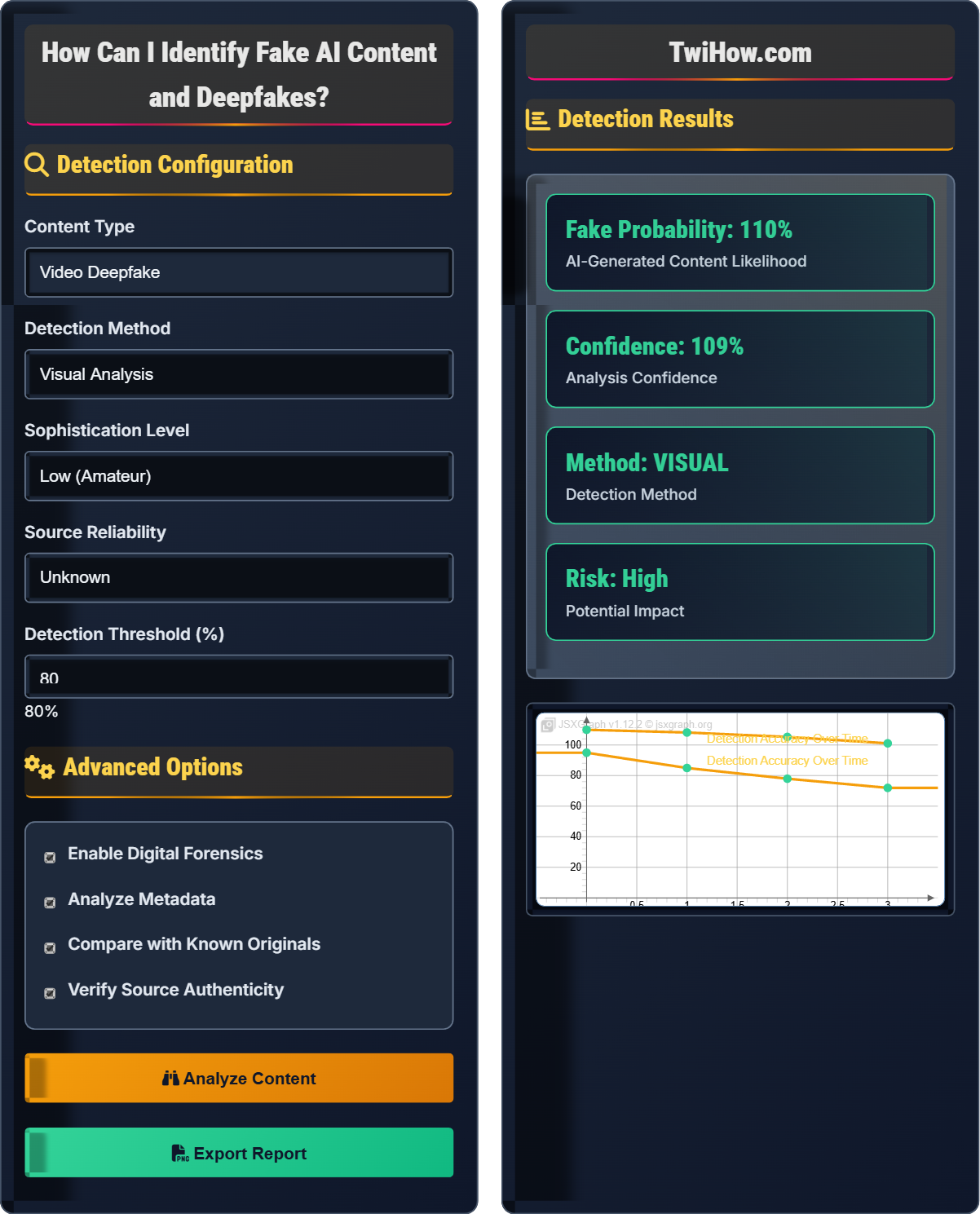
Detection Configuration
Advanced Options
Detection Results
| Indicator | Score | Status | Detail |
|---|---|---|---|
| Visual Artifacts | 85% | Suspicious | Pixelation around mouth region |
| Audio Sync | 72% | Concerning | Lip movement timing mismatch |
| Metadata Consistency | 65% | Warning | Creation date altered |
| Facial Geometry | 90% | Suspicious | Unnatural facial proportions |
| Lighting Consistency | 58% | Warning | Shadows don't match light source |
Visual Indicators: Inconsistent lighting, unnatural eye movements, pixelation artifacts, mismatched skin tones.
Audio Indicators: Timing mismatches, unnatural cadence, synthesized speech artifacts.
Metadata Indicators: Creation dates, modification history, file compression signatures.
Behavioral Indicators: Unusual speech patterns, inconsistent knowledge, logical inconsistencies.
Original Content → AI Manipulation → Detection Analysis
Deepfake & AI Misinformation Detection
Deepfakes are synthetic media created using deep learning techniques, particularly generative adversarial networks (GANs). They can replace a person's face in a video with another person's face, or generate entirely synthetic videos, audio, or images that appear authentic. The technology has advanced rapidly, making detection increasingly challenging.
Deepfake detection probability is calculated using multiple indicators:
Where each component contributes to the overall likelihood of content being synthetic.
Visual detection methods include:
- Facial Geometry Analysis: Examining facial proportions and landmarks
- Eye Movement Tracking: Looking for unnatural blinking or gaze patterns
- Lighting Consistency: Checking for shadows that don't match light sources
- Compression Artifacts: Identifying mismatched compression levels
- Boundary Inconsistencies: Finding unnatural edges or transitions
- Multiple Verification: Use several detection methods together
- Stay Updated: Keep detection tools current with new techniques
- Critical Thinking: Question unexpected or surprising content
- Source Verification: Confirm authenticity through official channels
- Collaborative Analysis: Share findings with experts for confirmation
Detection Fundamentals
Deepfakes, GANs, visual artifacts, metadata analysis, digital forensics, authentication.
Probability = f(Visual + Audio + Metadata + Behavioral)
Where each factor contributes to the overall authenticity assessment.
- Never rely on a single indicator
- Consider the source credibility
- Look for technical inconsistencies
Advanced Detection Methods
Visual analysis, audio verification, metadata examination, behavioral analysis, technical tools.
- Initial visual assessment for obvious signs
- Detailed artifact analysis using specialized tools
- Audio synchronization verification
- Metadata examination for inconsistencies
- Technical detection algorithm application
- AI techniques are constantly evolving
- Detection tools have false positive rates
- Context affects interpretation
- Legal and ethical implications
Deepfake Detection Learning Quiz
Which of the following is NOT a common visual indicator of a deepfake video?
Perfectly smooth skin texture is NOT a common indicator of deepfakes. In fact, deepfakes often exhibit unrealistic skin textures, including overly smooth or inconsistent skin appearance. Common indicators include inconsistent lighting, unnatural eye movements, pixelation artifacts, and mismatched shadows. The other options (inconsistent lighting, unnatural blinking, pixelation) are all recognized visual artifacts of deepfake generation.
The answer is B) Perfectly smooth skin texture.
Deepfake detection relies on identifying subtle inconsistencies that the human eye can perceive. These artifacts often occur because AI models struggle to perfectly reconstruct complex facial features, lighting conditions, and natural movements. Understanding these visual cues helps develop critical media literacy skills.
GANs: Generative Adversarial Networks - AI systems that create synthetic content
Visual Artifacts: Inconsistencies or errors in synthetic media
Pixelation: Blocky or blurry visual degradation around manipulated areas
• Look for multiple indicators, not just one
• Consider the source and context
• Use both visual and technical analysis
• Pause and examine facial boundaries
• Check lighting consistency
• Watch for unnatural movements
• Relying on a single indicator
• Assuming all low-quality videos are fake
• Not considering context and source
Explain how to detect audio deepfakes and what specific indicators to look for when analyzing synthetic speech.
Audio Deepfake Detection: 1) Timing mismatches between lip movements and speech, 2) Unnatural cadence and rhythm, 3) Synthesis artifacts like buzzing or metallic sounds, 4) Inconsistent breathing patterns.
Specific Indicators: 1) Lip-sync timing: Look for delays between mouth movements and audio, 2) Vocal inconsistencies: Changes in tone, pitch, or timbre that don't match natural speech patterns, 3) Background noise: Synthetic audio often lacks natural environmental sounds, 4) Respiratory patterns: Deepfakes may not include natural breathing between sentences.
Advanced Techniques: Use spectrogram analysis to identify frequency anomalies, check for audio compression inconsistencies, and analyze the acoustic environment for authenticity.
Audio deepfakes are particularly challenging because human auditory processing is less sensitive to subtle inconsistencies than visual processing. However, audio synthesis often introduces artifacts that are not present in natural speech. Understanding these audio-specific indicators is crucial for comprehensive deepfake detection.
Spectrogram: Visual representation of sound frequencies over time
Timbre: Quality of sound that distinguishes different voices
Cadence: Rhythm and flow of speech
• Combine visual and audio analysis
• Use technical tools for detailed analysis
• Consider the context and source
• Listen for unnatural pauses
• Check for consistent voice quality
• Use audio analysis software
• Only focusing on visual elements
• Not analyzing audio quality
• Ignoring timing mismatches
You receive a video of a political figure making a controversial statement. The video appears authentic but you suspect it might be a deepfake. Describe a systematic approach to verify its authenticity, including both visual and technical analysis methods.
Systematic Verification Process:
1. Initial Visual Assessment: Examine the video frame-by-frame for artifacts like pixelation, inconsistent lighting, unnatural eye movements, and mismatched facial geometry.
2. Audio Analysis: Check for lip-sync timing mismatches, unnatural speech patterns, and synthesis artifacts in the audio track.
3. Metadata Examination: Analyze the file's creation date, modification history, and technical properties using forensic tools.
4. Source Verification: Search for the original content on verified channels and official sources.
5. Technical Detection: Use specialized deepfake detection software to analyze the video for AI-generated indicators.
6. Cross-Reference: Compare with known authentic footage of the same person for consistency in mannerisms and speech patterns.
This scenario demonstrates the multi-layered approach required for comprehensive deepfake detection. No single method is foolproof, so combining visual analysis, technical tools, and source verification provides the most reliable assessment. Political deepfakes are particularly concerning due to their potential impact on public discourse.
Digital Forensics: Scientific analysis of digital media
Metadata: Data about the data file
Source Verification: Confirming origin authenticity
• Never share unverified content
• Use multiple verification methods
• Consult experts when in doubt
• Use frame-by-frame analysis
• Check official sources first
• Consult fact-checking organizations
• Sharing content before verification
• Relying on a single detection method
• Not considering the source context
You're developing a platform to help journalists verify media authenticity. What detection tools and techniques would you recommend for different types of content, and how would you implement them?
Recommended Tools: 1) Visual Analysis: Deepware Scanner, Sensity AI, 2) Audio Analysis: Descript for audio forensics, 3) Technical Detection: Microsoft Video Authenticator, 4) Metadata Tools: ExifTool for file analysis.
Implementation Strategy: 1) Create a multi-tiered verification system that combines multiple tools, 2) Implement automated scanning for initial triage, 3) Provide detailed analysis reports with confidence scores, 4) Include manual verification options for complex cases.
Platform Features: Upload functionality, real-time analysis, detailed reports, comparison tools, and integration with fact-checking databases.
Journalists require robust, reliable tools for verifying media authenticity in fast-paced news environments. The platform should combine automated detection with human expertise, providing quick initial assessments while enabling detailed analysis for complex cases. Integration with trusted sources and fact-checking organizations enhances reliability.
Forensic Analysis: Scientific examination of digital evidence
Confidence Score: Probability assessment of authenticity
Triage: Initial assessment for priority handling
• Implement multiple verification layers
• Provide clear confidence indicators
• Include manual verification options
• Use ensemble methods for higher accuracy
• Provide training resources
• Regularly update detection algorithms
• Relying on a single detection tool
• Not providing confidence indicators
• Failing to update detection methods
What is the greatest challenge facing deepfake detection as AI technology advances?
The greatest challenge is that detection technology consistently lags behind generation technology. As AI models become more sophisticated at creating realistic synthetic content, detection methods struggle to identify increasingly subtle manipulations. This creates an ongoing arms race where detection tools must constantly evolve to keep pace with advancing generation techniques. While computational requirements and costs are considerations, the fundamental challenge is the temporal gap between generation and detection capabilities.
The answer is C) Detection lagging behind generation technology.
This challenge represents a fundamental asymmetry in AI development. Generation models only need to fool current detection methods, while detection methods must identify all possible generation techniques, including future ones. This creates an inherent disadvantage for detection systems and explains why detection technology often trails generation advances.
Arms Race: Ongoing competition between opposing forces
Temporal Lag: Time delay between related developments
Adversarial Learning: Competition between AI systems
• Detection must constantly evolve
• Consider the generation-verification gap
• Plan for future technological advances
• Use ensemble detection methods
• Regularly update detection algorithms
• Combine technical and human analysis
• Assuming detection tools are permanently effective
• Not planning for technological evolution
• Over-relying on single detection methods
FAQ
Q: What are the most reliable tools for detecting AI-generated text?
A: Reliable tools for detecting AI-generated text include:
1. GPTZero: Analyzes token perplexity and burstiness to identify AI content
2. Originality.ai: Comprehensive AI detection with high accuracy rates
3. Writer.com: Built-in AI detection for content verification
4. Custom NLP Models: Trained on specific AI model outputs for higher accuracy
5. Linguistic Analysis: Manual review of coherence, complexity, and style consistency
However, remember that detection tools have limitations and false positive rates. The most reliable approach combines automated tools with human expertise and multiple verification methods.
Q: How can I teach students to identify AI-generated content?
A: Teaching AI detection requires a multi-faceted approach:
1. Critical Thinking: Encourage questioning of sources and claims
2. Visual Analysis: Teach students to look for inconsistencies in images/videos
3. Text Analysis: Identify overly perfect grammar, lack of personal experiences, and generic examples
4. Fact-Checking: Verify claims through multiple reliable sources
5. Tool Familiarity: Introduce detection tools and their limitations
6. Real Examples: Use actual examples of AI-generated content for practice
Emphasize that AI detection is an evolving field and that critical thinking remains the most important skill.