How Can I Learn AI Programming as a Beginner?
Complete learning guide • Step-by-step explanations
AI Programming Learning Path:
Start Learning PlanLearning AI programming as a beginner starts with foundational programming skills, progresses through mathematical concepts, and culminates in practical implementation of AI models. The journey typically begins with Python programming, followed by statistics and linear algebra, then machine learning frameworks like TensorFlow or PyTorch.
The learning path is progressive: programming basics → mathematical foundations → machine learning concepts → deep learning → real-world applications. Each stage builds upon the previous one.
Key learning concepts:
- Programming: Python fundamentals
- Mathematics: Statistics, calculus, linear algebra
- Frameworks: TensorFlow, PyTorch, scikit-learn
- Projects: Hands-on implementation
Success requires consistent practice, project-based learning, and community engagement.
Learning Assessment
Learning Plan
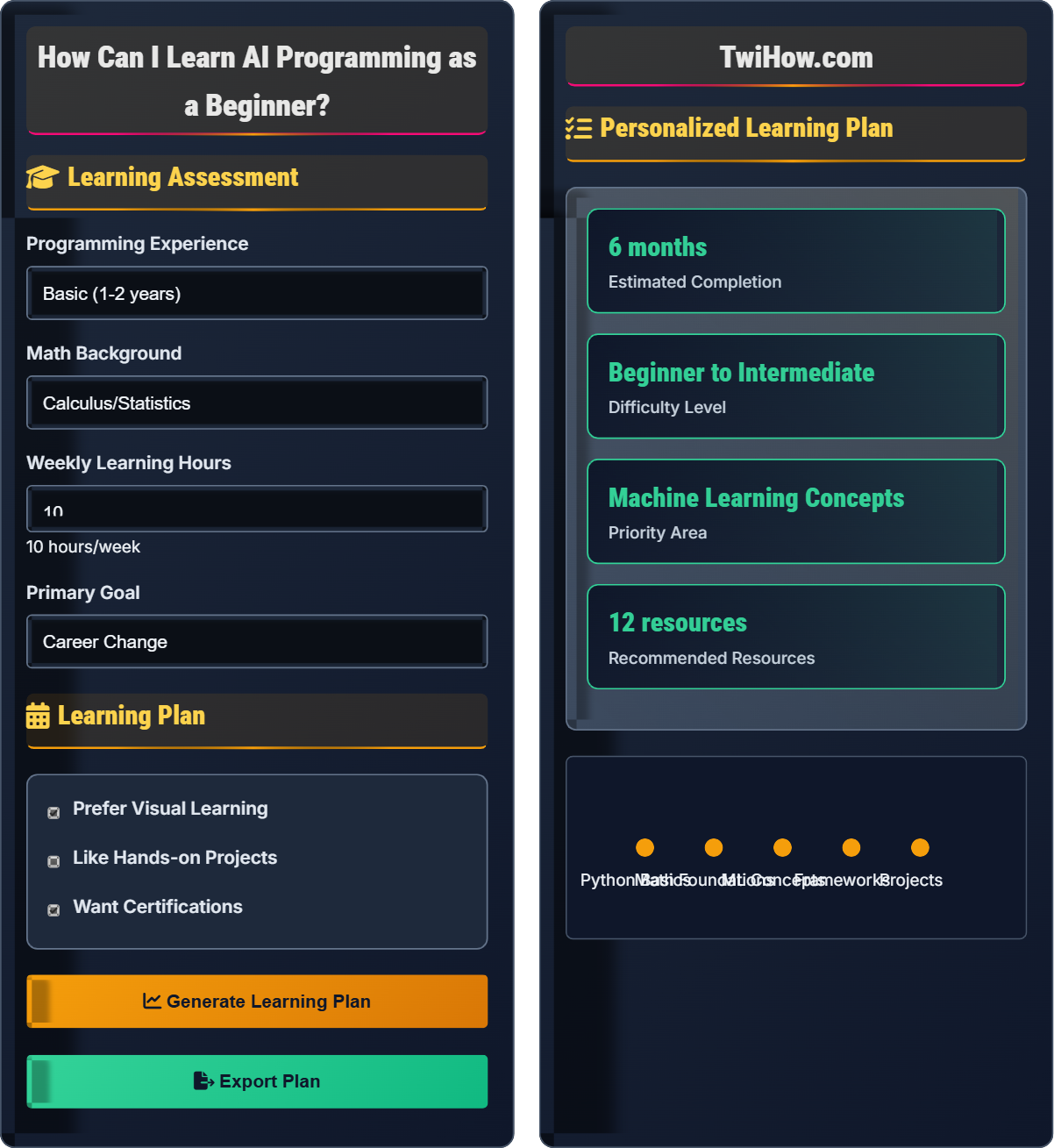
Personalized Learning Plan
Python Programming Fundamentals
Master variables, loops, functions, and data structures
Mathematical Foundations
Statistics, linear algebra, and calculus basics
Machine Learning Concepts
Supervised, unsupervised, and reinforcement learning
AI Frameworks
TensorFlow, PyTorch, and scikit-learn
Real-World Projects
Build and deploy practical AI applications
Python
Essential programming language
Mathematics
Statistics and linear algebra
Data Science
Pandas, NumPy, Matplotlib
AI Frameworks
TensorFlow, PyTorch
Learning AI Programming Explained
Before diving into AI programming, you need a solid foundation in several areas:
Programming Fundamentals
Variables, loops, functions, object-oriented programming
Mathematics
Linear algebra, calculus, probability, statistics
Data Manipulation
Pandas, NumPy, data cleaning, visualization
Problem Solving
Logical thinking, debugging, algorithm design
These are the fundamental programming concepts you'll need for AI development:
Variables & Data Types
Understanding integers, floats, strings, lists, dictionaries
Control Structures
Loops (for, while), conditionals (if/else), functions
Object-Oriented Programming
Classes, objects, inheritance, encapsulation
Error Handling
Try/except blocks, debugging techniques
Essential tools and frameworks for AI programming:
Python
Primary language for AI development
TensorFlow
Google's ML framework
PyTorch
Facebook's ML framework
scikit-learn
Classic ML algorithms
Here's a simple example of machine learning code to get started:
# Simple Linear Regression Example
import numpy as np
from sklearn.linear_model import LinearRegression
import matplotlib.pyplot as plt

# Sample data
X = np.array([[1], [2], [3], [4], [5]])
y = np.array([2, 4, 6, 8, 10])

# Create and train model
model = LinearRegression()
model.fit(X, y)

# Make predictions
predictions = model.predict(X)

print(f"Slope: {model.coef_[0]}")
print(f"Intercept: {model.intercept_}")
Week 1-4: Python Basics
Install Python, learn syntax, data types, functions, and modules
Week 5-8: Data Science Libraries
Learn NumPy, Pandas, Matplotlib for data manipulation
Week 9-12: Math Foundations
Statistics, linear algebra, and calculus for ML
Week 13-16: ML Fundamentals
Supervised and unsupervised learning concepts
Week 17-20: Deep Learning
Neural networks, TensorFlow/PyTorch
Week 21-24: Projects
Build and deploy real-world AI applications
AI Programming Fundamentals
Python Programming, Machine Learning, Neural Networks, Data Science, TensorFlow, PyTorch.
Programming Basics → Math Foundations → ML Concepts → Frameworks → Projects
Each stage builds upon the previous one.
- Master programming fundamentals first
- Practice consistently with projects
- Focus on understanding concepts, not just code
Project Ideas
Image Classification, Sentiment Analysis, Chatbot, Recommendation System.
Computer Vision
- Digit recognition
- Object detection
- Face recognition
Natural Language Processing
- Sentiment analysis
- Text summarization
- Language translation
Predictive Modeling
- Housing price prediction
- Stock price forecasting
- Customer churn prediction
- Start with small, manageable projects
- Gradually increase complexity
- Focus on one concept at a time
- Deploy your models when possible
AI Programming Learning Quiz
Which programming language is most commonly used for AI and machine learning development?
Python is the most popular language for AI and machine learning development. It has extensive libraries like TensorFlow, PyTorch, scikit-learn, NumPy, and Pandas that make AI programming accessible. Python's simple syntax and large community make it ideal for beginners.
The answer is B) Python.
Python's ecosystem of libraries and frameworks specifically designed for AI development makes it the de facto standard. Its readability and simplicity allow developers to focus on implementing algorithms rather than managing complex syntax.
Library: Pre-written code for specific tasks
Framework: Structured environment for development
AI Ecosystem: Tools and resources for AI development
• Python dominates AI development
• Extensive libraries available
• Beginner-friendly syntax
• Start with Python basics
• Learn NumPy and Pandas first
• Practice regularly
• Choosing the wrong language
• Skipping programming fundamentals
• Not practicing enough
What mathematical concepts are essential for understanding machine learning algorithms, and why are they important?
Linear Algebra: Vectors, matrices, eigenvalues, and eigenvectors are fundamental to representing data and transformations in ML algorithms. Neural networks rely heavily on matrix operations.
Calculus: Derivatives and partial derivatives are essential for understanding optimization algorithms like gradient descent, which is used to train neural networks.
Probability & Statistics: Understanding distributions, Bayes' theorem, hypothesis testing, and statistical inference is crucial for making predictions and interpreting results.
Why important: These mathematical concepts provide the theoretical foundation for understanding how algorithms work, allowing for better model selection, hyperparameter tuning, and troubleshooting.
Mathematics provides the language to describe and understand AI algorithms. Without mathematical foundations, you can use AI tools but won't understand why they work or how to improve them.
Gradient Descent: Optimization algorithm for minimizing cost
Matrix Operations: Mathematical operations on arrays
Bayes' Theorem: Probability of events given evidence
• Linear algebra for data representation
• Calculus for optimization
• Statistics for interpretation
• Focus on practical applications
• Use visualizations to understand concepts
• Practice with real examples
• Skipping math prerequisites
• Not understanding the theory
• Memorizing without understanding
You are a complete beginner with no programming experience. You can dedicate 10 hours per week to learning AI programming. Calculate how long it would take to become proficient enough to build a simple machine learning model. Assume the learning path includes: 4 weeks for Python basics, 3 weeks for data science libraries, 4 weeks for math foundations, 4 weeks for ML concepts, and 3 weeks for your first project. Account for 20% additional time for practice and review.
Core learning time:
Python basics: 4 weeks
Data science: 3 weeks
Math foundations: 4 weeks
ML concepts: 4 weeks
First project: 3 weeks
Total: 4 + 3 + 4 + 4 + 3 = 18 weeks
Additional time (20%):
18 weeks × 0.20 = 3.6 weeks ≈ 4 weeks
Total time: 18 + 4 = 22 weeks (approximately 5.5 months)
With 10 hours per week dedication, you can expect to build your first ML model in about 5.5 months, assuming consistent practice and application of concepts.
Learning AI programming is a structured process that requires building foundational skills before advancing to complex topics. Consistent practice and hands-on projects accelerate the learning process.
Proficiency: Competent skill level
Structured Learning: Organized progression of topics
Hands-on: Practical application of concepts
• Build foundations first
• Practice consistently
• Allow extra time for review
• Follow a structured curriculum
• Practice daily even if just 30 minutes
• Build projects to reinforce learning
• Skipping foundational topics
• Not practicing enough
• Rushing through concepts
You want to build a computer vision project for image classification. You have two options: TensorFlow or PyTorch. Considering you're a beginner, which framework would you recommend and why? Compare their strengths and weaknesses for a beginner learning AI programming.
Recommendation: TensorFlow (especially Keras API)
TensorFlow Advantages:
• Higher-level APIs like Keras make it beginner-friendly
• Extensive documentation and tutorials
• Pre-trained models available through TensorFlow Hub
• Strong community support
• Excellent for production deployment
PyTorch Advantages:
• More intuitive for research and experimentation
• Dynamic computation graph (easier to debug)
• Widely used in academia
For beginners: TensorFlow's Keras API provides a gentler learning curve with more structured approach to building models. PyTorch is more flexible but requires deeper understanding of underlying concepts.
Both are excellent choices, but TensorFlow's Keras is generally more beginner-friendly.
Choosing the right framework depends on your goals and learning style. For beginners, a framework that provides high-level abstractions while allowing gradual exploration of lower-level concepts is ideal.
Framework: Structured environment for development
Keras: High-level API for TensorFlow
Computation Graph: Representation of operations
• Choose based on learning goals
• Consider community support
• Both are viable options
• Start with Keras (TensorFlow)
• Try both eventually
• Focus on concepts, not syntax
• Getting stuck on framework debates
• Not focusing on fundamentals
• Choosing based on popularity alone
Which of the following is NOT a core library for AI programming in Python?
BeautifulSoup is a library for web scraping and parsing HTML/XML documents. While useful for gathering data, it's not a core library for AI programming. The other options are essential:
• NumPy: Numerical computing with arrays
• Pandas: Data manipulation and analysis
• Matplotlib: Data visualization
These three form the foundation of data science workflows in Python.
The answer is D) BeautifulSoup.
Understanding the purpose of different libraries helps prioritize learning. Core AI libraries focus on numerical computation, data manipulation, and visualization - essential for the machine learning pipeline.
NumPy: Numerical Python arrays
Pandas: Data analysis library
Matplotlib: Plotting library
• Focus on core libraries first
• Understand each library's purpose
• Build foundational skills
• Master NumPy and Pandas early
• Practice with datasets
• Visualize your data
• Learning too many libraries at once
• Not mastering fundamentals
• Skipping data manipulation skills
FAQ
Q: Do I need a computer science degree to learn AI programming?
A: No, you don't need a computer science degree to learn AI programming. Many successful AI practitioners are self-taught or come from diverse backgrounds. What matters more is your commitment to learning, mathematical aptitude, and problem-solving skills. Online resources, bootcamps, and university courses are widely available to anyone interested in learning AI programming.
Q: How much math do I really need to know to start?
A: You can start with basic algebra and learn the necessary math as you progress. Initially, focus on understanding concepts intuitively. As you advance, you'll need statistics (for understanding data), linear algebra (for neural networks), and calculus (for optimization). The key is to learn math in context - as it applies to the AI concepts you're studying.
Q: What's the best way to practice AI programming skills?
A: Practice by building projects! Start with simple ones like linear regression or image classification, then gradually tackle more complex problems. Participate in Kaggle competitions, contribute to open-source AI projects, and try to solve real-world problems. The key is to apply what you learn immediately rather than just reading about it.