How Can I Stay Updated on AI Developments Without Getting Overwhelmed?
Complete AI learning guide • Step-by-step explanations
AI Learning Strategies:
Show Learning PlannerStaying updated on AI developments requires strategic information management to avoid cognitive overload. With thousands of papers published monthly and rapid technological changes, effective curation and filtering are essential. The key is to focus on quality over quantity, using reliable sources and structured learning approaches.
Essential strategies for managing AI information:
- Source Curation: Select high-quality, authoritative sources
- Topic Filtering: Focus on relevant subfields and applications
- Time Management: Allocate specific time for learning
- Learning Systems: Create structured information workflows
Successful AI learners use a combination of curated newsletters, academic papers, industry reports, and community engagement to stay informed without becoming overwhelmed. The goal is to maintain a sustainable learning pace while capturing important developments.
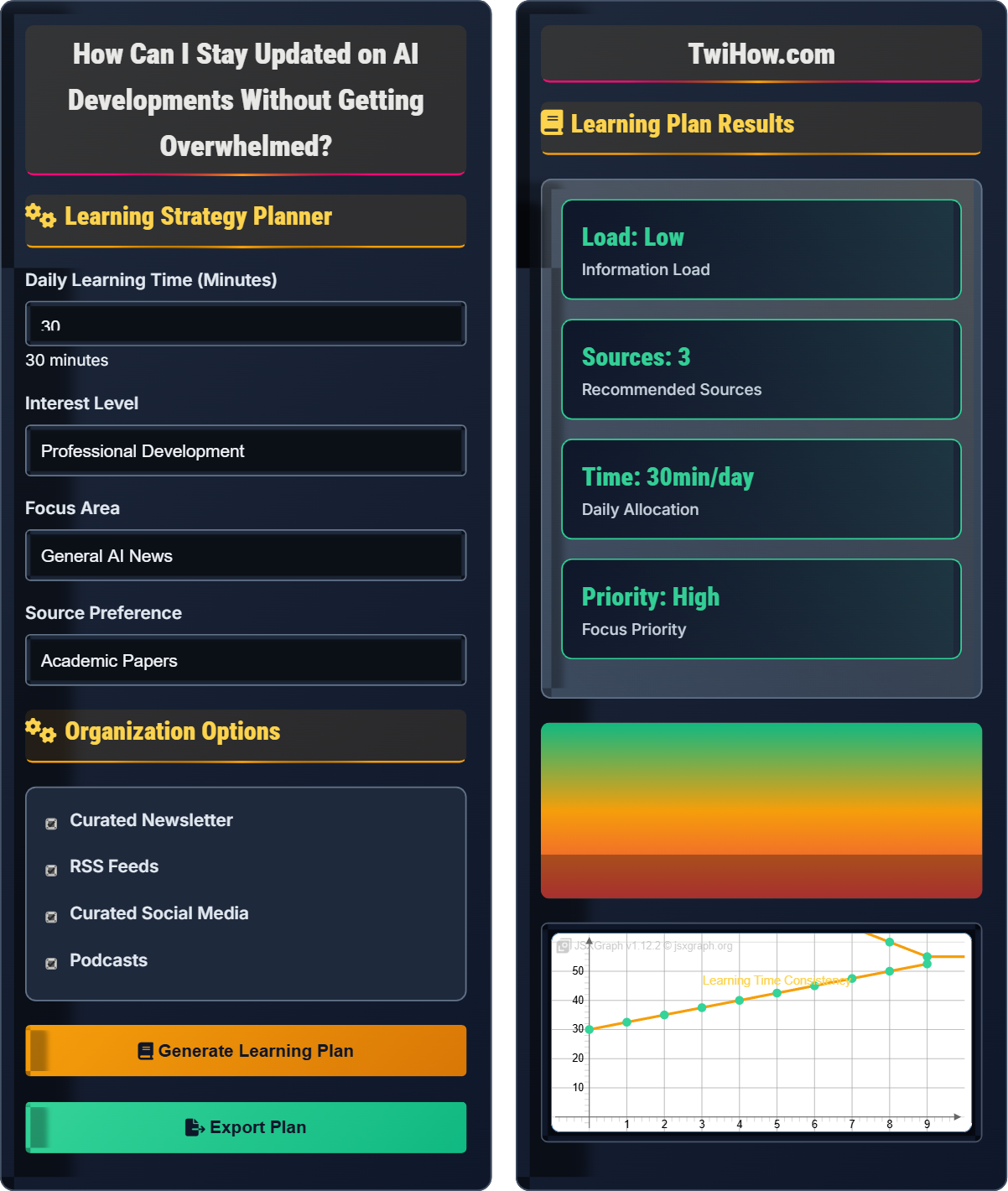
Learning Strategy Planner
Organization Options
Learning Plan Results
AI Learning Strategies Explained
Staying updated on AI developments requires strategic information management to avoid cognitive overload. With thousands of papers published monthly and rapid technological changes, effective curation and filtering are essential for sustainable learning.
Effective Learning = (Quality_Sources × Time_Allocation) ÷ Cognitive_Load
Where:
- Quality_Sources: Curated, authoritative information sources
- Time_Allocation: Dedicated time for learning activities
- Cognitive_Load: Mental capacity available for processing information
- Effective Learning: Sustainable learning outcome
Key areas for effective AI learning:
- Source Quality: Prioritize peer-reviewed papers and expert sources
- Topic Relevance: Focus on areas aligned with your interests/goals
- Time Management: Consistent, manageable daily allocations
- Tool Integration: RSS feeds, newsletters, and curation tools
- Community Engagement: Forums, conferences, and discussion groups
- Practice Application: Hands-on experimentation and projects
- Curated Newsletters: Subscribe to quality AI-focused newsletters
- Academic Papers: Focus on top-tier conferences and journals
- Podcasts: Listen during commutes or downtime
- Social Media: Follow experts and research institutions
- Hands-On Practice: Implement concepts through projects
- Community Participation: Join forums and discussion groups
Learning Management Fundamentals
Information curation, cognitive load, source quality, time management, learning systems.
Learning_Effectiveness = (Time × Quality) ÷ Distractions
Where Time = dedicated learning hours, Quality = source reliability, Distractions = noise level.
- Quality beats quantity in information consumption
- Consistency is more important than intensity
- Focus narrows cognitive load
Applications
Professional development, research updates, career advancement, skill maintenance.
- Software engineering
- Research and development
- Product management
- Consulting and advisory
- Time constraints and priorities
- Professional relevance
- Personal learning style
- Available resources
AI Learning Strategies Quiz
Which approach is most effective for managing the overwhelming volume of AI news and developments?
The most effective approach is to focus on quality sources and specific topics (Option C). This strategy emphasizes curation over consumption volume, which is essential for managing information overload. Rather than trying to consume everything, successful AI learners curate a focused set of high-quality sources that align with their interests and goals.
Research shows that cognitive load increases exponentially with information variety, so focusing on relevant topics from trusted sources is more effective than broad consumption.
The answer is C) Focus on quality sources and specific topics.
This question highlights the fundamental principle of information management: quality over quantity. The cognitive science behind learning shows that our brains have limited capacity for processing new information. When faced with information overload, we often resort to shallow processing, which reduces retention and understanding. By curating sources and focusing on relevant topics, learners can engage in deeper processing and retain more meaningful insights.
Cognitive Load: The total amount of mental effort being used in working memory
Information Curation: The process of gathering, organizing, and presenting information
Shallow Processing: Surface-level engagement with information
• Focus trumps breadth in information consumption
• Quality sources reduce cognitive load
• Consistent curation prevents information overload
• Identify 3-5 top-tier sources in your area of interest
• Schedule specific times for learning activities
• Trying to consume all available information
• Not establishing quality criteria for sources
• Failing to schedule consistent learning time
Design a comprehensive system for staying updated on AI developments that balances comprehensiveness with manageability. Include time allocation, source selection criteria, and organization methods.
Time Allocation: Dedicate 30-45 minutes daily, split into two sessions (morning news scan, evening deep reading).
Source Selection Criteria:
- Authority: Peer-reviewed papers, reputable institutions, recognized experts
- Relevance: Directly related to your focus area or career goals
- Frequency: Regular updates (daily/weekly) to maintain engagement
- Format: Mix of brief summaries and detailed analysis
Organization Methods:
- RSS Feeds: Aggregate high-quality blogs and news sites
- Newsletter Subscriptions: Curated summaries from experts
- Social Media Lists: Curated Twitter/Facebook lists of researchers
- Reading Apps: Pocket or Instapaper for later reading
- Note-Taking: Digital tools for organizing key insights
Weekly Review: Assess what worked, adjust sources, identify emerging themes.
A well-designed learning system balances automation with curation. The key is creating workflows that bring relevant information to you rather than requiring you to seek it out constantly. This system leverages the expertise of others who have already done the curation work, saving your cognitive resources for deeper processing and application of the information you receive.
Information Architecture: Structural design of shared information environments
Curated Content: Carefully selected and organized information
Cognitive Offloading: Using external systems to reduce mental burden
• Automate routine information gathering
• Maintain quality standards for all sources
• Regular review and adjustment of the system
• Start with fewer sources and gradually expand
• Use tools that sync across devices
• Create tags for organizing information by topic
• Starting with too many sources
• Not having a system for organizing information
• Failing to regularly review and adjust the system
A software engineer with 2 hours of free time per week wants to stay updated on AI developments relevant to their field. They're interested in machine learning applications in software development. Design a time-efficient strategy that maximizes their learning impact, considering their limited availability and specific interests.
Time Allocation: 2 hours weekly = 17 minutes daily (manageable and consistent)
Strategic Approach:
1. Primary Source: One high-quality newsletter focused on AI in software development (e.g., "Import AI" or "The Batch") - 5 minutes daily
2. Podcast: Subscribe to "This Week in Machine Learning & AI" for weekend listening - 1 hour weekly
3. Research Papers: Follow HN "Show AI" threads on Wednesdays for paper discussions - 10 minutes weekly
4. Community: Participate in r/MachineLearning's discussion threads - 15 minutes weekly
Tools: Use Feedly for RSS aggregation, Pocket for saving articles, and a simple note-taking app for key insights.
Weekly Review: Spend 10 minutes noting interesting developments and planning hands-on experiments.
This approach maximizes impact by focusing on relevant applications while using efficient consumption methods.
This problem demonstrates how to optimize learning with severe time constraints. The key is leveraging efficient formats (newsletters, podcasts) and community curation (Reddit threads) to maximize information density per minute invested. By focusing on the intersection of AI and software development, the learner ensures maximum relevance and applicability of the information consumed.
Information Density: Amount of useful information per unit of time
Relevance Filtering: Selecting information based on personal applicabilityCommunity Curation: Leveraging others' expertise for content selection
• Maximize relevance when time is limited
• Use efficient consumption formats
• Leverage community expertise
• Choose sources that match your time availability
• Use audio formats for multitasking opportunities
• Focus on immediately applicable information
• Trying to consume the same amount of content as full-time learners
• Not adjusting expectations for limited time availability
• Failing to leverage efficient consumption methods
A product team of 8 people wants to collectively stay updated on AI trends relevant to their industry. Design a collaborative learning system that distributes the workload while maximizing team knowledge. Include roles, responsibilities, and knowledge-sharing mechanisms.
Team Structure: Assign rotating specializations to team members based on their interests:
Specialization Areas:
- Computer Vision & Image Recognition
- Natural Language Processing
- Recommendation Systems
- AI Ethics & Compliance
- Industry Applications
- Emerging Technologies
- Competitive Landscape
- Implementation Best Practices
Individual Responsibilities:
- Each member dedicates 20 minutes daily to their specialization area
- Weekly brief summary shared with the team
- Monthly detailed presentation on key developments
- Maintain shared resource repository
Team Mechanisms:
- Weekly 15-minute "AI Spotlight" meeting
- Shared Slack channel for quick updates
- Monthly "AI Coffee Chat" for deeper discussions
- Quarterly strategy review and area rotation
Tools: Shared Notion workspace, RSS feeds, bookmark sharing, and presentation templates.
This approach multiplies individual capacity while ensuring comprehensive coverage.
This solution demonstrates the power of distributed learning, where the collective capacity exceeds the sum of individual efforts. By specializing and sharing, the team can cover more ground than if each member tried to stay updated on everything. This approach leverages the principle of comparative advantage - each person focuses on their strength area while benefiting from others' expertise.
Distributed Learning: Knowledge acquisition shared across multiple individuals
Comparative Advantage: Focusing on areas where you have relative strength
Knowledge Transfer: Sharing information and insights between team members
• Distribute workload based on interests and strengths
• Establish consistent sharing mechanisms
• Rotate areas to prevent stagnation
• Use asynchronous tools for flexibility
• Keep sharing formats simple and consistent
• Celebrate learning contributions
• Assigning the same topics to everyone
• Not establishing consistent sharing protocols
• Failing to rotate specializations over time
Which of the following represents the most sustainable approach to staying updated on AI developments over the long term?
Consistent daily learning habits (Option B) represent the most sustainable approach. Research in habit formation and learning science consistently shows that spaced repetition and regular engagement lead to better retention and reduced cognitive load compared to intensive, irregular study sessions.
Consistent daily habits of 15-30 minutes create compound learning effects over time while remaining manageable. This approach prevents the overwhelm associated with binge-learning and ensures steady progress without creating unsustainable demands on time or energy.
The spacing effect, a well-established psychological phenomenon, demonstrates that information is better retained when learning is distributed over time rather than massed together.
The answer is B) Consistent daily learning habits.
This question addresses one of the most important principles in lifelong learning: consistency over intensity. The brain consolidates memories during rest periods between learning sessions, making spaced practice more effective than massed practice. Daily habits also create momentum and reduce the activation energy required to begin learning, making it easier to maintain over the long term. This principle is especially important in rapidly evolving fields like AI where consistent engagement is crucial for staying current.
Spaced Repetition: Learning technique that increases intervals between reviews
Spacing Effect: Psychological phenomenon showing distributed practice is superior
Compound Learning: Accumulated knowledge growth over time
• Consistency beats intensity for long-term retention
• Small daily habits compound over time
• Regular practice reduces cognitive load
• Start with just 10-15 minutes daily
• Link learning to existing habits (habit stacking)
• Use apps that support spaced repetition
• Expecting rapid progress with irregular study
• Underestimating the power of small daily actions
• Creating unsustainable learning schedules
FAQ
Q: What are the best sources for staying updated on AI developments without getting overwhelmed?
A: The best sources for AI updates include:
Newsletters: "The Batch" (Andrew Ng), "Import AI", "AI Weekly" - curated summaries of important developments.
Academic Sources: Top-tier conferences like NeurIPS, ICML, CVPR, ACL - but focus on key papers relevant to your interests.
Industry Reports: State of AI reports, industry-specific publications, company blogs from major AI labs.
Communities: Reddit (r/MachineLearning, r/artificial), AI-focused Twitter accounts, LinkedIn groups.
Podcasts: "TWiML & AI", "This Week in Machine Learning & AI", "Lex Fridman Podcast" for in-depth discussions.
The key is to limit yourself to 3-5 high-quality sources and use RSS feeds or newsletters to aggregate content.
Q: How can I quickly identify which AI developments are worth my attention?
A: Use these criteria to identify valuable AI developments:
Impact Potential: Look for developments that could affect your industry, role, or business model. Consider both direct applications and broader implications.
Source Authority: Prioritize information from respected researchers, institutions, or companies with proven track records.
Reproducibility: Focus on developments that have been replicated or validated by multiple sources.
Practical Application: Identify developments that could be implemented in real-world scenarios, not just theoretical advances.
Community Interest: Pay attention to discussions in professional communities and the level of engagement around specific developments.
Create a simple scoring system (1-5 scale) based on these criteria to quickly evaluate new information.