How can I use AI for personalized learning experiences?
Complete guide to AI-powered education • Adaptive learning systems
AI-Powered Learning Overview:
Show Learning SimulatorAI transforms education by creating personalized learning experiences that adapt to each student's unique needs, pace, and learning style. Through intelligent tutoring systems, adaptive content delivery, and real-time feedback, AI enables customized educational pathways that maximize learning outcomes.
Key AI applications in personalized learning include:
- Adaptive Content: Learning materials that adjust difficulty based on performance
- Intelligent Tutoring: AI tutors that provide personalized guidance and feedback
- Learning Analytics: Data-driven insights into learning patterns and progress
- Content Recommendation: Personalized learning paths based on interests and goals
- Assessment Adaptation: Tests that adjust to student ability levels
- Study Optimization: AI-powered scheduling and study techniques
These technologies create more effective and engaging learning experiences while reducing the burden on educators.
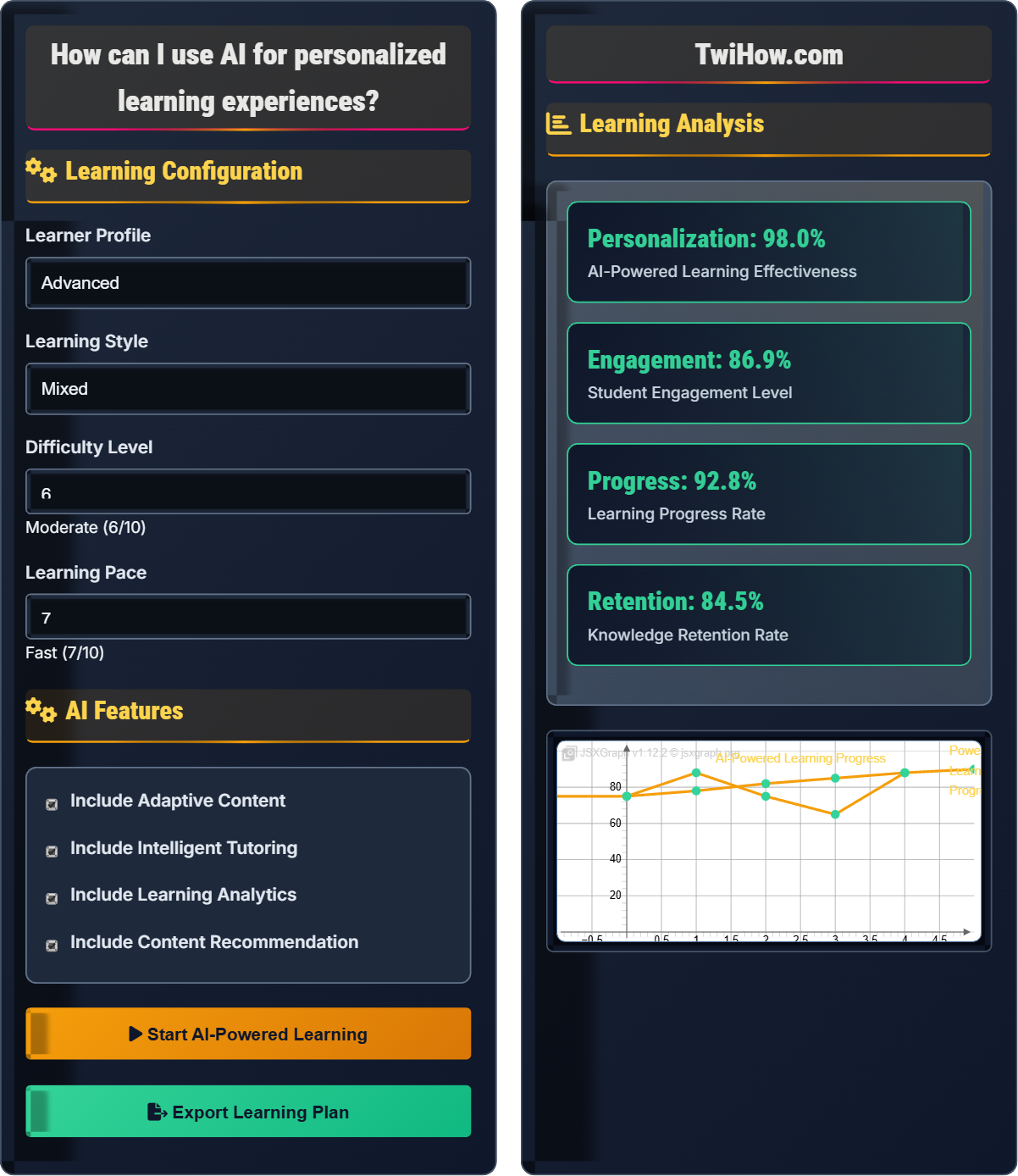
Learning Configuration
AI Features
Learning Analysis
| Module | Completion | Score | Time Spent |
|---|---|---|---|
| Introduction | 100% | 95% | 45 min |
| Basics | 85% | 88% | 60 min |
| Intermediate | 60% | 75% | 75 min |
| Advanced | 25% | 65% | 30 min |
| Final Assessment | 0% | - | - |
Using AI for Personalized Learning Experiences
AI transforms education through several key technologies that create personalized learning experiences:
- Adaptive Learning Systems: Platforms that adjust content difficulty and pacing based on learner performance
- Intelligent Tutoring Systems: AI-powered virtual tutors that provide personalized guidance
- Learning Analytics: Data analysis to identify learning patterns and optimize instruction
- Content Recommendation: AI algorithms that suggest relevant learning materials
- Assessment Adaptation: Tests that adjust to student ability in real-time
- Learning Path Optimization: Dynamic curriculum adjustment based on progress
The effectiveness of AI-powered personalization can be understood through:
Where:
- Content Adaptation: How well content adjusts to learner needs
- Engagement Level: Student motivation and participation
- Personalization Quality: Accuracy of individualized recommendations
AI enables personalization across various educational aspects:
- Content Delivery: Customized materials based on learning style and pace
- Assessment: Adaptive tests that match student ability levels
- Feedback: Personalized corrections and improvement suggestions
- Scheduling: Optimized study plans based on availability and retention
- Recommendations: Relevant resources and learning paths
- Intervention: Early identification of struggling students
- Individualized Pace: Students learn at their own optimal speed
- Targeted Support: Focus on areas where students need help
- Engagement Boost: Interactive and adaptive content increases motivation
- Efficient Learning: Reduced time to mastery through optimization
- Accessibility: Accommodates diverse learning needs and disabilities
- Scalability: Personalized learning for large numbers of students
AI Learning Fundamentals
Adaptive learning, intelligent tutoring, learning analytics, personalization algorithms, educational data mining, cognitive modeling, learning management systems.
Learning Effectiveness = (Adaptation Quality × Engagement × Relevance) ÷ Complexity Factor
Where Adaptation Quality = Content customization effectiveness, Engagement = Student motivation level, Relevance = Material pertinence to goals, Complexity Factor = Learning material difficulty adjustment.
- Personalization should enhance, not replace, human instruction
- Data privacy and security are paramount
- Continuous assessment and adjustment are essential
Implementation Areas
Content adaptation, assessment, feedback, scheduling, recommendation, intervention, progress tracking, skill assessment.
- Student profiling and data collection
- AI model development and training
- Content and platform integration
- Initial deployment and testing
- Performance monitoring and optimization
- Continuous improvement and scaling
- Balance automation with human interaction
- Ensure algorithmic fairness and transparency
- Maintain student privacy and data security
- Provide fallback options for system failures
AI Learning Quiz
What is the primary benefit of adaptive learning systems?
The primary benefit of adaptive learning systems is adjusting content difficulty based on student performance. These systems continuously assess student progress and modify the learning experience to match individual needs, ensuring optimal challenge levels that promote learning without frustration or boredom.
The answer is B) Adjusting content difficulty based on student performance.
Adaptive learning systems embody the educational principle of differentiated instruction by automatically adjusting to individual student needs. This approach recognizes that students learn differently and at varying paces, optimizing the learning experience for each individual.
Adaptive Learning: Systems that modify content based on learner performance
Differentiated Instruction: Tailoring teaching to individual student needs
Zone of Proximal Development: Optimal difficulty range for learning
• Difficulty should match student ability
• Continuous assessment enables adaptation
• Personalization enhances learning outcomes
• Look for systems with real-time adaptation
• Monitor progress metrics regularly
• Combine with human instruction for best results
• Assuming AI replaces human teachers
• Not monitoring system effectiveness
Explain how learning analytics powered by AI can improve personalized education. What data points are most valuable for creating effective learning experiences?
Learning Analytics Benefits: AI-powered learning analytics collect and analyze data to identify patterns, predict outcomes, and optimize learning experiences. These systems can identify struggling students early, recommend interventions, and personalize content delivery.
Valuable Data Points: Learning pace, interaction patterns, assessment performance, time spent on activities, error patterns, engagement metrics, and knowledge gaps.
Implementation: Analytics help educators understand learning behaviors, identify effective teaching strategies, and customize interventions for individual students.
Privacy Considerations: All data collection must comply with privacy regulations and maintain student confidentiality.
Learning analytics transform educational decision-making from intuition-based to evidence-based. By analyzing learning data, educators can make informed decisions about instruction, intervention, and personalization that would be impossible to make manually.
Learning Analytics: Analysis of learning-related data to optimize learning
Learning Patterns: Recurring behaviors in learning activities
Evidence-Based Instruction: Teaching based on data analysis
• Protect student privacy and data security
• Ensure algorithmic fairness and transparency
• Focus on actionable insights
• Monitor for bias in algorithmic decisions
• Use analytics to identify learning gaps
• Not considering privacy implications
• Over-relying on data without human oversight
• Not validating analytical insights
A high school math teacher wants to implement AI-powered personalized learning for her algebra class. She has 30 students with varying abilities and learning styles. Describe an AI implementation strategy that would benefit all students while maintaining classroom dynamics.
Implementation Strategy: Use an AI platform that provides differentiated content based on individual student needs while maintaining group activities. The system should assess each student's current level and learning style, then provide personalized practice problems and explanations.
Classroom Integration: Use AI for individual practice time while conducting group discussions and collaborative problem-solving sessions. AI can prepare students for group activities by ensuring they have foundational knowledge.
Monitoring: Implement dashboard for teacher oversight to track student progress and identify those needing additional support. Use AI insights to guide small group instruction.
Assessment: Use adaptive testing to accurately measure individual progress while maintaining classroom-based group assessments for collaborative skills.
Balance: Ensure AI complements rather than replaces human interaction and peer learning opportunities.
This example demonstrates how AI can enhance traditional classroom learning rather than replace it. The key is using AI to provide individualized support while preserving the social and collaborative aspects of learning that are crucial for student development.
Differentiated Instruction: Teaching methods tailored to individual needs
Blended Learning: Combination of digital and traditional instruction
Formative Assessment: Ongoing assessment for learning improvement
• Maintain human connection in learning
• Ensure equitable access to technology
• Start with one AI tool and expand gradually
• Use AI for formative assessment
• Maintain regular teacher-student interaction
• Replacing all traditional teaching with AI
• Not training teachers on AI tools
• Ignoring social aspects of learning
Design an AI system that creates personalized learning paths for students learning programming. How would you account for different learning styles, prior knowledge, and career goals while ensuring comprehensive skill development?
Assessment Phase: Evaluate prior programming knowledge, learning style preferences (visual, hands-on, theoretical), and career goals (web development, data science, etc.).
Path Creation: Generate initial learning path based on assessment results, with multiple entry points for different starting levels.
Adaptive Adjustments: Monitor progress and adjust path based on performance, engagement, and changing goals. Provide alternative learning modules for different learning styles.
Comprehensive Coverage: Ensure all students eventually cover core programming concepts, even with personalized paths. Use prerequisite mapping to maintain learning sequence integrity.
Goal Alignment: Emphasize relevant specializations based on career goals while maintaining fundamental skills.
Continuous Feedback: Regular assessments and student feedback to refine the learning path.
Programming education requires both fundamental concepts and specialized applications. The AI system must balance personalization with ensuring comprehensive skill development, creating pathways that are both engaging and educationally sound.
Prerequisite Mapping: Dependencies between learning concepts
Learning Sequence: Order of educational content delivery
Competency-Based Learning: Skill-focused education approach
• Maintain core competency requirements
• Ensure comprehensive skill development
• Use project-based learning for engagement
• Provide multiple learning modalities
• Regular competency assessments
• Ignoring fundamental programming concepts
• Not adapting to changing student interests
• Failing to provide adequate practice opportunities
Which of the following is NOT a primary benefit of AI-powered tutoring systems?
Emotional support and motivation are not primary benefits of AI-powered tutoring systems. While AI can provide encouragement through gamification and positive feedback, it cannot replace the emotional intelligence and personal connection that human tutors provide. Current AI systems excel at content delivery, feedback, and personalization but lack the emotional understanding of human tutors.
The answer is C) Emotional support and motivation.
AI tutoring systems excel at cognitive aspects of learning but have limitations in emotional and social domains. The most effective learning environments combine AI's analytical capabilities with human emotional support and motivation.
AI Tutoring: Computer systems that provide personalized instruction
Emotional Intelligence: Understanding and managing emotions
Human-AI Collaboration: Combining human and AI capabilities
• AI enhances but doesn't replace human instruction
• Balance AI efficiency with human connection
• Use AI for content and feedback
• Reserve human interaction for emotional support
• Combine AI with human mentorship
• Expecting AI to provide emotional support
• Replacing all human interaction with AI
• Not leveraging AI's analytical capabilities
FAQ
Q: How can AI personalize learning while maintaining classroom community?
A: AI can enhance classroom community through:
1. Preparation: AI prepares students individually so they're ready for group activities
2. Group Formation: AI can suggest optimal group compositions based on complementary skills
3. Collaborative Tools: AI-powered platforms that facilitate group projects and discussions
4. Peer Matching: Pairing students for peer learning based on strengths and needs
5. Class Insights: AI provides teacher insights for better classroom management
The key is using AI to enhance individual readiness while preserving group learning opportunities.
Q: What's the difference between AI tutoring and traditional online courses?
A: The key differences are:
Traditional Online Courses: Pre-defined content for all students, fixed paths, limited personalization, static assessments.
AI Tutoring: Individualized content delivery, dynamic adaptation based on performance, real-time feedback, personalized learning paths, and continuous assessment.
AI tutoring systems can adjust difficulty, recommend resources, and identify knowledge gaps in real-time, while traditional courses follow a one-size-fits-all approach.