How can Small Businesses Compete with AI-Powered Enterprises?
Complete guide to small business AI strategy • Competitive advantages
Small Business AI Strategy:
Show AI Competition SimulatorSmall businesses can successfully compete with AI-powered enterprises by leveraging their unique advantages: agility, customer intimacy, and focused expertise. Strategic AI adoption allows small businesses to enhance operations, personalize customer experiences, and automate routine tasks while maintaining their human touch.
Key competitive strategies include:
- Agility: Rapid adaptation to market changes and customer needs
- Personalization: Direct customer relationships and tailored experiences
- Cost Efficiency: Targeted AI investments for maximum ROI
- Niche Focus: Specialized expertise in specific market segments
Success requires strategic planning, selective AI adoption, and leveraging inherent small business strengths while mitigating resource limitations.
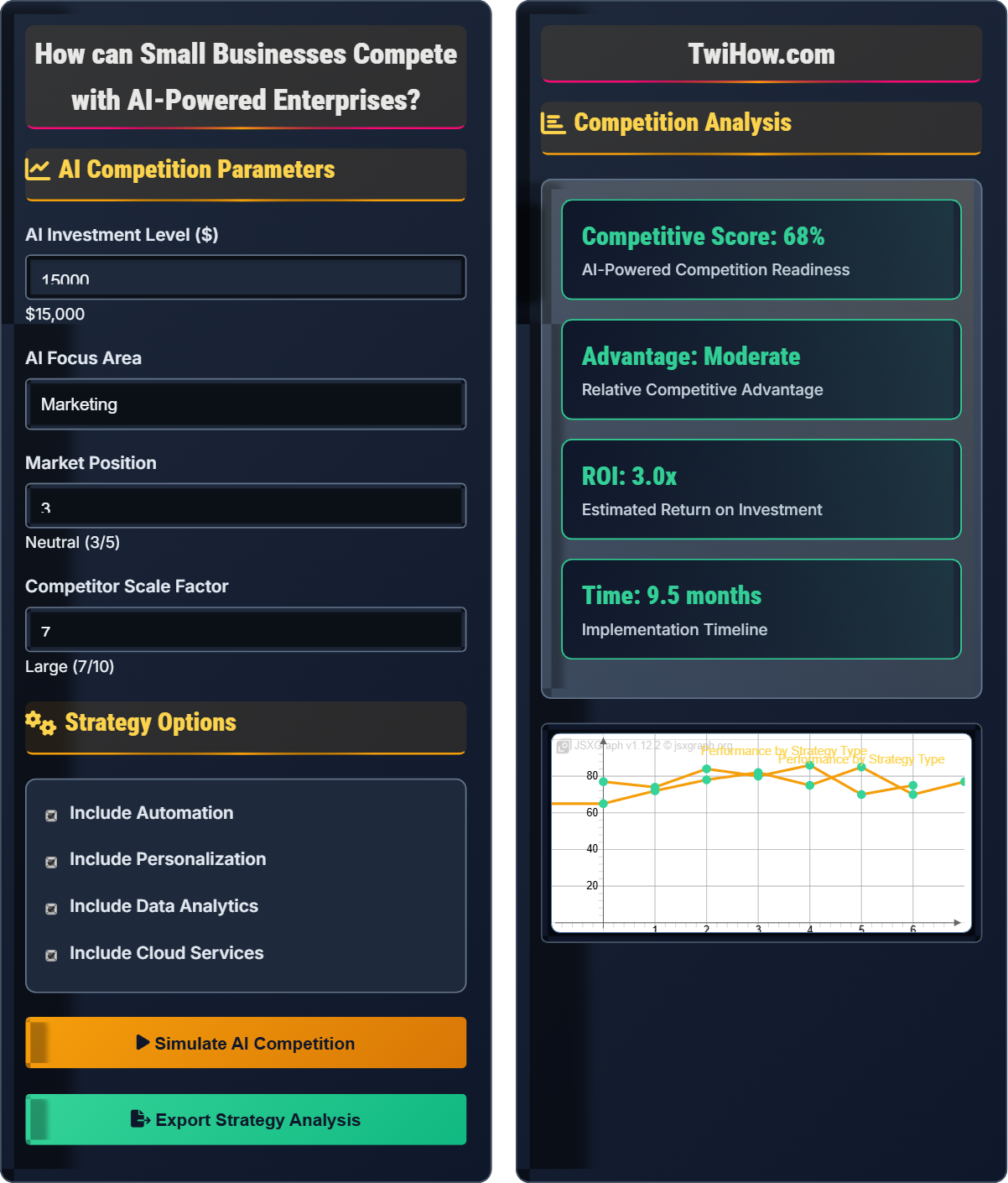
AI Competition Parameters
Strategy Options
Competition Analysis
| Strategy | Effectiveness | Investment | ROI |
|---|---|---|---|
| Customer Service AI | 85% | $8K | 2.8x |
| Marketing Automation | 78% | $12K | 3.1x |
| Operations Optimization | 72% | $15K | 2.5x |
| Sales Intelligence | 82% | $10K | 3.5x |
| Data Analytics | 75% | $20K | 2.9x |
How Small Businesses Can Compete with AI-Powered Enterprises
Small businesses possess unique competitive advantages that can be amplified with strategic AI adoption:
- Agility: Faster decision-making and implementation compared to large corporations
- Customer Intimacy: Direct relationships and personalized service capabilities
- Specialization: Deep expertise in specific niches or markets
- Flexibility: Ability to pivot quickly based on market feedback
- Cost Efficiency: Targeted investments with measurable returns
Successful AI implementation follows a structured approach:
Where:
- Strategic Alignment: Matching AI initiatives to business goals
- Resource Allocation: Efficient use of budget and personnel
- Execution Quality: Proper implementation and maintenance
Priority AI applications for small business competitiveness:
- Customer Service: Chatbots, automated support, and personalized recommendations
- Marketing: Customer segmentation, predictive analytics, and campaign optimization
- Operations: Inventory management, demand forecasting, and process automation
- Sales: Lead scoring, sales forecasting, and CRM automation
- Analytics: Business intelligence, performance monitoring, and insights
- Content: Automated content creation, social media management, and SEO
- Cloud-Based Services: Pay-as-you-go AI platforms without infrastructure costs
- Open Source Tools: Free AI libraries and frameworks for custom solutions
- Pre-built Solutions: Ready-to-use AI applications for specific business needs
- Consulting Partners: Expert guidance for AI implementation and optimization
- Hybrid Approach: Combination of DIY and outsourced AI capabilities
AI Strategy Fundamentals
Competitive advantage, strategic positioning, AI adoption, digital transformation, ROI optimization, cost efficiency.
Competitive Advantage = (Agility × Customer Intimacy × AI Enhancement) ÷ Resource Gap
Where Agility = Speed of adaptation, Customer Intimacy = Relationship depth, AI Enhancement = Technology amplification, Resource Gap = Difference in scale vs competitors.
- Leverage small business agility over big enterprise scale
- Focus on customer relationships and personalization
- Invest in AI that amplifies human strengths
Implementation Strategies
Customer service, marketing automation, operations optimization, sales intelligence, data analytics, content creation.
- Business assessment and opportunity identification
- AI solution selection and vendor evaluation
- Proof of concept and pilot testing
- Full deployment and staff training
- Ongoing optimization and expansion
- Performance measurement and ROI analysis
- Start with high-impact, low-complexity solutions
- Measure ROI continuously
- Maintain focus on customer value
- Preserve human touch in customer interactions
AI Competition Learning Quiz
Which advantage gives small businesses the greatest competitive edge against large AI-powered enterprises?
Small businesses excel in customer intimacy and agility, which are difficult for large enterprises to replicate. Direct customer relationships allow for personalized service and quick adaptation to individual needs. While large enterprises have resources and scale, small businesses can move faster and maintain closer customer ties, especially when enhanced with targeted AI tools.
The answer is C) Customer intimacy and agility.
Understanding small business advantages is crucial for developing effective AI strategies. Large enterprises often struggle with bureaucracy and generic customer interactions, creating opportunities for small businesses to differentiate themselves. When small businesses combine their inherent advantages with strategic AI implementation, they can achieve competitive parity or even superiority in specific areas.
Customer Intimacy: Deep understanding of individual customer needs and preferences
Agility: Ability to quickly adapt to market changes and customer feedback
Competitive Advantage: Unique strengths that provide marketplace superiority
• Leverage human relationships over pure automation
• Focus on niche markets and specialized expertise
• Use AI to enhance, not replace, personal touch
• Identify your unique value proposition
• Invest in AI that amplifies your strengths
• Maintain direct customer communication channels
• Trying to compete directly on scale with large enterprises
• Over-automating customer interactions
• Failing to leverage close customer relationships
Explain how small businesses should prioritize AI investments to maximize competitive advantage. What factors should influence their decision-making process?
Priority Factors: Small businesses should prioritize AI investments based on direct customer impact, implementation complexity, and ROI potential. Customer-facing applications like chatbots and personalization tools often provide immediate value. Operations improvements that reduce costs or increase efficiency are also valuable.
Decision Criteria: Budget constraints, staff technical capabilities, customer expectations, competitive pressures, and business growth objectives. Small businesses should focus on AI that amplifies their existing strengths rather than trying to replicate enterprise capabilities.
Implementation Strategy: Start with proven, low-risk applications before moving to more complex AI implementations. Measure ROI continuously and scale successful initiatives.
Small business AI investment strategy differs significantly from large enterprise approaches. With limited budgets, small businesses must be highly selective about AI investments, focusing on solutions that provide immediate, measurable benefits. The key is to enhance existing competitive advantages rather than attempting to compete directly on scale or resources.
Return on Investment (ROI): Financial gain relative to investment cost
Cost-Benefit Analysis: Evaluation of expenses versus benefits
Scalability: Ability to expand solutions as business grows
• Start with high-impact, low-complexity solutions
• Measure ROI continuously
• Focus on customer-facing improvements first
• Use cloud-based AI services to minimize upfront costs
• Partner with AI vendors for implementation support
• Start with free or trial versions before committing
• Investing in AI without clear business objectives
• Choosing complex solutions beyond technical capabilities
• Failing to measure actual business impact
A local restaurant chain with 5 locations wants to compete with large food delivery platforms using AI. They face challenges with order management, customer service, and marketing. Describe an AI strategy that leverages their local presence and customer relationships while addressing operational inefficiencies.
Customer Service AI: Implement chatbots for order taking and reservation management, maintaining personal touch through integration with local staff for complex requests. Use AI to remember customer preferences and dietary restrictions.
Operations Optimization: Deploy demand forecasting AI to optimize inventory and staffing, reducing waste and improving efficiency. Use route optimization for delivery logistics.
Marketing Personalization: Implement AI-driven customer segmentation to create targeted promotions based on local preferences and purchase history. Use predictive analytics to anticipate customer needs.
Local Advantage: Emphasize fresh, locally-sourced ingredients and community involvement, using AI to enhance rather than replace the personal touch that large platforms cannot provide.
This scenario illustrates how small businesses can use AI strategically to enhance their inherent advantages. Rather than competing directly with large platforms on scale, the restaurant focuses on local relationships and personalized service that AI can amplify. The key is using technology to enhance human connections rather than replacing them.
Demand Forecasting: Predictive analytics for anticipating customer demand
Route Optimization: AI algorithms for efficient delivery routingCustomer Segmentation: Dividing customers into groups based on characteristics
• Enhance local relationships with AI tools
• Focus on operational efficiency gains
• Maintain personal service differentiation
• Use AI to remember customer preferences
• Optimize inventory based on local demand patterns
• Personalize marketing based on neighborhood characteristics
• Over-automating customer interactions
• Failing to leverage local community connections
• Not measuring actual operational improvements
A small accounting firm wants to compete with large corporate tax services by implementing AI. They serve local businesses and individuals with personalized attention. Propose an AI implementation strategy that maintains their personal service model while increasing efficiency and competitive pricing.
Document Processing AI: Implement OCR and document classification to automate data entry and organize client documents, reducing preparation time while maintaining accuracy.
Tax Preparation Assistance: Use AI-powered tax software to identify deductions and ensure compliance, allowing staff to focus on complex planning and advisory services.
Client Communication: Deploy AI chatbots for common questions and appointment scheduling, while preserving human interaction for complex tax matters.
Process Automation: Automate routine tasks like data backup, report generation, and deadline tracking, freeing up staff for higher-value client service activities.
Professional services firms exemplify how AI can enhance rather than replace human expertise. The goal is to automate routine tasks so professionals can focus on high-value, relationship-based services that clients value most. This approach increases efficiency while preserving the personal touch that differentiates small firms from large competitors.
OCR (Optical Character Recognition): Technology that converts images to text
Process Automation: Using technology to perform routine tasks
Professional Services: Knowledge-based services requiring expertise
• Automate routine tasks, preserve expert judgment
• Maintain human oversight for complex decisions
• Focus on efficiency gains that benefit clients
• Choose AI tools that integrate with existing software
• Train staff to work effectively with AI tools
• Communicate AI benefits to clients transparently
• Automating client-facing interactions too extensively
• Choosing AI solutions that don't fit existing workflows
• Failing to train staff on new AI tools
For small businesses competing with AI-powered enterprises, which approach provides the most sustainable competitive advantage?
Targeted AI implementation that amplifies unique small business advantages provides the most sustainable competitive advantage. Rather than trying to match large enterprise capabilities, small businesses should focus on enhancing their inherent strengths like customer relationships, agility, and specialization. This approach creates defensible positions that are difficult for larger competitors to replicate.
The answer is B) Leveraging unique small business advantages with targeted AI.
The most successful small business AI strategies focus on enhancing existing competitive advantages rather than attempting to compete directly with large enterprises. This approach recognizes that small businesses have unique strengths that can be amplified with strategic technology implementation, creating sustainable competitive positions that are difficult for larger competitors to replicate.
Sustainable Advantage: Competitive position that's difficult to replicate
Defensible Position: Market advantage that resists competitive pressure
Strategic Amplification: Using technology to enhance existing strengths
• Focus on enhancing unique strengths
• Avoid direct competition on scale
• Maintain differentiation from large competitors
• Identify what makes your business unique
• Use AI to amplify those unique qualities
• Focus on customer value rather than feature parity
• Trying to compete directly with large enterprise capabilities
• Over-automating personal customer interactions
• Failing to leverage inherent business advantages
FAQ
Q: How can I afford AI tools when my budget is limited compared to large enterprises?
A: Small businesses can access AI affordably through several approaches:
1. Cloud-Based Services: Pay-as-you-go models eliminate upfront infrastructure costs
2. Freemium Models: Many AI tools offer free tiers with paid upgrades
3. Industry-Specific Solutions: Targeted tools often provide better ROI than generic platforms
4. Open Source Alternatives: Free AI libraries and frameworks for custom development
5. Gradual Implementation: Start with one solution and expand based on results
The key is focusing on AI tools that deliver immediate, measurable value rather than expensive, complex implementations.
Q: What's the difference between AI automation and human customer service?
A: Both AI automation and human customer service serve different purposes:
AI Automation: Handles routine inquiries, 24/7 availability, consistent responses, and scalable support. Best for FAQs, order tracking, and basic troubleshooting.
Human Service: Manages complex issues, emotional situations, relationship building, and creative problem-solving. Best for nuanced discussions, complaints, and high-value customers.
Small businesses should use AI to handle routine tasks while preserving human interaction for complex or high-value customer interactions, creating a hybrid approach that combines efficiency with personal touch.