How do AI Models Handle Bias and Fairness Issues?
Complete AI ethics guide • Step-by-step explanations
AI Bias & Fairness:
Show Bias SimulatorAI bias occurs when machine learning models produce systematically unfair outcomes, often reflecting historical discrimination or imbalanced training data. Fairness in AI involves implementing techniques to detect, measure, and mitigate these biases to ensure equitable treatment across different demographic groups.
Key AI fairness concepts:
- Bias Detection: Identifying discriminatory patterns in model predictions
- Fairness Metrics: Quantitative measures of equitable treatment
- Mitigation Techniques: Methods to reduce bias during training
- Group vs Individual Fairness: Balancing collective and individual rights
Modern AI systems employ various fairness-aware algorithms and post-processing techniques to address bias while maintaining predictive performance. These approaches include pre-processing data transformations, in-processing constraints, and post-processing adjustments.
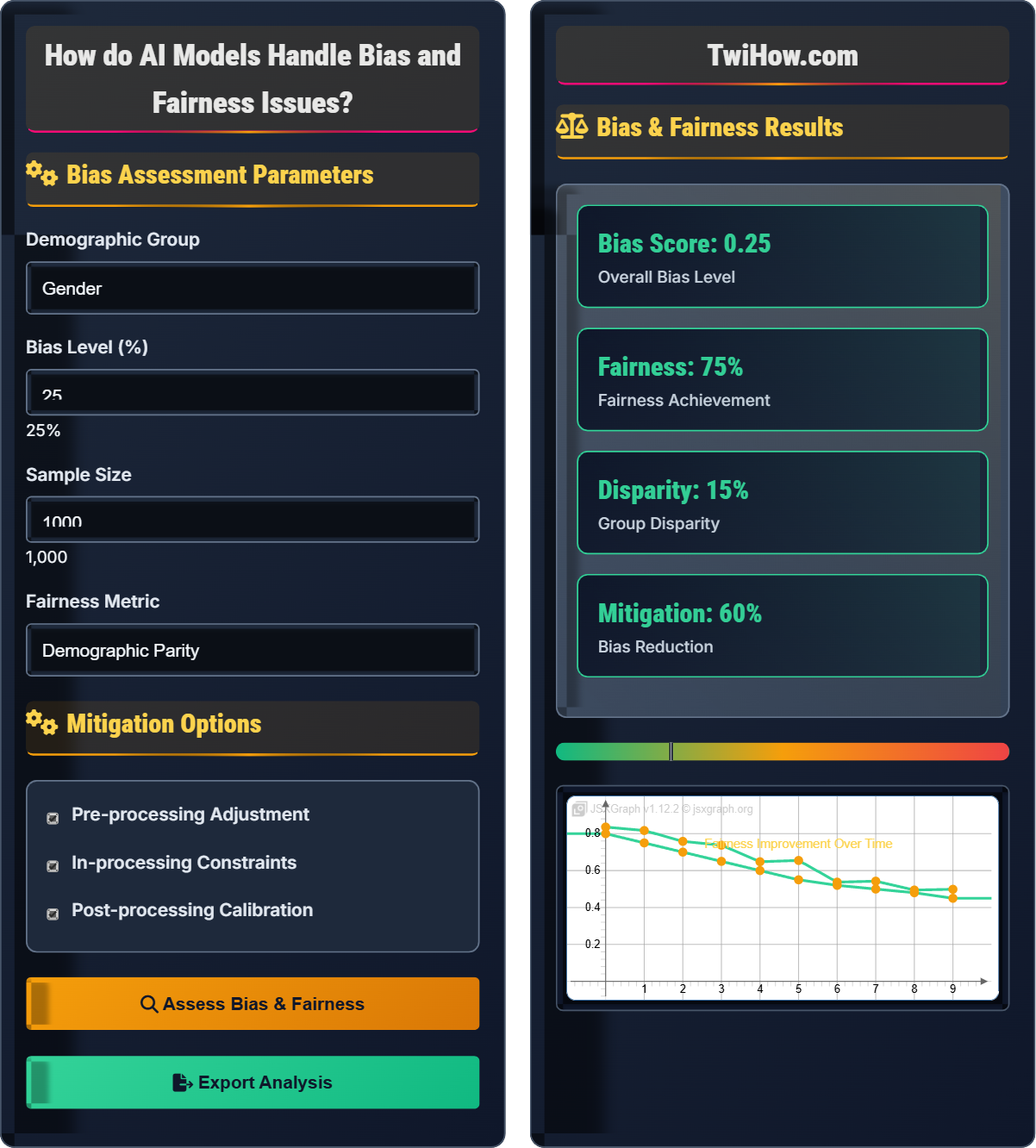
Bias Assessment Parameters
Mitigation Options
Bias & Fairness Results
AI Bias and Fairness Explained
AI bias occurs when machine learning models produce systematically unfair outcomes, often reflecting historical discrimination or imbalanced training data. This can manifest as preferential treatment for certain demographic groups or systematic disadvantages for others.
Common types of bias in AI systems:
Where:
- Selection Bias: Non-representative training data
- Confirmation Bias: Reinforcing existing stereotypes
- Algorithmic Bias: Built-in mathematical preferences
- Historical Bias: Past discriminatory practices encoded in data
Key areas where fairness is critical:
- Hiring Systems: Ensuring equal opportunity across demographics
- Credit Decisions: Preventing discriminatory lending practices
- Healthcare: Equitable treatment recommendations
- Law Enforcement: Fair risk assessment tools
- Education: Unbiased admissions and evaluation systems
- Social Media: Equal content visibility and moderation
- Pre-processing: Transform data to remove bias before training
- In-processing: Add fairness constraints during training
- Post-processing: Adjust model outputs for fairness
- Adversarial Debiasing: Train to hide sensitive attributes
- Re-weighting: Adjust sample importance during training
Bias & Fairness Fundamentals
Demographic parity, equalized odds, equal opportunity, predictive parity, statistical parity.
P(Ŷ = 1 | A = a) = P(Ŷ = 1 | A = b) for Demographic Parity
Where Ŷ = predicted outcome, A = sensitive attribute, a,b = different groups.
- Data reflects historical biases
- Fairness metrics may conflict
- Trade-offs between accuracy and fairness
Applications
Hiring algorithms, loan approvals, criminal justice, healthcare diagnostics, educational assessments.
- Financial services compliance
- Healthcare equity
- Employment screening
- Content recommendation
- Legal and regulatory compliance
- Ethical responsibility
- Stakeholder trust
- Continuous monitoring
AI Bias & Fairness Learning Quiz
Which fairness metric ensures that the probability of a positive prediction is the same across all demographic groups?
Demographic Parity (also known as Statistical Parity) ensures that the probability of a positive prediction is independent of the protected attribute. This means P(Ŷ = 1 | A = a) = P(Ŷ = 1 | A = b) for all groups a and b.
The formula for Demographic Parity is: P(Ŷ = 1 | A = sensitive_group) = P(Ŷ = 1 | A = reference_group)
The answer is B) Demographic Parity.
Demographic Parity is one of the most intuitive fairness criteria. It focuses on ensuring that positive outcomes are distributed equally across different demographic groups, regardless of the underlying differences in the groups. This is particularly important in scenarios where equal access or opportunity is legally mandated, such as hiring or lending decisions.
Demographic Parity: Equal probability of positive prediction across groups
Equalized Odds: Equal true positive and false positive rates across groups
Equal Opportunity: Equal true positive rates across groups
• Demographic Parity doesn't consider the ground truth
• Different fairness metrics may conflict
• Trade-offs between fairness and accuracy are common
• Remember: Demographic Parity = Equal Positive Rates
• Consider the context when choosing fairness metrics
• Be aware of potential conflicts between metrics
• Confusing Demographic Parity with Equalized Odds
• Assuming all fairness metrics are compatible
• Ignoring trade-offs between fairness and accuracy
Describe the comprehensive process for detecting bias in an AI model, including data preparation, metric selection, and interpretation of results. Include the mathematical formulas for at least two fairness metrics.
Data Preparation: Begin by identifying sensitive attributes (race, gender, age, etc.) and ensuring the dataset is representative of the population the model will serve. Clean and preprocess the data while documenting any transformations that might introduce bias.
Metric Selection: Choose appropriate fairness metrics based on the specific use case and ethical requirements:
Demographic Parity Formula: P(Ŷ = 1 | A = a) = P(Ŷ = 1 | A = b)
Where Ŷ is the predicted outcome and A represents the sensitive attribute.
Equalized Odds Formula: P(Ŷ = 1 | Y = y, A = a) = P(Ŷ = 1 | Y = y, A = b) for all y
This ensures both true positive and false positive rates are equal across groups.
Analysis Process: Calculate the chosen metrics across different demographic groups and quantify disparities. Interpret results in the context of acceptable thresholds and regulatory requirements. Document findings and recommend mitigation strategies if disparities exceed tolerance levels.
Bias detection is a systematic process that requires careful planning and methodical execution. The choice of fairness metric depends heavily on the specific application and ethical considerations. For example, in hiring scenarios, Equal Opportunity might be prioritized to ensure qualified candidates have equal chances regardless of demographic group. The mathematical formulation provides objective, quantifiable measures of fairness that can be tracked and reported.
Sensitive Attributes: Characteristics like race, gender, age that require protection
Disparate Impact: Unintentional discrimination affecting protected groups
Fairness Threshold: Acceptable level of disparity between groups
• Always identify sensitive attributes early in the process
• Select metrics based on the specific use case
• Document all steps for auditability
• Start bias detection during data collection phase
• Use multiple metrics to get a comprehensive view
• Set clear thresholds before analysis begins
• Detecting bias only after model deployment
• Using inappropriate fairness metrics for the use case
• Failing to establish clear thresholds for acceptable bias
A tech company's AI hiring tool shows that 80% of accepted candidates are male while only 20% are female, even though 50% of applicants are female. The company has 10,000 applicants (5,000 male, 5,000 female) and accepts 1,000 candidates total. Calculate the demographic parity ratio and determine if the system violates the 80% rule (commonly used in employment law).
Given Information:
- Total applicants: 10,000 (5,000 male, 5,000 female)
- Total accepted: 1,000 (800 male, 200 female)
Calculations:
Acceptance rate for males: 800/5,000 = 0.16 or 16%
Acceptance rate for females: 200/5,000 = 0.04 or 4%
Demographic Parity Ratio: 4%/16% = 0.25 or 25%
80% Rule Test: The acceptance rate for the minority group (females) must be at least 80% of the majority group (males).
Required minimum female acceptance rate: 16% × 0.8 = 12.8%
Actual female acceptance rate: 4%
Since 4% < 12.8%, the system violates the 80% rule.
The demographic parity ratio is 25%, indicating significant bias against female applicants.
This example demonstrates how demographic disparities in AI systems can lead to legal and ethical violations. The 80% rule (or four-fifths rule) is a standard used in employment law to detect potential discrimination. When the selection rate for any racial, ethnic, or sex group is less than 80% of the group with the highest selection rate, it generally indicates adverse impact. In this case, the AI system shows clear evidence of gender bias that would likely face legal challenges.
80% Rule: Legal standard requiring minority acceptance rate ≥ 80% of majority rate
Adverse Impact: Employment practices that disproportionately exclude protected groups
Disparate Treatment: Intentional discrimination against protected groups
• The 80% rule is a threshold for investigating potential discrimination
• Statistical evidence alone may not prove intentional discrimination
• AI systems must meet both legal and ethical standards
• Always calculate acceptance rates separately for different groups
• Compare results to established legal standards
• Consider both statistical significance and practical impact
• Failing to disaggregate results by protected characteristics
• Ignoring legal precedents like the 80% rule
• Not considering the magnitude of disparities
A financial institution's credit scoring AI shows that African American applicants have a 20% lower approval rate than White applicants, despite similar credit profiles. The bank needs to implement bias mitigation while maintaining model accuracy. Propose a multi-layered approach including three technical solutions and explain the trade-offs of each.
Multi-Layered Approach:
1. Pre-processing Solution - Reweighting: Adjust sample weights in the training data to give underrepresented groups higher importance. This balances the influence of different demographic groups during training.
Trade-offs: May reduce overall accuracy but maintains model interpretability. Risk of overfitting to minority groups.
2. In-processing Solution - Adversarial Debiasing: Train a secondary network to remove sensitive attributes from the model's internal representations while preserving predictive power. The main classifier competes with an adversary that tries to predict protected attributes.
Trade-offs: More complex model architecture, potential decrease in overall performance, but effective at removing bias.
3. Post-processing Solution - Equalized Odds: Adjust classification thresholds differently for each group to achieve equal true positive and false positive rates. Modify decision boundaries after model training.
Trade-offs: Maintains original model, allows fine-tuning of fairness, but may require ongoing calibration.
Implementation Strategy: Combine approaches with continuous monitoring. Start with reweighting for immediate impact, implement adversarial debiasing for long-term bias removal, and use post-processing adjustments for fine-tuning. Establish regular audits to ensure sustained fairness.
This problem illustrates the complexity of addressing bias in high-stakes applications like credit scoring. The multi-layered approach acknowledges that bias mitigation often requires interventions at multiple stages of the machine learning pipeline. Each technique has its strengths and weaknesses, so combining approaches can provide more robust bias mitigation. The trade-offs between fairness and accuracy are central to the challenge of responsible AI development.
Adversarial Debiasing: Technique using competing networks to remove bias
Equalized Odds: Equal TPR and FPR across demographic groups
Statistical Parity: Equal positive prediction rates across groups
• Bias mitigation often involves trade-offs with accuracy
• Multiple techniques may be needed for comprehensive mitigation
• Continuous monitoring is essential after implementation
• Start with the least disruptive intervention first
• Consider regulatory requirements in your domain
• Document all changes for audit purposes
• Implementing only one type of bias mitigation technique
• Not considering the regulatory landscape
• Failing to monitor effectiveness over time
Which of the following represents a fundamental challenge in achieving perfect fairness in AI systems?
One of the most significant challenges in AI fairness is that different fairness metrics are mathematically incompatible. Research has shown that it's impossible to satisfy multiple fairness criteria simultaneously unless the classifier is perfect or the base rates are identical across groups. For example, Demographic Parity (equal positive prediction rates) is often incompatible with Equalized Odds (equal true and false positive rates) when the underlying base rates differ between groups.
This incompatibility creates a fundamental tension in fair machine learning, forcing practitioners to make difficult choices about which definition of fairness to prioritize based on the specific application and ethical considerations.
The answer is B) Incompatibility between different fairness metrics.
This represents a profound theoretical limitation in fair machine learning. The incompatibility between fairness metrics is not a computational limitation but a mathematical impossibility. This means that achieving perfect fairness according to all possible definitions is impossible in most real-world scenarios where groups have different base rates for positive outcomes. This challenge forces AI practitioners to make explicit ethical choices about which groups to prioritize and which fairness criteria to emphasize.
Base Rate: The underlying probability of positive outcomes in each group
Fairness Incompatibility: Mathematical impossibility of satisfying multiple criteria
Trade-off Frontier: Set of optimal solutions balancing competing objectives
• Multiple fairness metrics cannot be satisfied simultaneously
• Choices must be made based on ethical priorities
• Transparency about trade-offs is essential
• Engage stakeholders in fairness metric selection
• Clearly communicate trade-offs to decision-makers
• Document the rationale for chosen fairness approach
• Assuming all fairness metrics can be satisfied simultaneously
• Not involving stakeholders in metric selection
• Failing to acknowledge inherent trade-offs
FAQ
Q: What are the main technical approaches for mitigating bias in AI models?
A: There are three main technical approaches for mitigating bias in AI models:
1. Pre-processing: Modify training data to remove bias before model training. Techniques include reweighting samples, resampling data, or transforming features to remove correlations with sensitive attributes.
2. In-processing: Incorporate fairness constraints directly into the model training process. Methods include adversarial debiasing, adding regularization terms for fairness, or using constrained optimization techniques.
3. Post-processing: Adjust model predictions after training to achieve fairness goals. This includes modifying decision thresholds differently for different groups or calibrating outputs to achieve desired fairness metrics.
Each approach has trade-offs in terms of accuracy, interpretability, and computational complexity. Often, combining multiple approaches yields the best results.
Q: How do fairness metrics in AI relate to legal standards for discrimination?
A: AI fairness metrics have direct connections to legal standards for discrimination:
Disparate Treatment: Corresponds to intentional discrimination, which is prohibited under civil rights law. In AI, this might involve explicitly using protected characteristics in decision-making.
Disparate Impact: Aligns with Demographic Parity in AI fairness. Under the 80% rule (four-fifths rule), if a selection rate for any group is less than 80% of the rate for the group with the highest selection rate, it indicates potential discrimination.
Business Necessity: In AI, this relates to whether a biased model serves a legitimate business purpose that cannot be achieved through less discriminatory means.
However, legal standards were developed for human decision-making and don't perfectly map to algorithmic systems, creating regulatory challenges that courts are still addressing.