How do AI-powered search engines differ from traditional search?
Complete guide to search engine evolution • Semantic understanding • Intelligence features
AI Search vs Traditional Search:
Show Search Comparison SimulatorAI-powered search engines fundamentally differ from traditional search by incorporating semantic understanding, natural language processing, and machine learning to provide more relevant, contextual, and personalized results. While traditional search relies on keyword matching and basic ranking algorithms, AI search understands meaning, intent, and context.
Key differences include:
- Query Understanding: AI interprets meaning; traditional matches keywords
- Result Relevance: AI considers context and intent; traditional uses basic algorithms
- Personalization: AI adapts to user behavior; traditional uses generic ranking
- Learning: AI improves over time; traditional remains static
- Content Processing: AI understands multimedia; traditional processes text only
- Response Format: AI provides direct answers; traditional lists results
These differences enable AI search engines to deliver more intuitive and helpful search experiences.
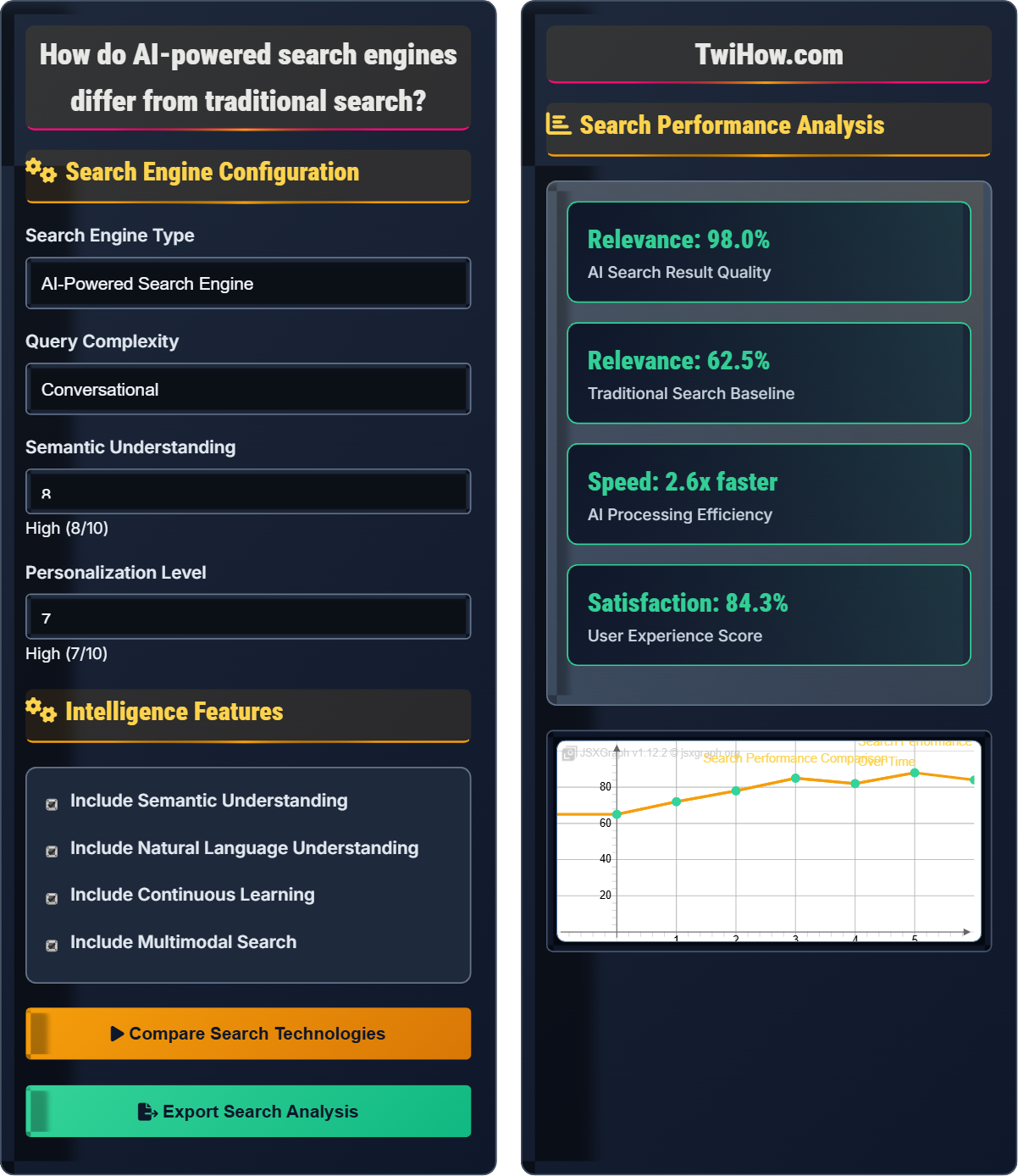
Search Engine Configuration
Intelligence Features
Search Performance Analysis
| Feature | Traditional Search | AI Search | Advantage |
|---|---|---|---|
| Query Understanding | Keyword Matching | Semantic Analysis | AI |
| Result Relevance | Basic Ranking | Context-Aware | AI |
| Personalization | Minimal | Deep Learning | AI |
| Learning | Static | Continuous | AI |
| Content Type | Text Only | Multi-Modal | AI |
Understanding AI-Powered Search Engines
Search engines have evolved from simple keyword matching systems to sophisticated AI-powered platforms that understand context, intent, and meaning:
- Traditional Search: Relies on keyword matching, basic ranking algorithms, and static indexes
- AI-Powered Search: Incorporates semantic understanding, natural language processing, and machine learning
- Evolution Stages: Boolean search → PageRank → Semantic search → Conversational AI
- Current State: Multimodal search with real-time learning and personalization
The effectiveness of AI search can be understood through:
Where:
- Understanding: Natural language comprehension and intent recognition
- Context: User history, location, and situational awareness
- Relevance: Match quality between query and results
Key capabilities that distinguish AI search from traditional search:
- Natural Language Understanding: Comprehend complex, conversational queries
- Semantic Search: Find meaning beyond exact keyword matches
- Intent Recognition: Understand what users are really looking for
- Contextual Awareness: Consider user history and situation
- Real-Time Learning: Adapt based on user feedback and behavior
- Multimodal Processing: Handle text, images, voice, and video
- Higher Relevance: More accurate results that match user intent
- Better User Experience: Natural, conversational search interactions
- Reduced Friction: Fewer clicks to find desired information
- Proactive Discovery: Surface relevant content users didn't explicitly search for
- Cross-Modal Search: Search using different types of input (text, voice, images)
- Continuous Improvement: Gets better with use through machine learning
Search Technology Fundamentals
Semantic search, natural language processing, query understanding, result ranking, personalization, machine learning, neural search, vector embeddings.
Search Effectiveness = (Query Understanding × Result Relevance × User Satisfaction) ÷ Latency Factor
Where Query Understanding = Natural language comprehension, Result Relevance = Match quality, User Satisfaction = Experience quality, Latency Factor = Response time adjustment.
- Understanding user intent is more important than keyword matching
- Context significantly improves search relevance
- Continuous learning enhances search quality over time
Search Capabilities Comparison
Traditional search, semantic search, neural search, multimodal search, conversational search, federated search.
- Query analysis and intent recognition
- Indexing with semantic understanding
- Result ranking and personalization
- Performance optimization and scaling
- Continuous learning and adaptation
- Integration with user experience
- Balance between relevance and performance
- Consider privacy implications of personalization
- Ensure fairness in result ranking
- Maintain explainability of search decisions
AI Search Learning Quiz
What is the primary advantage of AI-powered search over traditional keyword search?
The primary advantage of AI-powered search is its ability to understand semantic meaning and context, allowing it to return relevant results even when exact keywords don't match. This includes understanding synonyms, related concepts, user intent, and contextual factors that traditional keyword matching cannot handle.
The answer is B) Understanding of semantic meaning and context.
Semantic search represents a fundamental shift from syntactic matching to meaning-based retrieval. This allows search engines to understand what users are actually looking for rather than just finding documents containing the same words.
Semantic Search: Understanding meaning beyond keywords
Natural Language Processing: AI understanding of human language
Query Intent: User's actual information need
• Context matters more than exact matches
• Intent understanding improves relevance
• AI search requires more computational resources
• Use conversational queries with AI search
• Leverage context-aware features
• Expect more relevant results with less precise keywords
• Treating AI search like traditional keyword search
• Not utilizing conversational query capabilities
• Expecting identical results to traditional search
Explain how AI-powered search engines use personalization to improve results and what privacy considerations arise from this approach.
Personalization Mechanisms: AI search engines track user behavior, search history, location, device, and preferences to tailor results. Machine learning models analyze patterns to predict what content is most relevant to each user.
Improvement Methods: Contextual ranking, preference learning, behavioral analysis, and collaborative filtering enhance result relevance.
Privacy Considerations: Extensive data collection raises concerns about user privacy, data security, and potential manipulation. Users may receive filtered information that limits exposure to diverse perspectives.
Balance Strategies: Implement privacy controls, data minimization, and transparency about personalization methods while maintaining effectiveness.
Personalization in AI search creates a tension between relevance and privacy. While it significantly improves user experience, it also raises important ethical questions about data collection and algorithmic influence on information access.
Behavioral Analysis: Studying user interactions and patterns
Collaborative Filtering: Using similar users' preferences
Data Minimization: Collecting only necessary information
• Balance personalization with privacy
• Provide user control over data collection
• Maintain transparency about algorithmic decisions
• Review privacy settings regularly
• Use incognito mode for unbiased searches
• Periodically clear search history
• Not understanding how personalization affects results
• Failing to manage privacy settings
• Assuming all users receive identical results
A company wants to implement an AI-powered search system for their internal knowledge base. Their employees often use complex, natural language queries to find information. Compare the benefits and challenges of AI search versus traditional search for this use case.
Benefits of AI Search: Better understanding of complex queries, ability to find relevant information even with imprecise terminology, natural language processing for conversational queries, improved result relevance through semantic understanding.
Challenges: Higher implementation cost, need for training data, potential privacy concerns with internal data, complexity of setup and maintenance.
Traditional Search Limitations: Poor performance with complex queries, inability to understand synonyms or related concepts, requirement for precise keyword matching.
Recommendation: AI search is highly beneficial for internal knowledge bases where users ask complex questions and expect quick, accurate answers.
Enterprise search scenarios particularly benefit from AI capabilities because internal queries tend to be complex and information needs are specific. The investment in AI search typically pays off through improved productivity and reduced search time.
Enterprise Search: Internal organization information retrieval
Knowledge Base: Centralized repository of informationProductivity Gains: Time savings through improved search
• Consider ROI when implementing AI search
• Ensure data security and compliance
• Plan for ongoing maintenance and updates
• Start with pilot implementation
• Train models on relevant internal data
• Monitor user adoption and satisfaction
• Underestimating implementation complexity
• Not involving end users in design process
• Failing to maintain and update models
Design a multimodal search system that can handle text, voice, and image queries. What AI technologies would you use and how would you integrate them for a unified search experience?
Text Processing: Natural language understanding models for semantic search and query interpretation.
Voice Processing: Automatic speech recognition (ASR) to convert speech to text, then process through text models.
Image Processing: Computer vision models for object recognition, scene understanding, and visual search.
Integration: Common vector embedding space to represent all modalities, allowing cross-modal search where text queries can find images and vice versa.
Implementation: Use transformer architectures, attention mechanisms, and shared semantic representations across modalities.
Multimodal search represents the cutting edge of AI search technology, requiring sophisticated integration of different AI models to create a seamless user experience across different input types.
Multimodal Search: Search using multiple input types
Vector Embeddings: Numerical representations of meaning
Cross-Modal: Search across different input/output types
• Maintain consistent user experience across modalities
• Ensure accurate conversion between modalities
• Provide fallback options when one modality fails
• Use pre-trained models to accelerate development
• Implement robust error handling for each modality
• Provide clear feedback about search progress
• Treating modalities as separate systems
• Not accounting for different accuracy rates
• Failing to provide modality-specific feedback
What is a significant limitation of current AI search systems compared to human information seeking?
While AI search systems excel at processing and retrieving information, they lack true comprehension and common sense reasoning that humans possess. AI systems can process queries and return relevant results, but they don't understand meaning in the way humans do, which can lead to failures in handling ambiguity, nuance, and contextual subtleties.
The answer is B) Lack of true comprehension and common sense.
This limitation highlights the fundamental difference between narrow AI and artificial general intelligence. Current AI search systems are powerful tools but remain specialized systems without genuine understanding or consciousness.
True Comprehension: Genuine understanding of meaning
Common Sense: Basic understanding of the world
Narrow AI: Specialized systems without general intelligence
• AI systems process but don't truly understand
• Common sense remains a major AI challenge
• Human oversight is still important for critical searches
• Use AI search as a tool, not a replacement for critical thinking
• Verify important information through multiple sources
• Understand the limitations of AI comprehension
• Assuming AI has human-like understanding
• Not verifying AI-generated answers
• Over-relying on AI for critical decisions
FAQ
Q: How does semantic search differ from traditional keyword search?
A: Semantic search understands the meaning and context behind queries, while keyword search only matches exact terms:
Traditional Keyword Search: Matches documents containing exact query terms. "Apple" returns results about both the fruit and the company equally.
Semantic Search: Understands context and intent. "Apple" in a technology context prioritizes Apple Inc. results, while in a nutrition context prioritizes fruit information.
Semantic search uses natural language processing, vector embeddings, and machine learning to understand relationships between concepts, synonyms, and related topics.
Q: Should I implement AI search for my small business website?
A: Consider your content and user needs:
Beneficial for: Sites with substantial content, complex products, or frequent user questions. E-commerce sites, knowledge bases, and content-rich websites benefit significantly.
May not be necessary for: Simple websites with minimal content or straightforward navigation.
Many platforms offer AI search as a service, making implementation accessible even for small businesses. Start with a pilot implementation to measure impact on user satisfaction and conversions.