How do AI recommendation algorithms influence our choices?
Complete guide to recommendation systems • Influence and impact
Recommendation Algorithm Overview:
Show Influence SimulatorAI recommendation algorithms significantly influence our choices by shaping what we see, buy, watch, read, and engage with. These systems use our behavior, preferences, and contextual data to suggest items, creating personalized experiences that can profoundly affect our decisions.
Key influence mechanisms include:
- Filter Bubbles: Isolated information ecosystems based on personal preferences
- Confirmation Bias: Reinforcement of existing beliefs and preferences
- Choice Architecture: Strategic placement and presentation of options
- Behavioral Nudges: Subtle influences toward specific actions
- Personalization: Tailored experiences that increase engagement
- Attention Economy: Competition for limited attention resources
Understanding these influences is crucial for making conscious decisions in our algorithm-mediated world.
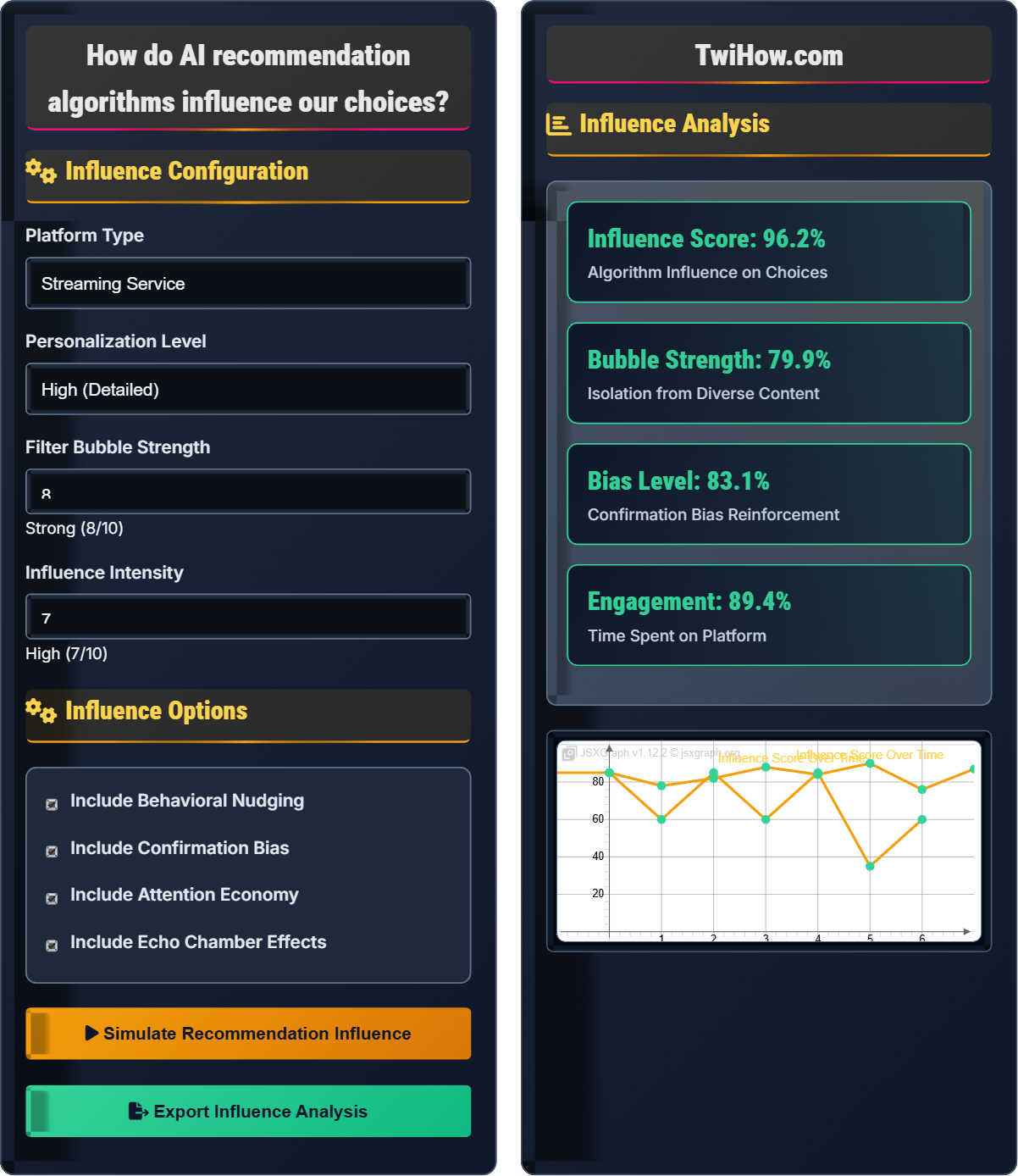
Influence Configuration
Influence Options
Influence Analysis
| Influence Type | Intensity | Impact | Frequency |
|---|---|---|---|
| Filter Bubbles | High | Significant | Constant |
| Confirmation Bias | Medium | Important | Frequent |
| Behavioral Nudging | High | Significant | Regular |
| Choice Architecture | Medium | Functional | Regular |
| Attention Capture | High | Important | Constant |
How Recommendation Algorithms Influence Our Choices
Recommendation algorithms influence our choices through several psychological and technical mechanisms:
- Filter Bubbles: Isolate us in personalized information ecosystems that reinforce existing views
- Confirmation Bias: Present content that confirms our existing beliefs and preferences
- Behavioral Nudging: Subtly guide us toward specific actions through design choices
- Choice Architecture: Structure how options are presented to influence decision-making
- Attention Economy: Compete for our limited attention with increasingly engaging content
- Recency Bias: Prioritize recent interactions and trending topics
The overall influence of recommendation algorithms can be understood through:
Where:
- Personalization: How well recommendations match user preferences
- Engagement: How compelling the recommendations are
- Exposure: How frequently users encounter recommendations
Recommendation algorithms influence various aspects of our behavior:
- Consumption: What we buy, watch, read, or listen to
- Information: What news and content we consume
- Social: Who we connect with and interact with
- Political: Which opinions and viewpoints we encounter
- Commercial: What products and services we consider
- Intellectual: What ideas and concepts we explore
- Availability Heuristic: We rely on readily available information
- Anchoring Bias: Initial recommendations influence subsequent choices
- Social Proof: Popular items appear more appealing
- Loss Aversion: Fear of missing out on recommended content
- Cognitive Load: Recommendations reduce mental effort of decision-making
- Habit Formation: Repeated exposure creates automatic responses
Recommendation Influence Fundamentals
Filter bubbles, confirmation bias, behavioral nudging, choice architecture, attention economy, echo chambers, recommendation systems.
Influence Impact = (Personalization × Engagement × Exposure) ÷ Resistance Factor
Where Personalization = Match quality, Engagement = Compelling nature, Exposure = Frequency of encounter, Resistance Factor = User awareness and critical thinking.
- Algorithms optimize for engagement, not necessarily user benefit
- Repeated exposure creates familiarity and preference
- Personalization can limit diversity of experiences
Influence Categories
Content consumption, purchasing decisions, social connections, political opinions, entertainment choices, information exposure.
- Filter bubble creation and reinforcement
- Confirmation bias exploitation
- Behavioral nudging and subtle persuasion
- Choice architecture manipulation
- Attention capture and retention
- Feedback loop amplification
- Subconscious nature of algorithmic influence
- Compounding effects over time
- Individual susceptibility varies
- Platform-specific influence patterns
Recommendation Influence Quiz
What is a "filter bubble" in the context of recommendation algorithms?
A filter bubble is an isolated information ecosystem where users are exposed primarily to content that aligns with their existing preferences, beliefs, and behaviors. This occurs because recommendation algorithms continuously refine suggestions based on user interactions, creating a feedback loop that reinforces existing interests and limits exposure to diverse perspectives.
The answer is B) An isolated information ecosystem based on personal preferences.
Understanding filter bubbles is crucial for recognizing how recommendation systems can limit our exposure to diverse viewpoints. This concept explains why we often see content that confirms our existing beliefs and rarely encounter opposing perspectives or new ideas outside our established interests.
Filter Bubble: Personalized information ecosystem that isolates users
Information Ecosystem: Environment of content and information sources
Feedback Loop: System where outputs influence future inputs
• Algorithmic personalization can limit diversity
• Awareness helps maintain critical thinking
• Diverse sources counteract filter bubbles
• Actively seek diverse perspectives
• Periodically clear browsing history
• Assuming all recommended content is objective
• Not recognizing personalization effects
• Taking algorithmic suggestions as complete truth
Explain how behavioral nudging works in recommendation algorithms and describe its psychological impact on user choices.
Behavioral Nudging: Recommendation algorithms use subtle design elements to guide user choices without restricting options. This includes strategic placement, timing, visual emphasis, and social proof indicators.
Psychological Impact: Nudging exploits cognitive biases like anchoring (first items influence decisions), availability heuristic (readily available options seem better), and social proof (popular items seem more desirable).
Implementation: Algorithms highlight trending content, show "people also liked" suggestions, create urgency with "limited time" offers, and emphasize popular choices.
Effects: Users tend to choose recommended items without extensive consideration, leading to increased engagement and conversion rates.
Behavioral nudging is particularly effective because it operates below conscious awareness. Users feel they are making free choices while being subtly guided toward algorithm-preferred outcomes. This technique leverages well-established psychological principles to influence behavior.
Behavioral Nudging: Subtle guidance toward specific choices
Cognitive Bias: Systematic deviation from rational judgment
Social Proof: Influence of others' actions on our behavior
• Nudging operates unconsciously
• Design can promote positive outcomes
• Pause before clicking recommendations
• Consider alternatives before deciding
• Recognize when you're being nudged
• Assuming all choices are equally accessible
• Not recognizing subtle design influences
• Taking algorithmic preferences as personal preferences
You've noticed that your streaming service keeps recommending similar movies to what you've watched before, and you feel like you're seeing the same types of content repeatedly. Explain what's happening and suggest strategies to break out of this pattern while maintaining awareness of algorithmic influence.
What's Happening: The algorithm has identified your preferences based on viewing history and continues to recommend similar content, creating a feedback loop that reinforces your existing tastes.
Breaking the Pattern: Deliberately explore different genres, search for content outside your usual preferences, and occasionally rate diverse content positively.
Maintaining Awareness: Recognize when recommendations become repetitive, actively seek diverse content, and periodically reset your viewing profile.
Long-term Strategy: Use the algorithm's knowledge of your preferences as a starting point, but consciously expand beyond it by exploring new categories and accepting recommendations that challenge your usual choices.
This scenario illustrates how recommendation algorithms can create a self-reinforcing cycle that limits exposure to diverse content. The key is understanding the algorithm's behavior and intentionally diversifying your interactions to maintain a broader range of experiences.
Feedback Loop: System where outputs influence future inputs
Reinforcement: Strengthening of existing patterns
Diversification: Expanding exposure to different content types
• Algorithms learn from all interactions
• Conscious exploration breaks patterns
• Diversity maintains cognitive flexibility
• Explore "New Releases" or "Trending" sections
• Search for content from different decades
• Try content from different cultures or languages
• Only consuming algorithmically recommended content
• Not recognizing repetitive patterns
• Assuming the algorithm knows your true preferences
Research shows that social media recommendation algorithms can influence political opinions by creating echo chambers. Propose a framework for maintaining political awareness and avoiding algorithmic polarization while using social media platforms.
Information Diet: Consciously consume news from diverse sources with different editorial perspectives. Use RSS feeds or bookmark sites to bypass algorithmic recommendations.
Engagement Strategy: Like, share, and comment on content from various political perspectives to signal interest in diverse viewpoints to algorithms.
Verification Protocol: Fact-check information before sharing and verify sources independently of social media recommendations.
Offline Engagement: Maintain real-world conversations with people holding different political views to gain nuanced perspectives.
Platform Settings: Adjust algorithm preferences, turn off personalized recommendations, and periodically clear browsing data to reset algorithmic profiles.
Critical Thinking: Question why certain content appears in feeds and consider the motivations behind recommendations.
Political influence through recommendation algorithms is particularly concerning because it can polarize societies and undermine democratic discourse. Active management of information consumption is essential for maintaining balanced political perspectives.
Echo Chamber: Environment where beliefs are reinforced
Political Polarization: Increasing division between political views
Information Diet: Conscious selection of information sources
• Diverse sources counteract polarization
• Critical thinking prevents manipulation
• Offline verification validates online information
• Follow fact-checking organizations
• Read full articles before sharing
• Engage respectfully with opposing views
• Sharing unverified information
• Only engaging with like-minded individuals
• Assuming social media represents reality
What characterizes the "attention economy" in relation to recommendation algorithms?
The attention economy refers to the economic value of user attention, where recommendation algorithms compete to capture and retain users' limited attention spans. In this model, user attention becomes the scarce resource that platforms monetize through advertising revenue, making it profitable to keep users engaged for as long as possible.
The answer is A) The economic value of user attention.
Understanding the attention economy explains why recommendation algorithms are designed to maximize engagement. Platforms have economic incentives to keep users on their services, which influences how recommendations are prioritized and presented.
Attention Economy: Economic model where attention is the scarce resource
Engagement Metrics: Measures of user interaction and retention
Monetization: Converting user behavior into revenue
• Platforms optimize for attention retention
• Engagement drives algorithmic design
• Awareness helps reclaim attention control
• Set time limits for platform usage
• Use apps that track screen time
• Take regular digital detox breaks
• Not recognizing attention as a valuable resource
• Assuming platform goals align with user goals
• Underestimating the impact of constant notifications
FAQ
Q: How can I tell if I'm being influenced by recommendation algorithms?
A: Signs of algorithmic influence include:
1. Homogeneity: Seeing very similar content repeatedly
2. Unexpected Discoveries: Finding yourself interested in topics you didn't know you liked
3. Time Distortion: Spending more time than intended on platforms
4. Confirmation: Frequently seeing content that confirms existing beliefs
5. Impulse Actions: Clicking or buying things without conscious deliberation
6. Feedback Loops: Recommendations becoming increasingly narrow over time
The key is developing awareness of these patterns and making conscious choices about your digital consumption.
Q: What's the difference between collaborative and content-based filtering?
A: These are two fundamental recommendation approaches:
Collaborative Filtering: Recommends items based on similarity to other users' preferences. "Users who liked X also liked Y." Based on user behavior patterns and collective wisdom.
Content-Based Filtering: Recommends items based on similarity to items a user has previously liked. "Because you liked X, you might like Y with similar characteristics." Based on item features and user preferences.
Both approaches have different influence patterns: collaborative filtering can introduce serendipitous discoveries, while content-based filtering tends to reinforce existing preferences.