How Do I Protect My Data from AI Systems?
Complete data protection guide • Step-by-step strategies
Data Protection from AI:
Show Protection AnalyzerProtecting your data from AI systems involves understanding how AI collects, processes, and stores personal information. With the rapid advancement of AI technologies, individuals must take proactive steps to safeguard their privacy and maintain control over their personal data.
Modern AI systems can collect data through various channels including social media, search engines, applications, and IoT devices. Understanding these data collection methods is crucial for implementing effective protection strategies.
Key protection strategies include:
- Data Minimization: Sharing only necessary information
- Privacy Controls: Configuring settings to limit data collection
- Encryption: Securing data transmission and storage
- Vendor Selection: Choosing services with strong privacy policies
- Regular Monitoring: Checking data access and usage
Implementing these strategies helps maintain privacy while still benefiting from AI technologies.
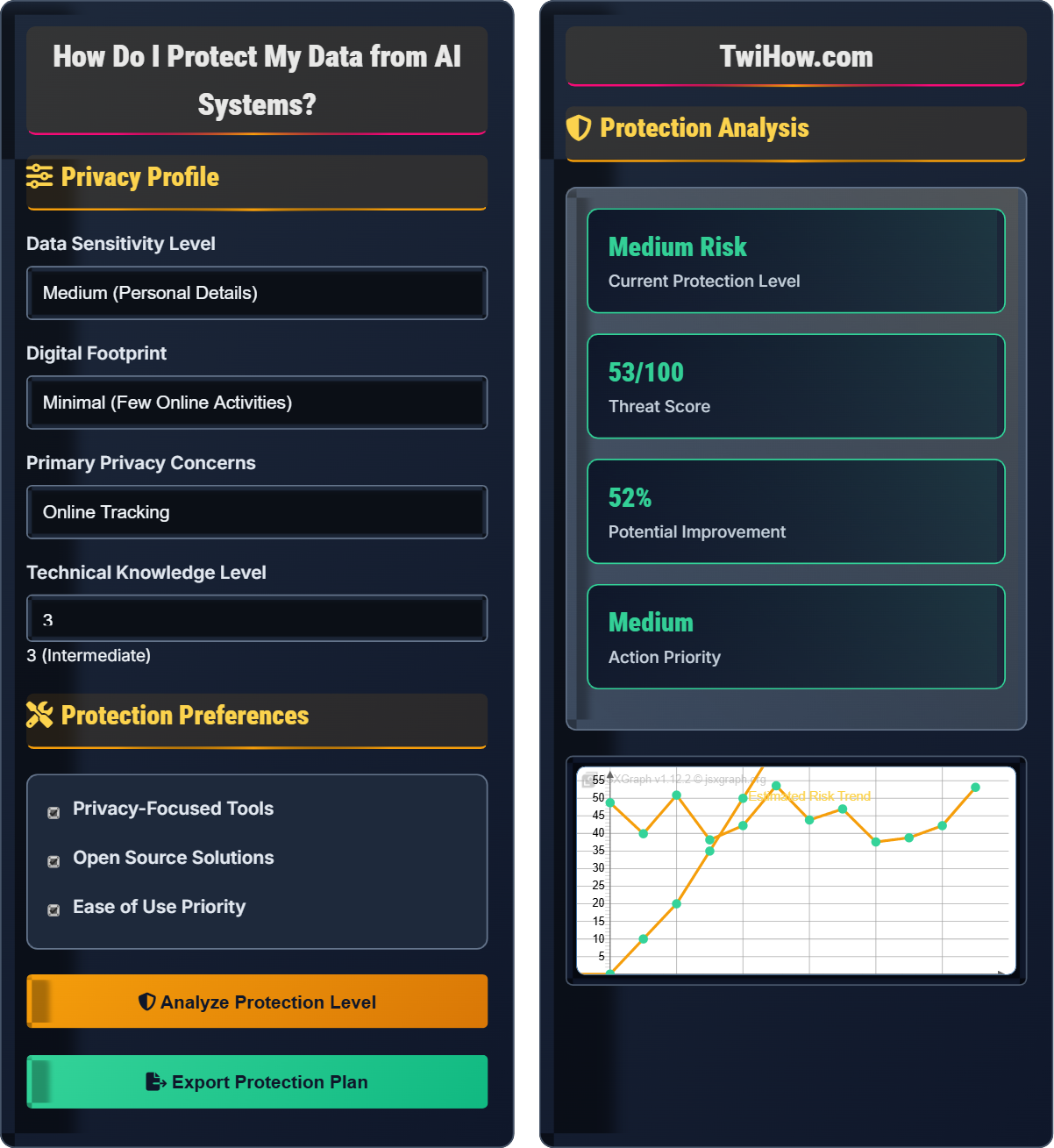
Privacy Profile
Protection Preferences
Protection Analysis
| Action | Priority | Impact | Difficulty |
|---|---|---|---|
| Enable 2FA | High | High | Easy |
| Review Privacy Settings | High | Medium | Medium |
| Use VPN | Medium | High | Easy |
| Limit Data Sharing | High | High | Medium |
| Regular Data Checks | Medium | Medium | Easy |
- Limit profile visibility
- Disable location sharing
- Review app permissions
- Use private browsing
- Switch to privacy-focused engines
- Clear cookies regularly
Data Protection from AI Systems Overview
AI systems collect and process personal data to improve their algorithms and provide personalized experiences. This data can include personal information, behavioral patterns, preferences, and interactions. Understanding how AI systems collect data is the first step in protecting your privacy.
The risk of privacy exposure can be calculated using:
Where higher values indicate greater risk and require stronger protection measures.
AI systems gather data through various channels:
- Direct Input: Information you explicitly provide (forms, surveys)
- Behavioral Tracking: Monitoring of clicks, searches, and interactions
- Device Data: Location, device identifiers, and hardware information
- Third-Party Sources: Data purchased from other companies
- Pattern Recognition: Inferring information from available data
- Social Connections: Information from contacts and connections
- Data Minimization: Share only necessary information
- Privacy by Design: Choose tools with privacy built-in
- Regular Audits: Review data sharing practices periodically
- Strong Authentication: Use secure login methods
- Encrypted Communication: Secure data transmission
- Vendor Due Diligence: Research companies' privacy practices
Data Protection Strategies
- Review privacy settings annually
- Limit location sharing
- Opt out of data collection
- Enable two-factor authentication
- Use strong, unique passwords
- Consider password managers
- Use HTTPS connections
- Encrypt sensitive files
- Consider encrypted messaging
- Limit social media sharing
- Opt out of unnecessary tracking
- Use pseudonyms when possible
Privacy Control Recommendations
Risk Assessment
| Risk Factor | Level | Description | Mitigation Strategy |
|---|---|---|---|
| Social Media Exposure | High | Personal information shared publicly | Limit visibility, review posts regularly |
| Location Tracking | Medium | Continuous location data collection | Disable location services when not needed |
| Browser Tracking | High | Behavioral profiling through browsing | Use privacy-focused browsers, clear cookies |
| Email Privacy | Medium | Email content analysis by providers | Use encrypted email services |
| App Permissions | High | Apps accessing unnecessary data | Review and limit app permissions |
| Smart Devices | Medium | Voice and activity monitoring | Configure privacy settings, limit use |
Data Protection from AI Quiz
Which of the following is the best example of data minimization when using AI-powered services?
Data minimization involves sharing only the minimum amount of personal information necessary for a specific purpose. Option B exemplifies this principle by using a pseudonym and providing only the essential information (email address) for the required service. This limits the amount of personal data available for AI systems to collect and process.
The answer is B) Using a pseudonym and only providing an email address for a service that only requires email notifications.
Data minimization is a fundamental privacy principle that reduces the risk of data exposure and misuse. When using AI services, users should critically evaluate what information is truly necessary for the service to function. Sharing excessive data not only increases privacy risks but also provides AI systems with more information to create detailed profiles.
Data Minimization: Principle of collecting only necessary data for a specific purpose
Pseudonym: Identifier that doesn't reveal true identity
Privacy by Design: Incorporating privacy protections into system design
• Share only what's required for service functionality
• Question why services request specific information
• Use pseudonyms when identity isn't necessary
• Create separate email addresses for different purposes
• Use burner phones for services requiring phone numbers
• Review privacy policies before sharing data
• Providing more information than required
• Not reading privacy policies
• Assuming all data sharing is necessary
Explain the importance of regularly reviewing privacy settings on social media platforms and other AI-powered services. What specific actions should users take?
Importance of Regular Reviews: Privacy policies and settings change frequently, and AI systems evolve their data collection practices. Regular reviews ensure that your data protection remains effective over time.
Specific Actions:
1. Check Privacy Settings: Review who can see your posts, personal information, and contact details
2. Manage Data Access: Review which third-party apps have access to your account
3. Control Data Usage: Configure how your data is used for advertising and recommendations
4. Review Location Sharing: Disable location services for apps that don't need it
5. Check Tagging Permissions: Control who can tag you in posts and photos
6. Update Contact Information: Remove unnecessary contacts and data that may be shared
Privacy settings are not set-and-forget configurations. As AI systems become more sophisticated, they often request additional permissions or change how they use data. Regular reviews help users stay aware of these changes and maintain control over their personal information. This proactive approach is essential for long-term privacy protection.
Privacy Settings: Controls that determine how personal data is collected and used
Data Access: Permission granted to applications to access personal information
Proactive Privacy: Taking action to protect privacy before problems occur
• Review settings quarterly at minimum
• Understand what each setting controls
• Make changes based on actual needs
• Set calendar reminders for privacy reviews
• Use privacy checkup tools when available
• Keep a log of your privacy settings
• Never reviewing settings after initial setup
• Accepting all default privacy options
• Not understanding the implications of settings
A user discovers that a service they've been using for years has experienced a data breach, exposing their personal information including email, username, and hashed passwords. The service uses AI to analyze user behavior patterns. What steps should the user take to protect themselves and minimize future AI data collection risks?
Immediate Actions:
1. Change Passwords: Update passwords for the affected account and any other accounts using the same password
2. Enable 2FA: Activate two-factor authentication if available
3. Monitor Accounts: Watch for suspicious activity on related accounts
4. Check Credit Reports: Monitor for identity theft indicators
Future Risk Reduction:
1. Minimize Data Sharing: Reduce the amount of personal information provided to similar services
2. Review Privacy Settings: Configure stricter privacy controls
3. Choose Privacy-Focused Alternatives: Consider services with better privacy practices
4. Use Strong Authentication: Implement password managers and unique passwords
Data breaches are unfortunately common, and users must be prepared to respond quickly. Beyond immediate security measures, users should reassess their relationship with AI-powered services and consider how much data they're comfortable sharing. This incident serves as a reminder of the importance of privacy-first approaches to digital services.
Data Breach: Unauthorized access to sensitive information
Two-Factor Authentication: Security method requiring two forms of verificationPassword Hashing: Encryption of passwords for storage security
• Act quickly after breach notifications
• Change passwords on all affected accounts
• Monitor accounts for unusual activity
• Use breach notification services to monitor exposure
• Keep a record of affected accounts
• Consider credit monitoring services
• Ignoring breach notifications
• Not changing passwords after breach
• Continuing to use compromised services without caution
A household has multiple smart devices (speakers, TVs, thermostats) that use AI to provide personalized experiences. These devices continuously listen for voice commands and collect usage data. Calculate the potential privacy risk score if each device has a baseline risk of 15 points, but the risk increases by 20% for each additional device due to data correlation possibilities. If the household has 5 smart devices, what is the total privacy risk score?
Baseline Risk Calculation: 5 devices × 15 points = 75 points
Correlation Risk Increase: Each additional device beyond the first increases total risk by 20%
Calculation:
• First device: 15 points
• Second device: 15 × 1.2 = 18 points
• Third device: 15 × 1.2² = 21.6 points
• Fourth device: 15 × 1.2³ = 25.92 points
• Fifth device: 15 × 1.2⁴ = 31.10 points
Total Risk Score: 15 + 18 + 21.6 + 25.92 + 31.10 = 111.62 points
This demonstrates how interconnected devices significantly increase privacy risks through data correlation.
Smart devices pose unique privacy challenges because their combined data creates a more comprehensive picture of user behavior than any single device could provide. The correlation of data across multiple devices exponentially increases privacy risks, as AI systems can infer sensitive information from seemingly innocuous data combinations.
Data Correlation: Combining information from multiple sources to create new insights
Smart Devices: Internet-connected devices with AI capabilitiesPrivacy Risk Score: Quantitative measure of potential privacy exposure
• Consider cumulative privacy effects of multiple devices
• Configure privacy settings on each device individually
• Limit inter-device data sharing when possible
• Use separate networks for smart devices
• Disable voice activation when not needed
• Regularly review device privacy settings
• Not considering cumulative privacy effects
• Assuming all smart device features are necessary
• Not configuring privacy settings on individual devices
Which of the following is the most effective way to understand how an AI system uses your personal data?
Reading the privacy policy and data use disclosure documents is the most effective way to understand how an AI system uses personal data. These documents are legally required to provide information about data collection, processing, sharing, and retention practices. While they can be lengthy and complex, they contain the most accurate and comprehensive information about how your data is handled.
The answer is B) Reading the privacy policy and data use disclosure documents.
Transparency is a key principle of privacy protection. Organizations are legally obligated to disclose their data practices in privacy policies. While these documents can be complex, they provide the most authoritative information about data handling. Users should develop the habit of reviewing these documents before using AI services, particularly those that handle sensitive information.
Privacy Policy: Legal document describing data collection and use practices
Data Disclosure: Information about how personal data is processed
Transparency Principle: Requirement to inform users about data practices
• Read privacy policies before using services
• Look for data portability and deletion rights
• Understand third-party data sharing practices
• Use privacy policy summary tools
• Focus on sections about data sharing
• Note data retention periods
• Never reading privacy policies
• Assuming all AI systems handle data similarly
• Not understanding the implications of consent
FAQ
Q: Is it possible to completely avoid AI data collection in today's digital world?
A: Complete avoidance of AI data collection is extremely difficult in our interconnected world, but you can significantly minimize exposure:
• Use privacy-focused alternatives to mainstream services
• Employ technical tools like VPNs, ad blockers, and encrypted communications
• Practice data minimization - share only what's absolutely necessary
• Regularly audit and delete old accounts and data
• Stay informed about privacy laws and regulations
While complete avoidance may require extreme measures like avoiding the internet entirely, significant privacy improvements are achievable through conscious choices and protective measures.
Q: Do privacy-focused browsers really make a difference against AI tracking?
A: Yes, privacy-focused browsers like Tor, Firefox with privacy extensions, or Brave can significantly reduce AI tracking:
• Built-in tracker blocking prevents many AI surveillance mechanisms
• Fingerprinting protection makes it harder for AI to identify you across sites
• Enhanced cookie controls limit behavioral profiling
• Encrypted DNS and other features add additional protection layers
However, browsers alone aren't sufficient - combining them with other tools like VPNs and careful online behavior provides the strongest protection against AI data collection.