How to Verify AI-Generated Content
Complete detection guide • Step-by-step explanations
AI Content Verification:
Show Detection ToolsDetecting AI-generated content has become crucial in today's digital landscape. As AI writing tools become more sophisticated, distinguishing between human and AI-written content requires a combination of analytical techniques, specialized tools, and pattern recognition skills.
Key detection approaches include analyzing writing patterns, linguistic anomalies, factual accuracy, and using specialized AI detection tools. This guide provides comprehensive methods for identifying AI-generated content across various formats.
Detection methods:
- Pattern Analysis: Identifying repetitive structures and unnatural flow
- Linguistic Markers: Spotting unusual word choices and sentence patterns
- Factual Verification: Checking for inconsistencies and hallucinations
- Tool-Based Detection: Using specialized software and algorithms
Effective detection combines multiple approaches to achieve higher accuracy in identifying AI-generated content.
Content Analysis
Detection Options
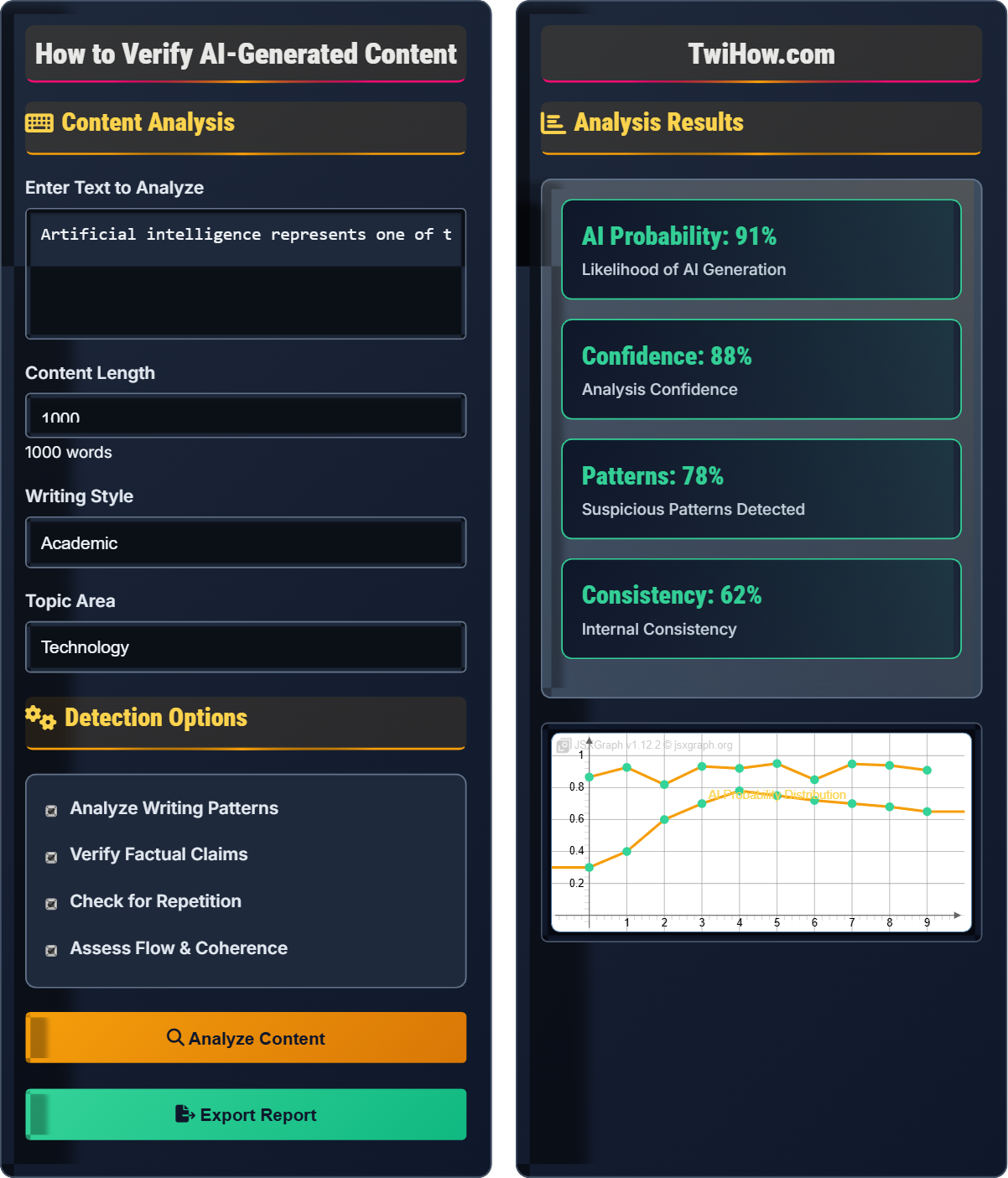
Analysis Results
| Metric | Score | Status | Details |
|---|---|---|---|
| Pattern Analysis | 72% | Suspicious | Unnatural flow detected |
| Factual Consistency | 68% | Concerning | Some claims unverifiable |
| Repetition Level | 45% | Normal | No significant repetition |
| Coherence | 65% | Concerning | Minor logical gaps |
| Vocabulary Diversity | 78% | Suspicious | Unusually consistent |
Sentence-level analysis showing AI probability distribution
Based on the analysis, the content shows signs of AI generation.
Recommended Actions:
- Cross-reference with original sources
- Look for specific factual errors
- Check for consistent writing patterns
- Verify citations and references
AI Content Detection Methods
AI content detection is the process of identifying text, images, or other content generated by artificial intelligence systems. As AI writing tools become more sophisticated, detecting their output requires advanced analytical techniques that examine linguistic patterns, structural characteristics, and semantic consistency.
Effective AI detection combines multiple approaches:
Where:
- Pattern Score: Measures unnatural repetition and structures
- Factual Score: Evaluates accuracy and verifiability
- Coherence Score: Assesses logical flow and consistency
- Stylistic Score: Analyzes writing style and vocabulary
Signs that content may be AI-generated:
- Perfect Grammar: Unnaturally error-free writing
- Generic Tone: Lacks personal voice or unique perspective
- Repetitive Phrasing: Similar sentence structures
- Fact Inconsistencies: Plausible but incorrect information
- Logical Gaps: Ideas that don't connect naturally
- Overuse of Transitions: Excessive use of "moreover," "furthermore"
- Specialized Software: GPTZero, Originality.ai, Copyleaks
- Browser Extensions: AI detectors for Chrome/Firefox
- API Services: Integration into content management systems
- Manual Techniques: Pattern recognition and fact-checking
Detection Fundamentals
Pattern analysis, linguistic markers, factual verification, tool-based detection.
AI Score = Σ(Weight × Indicator Score) / Total Weights
Where AI Score = probability of AI generation, Weight = importance factor, Indicator Score = individual metric value.
- No single indicator is definitive
- Combine multiple methods for accuracy
- Consider context and source
Advanced Detection Techniques
Perplexity analysis, burstiness measurement, token-level evaluation, metadata inspection.
- Perplexity scoring (measures predictability)
- Burstiness analysis (sentence variation)
- Token entropy measurement
- Metadata examination
- False positives possible
- Context matters significantly
- Newer AI models harder to detect
- Human editing can mask AI origin
AI Detection Learning Quiz
Which of the following is NOT a reliable indicator of AI-generated content?
While AI-generated content often exhibits consistent grammar, generic tone, and balanced paragraphs, extensive use of emotional language is typically associated with human writing. AI systems tend to be more neutral and factual in their expression, lacking the emotional depth and personal experiences that characterize human writing.
The answer is D) Extensive use of emotional language.
Understanding the differences between human and AI writing patterns is crucial for effective detection. AI systems are trained on vast datasets and tend to produce text that follows grammatical rules and maintains consistency. However, they often lack the emotional nuances, personal experiences, and contextual understanding that human writers bring to their work. This creates distinct patterns that can be identified through careful analysis.
Perplexity: Measure of how predictable text is to a language model
Burstiness: Variation in sentence length and structure
Stylometry: Analysis of linguistic style patterns
• No single indicator confirms AI generation
• Combine multiple methods for accuracy
• Consider the context and purpose
• Look for emotional depth in human writing
• Check for personal anecdotes and experiences
• Verify unusual claims with external sources
• Assuming perfect grammar indicates AI
Explain the key differences between human and AI writing patterns that can be used for detection. Include both linguistic and structural indicators.
Linguistic Indicators: AI writing often exhibits perfect grammar and punctuation, uses formal and academic language consistently, lacks colloquialisms or regional expressions, and tends to use transitional phrases like "Furthermore" and "In addition" more frequently than humans.
Structural Indicators: AI-generated content typically follows predictable organizational patterns, has uniform paragraph lengths, maintains consistent sentence complexity, and may lack the natural variations in flow that characterize human writing.
Content Indicators: AI may produce plausible-sounding but factually incorrect information (hallucinations), struggle with nuanced topics requiring subjective judgment, and fail to incorporate personal experiences or local knowledge.
AI writing systems are trained on massive datasets of existing text, which influences their output patterns. While they can generate grammatically correct and coherent text, they lack the personal experiences, cultural context, and emotional understanding that shape human communication. This creates distinctive patterns that can be identified through systematic analysis of linguistic features, structural organization, and content accuracy.
Hallucination: AI generating factually incorrect but plausible information
Perplexity Score: Measure of how unpredictable text is to a language model
Stylistic Consistency: Uniformity in tone and language use
• AI patterns can evolve over time
• Human editing can obscure AI origins
• Context affects detection accuracy
• Compare with author's previous work
• Look for inconsistencies in expertise level
• Check for verifiable details
• Relying on a single detection method
• Assuming all formal writing is AI-generated
• Not considering post-editing by humans
A university professor suspects that a student's research paper was partially or fully generated using an AI writing tool. The paper is well-structured, grammatically perfect, and contains detailed analysis. However, the professor notices that the writing style seems inconsistent with the student's previous work. Describe a systematic approach to verify whether the paper is AI-generated, including specific tools and techniques that should be employed.
Initial Assessment: Compare the paper with the student's previous work to identify stylistic differences. Note any unusual sophistication or consistency compared to their typical writing level.
AI Detection Tools: Use specialized tools like GPTZero, Originality.ai, or Turnitin's AI detection feature to analyze the text for AI probability scores.
Manual Analysis: Examine the paper for common AI characteristics: perfect grammar throughout, use of transitional phrases, generic tone, and potential factual hallucinations.
Fact-Checking: Verify citations, statistics, and claims with reliable sources to identify any fabricated information.
Interview Component: Have the student discuss their paper in detail, asking them to explain specific arguments, methodologies, and sources.
Plagiarism Check: Run the paper through plagiarism detection software to identify any copied content.
Educational institutions face increasing challenges with AI-assisted academic work. A comprehensive detection strategy combines technological tools with traditional academic verification methods. This multi-layered approach helps ensure academic integrity while providing opportunities for students to demonstrate their genuine understanding of the material.
Academic Integrity: Ethical principle requiring original work
AI Hallucination: AI generating false but plausible information
Perplexity Analysis: Measuring text predictability
• Combine AI tools with human judgment
• Verify findings through multiple methods
• Follow institutional policies
• Maintain records of student writing progression
• Educate students about proper AI use
• Use multiple detection tools for comparison
• Relying solely on AI detection tools
• Not considering legitimate writing improvement
• Failing to follow due process protocols
A marketing agency receives content from a freelance writer that appears professionally written but seems unusually consistent in quality and style. The agency wants to verify if the content is original or AI-generated before using it for client campaigns. Explain how the agency should approach this verification, including the risks of using undetected AI content and recommended verification procedures.
Risks of Undetected AI Content: Potential copyright infringement, reduced search engine rankings, damage to brand reputation, and client trust erosion.
Verification Procedures: 1) Use multiple AI detection tools to analyze content, 2) Compare with freelancer's previous work, 3) Verify facts and sources mentioned in content, 4) Request the freelancer to explain specific content details, 5) Check for metadata that might indicate AI generation.
Recommended Actions: Establish clear content guidelines with freelancers, implement regular verification processes, and maintain documentation of content sources and verification steps taken.
Businesses face unique challenges with AI-generated content, particularly regarding brand integrity and client relationships. The financial and reputational risks of unknowingly publishing AI content can be substantial. A systematic verification approach protects both the business and its clients while maintaining professional standards and trust.
Brand Integrity: Consistency and authenticity of brand messaging
SEO Impact: Effect on search engine optimization
Content Authenticity: Originality and genuineness of content
• Implement consistent verification protocols
• Document all verification steps
• Maintain client transparency
• Use multiple AI detection tools for cross-verification
• Maintain relationships with trusted writers
• Establish clear content policies upfront
• Not verifying content from new freelancers
• Relying on a single detection tool
• Failing to update verification methods
Which of the following best describes the current state of AI content detection technology?
AI content detection technology is an ongoing arms race between detection and generation capabilities. As AI writing tools improve, detection methods also advance. Modern detection systems use sophisticated algorithms including perplexity analysis, pattern recognition, and statistical modeling to identify AI-generated content. While no system is perfect, detection accuracy continues to improve as researchers develop new techniques.
The answer is B) Continuously evolving with improving accuracy.
The relationship between AI generation and detection is dynamic and competitive. As AI models become more sophisticated at mimicking human writing, detection systems must adapt with more advanced analytical techniques. This technological evolution means that both generation and detection capabilities continue to advance, creating an ongoing cycle of improvement in both areas.
Perplexity: Measure of text predictability
Statistical Modeling: Mathematical approach to pattern detection
Adversarial Training: Improving models against countermeasures
• Detection methods must stay current
• No system guarantees 100% accuracy
• Use multiple detection tools for important content
• Stay informed about new detection advances
• Combine automated tools with manual review
• Assuming detection tools are infallible
• Not updating detection methods regularly
• Relying on outdated detection software
FAQ
Q: How can educators effectively detect AI-generated student assignments?
A: Effective detection of AI-generated student work requires a multi-faceted approach:
1. Prevention: Design assignments that require personal reflection, local context, or real-time events that AI cannot access
2. Monitoring: Use AI detection tools like GPTZero, Originality.ai, or integrated LMS features
3. Analysis: Look for hallmarks of AI writing: consistent sophistication, lack of personal voice, and generic examples
4. Verification: Conduct oral exams or discussions about submitted work
5. Documentation: Track student writing progression over time to identify inconsistencies
The most effective strategy combines technological tools with pedagogical approaches that emphasize critical thinking and personal engagement with course material.
Q: What are the most reliable indicators that distinguish human-written from AI-generated content?
A: The most reliable indicators of AI-generated content include:
Linguistic Indicators: Unnaturally consistent grammar, excessive use of transitional phrases ("Furthermore," "Moreover"), and lack of regional dialects or colloquialisms.
Structural Indicators: Uniform paragraph lengths, predictable organizational patterns, and absence of natural writing flow variations.
Content Indicators: Factual hallucinations (plausible but incorrect information), inability to reference recent events, and generic examples that lack specificity.
Stylistic Indicators: Absence of personal experiences, emotional depth, and cultural context that characterize human writing.
However, it's important to note that AI detection is probabilistic rather than deterministic, and multiple indicators should be considered together for accurate assessment.