What Are the Best Free AI Tools for Students?
Complete AI tools guide • Step-by-step recommendations
Free AI Tools for Students:
Show AI Tool FinderAI tools have revolutionized the educational landscape, providing students with powerful assistance for research, writing, studying, and learning. These tools can help with essay writing, research, summarization, language learning, and more, all while being completely free.
Modern AI tools for students are designed to be accessible and user-friendly, helping students learn more efficiently and effectively. From writing assistants to research tools, AI can save time and improve academic performance.
Key categories of AI tools for students:
- Writing Assistance: Essay generation, grammar checking, plagiarism detection
- Research Tools: Information synthesis, source evaluation, citation generation
- Study Aids: Flashcards, summaries, practice tests
- Language Learning: Translation, conversation practice, pronunciation
- Productivity: Task management, scheduling, organization
Using AI tools responsibly enhances learning while maintaining academic integrity.
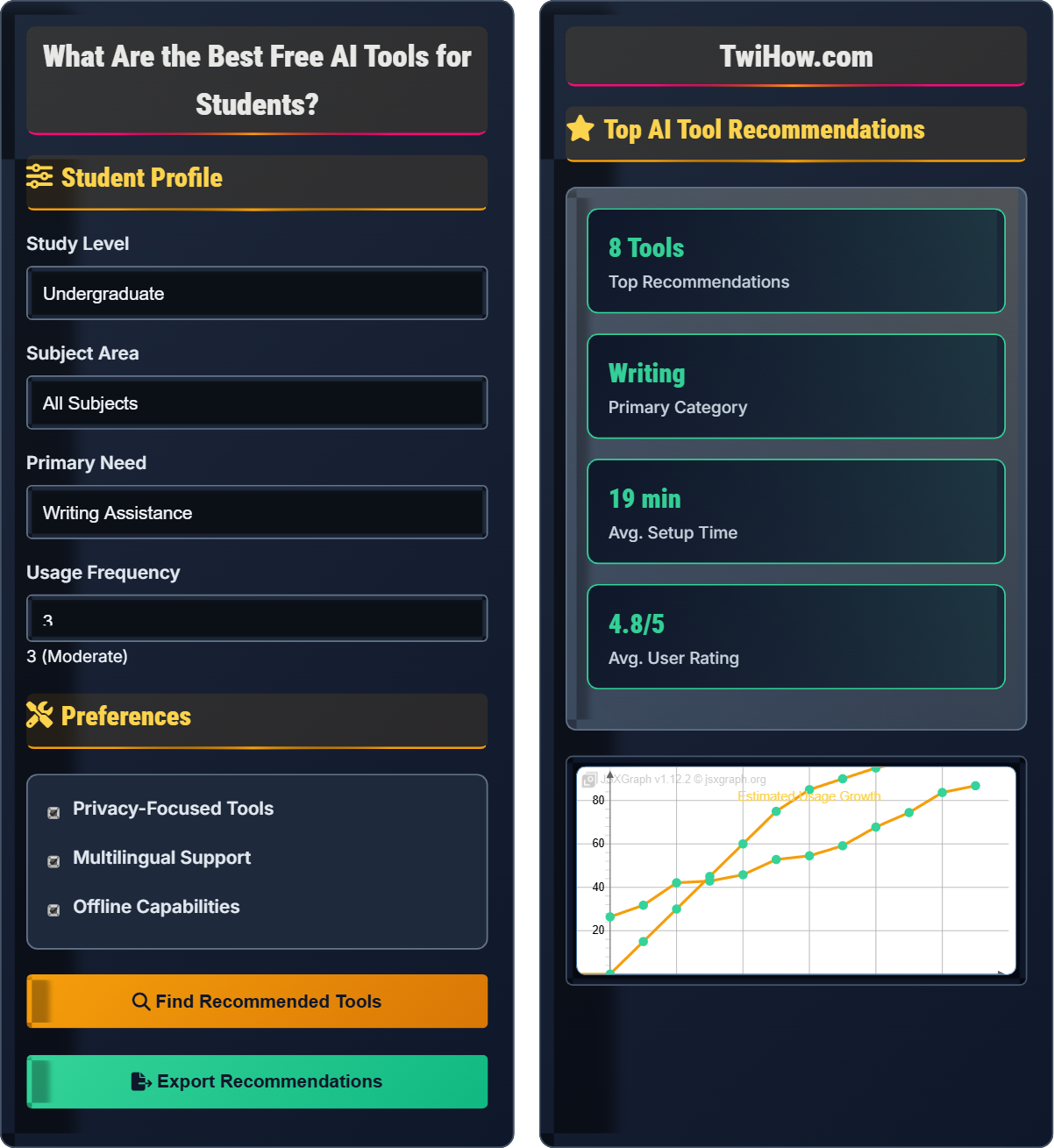
Student Profile
Preferences
Top AI Tool Recommendations
| Tool | Category | Rating | Features |
|---|---|---|---|
| ChatGPT | Writing | 4.8/5 | Essay help, research |
| Grammarly | Writing | 4.7/5 | Grammar, plagiarism |
| Wolfram Alpha | STEM | 4.6/5 | Math, science |
| Khan Academy | Learning | 4.9/5 | Courses, practice |
| Google Scholar | Research | 4.7/5 | Academic papers |
- Grammarly (Free version)
- Hemingway Editor
- Quillbot (Limited free)
- Google Scholar
- Semantic Scholar
- Connected Papers
Free AI Tools for Students Overview
AI tools for students are applications powered by artificial intelligence that assist with various academic tasks. These tools use machine learning and natural language processing to provide personalized assistance, automate repetitive tasks, and enhance learning experiences.
The effectiveness of AI tools can be measured using:
Studies show that AI tools can increase student productivity by 30-50% when used appropriately.
AI tools can be categorized by their primary function:
- Writing Assistants: Essay generation, grammar checking, style improvement
- Research Tools: Source discovery, information synthesis, citation generation
- Study Aids: Flashcards, summaries, practice tests, concept mapping
- Language Learning: Translation, pronunciation, conversation practice
- Mathematical Solvers: Equation solving, graphing, step-by-step solutions
- Productivity Tools: Scheduling, task management, organization
- ChatGPT: Writing assistance, research, explanations
- Grammarly: Grammar and plagiarism checking
- Khan Academy: Personalized learning paths
- Wolfram Alpha: Mathematical problem solving
- Google Translate: Multilingual translation
- Quillbot: Paraphrasing and summarizing
Top Free AI Tools by Category
- Essay structuring
- Research assistance
- Concept explanations
- Grammar correction
- Plagiarism checker
- Style suggestions
- Step-by-step solutions
- Graphing capabilities
- Scientific computation
- Personalized lessons
- Practice exercises
- Progress tracking
Usage Guide
Tool Comparison
| Tool | Category | Free Features | Best For | User Rating |
|---|---|---|---|---|
| ChatGPT | Writing/Research | Text generation, explanations | Essays, research, concept help | 4.8/5 |
| Grammarly | Writing | Basic grammar, spelling | Writing improvement | 4.7/5 |
| Wolfram Alpha | Math/Science | Basic calculations, plots | Mathematical problems | 4.6/5 |
| Khan Academy | Learning | All courses and exercises | Self-paced learning | 4.9/5 |
| Google Scholar | Research | Full access to papers | Academic research | 4.7/5 |
| Quillbot | Writing | Paraphrasing, summarizing | Content revision | 4.5/5 |
AI Tools for Students Quiz
Which AI tool would be most appropriate for a student who needs help with mathematical problem-solving and scientific computations?
Wolfram Alpha is specifically designed for mathematical and scientific computations. It provides step-by-step solutions, graphing capabilities, and detailed explanations for complex mathematical problems. While other tools may offer some mathematical assistance, Wolfram Alpha is the most specialized and powerful for STEM subjects.
The answer is B) Wolfram Alpha.
Choosing the right AI tool depends on the specific academic need. For mathematical and scientific problems, computational engines like Wolfram Alpha provide detailed, step-by-step solutions that help students understand the underlying concepts. This is more effective than general-purpose tools for STEM subjects.
Computational Engine: Software designed for mathematical calculations and scientific computations
Step-by-Step Solutions: Detailed breakdown of problem-solving process
STEM: Science, Technology, Engineering, and Mathematics
• Match tool to specific academic need
• Consider subject specialization
• Evaluate feature sets for relevance
• Use specialized tools for subject-specific tasks
• Combine multiple tools for comprehensive support
• Learn tool-specific shortcuts and features
• Using general-purpose tools for specialized tasks
• Not exploring all features of a tool
• Relying on one tool for all academic needs
Explain how students can use AI tools responsibly while maintaining academic integrity. What steps should they take to ensure they're learning effectively?
Responsible AI Use: Students should use AI as a learning aid, not a replacement for critical thinking. This means understanding their institution's policies, citing AI-generated content when required, and verifying information independently.
Steps for Effective Learning:
1. Supplement Learning: Use AI to clarify concepts, not to complete assignments without understanding
2. Verify Information: Always cross-check AI-generated content with reliable sources
3. Understand Processes: Focus on understanding how AI arrives at answers, not just the answers themselves
4. Develop Skills: Continue practicing skills that AI can assist with to maintain proficiency
5. Transparency: Be honest about AI tool use when required by instructors
AI tools are most effective when they enhance learning rather than replace it. Students who use AI responsibly develop stronger critical thinking skills, better research abilities, and deeper understanding of subjects. The key is to view AI as a tutor or study partner rather than a shortcut.
Academic Integrity: Ethical conduct in academic work and research
Critical Thinking: Analytical thinking that evaluates information objectively
Learning Enhancement: Using tools to improve understanding rather than substitute for it
• Always cite AI use when required
• Understand institutional policies
• Verify AI-generated information
• Use AI to explain difficult concepts
• Ask AI to provide multiple perspectives
• Request explanations of AI reasoning
• Submitting AI-generated content without attribution
• Not verifying accuracy of AI responses
• Relying entirely on AI for learning
A college student majoring in psychology needs to write a research paper on cognitive behavioral therapy. They need help finding academic sources, organizing their thoughts, and checking their writing for clarity and grammar. Which combination of AI tools would be most effective for this task?
Optimal Tool Combination:
1. Google Scholar: For finding peer-reviewed academic sources and research papers on cognitive behavioral therapy
2. ChatGPT: For brainstorming ideas, outlining the paper, and clarifying complex concepts about CBT
3. Grammarly: For checking grammar, style, and ensuring academic writing standards are met
4. Quillbot: For paraphrasing complex research findings while maintaining academic integrity
This combination covers all phases of the research paper process: research, planning, writing, and editing.
Complex academic tasks often require multiple specialized tools. For research papers, students need tools for each phase: source discovery, organization, writing, and refinement. Using a combination of tools maximizes effectiveness while maintaining quality and academic standards.
Peer-Reviewed: Articles evaluated by experts in the field before publication
Academic Writing Standards: Formal writing conventions for scholarly workParaphrasing: Restating information in one's own words while maintaining meaning
• Use appropriate tools for each phase of academic work
• Verify credibility of sources found online
• Maintain consistent academic tone throughout
• Start with research tools before moving to writing tools
• Use outlining tools to organize complex topics
• Check citations generated by tools for accuracy
• Using only one tool for all phases of academic work
• Not verifying the credibility of AI-suggested sources
• Relying on AI for citation formatting without verification
A student has 20 hours per week to dedicate to studying but struggles with time management. Calculate how much time they could potentially save using AI productivity tools, assuming these tools increase efficiency by 35%. How should they allocate this saved time?
Time Saved: 20 hours × 35% = 7 hours per week
Recommendation for Saved Time:
1. Additional Study Time: 4 hours - Review challenging concepts
2. Rest and Recovery: 2 hours - Prevent burnout and maintain health
3. Extra Practice: 1 hour - Additional problem-solving or writing practice
By using AI productivity tools, the student gains 7 extra hours per week, which can be strategically allocated to enhance learning outcomes and maintain well-being.
AI productivity tools can significantly impact study efficiency by automating routine tasks, organizing information, and providing personalized schedules. The time saved should be reinvested in learning activities that enhance understanding and retention, rather than simply reducing study time.
Time Efficiency: Maximizing output relative to time invested
Productivity Tools: Software that helps organize and manage tasksStudy Optimization: Improving study methods to achieve better results
• Reinvest saved time in learning activities
• Maintain balance between study and rest
• Use time savings to deepen understanding
• Use saved time for active learning techniques
• Schedule breaks to maintain focus
• Allocate time for review and practice
• Simply reducing study time instead of optimizing it
• Not accounting for learning curve of new tools
• Over-automating to the point of reduced learning
Which of the following is the most important factor to consider when evaluating whether to use an AI tool for academic purposes?
Alignment with institutional policies is the most critical factor. Before using any AI tool, students must ensure that its use complies with their school's academic integrity policies. Violating these policies can result in serious consequences regardless of the tool's effectiveness or features.
The answer is B) Alignment with institutional policies.
While features, popularity, and interface design are important considerations, academic integrity takes precedence. Students must first ensure that their use of AI tools aligns with their institution's policies before evaluating other factors. This prevents potential academic violations that could impact their education.
Institutional Policies: Rules set by educational institutions regarding academic conduct
Academic Integrity: Ethical standards in academic work
Policy Compliance: Adherence to established rules and guidelines
• Check institutional policies before using AI tools
• Understand citation requirements for AI-generated content
• Be aware of restrictions on AI use in assignments
• Review academic integrity policy regularly
• Consult with instructors about AI tool use
• Keep documentation of AI tool usage when required
• Using AI tools without checking policies
• Assuming all AI use is prohibited
• Not understanding specific citation requirements
FAQ
Q: Are free AI tools safe to use for academic work?
A: Most reputable free AI tools are safe for academic use, but students should consider:
• Data Privacy: Review privacy policies to understand how your data is used
• Academic Policies: Ensure tools comply with your institution's guidelines
• Information Verification: Always verify AI-generated information independently
• Attribution: Properly cite AI tools when required by instructors
Popular tools like Khan Academy, Google Scholar, and Wolfram Alpha are generally safe and beneficial for learning. The key is using them responsibly and transparently.
Q: How can students avoid over-dependence on AI tools?
A: To avoid over-dependence on AI tools, students should:
• Use AI as a supplement to learning, not a replacement for understanding
• Practice skills that AI can assist with to maintain proficiency
• Engage in regular self-assessment without AI assistance
• Focus on understanding the reasoning behind AI-generated answers
• Set aside time for traditional study methods alongside AI-enhanced learning
The goal is to use AI as a tool that enhances learning while maintaining critical thinking and problem-solving skills.