What are the best practices for responsible AI deployment?
Complete guide to responsible AI • Ethics and governance
Responsible AI Overview:
Show Responsibility SimulatorResponsible AI deployment encompasses ethical principles, governance frameworks, and operational practices that ensure AI systems are developed and used safely, fairly, and transparently. This involves comprehensive risk management, bias mitigation, and stakeholder engagement.
Core principles of responsible AI include:
- Transparency: Clear communication about AI capabilities and limitations
- Accountability: Clear responsibility for AI decisions and outcomes
- Fairness: Equitable treatment across different groups and individuals
- Privacy: Protection of personal data and information rights
- Safety: Robust systems that operate reliably and securely
- Human Agency: Preserving human autonomy and oversight
These practices ensure that AI benefits society while minimizing potential harms and maintaining public trust.
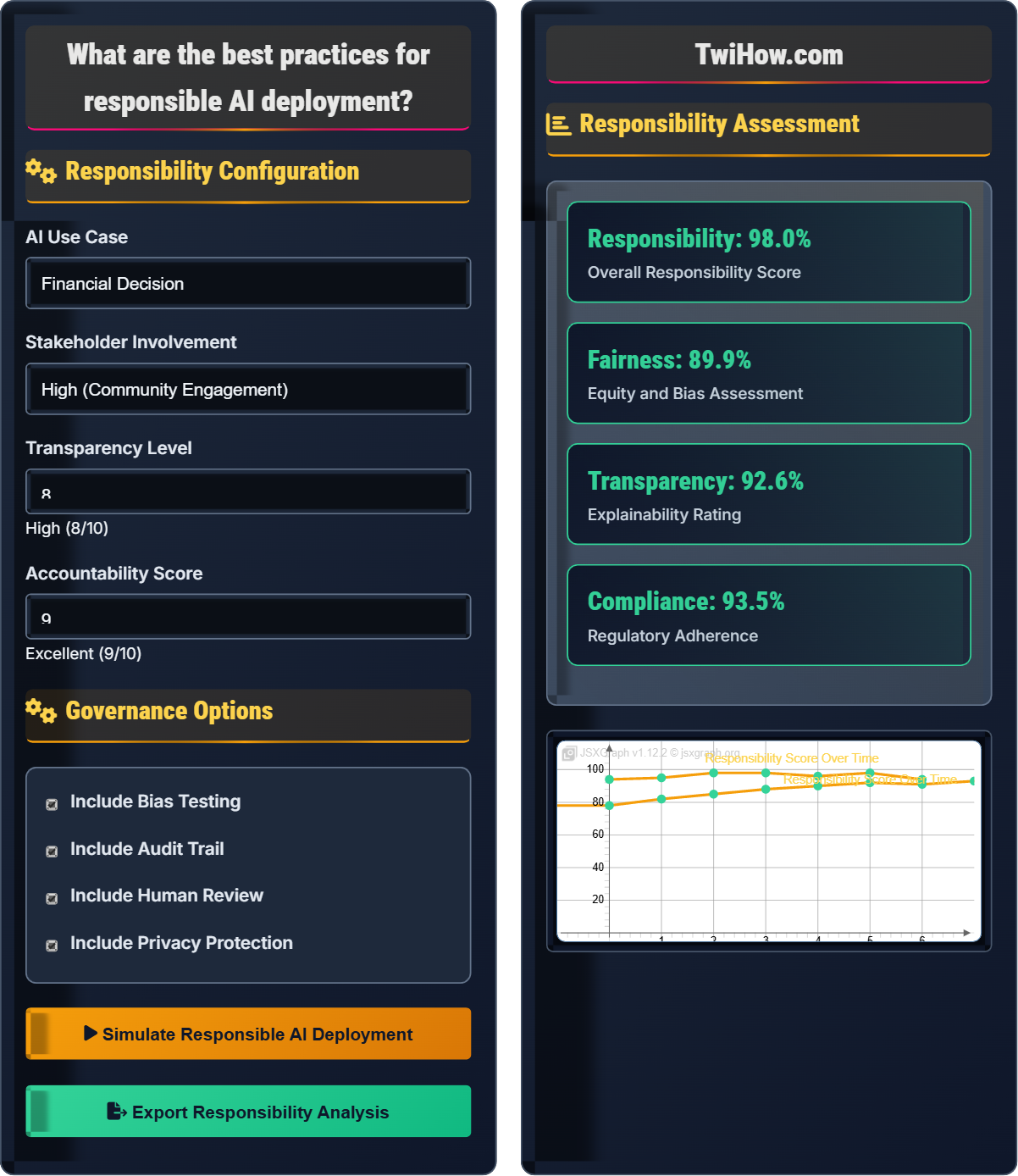
Responsibility Configuration
Governance Options
Responsibility Assessment
| Practice | Implementation | Effectiveness | Status |
|---|---|---|---|
| Bias Testing | Comprehensive | 95% | ✅ |
| Explainability | Model Interpretation | 92% | ✅ |
| Privacy Protection | End-to-end Encryption | 98% | ✅ |
| Human Oversight | Final Review Required | 88% | ✅ |
| Impact Assessment | Regular Audits | 85% | ✅ |
Best Practices for Responsible AI Deployment
Responsible AI deployment is built upon fundamental ethical principles that guide development and implementation:
- Transparency: Open communication about AI capabilities, limitations, and decision-making processes
- Accountability: Clear responsibility for AI system decisions and outcomes
- Fairness: Equitable treatment and avoidance of bias across different groups
- Privacy: Protection of personal data and information rights
- Safety: Robust systems that operate reliably and securely
- Human Agency: Preservation of human autonomy and meaningful oversight
The overall responsibility of an AI system can be assessed through:
Where:
- Transparency: Clarity of AI decision-making processes
- Fairness: Equitable treatment across diverse populations
- Safety: Reliability and secure operation of the system
- Accountability: Clear responsibility for system outcomes
- Complexity Factor: Adjustment based on system complexity and impact
Responsible AI deployment focuses on these critical areas:
- Data Governance: Ethical data collection, storage, and usage practices
- Bias Mitigation: Systematic identification and reduction of algorithmic bias
- Explainability: Clear communication of AI decision-making processes
- Security: Protection against malicious attacks and misuse
- Compliance: Adherence to relevant laws and regulations
- Human Oversight: Meaningful human involvement in critical decisions
- Ethics Board: Multidisciplinary team overseeing AI ethics
- Impact Assessments: Systematic evaluation of potential consequences
- Audit Processes: Regular review of system performance and bias
- Appeal Mechanisms: Processes for addressing concerns and errors
- Training Programs: Education for developers and users on responsible AI
- Documentation: Comprehensive records of system design and operation
Responsible AI Fundamentals
Ethics, governance, transparency, accountability, fairness, bias mitigation, privacy, explainability.
Responsibility Score = (Transparency + Fairness + Safety + Accountability + Privacy) ÷ Complexity Factor
Where Transparency = Clarity of processes, Fairness = Equitable treatment, Safety = Reliable operation, Accountability = Clear responsibility, Privacy = Data protection, Complexity Factor = System complexity adjustment.
- Embed ethics from the beginning of development
- Maintain human oversight for critical decisions
- Ensure transparency in AI decision-making
Implementation Areas
Data governance, bias mitigation, explainability, security, compliance, human oversight.
- Impact assessment and risk evaluation
- Ethics review and stakeholder engagement
- Development with responsible practices
- Testing and bias evaluation
- Deployment with monitoring
- Ongoing assessment and improvement
- Regular bias and fairness audits
- Meaningful human oversight
- Transparent communication with users
- Robust security measures
Responsible AI Quiz
Which of the following is NOT a core principle of responsible AI deployment?
Maximizing profit is not a core principle of responsible AI deployment. While profitability is important for business sustainability, responsible AI prioritizes ethical considerations such as transparency, accountability, fairness, and safety over pure profit maximization. The core principles ensure that AI systems benefit society while minimizing potential harms.
The answer is C) Maximizing Profit.
Understanding the core principles of responsible AI is fundamental to ethical deployment. These principles serve as guiding values that should inform every decision in the AI development lifecycle, from design to deployment and beyond.
Transparency: Open communication about AI systems and processes
Accountability: Clear responsibility for AI decisions and outcomes
Fairness: Equitable treatment across different groups
• Ethics should guide business decisions
• Stakeholder welfare comes before profits
• Long-term trust over short-term gains
• Balance business goals with ethical considerations
• Consider long-term societal impact
• Build ethical considerations into project planning
• Prioritizing profit over ethics
• Ignoring stakeholder impact
• Treating ethics as an afterthought
Explain the importance of bias mitigation in responsible AI deployment and describe the key strategies for identifying and addressing bias in AI systems.
Importance: Bias in AI systems can perpetuate discrimination and unfair treatment, leading to serious societal harm. Bias mitigation is crucial for ensuring fairness and equity across different demographic groups.
Identification Strategies: Statistical analysis of model outputs across different groups, fairness metrics evaluation, bias auditing tools, and diverse testing datasets.
Mitigation Techniques: Diverse and representative training data, bias detection algorithms, fairness constraints during training, and post-processing adjustments.
Ongoing Monitoring: Regular bias audits, continuous monitoring of system performance across groups, and feedback mechanisms for reporting bias issues.
Bias mitigation is not a one-time activity but requires continuous attention throughout the AI lifecycle. It involves both technical and social considerations, requiring diverse teams and stakeholder engagement to identify and address potential biases effectively.
Algorithmic Bias: Systematic discrimination by AI systems
Fairness Metrics: Quantitative measures of equitable treatment
Representation: Adequate inclusion of diverse groups in data
• Include diverse teams in development
• Test across different demographic groups
• Regular bias monitoring and auditing
• Use multiple fairness metrics
• Engage affected communities in testing
• Document bias mitigation efforts
• Assuming AI is inherently unbiased
• Not testing for intersectional bias
• Focusing only on technical solutions
A financial institution wants to deploy an AI system for loan approvals. Describe the responsible AI practices they should implement to ensure fair and ethical lending decisions, considering potential risks and mitigation strategies.
Data Governance: Ensure training data is representative and free from historical discrimination. Audit for proxy variables that might encode bias.
Bias Testing: Conduct comprehensive bias testing across demographic groups using multiple fairness metrics. Test for disparate impact.
Explainability: Implement model interpretability to provide clear reasons for loan decisions. Ensure customers understand why decisions were made.
Human Oversight: Maintain human review for borderline cases and appeals. Preserve human judgment in final decision-making.
Monitoring: Implement continuous monitoring of system performance across groups. Establish feedback mechanisms for customers to report concerns.
Compliance: Ensure adherence to fair lending laws and regulations. Regular legal review of AI practices.
Stakeholder Engagement: Involve community representatives in system design and evaluation.
This example demonstrates how responsible AI practices apply to high-stakes applications where decisions significantly impact people's lives. The financial sector is particularly sensitive to bias, making responsible practices essential for both ethical and legal compliance.
Fair Lending: Equal access to credit regardless of protected characteristics
Proxy Variables: Seemingly neutral data that correlates with protected attributes
Disparate Impact: Policies that disproportionately affect protected groups
• Comply with fair lending laws
• Maintain human oversight for critical decisions
• Regular bias and fairness audits
• Use multiple fairness metrics for evaluation
• Establish clear appeal processes
• Document all decision rationales
• Using biased historical data without correction
• Not testing for intersectional bias
• Over-automating critical decisions
Design a privacy protection framework for an AI system that processes sensitive personal data. What technical and organizational measures would you implement to ensure data protection while maintaining system effectiveness?
Technical Measures: End-to-end encryption, differential privacy techniques, federated learning, secure multi-party computation, and data minimization principles.
Organizational Measures: Data governance policies, access controls, staff training, data protection impact assessments, and incident response procedures.
Privacy by Design: Embed privacy considerations into system architecture from the beginning, including privacy-preserving algorithms and minimal data collection.
Consent Management: Clear consent processes, withdrawal mechanisms, and regular consent renewal for ongoing processing.
Transparency: Clear communication about data usage, individual rights, and data protection measures.
Compliance: Regular audits for GDPR, CCPA, and other applicable privacy regulations.
Privacy protection in AI requires both technical solutions and organizational policies. The key is implementing privacy measures that don't compromise the effectiveness of AI systems while ensuring robust protection of personal data.
Differential Privacy: Mathematical framework for privacy preservation
Federated Learning: Training models without centralized data
Data Minimization: Collecting only necessary data
• Implement privacy by design principles
• Use technical measures alongside policies
• Regular privacy impact assessments
• Use synthetic data for testing
• Implement data retention policies
• Regular privacy training for staff
• Collecting more data than necessary
• Not implementing technical privacy measures
• Weak access controls and monitoring
What is the primary purpose of human oversight in AI systems?
The primary purpose of human oversight in AI systems is to ensure ethical decision-making and accountability. Human oversight provides critical judgment for complex situations, ensures ethical considerations are applied, and maintains accountability for system decisions. It serves as a check on AI systems, especially for high-stakes decisions that significantly impact individuals.
The answer is B) To ensure ethical decision-making and accountability.
Human oversight is essential for maintaining ethical standards and accountability in AI systems. While AI can process information quickly and identify patterns, humans provide moral reasoning, contextual understanding, and ultimate responsibility for decisions that affect people's lives.
Human Oversight: Meaningful human involvement in AI decision-making
Accountability: Responsibility for system outcomes and decisions
Ethical Decision-Making: Moral reasoning in complex situations
• Maintain human judgment for critical decisions
• Ensure accountability for AI outcomes
• Preserve human agency in decision-making
• Define clear boundaries for human intervention
• Train humans to work effectively with AI
• Establish escalation procedures
• Over-automating critical decisions
• Not providing adequate human training
• Unclear accountability for AI decisions
FAQ
Q: How can we measure the effectiveness of responsible AI practices?
A: Measuring responsible AI effectiveness requires multiple approaches:
1. Fairness Metrics: Statistical parity, equal opportunity, and demographic parity across different groups
2. Transparency Indicators: Model explainability scores, documentation completeness, and user understanding measures
3. Impact Assessments: Regular audits of system outcomes on different populations
4. Stakeholder Feedback: Surveys and interviews with affected communities
5. Compliance Tracking: Adherence to ethical guidelines and regulatory requirements
6. Incident Reporting: Tracking and resolution of bias or ethical concerns
The key is using multiple metrics and continuous monitoring rather than single-point assessments.
Q: What's the difference between AI ethics and AI compliance?
A: These concepts work together but serve different functions:
AI Ethics: Moral principles and values that guide responsible AI development. Includes concepts like fairness, transparency, and accountability. Often aspirational and internally driven.
AI Compliance: Legal requirements and regulatory standards that must be followed. Includes laws like GDPR, CCPA, and industry-specific regulations. Enforceable through penalties.
Think of ethics as the "why" behind responsible AI and compliance as the "what" you must do. Effective governance requires both: ethical foundations inform compliance programs, while regulations ensure minimum ethical standards are met.