What Are the Privacy Risks of Using AI Assistants?
Complete privacy guide • Step-by-step explanations
AI Assistant Privacy:
Show Privacy Risk AnalyzerAI assistants collect vast amounts of personal data, creating significant privacy risks. These devices listen continuously, record conversations, and store sensitive information about your daily habits, preferences, and personal life. Understanding these risks is crucial for making informed decisions about AI assistant usage and implementing appropriate protective measures.
Key privacy concerns include unauthorized data collection, third-party sharing, voiceprint identification, and persistent surveillance. However, many risks can be mitigated through proper configuration, privacy settings, and awareness of data practices.
Primary privacy risks:
- Continuous Monitoring: Always-listening devices capturing private conversations
- Data Aggregation: Linking personal information across services
- Third-Party Sharing: Data shared with advertisers and partners
- Identity Profiling: Voice recognition and behavioral tracking
Users should carefully evaluate privacy settings, data retention policies, and alternative options before adopting AI assistant technology.
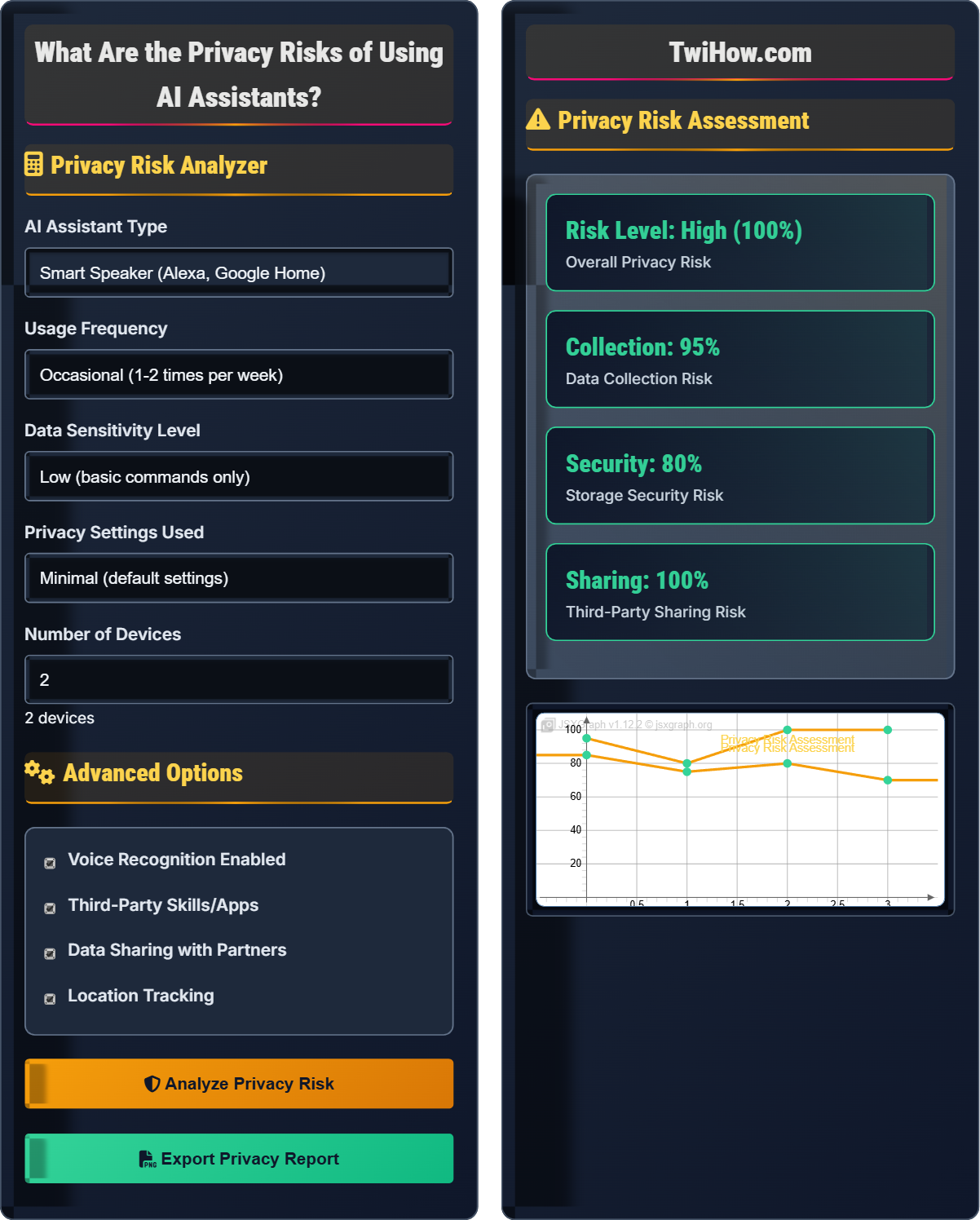
Privacy Risk Analyzer
Advanced Options
Privacy Risk Assessment
| Risk Category | Level | Impact | Probability |
|---|---|---|---|
| Voice Data Collection | High | Personal conversations recorded | Very Likely |
| Data Aggregation | High | Behavioral profiling | Likely |
| Third-Party Sharing | Medium | Data sold to advertisers | Possible |
| Location Tracking | Medium | Physical movement monitoring | Likely |
| Voice Recognition | High | Biometric identity tracking | Very Likely |
Immediate Actions:
• Review and adjust privacy settings regularly
• Disable voice recognition if not needed
• Limit third-party skill access
• Use microphone muting when not needed
• Delete voice recordings periodically
User → AI Assistant → Data Collection → Third Parties
AI Assistant Privacy Risk Framework
AI assistants pose significant privacy risks due to their continuous monitoring capabilities, data collection practices, and potential for misuse. These devices are designed to listen for wake words and process voice commands, but they may inadvertently capture private conversations, store sensitive information, and share data with third parties. Understanding these risks is essential for making informed decisions about AI assistant usage.
Privacy risk can be assessed using this formula:
Where:
- Exposure: Degree of data collection and monitoring
- Sensitivity: Personal nature of collected data
- Vulnerability: Security measures and data protection
- Consequence: Potential harm from data misuse
Major privacy risk categories for AI assistants:
- Voice Data Collection: Recording of conversations and commands
- Behavioral Tracking: Monitoring usage patterns and preferences
- Location Monitoring: Tracking physical location and movements
- Biometric Identification: Voice recognition and identity profiling
- Data Aggregation: Linking information across services
- Third-Party Sharing: Data shared with partners and advertisers
- Privacy Settings: Configure maximum privacy options
- Microphone Control: Use physical muting when not needed
- Data Deletion: Regularly delete voice recordings
- Third-Party Limits: Restrict skill and app access
- Network Security: Secure home WiFi networks
- Alternative Options: Consider privacy-focused alternatives
Privacy Risk Fundamentals
Data collection, voice recording, behavioral tracking, biometric identification, third-party sharing.
Privacy Risk = Exposure × Sensitivity × Vulnerability × Consequence
Where each factor contributes to the overall privacy risk assessment.
- Always assume data is being collected
- Review privacy settings regularly
- Understand data retention policies
Mitigation Strategies
Privacy settings, microphone control, data deletion, network security, alternative options.
- Configure privacy settings to maximum
- Use physical microphone muting
- Delete voice recordings regularly
- Secure network connections
- Limit third-party integrations
- Functionality vs privacy trade-offs
- Regular monitoring and updates
- Company privacy policy changes
- Legal and regulatory compliance
AI Privacy Learning Quiz
Which type of data collected by AI assistants poses the highest privacy risk?
Voice recordings and conversations pose the highest privacy risk because they contain intimate personal information, private discussions, and sensitive details about your life, relationships, and activities. Unlike other data types, voice recordings can reveal emotional states, personal secrets, and confidential information that users may not intend to share. Voice data also includes biometric identifiers that can be used for identity tracking.
The answer is A) Voice recordings and conversations.
Voice data is particularly sensitive because it captures not just what people say but also how they say it, revealing emotional states, health conditions, and personal relationships. This type of data is more revealing than other behavioral data because it can include private conversations that were never intended to be recorded or shared.
Biometric Identifier: Unique physical characteristics used for identification
Intimate Information: Personal details about private life
Voiceprint: Unique vocal characteristics for identification
• Voice data reveals more than other data types
• Conversations may include unintended disclosures
• Biometric data has unique privacy implications
• Regularly delete voice recordings
• Use microphone muting when discussing private matters
• Review who has access to your voice data
• Underestimating the sensitivity of voice data
• Not realizing conversations are being recorded
• Forgetting to delete old recordings
Explain the privacy risks associated with AI assistants sharing data with third parties, including advertising networks and partner companies. What are the potential consequences?
Risks of Third-Party Sharing: 1) Advertising networks receive detailed behavioral profiles for targeted advertising, 2) Partner companies may use data for purposes beyond original consent, 3) Data may be sold to data brokers, 4) Information could be shared with government agencies.
Potential Consequences: 1) Intrusive targeted advertising based on private conversations, 2) Price discrimination based on personal financial information, 3) Identity theft if biometric data is compromised, 4) Stalking or harassment if location data is misused, 5) Employment or insurance discrimination based on health-related discussions.
Mitigation: Review privacy policies, disable third-party sharing, use ad blockers, and choose assistants with stronger privacy commitments.
The risk amplifies when data moves beyond the original company's control. Third parties may have different privacy standards, weaker security measures, or conflicting interests. Once shared, data becomes difficult to control and may be combined with other datasets to create detailed profiles of individuals.
Data Broker: Company that collects and sells personal information
Price Discrimination: Charging different prices based on personal data
Behavioral Profiling: Creating detailed user behavior models
• Third-party sharing extends your privacy risk
• Different companies have different privacy standards
• Data sharing agreements may change over time
• Read data sharing sections carefully
• Opt out of targeted advertising
• Choose services with limited sharing policies
• Not reading privacy policies thoroughly
• Assuming data won't be shared
• Not reviewing sharing settings regularly
A family installs smart speakers throughout their home for convenience. Over time, they realize their insurance premiums have increased and they're receiving targeted ads for medical conditions they've discussed privately. The family also notices their mortgage application was denied despite good credit. Analyze the potential privacy risks that could explain these events and suggest protective measures.
Identified Risks: 1) Smart speakers captured private health discussions and shared with data brokers, 2) Voice recordings revealed financial stress or health concerns, 3) Behavioral patterns indicated lifestyle changes, 4) Location data showed frequent doctor visits.
How Data Could Be Used: Insurance companies may have purchased health-related behavioral data to adjust premiums. Lenders could have accessed this information during credit applications. Advertisers used the data for targeted marketing.
Protective Measures: 1) Delete all voice recordings from accounts, 2) Disable voice recognition features, 3) Review and restrict data sharing permissions, 4) Use microphone muting during private conversations, 5) Consider alternative, privacy-focused devices.
This scenario demonstrates how seemingly innocent conversations can have significant real-world consequences when collected and analyzed. AI assistants can capture sensitive information that users assume is private, and this data can be used in ways that affect financial decisions and personal opportunities.
Data Broker: Entity that buys and sells personal information
Price Discrimination: Charging different prices based on personal dataBehavioral Profiling: Creating detailed user behavior models
• Assume all conversations may be recorded
• Privacy violations can have financial consequences
• Data sharing can affect multiple life areas
• Discuss sensitive topics away from devices
• Regularly audit and delete data
• Monitor financial accounts for unusual activity
• Not realizing the extent of data collection
• Assuming private conversations remain private
• Not connecting privacy violations to financial impacts
You're helping a privacy-conscious friend set up a new smart speaker. Create a comprehensive privacy configuration plan that minimizes data collection while maintaining basic functionality. What settings would you recommend and why?
Recommended Configuration: 1) Disable voice recognition for identity tracking, 2) Set data retention to minimum (auto-delete after shortest period), 3) Turn off personalized advertising, 4) Disable third-party skill access, 5) Use local processing when available, 6) Enable microphone muting when not in use.
Additional Measures: 1) Create a separate email account for device registration, 2) Use VPN for additional network privacy, 3) Regularly review and delete voice recordings, 4) Monitor account activity logs, 5) Physically cover microphones when not needed.
Functionality Trade-offs: Some personalization features will be lost, but core functionality (setting timers, weather, music) remains available with minimal privacy risk.
Privacy configuration requires balancing convenience with security. By disabling the most invasive features while keeping basic functionality, users can enjoy AI assistant benefits while significantly reducing privacy risks. Regular monitoring ensures settings remain effective over time.
Local Processing: Computing performed on device rather than cloud
Data Retention: How long data is stored before deletion
Personalization: Features that use personal data for customization
• Default settings favor data collection
• Privacy settings require regular review
• Basic functionality doesn't require extensive data
• Set up devices with privacy-first mindset
• Use separate accounts for device registration
• Regularly audit device permissions
• Accepting default privacy settings
• Not reviewing settings after updates
• Assuming privacy settings are permanent
Which of the following provides the strongest legal protection for privacy data collected by AI assistants?
Consumer privacy laws like GDPR (General Data Protection Regulation) and CCPA (California Consumer Privacy Act) provide the strongest legal protection. These laws establish binding requirements for data collection, processing, and sharing, with significant penalties for violations. Unlike terms of service or privacy policies, which can be changed unilaterally by companies, privacy laws create enforceable rights for consumers and impose mandatory compliance obligations.
The answer is B) Consumer privacy laws (GDPR, CCPA).
Legal frameworks provide the most robust protection because they create enforceable rights and obligations. While company policies can be changed at will, privacy laws require compliance and provide legal remedies for violations. However, enforcement and awareness remain challenges in practice.
GDPR: European Union data protection regulation
CCPA: California Consumer Privacy Act
Enforceable Rights: Legally protected consumer protections
• Legal protections vary by jurisdiction
• Privacy laws establish minimum standards
• Enforcement mechanisms are critical for effectiveness
• Know your regional privacy rights
• Exercise data access and deletion rights
• Report privacy violations to authorities
• Assuming company policies provide legal protection
• Not knowing regional privacy rights
• Not exercising available legal rights
FAQ
Q: Can AI assistants record private conversations even when not activated?
A: Yes, AI assistants can potentially record private conversations even when not activated:
Always-Listening: Devices continuously listen for wake words, capturing audio before activation
False Positives: Accidental activations can occur, recording unintended conversations
Buffer Storage: Short audio clips are often stored temporarily for wake word detection
Malware Vulnerabilities: Compromised devices may continuously record without user knowledge
Manufacturers claim only post-activation audio is stored, but investigations have revealed pre-activation recordings in some cases. The risk exists that private conversations may be captured and potentially accessed by unauthorized parties.
Q: How can businesses protect sensitive information when using AI assistants?
A: Businesses should implement these protective measures:
Segregated Networks: Keep AI assistants off corporate networks with sensitive data
Policy Restrictions: Prohibit use in meetings discussing confidential information
Physical Controls: Use microphone covers and disable voice features when needed
Vendor Assessment: Evaluate AI assistant providers' security practices
Data Classification: Identify and protect sensitive business information
Employee Training: Educate staff on privacy risks and best practices
Consider using enterprise-grade voice assistants with enhanced security features and compliance certifications.