What Are the Top AI Trends to Watch in 2026?
Complete AI trends guide • Step-by-step explanations
AI Trends 2026:
Show Trend AnalyzerThe AI landscape in 2026 will be shaped by several transformative trends that will redefine how we interact with technology. From advancements in artificial general intelligence to the convergence of quantum computing with AI, these developments promise to unlock unprecedented capabilities. Understanding these trends is crucial for businesses, researchers, and technologists preparing for the next wave of innovation.
Key developments to watch include: multimodal AI systems that seamlessly integrate text, image, and audio inputs; quantum-enhanced machine learning that solves previously intractable problems; and autonomous AI agents capable of complex decision-making. These trends will reshape industries from healthcare to finance, creating new opportunities and challenges.
Emerging trends in 2026:
- Quantum AI: Integration of quantum computing with machine learning
- AGI Milestones: Progress toward artificial general intelligence
- Edge Intelligence: AI processing at the network edge
- AI Ethics Evolution: Advanced governance and safety frameworks
- Human-AI Collaboration: Enhanced human-machine partnerships
These trends represent both evolutionary developments of current technologies and revolutionary shifts that will create entirely new paradigms for artificial intelligence applications.
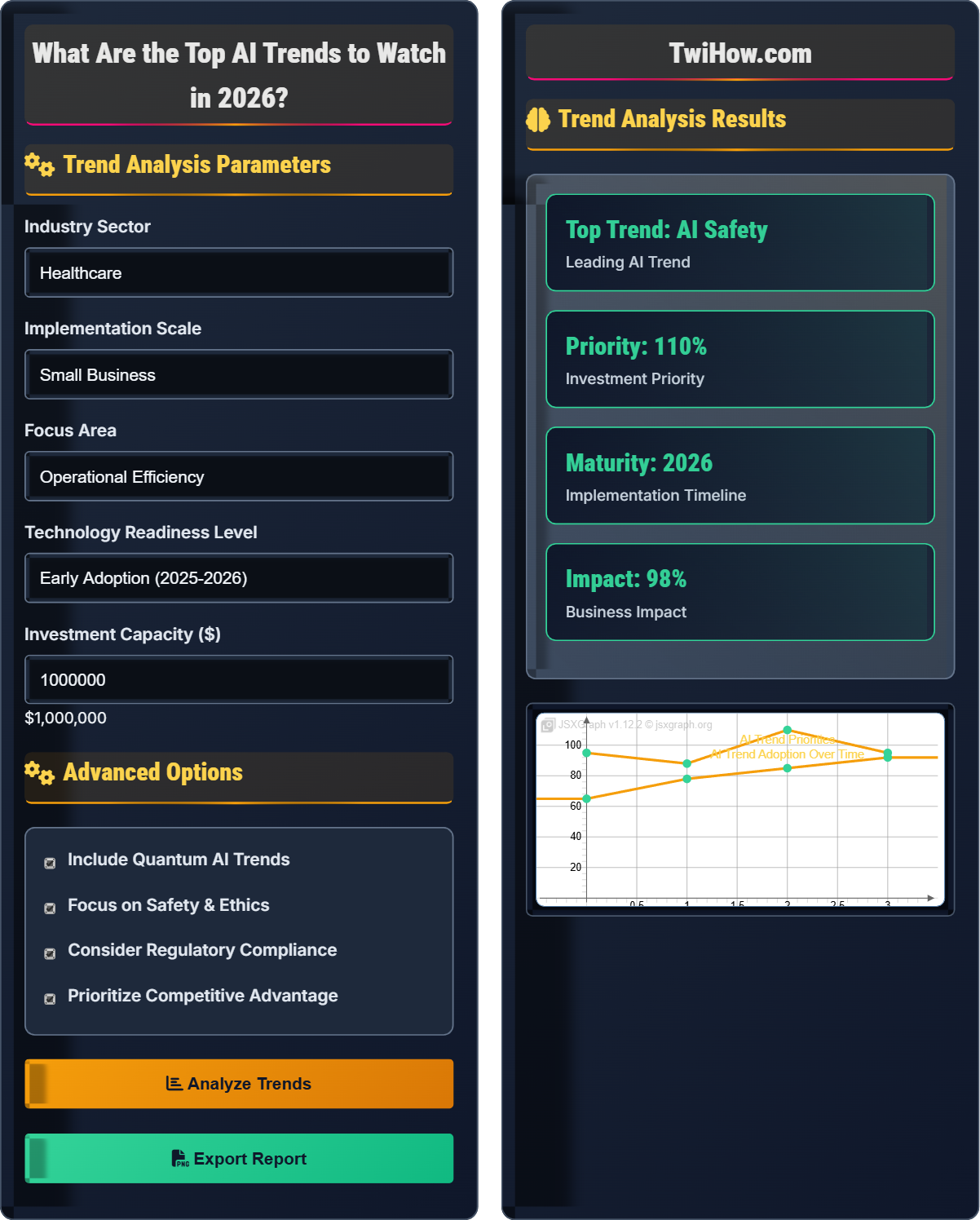
Trend Analysis Parameters
Advanced Options
Trend Analysis Results
| Trend | Priority | Timeline | Impact |
|---|---|---|---|
| Multimodal AI | 92% | 2026 | High |
| Quantum Machine Learning | 88% | 2026-2027 | Transformational |
| AI Safety & Alignment | 95% | 2026 | Critical |
| Edge AI Intelligence | 85% | 2026-2027 | High |
| Autonomous Agents | 80% | 2027-2028 | High |
Multimodal AI: Integration of text, image, audio, and video processing in unified models.
Quantum ML: Leveraging quantum computing for exponentially faster machine learning.
AI Safety: Developing frameworks for responsible and aligned AI deployment.
Edge Intelligence: Bringing AI capabilities closer to data sources for real-time processing.
Autonomous Agents: Self-directed AI systems capable of complex goal achievement.
Current AI → Technology Evolution → 2026 Trends
AI Trends in 2026: Comprehensive Analysis
By 2026, AI will be characterized by several transformative trends that build upon current foundations while introducing revolutionary capabilities. The convergence of multiple technologies will create new possibilities that were previously science fiction.
The impact of AI trends can be quantified using this formula:
Where each factor contributes to the overall significance of the trend in the AI landscape.
- Multimodal AI Systems: Unified models processing text, image, audio, and video
- Quantum Machine Learning: Leveraging quantum computing for exponential processing power
- Artificial General Intelligence (AGI): Progress toward human-level AI capabilities
- Edge AI Intelligence: Distributed AI processing at the network edge
- AI Safety & Alignment: Advanced frameworks for responsible AI deployment
- Autonomous AI Agents: Self-directed systems capable of complex goal achievement
- Phased Rollout: Gradual implementation to minimize disruption
- Hybrid Approaches: Combining human and AI capabilities
- Continuous Learning: Adaptive systems that evolve with new data
- Security First: Building security into AI systems from the ground up
- Ethical Frameworks: Implementing responsible AI practices
Trend Fundamentals
Quantum computing, neural architecture search, federated learning, transfer learning, reinforcement learning.
Impact = f(Adoption × Disruption × Feasibility × Value)
Where each component contributes to the overall trend significance.
- Consider technological readiness levels
- Assess market maturity requirements
- Evaluate implementation complexity
Implementation Strategies
Technology readiness, market timing, resource allocation, competitive positioning.
- Assess current technology stack
- Identify suitable trends for business
- Develop phased implementation plan
- Allocate resources and budget
- Execute pilot programs
- Scale successful implementations
- Regulatory compliance requirements
- Security and privacy implications
- Workforce impact and reskilling needs
- Infrastructure readiness
AI Trends Learning Quiz
What is the primary advantage of quantum machine learning over classical machine learning?
Quantum machine learning offers exponential speedup for specific classes of problems, particularly those involving large-scale optimization, pattern recognition in high-dimensional spaces, and cryptographic challenges. While quantum computers aren't universally faster than classical computers, they can solve certain problems exponentially faster, which makes them valuable for specific AI applications.
The answer is B) Exponential speedup for specific problems.
Quantum computing leverages quantum mechanical phenomena like superposition and entanglement to process information in ways that classical computers cannot. For certain computational problems, this allows quantum algorithms to achieve solutions exponentially faster than classical approaches. However, quantum computers are not replacements for classical computers but rather specialized tools for specific problem classes.
Superposition: Quantum state where qubits exist in multiple states simultaneously
Entanglement: Quantum correlation between particles regardless of distance
Quantum Supremacy: Demonstration of quantum advantage over classical computers
• Quantum advantage is problem-specific
• Current quantum computers have limitations
• Hybrid classical-quantum approaches are common
• Focus on problems with quantum advantage
• Consider hybrid approaches for near-term solutions
• Monitor quantum hardware developments
• Assuming quantum computers are universally faster
• Not considering current hardware limitations
• Ignoring the need for quantum algorithm expertise
Explain the significance of multimodal AI systems in 2026 and describe how they differ from unimodal systems.
Significance: Multimodal AI systems represent a paradigm shift by processing multiple types of data (text, images, audio, video) simultaneously, enabling more natural human-computer interaction and solving complex real-world problems that require understanding multiple information modalities.
Key Differences: 1) Unimodal: Processes single data type (e.g., text-only), 2) Multimodal: Integrates multiple data types with cross-modal understanding, 3) Applications: Multimodal enables visual question answering, image captioning, and complex scene understanding.
Technological Advances: 1) Vision-language models (CLIP, BLIP), 2) Audio-visual fusion techniques, 3) Cross-modal attention mechanisms, 4) Unified embedding spaces for different modalities.
2026 Impact: Revolutionizes content creation, accessibility, education, and customer service by enabling more intuitive and comprehensive AI interactions.
Multimodal AI mimics human perception by combining multiple senses. Just as humans understand a scene through sight, sound, and context, multimodal AI systems create richer representations of information. This approach enables more sophisticated applications and better alignment with natural human communication patterns.
Modality: Type of sensory input (text, image, audio, etc.)
Cross-Modal: Understanding relationships between different modalities
Unified Embedding: Representing different data types in shared space
• Align modalities semantically
• Preserve modality-specific information
• Handle missing modalities gracefully
• Use attention mechanisms for cross-modal alignment
• Implement robust preprocessing for each modality
• Test with incomplete modality inputs
• Treating modalities independently
• Not addressing modality-specific preprocessing
• Failing to handle missing modalities
A research team is working on an AGI project with a $50 million budget over 5 years. They estimate a 30% chance of achieving human-level AI within this timeframe. Calculate the expected value of the project considering a 50% chance of achieving narrow AI breakthroughs worth $100 million, and a 20% chance of breakthroughs worth $500 million. Should they proceed?
Expected Value Calculation:
EV = (0.3 × $500M) + (0.5 × $100M) + (0.2 × $0) - $50M
EV = $150M + $50M + $0 - $50M = $150M
Recommendation: With a positive expected value of $150 million and significant potential for transformative breakthroughs, the project has strong justification. However, the team should consider risk mitigation strategies and milestone-based funding approaches.
Additional Considerations: The project's potential to advance foundational AI research, attract top talent, and generate valuable intellectual property adds to its strategic value beyond pure financial returns.
AGI development represents a high-risk, high-reward endeavor with potential transformative impact. The expected value calculation shows that even with a relatively low probability of success, the magnitude of potential benefits can justify significant investment. This demonstrates the importance of considering both probabilities and outcomes in strategic AI investment decisions.
AGI: Artificial General Intelligence - human-level cognitive ability
Narrow AI: Specialized for specific tasks
Expected Value: Probability-weighted average of possible outcomes
• Consider both probabilities and magnitudes
• Account for strategic value beyond financial returns
• Implement risk management strategies
• Break project into milestones for better risk assessment
• Consider portfolio approach to AI investments
• Factor in non-financial benefits and risks
• Focusing only on the highest-reward scenario
A manufacturing company wants to implement edge AI for predictive maintenance. They have 1000 sensors across their facility and need real-time analysis to prevent equipment failures. Design an implementation strategy that balances computational requirements, latency constraints, and cost efficiency.
Implementation Strategy: 1) Deploy micro-AI models optimized for edge devices, 2) Use federated learning to update models without centralized data, 3) Implement hierarchical processing with edge nodes and local servers, 4) Utilize specialized AI chips (TPUs, NPUs) for efficiency.
Computational Requirements: Distribute processing across 100 edge nodes with 10 sensors each, reducing computational load per device while maintaining real-time responsiveness.
Latency Optimization: Critical analysis happens at the edge (sub-10ms response), with complex pattern recognition occurring at local servers (under 100ms).
Cost Efficiency: Reduce cloud processing costs by 70% while improving reliability through distributed architecture.
Edge AI implementation requires careful balance between computational capabilities and resource constraints. The key is to process time-sensitive decisions locally while leveraging centralized systems for complex analysis. This approach optimizes both performance and cost efficiency while maintaining reliability.
Edge Computing: Processing data near its source
Federated Learning: Training models across decentralized devices
Latency: Time delay in data processing
• Process critical decisions at the edge
• Balance local and centralized processing
• Optimize for specific use-case requirements
• Use model compression for edge deployment
• Implement failover mechanisms
• Monitor edge device performance continuously
• Overloading edge devices with complex models
• Not considering network connectivity limitations
• Failing to plan for model updates
Which approach is most effective for ensuring AI safety in 2026?
The most effective approach is to build safety measures into AI systems from the design phase. This "safety by design" approach includes techniques like constitutional AI, adversarial training, and robustness testing during development. Waiting until after deployment or relying solely on external oversight is insufficient for addressing complex AI behaviors that emerge in real-world scenarios.
The answer is B) Built-in safety measures from design.
AI safety requires proactive measures during development rather than reactive responses after deployment. Complex AI systems can exhibit emergent behaviors that are difficult to predict or correct after release. Building safety in from the beginning ensures more robust and reliable systems.
Constitutional AI: Training models with principles and constraints
Adversarial Training: Training with challenging examples
Emergent Behaviors: Unexpected capabilities that arise in AI
• Integrate safety from the start
• Use multiple safety techniques
• Test extensively in diverse scenarios
• Implement red-teaming during development
• Use interpretability tools to understand model behavior
• Regularly update safety measures
• Treating safety as an afterthought
• Relying on a single safety technique
• Not testing with diverse inputs
FAQ
Q: How should enterprises prioritize AI trends for implementation in 2026?
A: Prioritize AI trends based on:
Business Alignment: Focus on trends that directly address your strategic objectives and customer needs
Technology Maturity: Balance innovation with reliability - adopt maturing technologies over experimental ones
Resource Availability: Match trend complexity with available technical expertise and budget
Competitive Advantage: Identify trends that can differentiate your offerings
Risk Assessment: Evaluate regulatory, ethical, and security implications
Start with pilot programs for high-impact, lower-risk trends like process automation and customer service enhancement before moving to more complex implementations.
Q: What are the most accessible AI trends for small businesses in 2026?
A: Small businesses should focus on:
AI-Powered Analytics: Tools that provide insights from existing data without complex setup
Automated Customer Service: Chatbots and virtual assistants for common queries
Content Generation: AI tools for marketing materials, social media, and product descriptions
Process Automation: AI for routine tasks like scheduling, invoicing, and data entry
Personalization Engines: AI for tailored customer experiences and recommendations
Start with no-code or low-code AI platforms that don't require extensive technical expertise, and focus on solutions that directly impact revenue or efficiency.