What is AGI and When Will We Achieve It?
Complete AGI guide • Step-by-step explanations
AGI Explained:
Show AGI Timeline CalculatorArtificial General Intelligence (AGI) represents the next frontier in AI development - machines that can understand, learn, and apply knowledge across a wide range of tasks at human level or beyond. Unlike current AI systems that excel in specific domains, AGI would demonstrate general cognitive abilities comparable to human intelligence.
AGI development involves creating systems capable of reasoning, planning, problem-solving, and learning across diverse domains. The timeline for achieving AGI remains highly debated among researchers, with predictions ranging from decades to centuries.
Key considerations for AGI development include:
- Cognitive Architecture: Creating flexible, general-purpose learning systems
- Resource Requirements: Computational power and energy needs
- Safety Protocols: Ensuring beneficial outcomes for humanity
- Ethical Frameworks: Governance and control mechanisms
- Technological Hurdles: Fundamental breakthroughs needed
Understanding AGI requires examining current AI capabilities, research directions, and expert predictions about future developments.
AGI Development Parameters
Scenario Factors
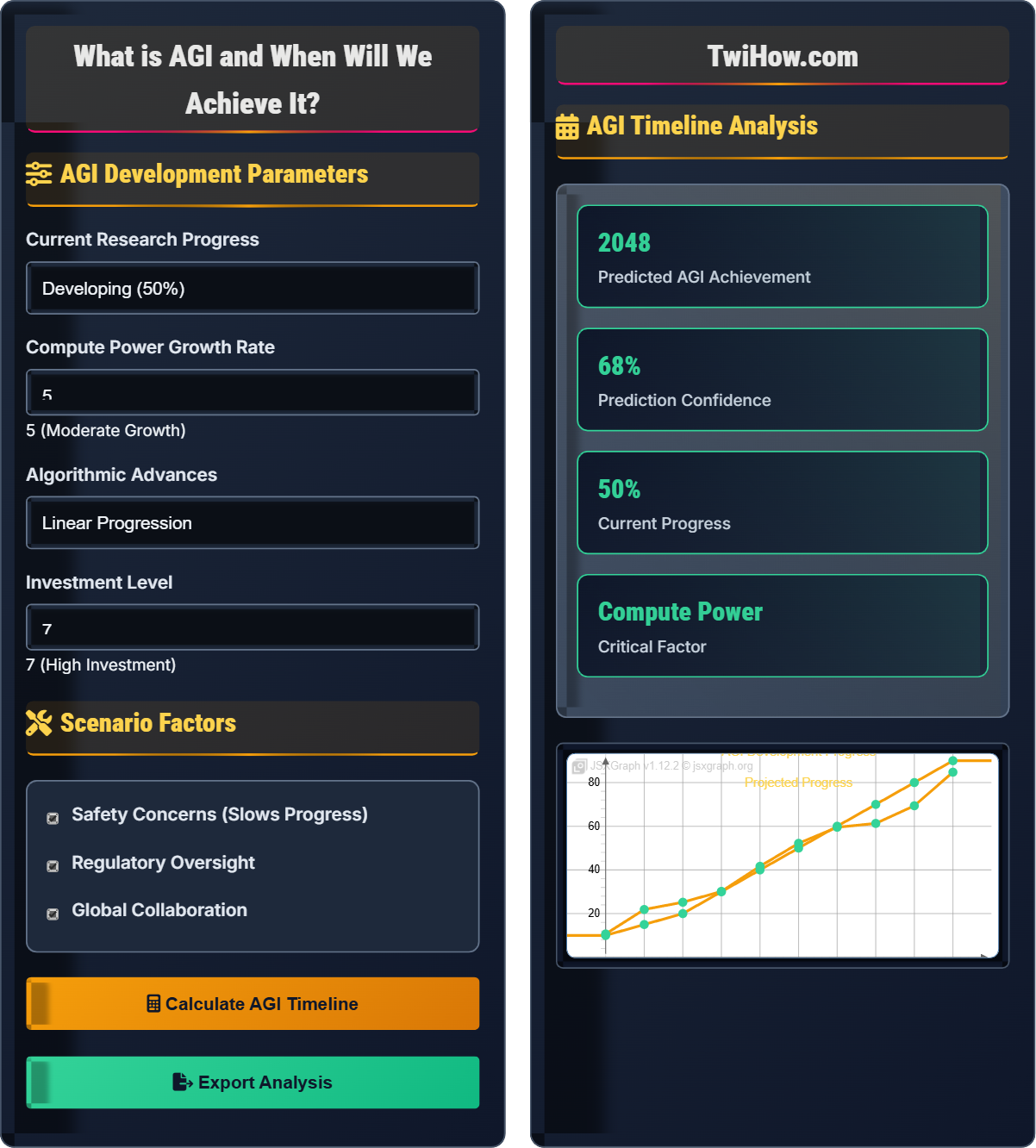
AGI Timeline Analysis
| Researcher | Prediction | Reasoning | Confidence |
|---|---|---|---|
| Ray Kurzweil | 2029 | Exponential tech growth | 90% |
| Stuart Russell | 2050 | Safety considerations | 60% |
| Geoffrey Hinton | 2040 | Deep learning advances | 70% |
| Yann LeCun | 2050+ | Fundamental challenges | 50% |
| Elon Musk | 2029 | Accelerated development | 80% |
AGI Fundamentals Explained
Artificial General Intelligence (AGI) refers to a machine's ability to understand, learn, and apply knowledge across a wide range of tasks at a level comparable to human intelligence. Unlike current AI systems that excel in specific domains (narrow AI), AGI would demonstrate general cognitive abilities including reasoning, problem-solving, planning, and learning across diverse domains.
The timeline for AGI achievement can be conceptualized as:
Where higher research progress and resource allocation accelerate development, while remaining technical challenges extend the timeline.
Key differences between current AI systems and AGI:
- Specialization vs. Generalization: Current AI excels in narrow domains; AGI would be broadly capable
- Data Dependency: Current AI requires large datasets; AGI could learn efficiently from few examples
- Transfer Learning: Current AI struggles to transfer knowledge; AGI would excel at it
- Common Sense: Current AI lacks; AGI would possess intuitive understanding
- Adaptability: Current AI is rigid; AGI would be highly adaptable
- Causal Reasoning: Current AI has limited capability; AGI would demonstrate robust reasoning
- Deep Learning Evolution: Scaling current neural networks with architectural improvements
- Neurosymbolic AI: Combining neural networks with symbolic reasoning
- Neuromorphic Computing: Hardware that mimics brain architecture
- Evolutionary Approaches: Using evolutionary algorithms to develop intelligence
- Hybrid Architectures: Integrating multiple AI paradigms
- Consciousness-Inspired Models: Architectures based on theories of consciousness
AGI Milestones Timeline
AGI Comparison Framework
Expert Predictions
AGI Knowledge Quiz
What is the key distinguishing characteristic of Artificial General Intelligence compared to current AI systems?
The key characteristic of AGI is its ability to demonstrate general cognitive abilities across diverse domains, similar to human intelligence. Unlike current AI systems that excel in specific tasks (narrow AI), AGI would be capable of learning, reasoning, and applying knowledge across a wide range of intellectual tasks.
The answer is C) General cognitive abilities across diverse domains.
Understanding the distinction between narrow AI and AGI is fundamental to the field. Current AI systems are highly specialized - for example, a chess-playing AI cannot play Go, and a language model cannot drive a car. AGI would transcend these limitations by possessing general intelligence that can adapt to new tasks and domains.
AGI (Artificial General Intelligence): AI with general cognitive abilities comparable to human intelligence
Narrow AI: AI specialized for specific tasks or domains
General Intelligence: Ability to reason, learn, and apply knowledge across diverse contexts
• AGI ≠ advanced narrow AI
• Generalization is the key differentiator
• Human-level performance across domains is the benchmark
• Think of AGI as a generalist, not a specialist
• Consider transfer learning capabilities
• Remember the adaptability requirement
• Confusing AGI with very advanced narrow AI
• Thinking current AI is close to AGI
• Underestimating the generalization challenge
Explain the main technical challenges that must be overcome to achieve AGI. Why is each challenge significant?
Main Technical Challenges:
1. Common Sense Reasoning: Humans possess intuitive understanding of everyday situations, causality, and physics. AGI systems lack this foundational knowledge that enables humans to make reasonable assumptions about the world.
2. Transfer Learning: Current AI systems struggle to apply knowledge from one domain to another. AGI must be able to transfer learning across different contexts and tasks efficiently.
3. Causal Reasoning: Understanding cause-and-effect relationships is crucial for prediction, planning, and intervention. Most current AI systems only capture correlations, not causation.
4. Generalization: AGI must perform well on tasks it hasn't specifically been trained for, requiring robust generalization capabilities beyond current AI systems.
5. Consciousness and Self-Awareness: While debated, some argue that true AGI may require aspects of consciousness for genuine understanding and decision-making.
These challenges represent fundamental gaps between current AI capabilities and human intelligence. Each challenge addresses a different aspect of cognition that humans take for granted but is incredibly difficult to replicate in machines. Solving these challenges requires breakthroughs in multiple areas of AI research.
Common Sense Reasoning: Intuitive understanding of everyday situations and relationships
Transfer Learning: Applying knowledge from one domain to another
Causal Reasoning: Understanding cause-and-effect relationships
• Technical challenges are interdependent
• Solutions may require paradigm shifts
• Incremental progress is possible
• Study human cognitive development for insights
• Consider interdisciplinary approaches
• Focus on foundational capabilities
• Underestimating the complexity of common sense
• Assuming scaling alone will achieve AGI
• Ignoring the integration challenge
Five leading AI researchers predict the following AGI achievement dates: Ray Kurzweil (2029), Stuart Russell (2050), Geoffrey Hinton (2040), Yann LeCun (2055), and Demis Hassabis (2045). Calculate the mean, median, and range of these predictions. Based on this data, what can you infer about expert consensus?
Calculations:
• Sorted predictions: 2029, 2040, 2045, 2050, 2055
• Mean: (2029 + 2040 + 2045 + 2050 + 2055) ÷ 5 = 10219 ÷ 5 = 2043.8
• Median: Middle value = 2045
• Range: 2055 - 2029 = 26 years
Inference: Experts predict AGI will be achieved between 2029 and 2055, with a consensus around 2040-2045. The 26-year range indicates significant disagreement about the timeline, likely reflecting different assumptions about research progress, technical challenges, and resource availability.
This exercise demonstrates the uncertainty in AGI predictions. Even among leading experts, there's a 26-year range in predictions, highlighting how difficult it is to forecast technological breakthroughs. The wide range suggests that AGI development involves unpredictable factors and that different experts weight various challenges differently.
Mean: Average of all values
Median: Middle value when sortedRange: Difference between highest and lowest values
• Expert opinions vary significantly
• Uncertainty is inherent in forecasting
• Multiple factors influence predictions
• Consider the reasoning behind predictions
• Look for patterns in expert views
• Account for different methodologies
• Treating expert predictions as certainties
• Ignoring the range of opinions
• Not considering the basis for predictions
If AGI is achieved in 2045, and it takes 5 years to implement robust safety measures, calculate the effective deployment date. Considering that 60% of AI researchers believe AGI poses significant existential risks, discuss the importance of prioritizing safety research now.
Deployment Calculation: 2045 (AGI achievement) + 5 years (safety implementation) = 2050
Safety Importance:
Given that 60% of AI researchers perceive existential risks, safety research is paramount:
1. Alignment Problem: Ensuring AGI goals align with human values
2. Control Mechanisms: Maintaining human oversight of AGI systems
3. Robustness: Ensuring AGI behaves predictably under all conditions
4. Fail-Safe Protocols: Mechanisms to shut down or redirect AGI if needed
Starting safety research now is crucial because: (a) safety is harder to retrofit than to design in, (b) safety research takes time to develop and validate, and (c) the stakes are highest once AGI is achieved.
This problem highlights the critical intersection of technical development and safety considerations. The timeline calculation shows that safety research must be parallel to technical development, not an afterthought. The high percentage of researchers concerned about risks underscores the importance of the safety-first approach in AGI development.
Alignment Problem: Ensuring AI systems pursue goals compatible with human values
Existential Risk: Threat to human civilization or survivalFail-Safe Protocols: Mechanisms to prevent or mitigate harmful outcomes
• Safety research should precede deployment
• Robustness is essential for powerful systems
• International cooperation is necessary
• Invest in interpretability research
• Develop formal verification methods
• Create international safety standards
• Underestimating safety complexity
• Assuming safety is optional
• Delaying safety research
Which of the following represents the most significant transformative impact AGI could have on society?
While AGI would improve all the options listed, the most transformative impact would be the acceleration of scientific research and problem-solving. AGI could potentially solve complex global challenges like climate change, disease, poverty, and scientific mysteries that currently require decades of human effort. The ability to rapidly advance knowledge across all fields would fundamentally reshape human civilization.
The answer is C) Acceleration of scientific research and problem-solving.
The transformative potential of AGI lies in its ability to augment human intellectual capacity across all domains. While current AI applications improve specific tasks, AGI could revolutionize our approach to knowledge creation and problem-solving itself. This represents a fundamental shift in humanity's capability to address complex challenges.
Transformative Impact: Fundamental change to societal structures or capabilities
Scientific Acceleration: Dramatically faster pace of scientific discovery
Problem-Solving: Ability to address complex, multifaceted challenges
• Consider multiplicative effects of AGI
• Focus on capability amplification
• Think beyond incremental improvements
• Consider compound effects of AGI
• Think about meta-problems AGI could solve
• Evaluate societal transformation potential
• Focusing on narrow applications
• Underestimating compound effects
• Missing the meta-level capabilities
FAQ
Q: How is AGI different from the AI we have today?
A: Current AI systems (called "narrow AI") are designed to perform specific tasks exceptionally well, such as playing chess, recognizing faces, or translating languages. They cannot transfer their skills to unrelated tasks.
AGI, in contrast, would possess general cognitive abilities comparable to human intelligence. It could understand, learn, and apply knowledge across diverse domains. For example, an AGI system could read a book, understand its themes, apply the concepts to real-world problems, and then write a response - all while adapting to new information and contexts.
The difference is like comparing a calculator (narrow AI) to a human mathematician (AGI) - both can solve math problems, but only the human can understand broader implications, transfer knowledge to other domains, and think creatively about solutions.
Q: What are the main obstacles preventing us from achieving AGI today?
A: Several fundamental obstacles stand in the way of AGI:
1. Theoretical Understanding: We don't fully understand human intelligence, consciousness, or how to replicate general cognitive abilities in machines
2. Common Sense: Humans possess intuitive knowledge about the world that current AI systems lack
3. Transfer Learning: Current AI struggles to apply knowledge from one domain to another
4. Causal Reasoning: Understanding cause-and-effect relationships, not just correlations
5. Scalability: Current approaches may not scale to the complexity required for general intelligence
6. Safety: Ensuring AGI systems behave beneficially is crucial but technically challenging
7. Computational Resources: AGI may require computational power beyond current capabilities
Addressing these challenges requires breakthroughs in multiple areas of cognitive science, neuroscience, and computer science.