What is AI Sovereignty and Why Are Countries Investing in It?
Complete AI sovereignty guide • Step-by-step explanations
AI Sovereignty:
Show Investment CalculatorAI sovereignty refers to a nation's ability to control and govern its own artificial intelligence development, infrastructure, and data flows. It encompasses policies and strategies that ensure domestic control over critical AI technologies, data governance, and technological independence from foreign influence.
Countries are investing heavily in AI sovereignty to maintain national security, protect sensitive data, ensure economic competitiveness, and maintain technological autonomy. This includes developing domestic AI talent, creating national AI strategies, and establishing regulatory frameworks.
Key investment areas include:
- Domestic AI Infrastructure: Building local computing power and data centers
- AI Research & Development: Funding universities and research institutions
- Data Governance: Establishing data localization and privacy regulations
- Talent Development: Education programs and AI workforce training
Global competition in AI sovereignty is intensifying as nations recognize AI as a critical strategic asset for national security and economic growth.
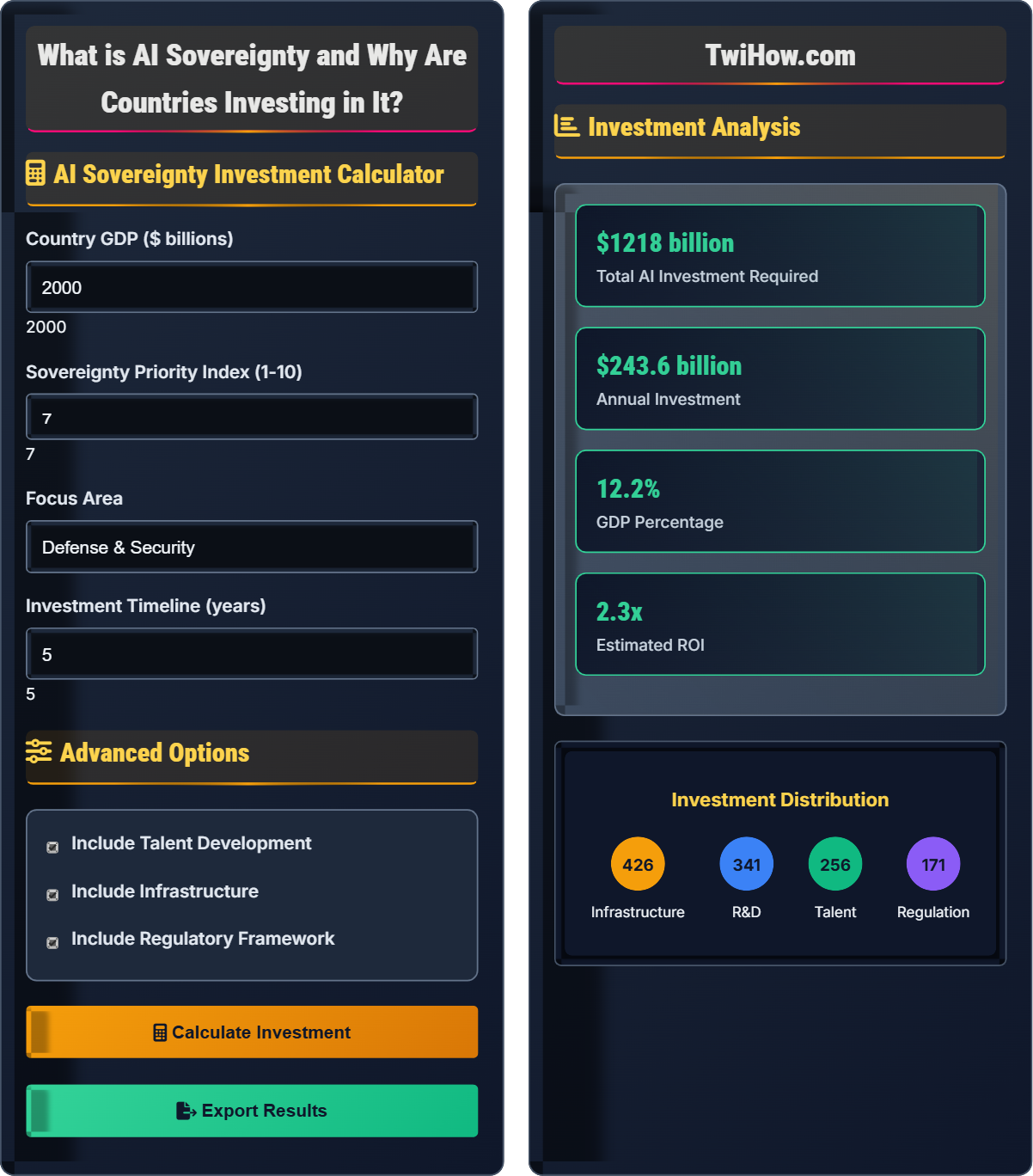
AI Sovereignty Investment Calculator
Advanced Options
Investment Analysis
| Category | Investment | Percentage | Timeline |
|---|---|---|---|
| Infrastructure | $50B | 35% | Year 1-3 |
| Research & Development | $40B | 28% | Year 1-5 |
| Talent Development | $30B | 21% | Year 1-5 |
| Regulatory Framework | $20B | 14% | Year 1-2 |
| Security | $10B | 7% | Year 1-5 |
Investment: $140B over 5 years
Benefits: Rapid technological advancement, global leadership
Challenges: High fiscal burden, coordination complexity
Investment: $70B over 5 years
Benefits: Balanced approach, manageable costs
Challenges: Slower progress, competitive disadvantage
Investment: $35B over 5 years
Benefits: Lower fiscal pressure, targeted focus
Challenges: Technological dependency, security risks
AI Sovereignty Explained
AI sovereignty refers to a nation's ability to exercise control over its artificial intelligence ecosystem, including data governance, algorithmic transparency, and technological independence. It encompasses policies and strategies that ensure domestic control over critical AI technologies, data flows, and decision-making processes.
Where:
- Domestic AI Capability: Local AI infrastructure, talent, and innovation capacity
- Data Governance Score: Control over data flows, privacy protection, and data localization
- Regulatory Framework: Legal and policy structures governing AI development and deployment
Core Concepts
National control over AI development, data governance, and technological infrastructure to ensure independence and security.
Investment = (GDP × Sovereignty Index ÷ 100) × Investment Years × Sector Multiplier
Where: GDP = Gross Domestic Product, Sovereignty Index = Strategic Priority Level, Sector Multiplier = Focus Area Adjustment.
- Data must remain within national jurisdiction
- Critical AI infrastructure requires domestic control
- Algorithmic transparency supports accountability
Strategic Importance
AI sovereignty ensures that critical national infrastructure, defense systems, and sensitive data are protected from foreign influence.
- Job creation in high-tech sectors
- Reduced dependency on foreign technology
- Enhanced innovation capacity
- Competitive advantage in global markets
- Balancing openness with security needs
- Coordinating multi-sector initiatives
- Managing international trade relationships
- Ensuring regulatory effectiveness
AI Sovereignty Learning Quiz
Which of the following is NOT a core component of AI sovereignty?
AI sovereignty encompasses four main components: Data Sovereignty (control over data storage and processing), Computational Sovereignty (domestic access to computing resources), Algorithmic Sovereignty (ability to develop and control AI algorithms), and Talent Sovereignty (national expertise). Market monopoly is not a component of AI sovereignty - in fact, sovereignty often aims to create competitive markets while maintaining national control.
The answer is D) Market Monopoly.
Understanding the components of AI sovereignty helps clarify what national control means in practice. Each component addresses a different aspect of the AI ecosystem: data (the raw material), computation (the processing power), algorithms (the decision-making systems), and talent (the human expertise). These components work together to create a self-sufficient national AI ecosystem.
Data Sovereignty: National control over data storage, processing, and transfer within borders
Computational Sovereignty: Domestic access to high-performance computing and cloud infrastructure
Algorithmic Sovereignty: National capability to develop, audit, and control AI algorithms
• AI sovereignty balances national control with global cooperation
• Components work synergistically to achieve self-sufficiency
• Sovereignty doesn't mean isolation
• Think of sovereignty as building national capability
• Remember the four D's: Data, Data, Data, and Data!
• Consider how components interact
• Confusing sovereignty with isolationism
• Overlooking the importance of talent development
• Focusing only on one component
Explain why countries are investing heavily in AI sovereignty. What are the key strategic motivations behind these investments?
National Security: Countries invest in AI sovereignty to protect critical infrastructure, defense systems, and sensitive data from foreign interference. Control over AI systems ensures that vital national assets aren't vulnerable to manipulation by foreign actors.
Economic Competitiveness: AI is becoming central to economic productivity and innovation. Countries that control their AI ecosystems gain competitive advantages in emerging industries, job creation, and technological leadership.
Data Protection: AI systems require massive amounts of data. Sovereignty ensures that citizens' data remains protected under national laws rather than being subject to foreign jurisdictions.
Technological Independence: Heavy investment reduces dependency on foreign AI technologies and companies, ensuring that countries aren't vulnerable to supply disruptions or geopolitical pressures.
Regulatory Control: Sovereignty allows countries to implement ethical standards, privacy protections, and safety measures aligned with national values and priorities.
The strategic importance of AI sovereignty extends beyond technology to encompass fundamental national interests. Countries recognize that AI will shape economic, military, and social power in the coming decades. Investment in sovereignty is thus seen as an investment in long-term national resilience and prosperity.
Technological Independence: Ability to develop and deploy critical technologies without reliance on foreign sources
Strategic Asset: Technology or resource critical to national security and economic competitiveness
Data Localization: Requirement that data be stored and processed within national borders
• AI is considered a dual-use technology
• Economic and security interests often overlap
• Sovereignty requires sustained investment
• Remember the acronym SEED: Security, Economics, Ethics, Dependence
• Consider both short-term and long-term benefits
• Think about how investments compound over time
• Focusing only on economic benefits
• Underestimating security implications
• Ignoring the global competitive context
A mid-sized European country with a GDP of $500 billion wants to establish AI sovereignty over the next 7 years. The government has set a sovereignty priority index of 8 out of 10 and plans to focus equally on infrastructure, research, and talent development. Calculate the total investment required and break it down by category. What challenges might this country face in implementing its AI sovereignty strategy?
Total Investment Calculation: Using the formula: Investment = (GDP × Sovereignty Index ÷ 100) × Investment Years × Sector Multiplier
With GDP = $500B, Sovereignty Index = 8, Investment Years = 7, Sector Multiplier = 1.0 (equal focus):
Total Investment = ($500B × 8 ÷ 100) × 7 × 1.0 = $40B × 7 = $280B
Breakdown by Category:
• Infrastructure: $93.3B (33.3%) - Computing resources, data centers, networking
• Research & Development: $93.3B (33.3%) - Universities, labs, innovation centers
• Talent Development: $93.3B (33.3%) - Education, training, retention programs
Challenges: Competition with larger economies for talent, limited domestic market size, need for international partnerships while maintaining sovereignty, regulatory complexity, and potential brain drain to higher-paying markets.
Smaller countries face unique challenges in achieving AI sovereignty due to scale limitations. They must carefully balance domestic investment with international cooperation, leverage niche strengths, and potentially form regional alliances to compete with larger economies. The investment calculation shows that even moderate priorities require substantial commitments.
Sector Multiplier: Factor adjusting investment based on strategic focus area
Brain Drain: Emigration of skilled professionals to other countriesRegional Alliance: Partnership between neighboring countries for mutual benefit
• Investment scales with GDP and priority level
• Smaller countries need creative approaches
• International cooperation can support sovereignty goals
• Use the formula consistently
• Consider percentage breakdowns
• Think about implementation challenges
• Forgetting to account for sector multipliers
• Ignoring practical implementation challenges
• Not considering the competitive landscape
A developing country wants to implement an AI sovereignty strategy but faces budget constraints and limited technical expertise. Propose a phased approach that balances immediate needs with long-term goals. What would be the priority investments and how could the country leverage international partnerships?
Phase 1 (Years 1-2): Foundation Building
• Establish regulatory framework and data governance policies
• Invest in basic digital infrastructure and connectivity
• Partner with international organizations for capacity building
Phase 2 (Years 3-5): Capability Development
• Launch education and training programs in AI
• Develop partnerships with universities and research institutions
• Begin pilot projects in critical sectors
Phase 3 (Years 6-10): Self-Sufficiency
• Scale successful pilot projects
• Develop indigenous AI capabilities
• Establish regional partnerships and knowledge sharing
International Partnerships: Focus on technical assistance, joint research, and capacity building rather than technology transfer. Leverage multilateral organizations for funding and expertise.
Developing countries must take a pragmatic approach to AI sovereignty, starting with foundational elements before building advanced capabilities. The phased approach allows for gradual capacity building while managing financial constraints. International partnerships can accelerate progress while maintaining strategic direction.
Phased Approach: Staged implementation strategy to manage complexity and resources
Capacity Building: Developing skills, institutions, and systems to achieve objectives
Technical Assistance: Support provided to build institutional and technical capabilities
• Start with regulatory foundations
• Build capabilities incrementally
• Maintain strategic direction in partnerships
• Prioritize low-cost, high-impact interventions
• Leverage existing infrastructure
• Focus on human capital development
• Attempting to implement everything simultaneously
• Over-relying on technology imports
• Neglecting human resource development
Which trend is most likely to shape the future of AI sovereignty?
Data localization and control are becoming central to AI sovereignty strategies as countries recognize that data is the foundation of AI capabilities. This trend is driven by concerns about privacy, security, and economic competitiveness. Countries are implementing data localization laws, creating national data strategies, and investing in domestic data infrastructure to maintain control over their digital assets.
The answer is B) Increased emphasis on data localization and control.
Data is often called the "new oil" in the AI economy because it's the raw material that powers AI systems. Countries that control their data have greater leverage in the AI ecosystem. This trend reflects the recognition that sovereignty begins with controlling the foundational resource of AI development.
Data Localization: Requirement that data be stored and processed within national borders
Digital Assets: Information resources that provide economic value
Data Sovereignty: National control over data governance and flows
• Data is the foundation of AI capabilities
• Control over data enables control over AI
• Privacy and security concerns drive policy
• Remember: Data drives AI
• Consider the economic value of data
• Think about privacy-security nexus
• Underestimating the importance of data
• Confusing data protection with data sovereignty
• Ignoring the economic implications
FAQ
Q: How do countries balance AI sovereignty with international cooperation and trade?
A: Countries balance AI sovereignty with international cooperation through several mechanisms:
1. Strategic Partnerships: Forming alliances with trusted partners for shared research and development while maintaining core capabilities domestically
2. Standards Harmonization: Working together to develop compatible technical standards and certification processes
3. Conditional Cooperation: Engaging in international projects with safeguards to protect sensitive technologies
4. Graduated Access: Creating tiered systems where different levels of access are granted based on trust and reciprocity
The key is maintaining strategic autonomy while benefiting from international collaboration, which requires careful legal frameworks and diplomatic coordination.
Q: What are the economic implications of AI sovereignty for businesses and consumers?
A: AI sovereignty has significant economic implications:
For Businesses: Increased costs for compliance with data localization requirements, potential market fragmentation, but also opportunities for domestic AI companies. Companies may need to duplicate infrastructure across jurisdictions.
For Consumers: Potentially higher prices due to increased operational costs, but also enhanced privacy protections and reduced risk of foreign data exploitation.
For Innovation: May slow global collaboration but accelerate domestic innovation. Could lead to parallel AI ecosystems with different standards and capabilities.
Long-term Effects: Potential for increased economic resilience and national competitiveness, but also risks of technological fragmentation and reduced global efficiency.