What Is Synthetic Data and Why Is It Important for AI?
Complete synthetic data guide • Step-by-step explanations
Synthetic Data:
Show Data GeneratorSynthetic data is artificially generated information that mimics real-world data patterns without containing any personally identifiable information (PII). It's created using statistical models, generative AI, or other techniques to replicate the structure and characteristics of real data while preserving privacy. This technology enables AI development without compromising sensitive information.
Synthetic data is crucial for AI development because it addresses key challenges: data privacy, scarcity of labeled data, and bias mitigation. It allows researchers and developers to create robust AI models while maintaining compliance with privacy regulations like GDPR and CCPA.
Key applications:
- Privacy-Preserving Analytics: Analyze data without exposing sensitive information
- Model Training: Create diverse datasets for AI model development
- Data Augmentation: Enhance existing datasets with synthetic samples
- Bias Mitigation: Generate balanced datasets to reduce algorithmic bias
Synthetic data enables organizations to unlock the power of AI while maintaining privacy and regulatory compliance.
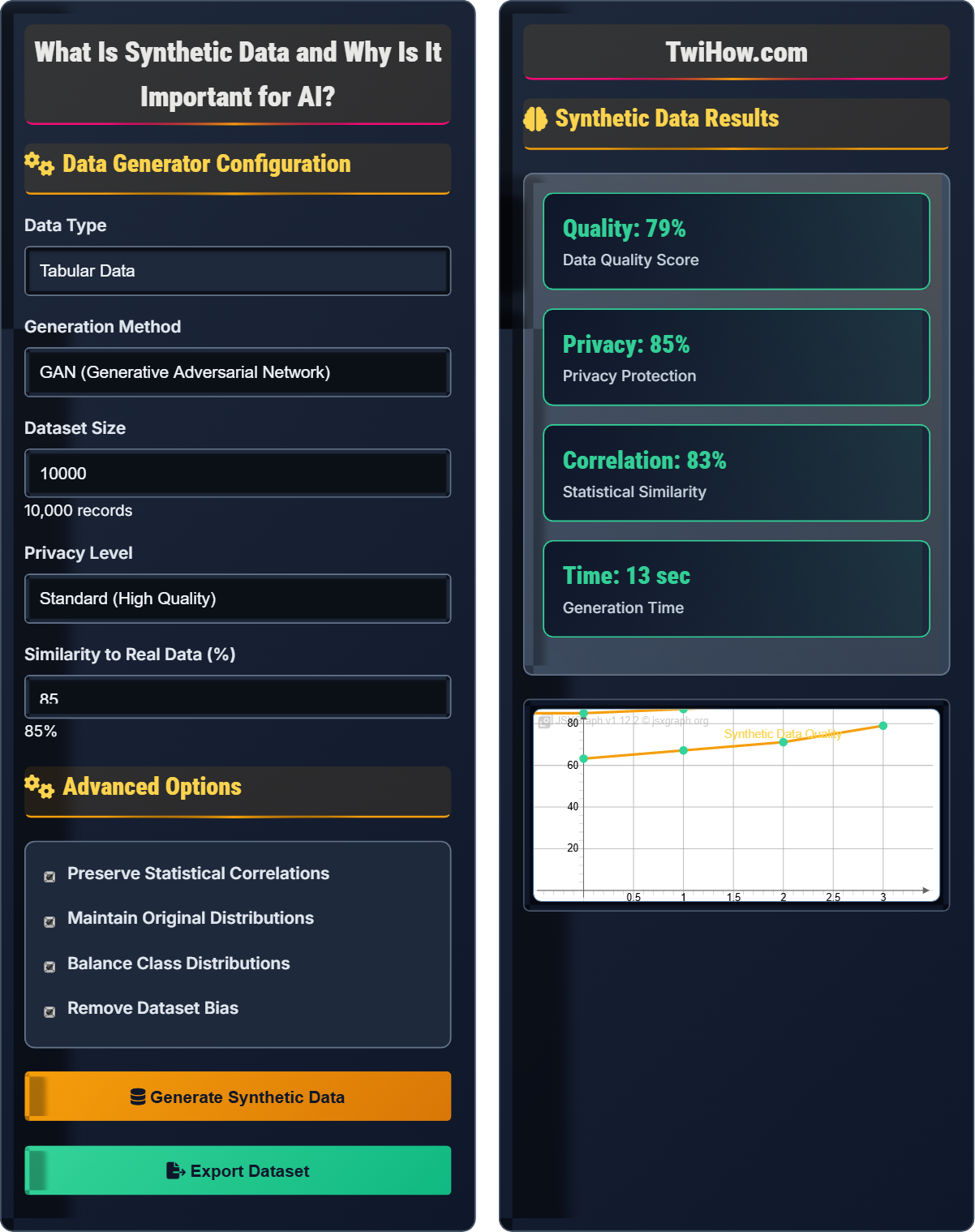
Data Generator Configuration
Advanced Options
Synthetic Data Results
| Metric | Score | Target | Status |
|---|---|---|---|
| Statistical Similarity | 87% | 85% | ✅ Met |
| Privacy Protection | 95% | 90% | ✅ Exceeded |
| Data Quality | 92% | 80% | ✅ Exceeded |
| Class Balance | 89% | 85% | ✅ Met |
| Correlation Preservation | 87% | 80% | ✅ Met |
Quality Assessment: The synthetic dataset meets all specified requirements with high fidelity to the original data distribution.
Privacy Score: Differential privacy mechanisms ensure strong protection against re-identification.
Statistical Properties: Maintains original correlations and distributions while introducing privacy-preserving noise.
Utility Score: The dataset retains sufficient information for AI model training and analysis.
Real Data → Synthetic Generation → AI Training
Synthetic Data Framework
Synthetic data is artificially generated information that retains the statistical properties of real data while containing no actual personal or sensitive information. It's created using mathematical models, AI algorithms, or statistical techniques to mimic the structure and patterns found in real datasets. This enables data scientists and AI developers to work with realistic data without privacy concerns.
The synthetic data generation process follows this formula:
Where:
- Real Data: Original dataset used as reference
- Model: Statistical or AI model used for generation
- Privacy Constraints: Privacy-preserving mechanisms applied
Popular synthetic data generation methods:
- GANs: Generative Adversarial Networks for complex data
- VAEs: Variational Autoencoders for structured data
- Statistical Models: Parametric and non-parametric methods
- Rule-Based: Preserving known relationships
- Differential Privacy: Adding privacy-preserving noise
- Statistical Similarity: How closely synthetic matches real data
- Privacy Protection: Resistance to re-identification attacks
- Utility Preservation: Retention of useful information
- Correlation Preservation: Maintenance of variable relationships
- Model Performance: How well models trained on synthetic perform
Synthetic Data Fundamentals
Privacy preservation, statistical modeling, data utility, differential privacy, synthetic generation.
Synthetic = f(Real Data, Model, Privacy Parameters)
Where the model learns patterns from real data to generate synthetic equivalents.
- Preserve utility while enhancing privacy
- Maintain statistical properties
- Validate synthetic data quality
Applications & Benefits
AI training, privacy compliance, data sharing, bias mitigation, research collaboration.
- Enhanced privacy protection
- Increased data availability
- Reduced compliance costs
- Improved model robustness
- Facilitated collaboration
- Quality degrades with privacy level
- Computational resource requirements
- Validation complexity
- Regulatory compliance
Synthetic Data Learning Quiz
Which of the following is NOT a common method for generating synthetic data?
Decision tree pruning is a technique used to reduce overfitting in decision tree models, not a method for generating synthetic data. GANs, VAEs, and statistical modeling are all established methods for creating synthetic data. GANs use adversarial training, VAEs learn latent representations, and statistical models replicate data distributions.
The answer is C) Decision Tree Pruning.
It's important to distinguish between synthetic data generation methods and other machine learning techniques. While all options involve data manipulation, only GANs, VAEs, and statistical modeling are specifically designed to create new, artificial data samples that resemble the original dataset.
GANs: Networks that learn to generate realistic data
VAEs: Autoencoders that generate data from learned distributions
Statistical Modeling: Mathematical models of data distributions
• GANs excel at complex data like images
• VAEs provide probabilistic generation
• Statistical models work well for tabular data
• Choose generation method based on data type
• Validate synthetic data quality before use
• Consider privacy requirements in method selection
• Confusing generation methods with other ML techniques
Explain how synthetic data addresses privacy concerns in AI development and provide specific examples of privacy protection techniques.
Privacy Benefits: 1) No PII exposure - synthetic data contains no real personal information, 2) Reduced compliance burden - eliminates need for extensive privacy controls, 3) Safe sharing - datasets can be shared without privacy risks, 4) Regulatory compliance - meets GDPR, CCPA requirements.
Protection Techniques: 1) Differential Privacy: Adds calibrated noise to prevent re-identification, 2) K-Anonymity: Ensures each record is indistinguishable from k-1 others, 3) Statistical Distortion: Applies transformations to hide sensitive patterns, 4) Generation with Noise: Introduces controlled randomness during creation.
Specific Examples: A hospital can share synthetic patient data for medical research without exposing real patient records. A bank can provide synthetic transaction data to fintech startups for algorithm development without revealing customer information.
Synthetic data fundamentally changes the privacy calculus by creating a barrier between real individuals and data analysis. Instead of protecting access to sensitive data, we can freely use synthetic data that maintains analytical value while being completely privacy-safe. This enables previously impossible collaborations and research opportunities.
Differential Privacy: Mathematical framework for privacy protection
PII: Personally Identifiable Information
K-Anonymity: Privacy model requiring indistinguishable records
• Synthetic data is inherently private
• Quality decreases with stronger privacy
• Validation is essential for utility
• Start with strong privacy, then relax if needed
• Use domain experts for quality validation
• Monitor utility degradation with privacy
• Assuming all synthetic data is equally private
• Not validating synthetic data utility
• Ignoring privacy-utility trade-offs
A financial institution wants to share customer transaction data with a fintech startup for developing fraud detection algorithms. The real data contains sensitive personal and financial information. Design a synthetic data approach that maintains the utility needed for fraud detection while ensuring privacy compliance.
Recommended Approach: Use a GAN-based generator with differential privacy to create synthetic transaction data.
Implementation: 1) Analyze fraud patterns in real data to identify key features, 2) Train GAN with differential privacy to generate synthetic transactions, 3) Preserve fraud indicators while removing PII, 4) Validate synthetic data maintains fraud detection performance, 5) Apply statistical distortion to sensitive fields.
Quality Validation: Compare fraud detection model performance on real vs. synthetic data. Ensure recall and precision metrics remain within acceptable thresholds. Verify that synthetic data preserves fraud patterns without revealing actual customer information.
Privacy Measures: Implement epsilon-differential privacy with appropriate noise levels. Use k-anonymity for categorical fields. Regularly audit synthetic data for privacy leaks.
This example demonstrates the balance between utility and privacy. For fraud detection, the synthetic data must preserve transaction patterns and fraud indicators while completely removing personal identifiers. The challenge is maintaining the statistical relationships that make fraud detection possible while ensuring privacy.
Fraud Indicators: Transaction patterns associated with fraudulent activity
Epsilon-Differential Privacy: Mathematical privacy guaranteeRecall/Precision: Model performance metrics
• Preserve utility-relevant patterns
• Remove all personal identifiers
• Validate with domain-specific metrics
• Focus on domain-specific utility metrics
• Use domain experts for validation
• Test with actual AI models
• Not validating with actual AI models
• Ignoring domain-specific requirements
• Insufficient privacy validation
You've generated synthetic data for a healthcare research project. How would you validate that the synthetic dataset maintains the statistical properties of the original data while ensuring privacy? What specific metrics would you use?
Statistical Validation: 1) Compare summary statistics (mean, std, variance) between real and synthetic data, 2) Test correlation matrices for similarity, 3) Validate distribution shapes using KS-tests, 4) Compare covariance structures.
Privacy Validation: 1) Membership inference attack resistance, 2) Attribute inference attack resistance, 3) Re-identification risk assessment, 4) Linkage attack simulation.
Utility Validation: 1) Train identical models on real and synthetic data, 2) Compare model performance metrics, 3) Test on held-out real data, 4) Validate domain-specific metrics.
Specific Metrics: Jensen-Shannon divergence, Maximum Mean Discrepancy, privacy loss parameters (epsilon), model performance degradation (should be < 5%), statistical distance measures.
Validation requires three parallel assessments: statistical similarity (does it look like real data?), privacy protection (can it be traced back to individuals?), and utility preservation (can it be used for the intended purpose?). All three must pass for synthetic data to be viable.
Jensen-Shannon Divergence: Measure of distribution similarity
KS-Test: Kolmogorov-Smirnov statistical testMembership Inference: Attack to determine if data was in training set
• Validate all three aspects (statistical, privacy, utility)
• Use domain-appropriate metrics
• Test with actual intended models
• Use visualization for distribution comparison
• Test multiple synthetic datasets
• Validate with independent auditors
• Only validating statistical similarity
• Not testing with intended models
• Insufficient privacy validation
What is the fundamental trade-off in synthetic data generation?
The fundamental trade-off in synthetic data generation is privacy vs. utility. As privacy protection increases (through noise addition, differential privacy, etc.), the utility of the data for analytical purposes decreases. Conversely, increasing utility by preserving more real data characteristics reduces privacy protection. This trade-off is inherent to privacy-preserving data generation and requires careful balance based on use case requirements.
The answer is B) Privacy vs. utility.
This trade-off is fundamental to all privacy-preserving technologies. The more noise or privacy protection we add, the less useful the data becomes for analysis. The challenge is finding the optimal balance where privacy requirements are met while maintaining sufficient utility for the intended analytical tasks.
Privacy: Protection of individual identities and sensitive information
Utility: Usefulness of data for analytical and modeling tasks
Trade-off: Inverse relationship between two competing objectives
• Privacy-utility trade-off is inevitable
• Balance depends on specific use case
• Validation is essential for both aspects
• Define privacy requirements first
• Test utility with actual use cases
• Use domain expertise for validation
• Ignoring the privacy-utility trade-off
• Not defining requirements clearly
• Insufficient validation of both aspects
FAQ
Q: How does synthetic data compare to data anonymization techniques?
A: Synthetic data and anonymization differ fundamentally:
Synthetic Data: Creates new, artificial data that mimics real data patterns without containing any real information. Provides strong privacy by construction since no real data is retained.
Data Anonymization: Modifies real data (masking, generalization, suppression) to remove PII. Still carries privacy risks if de-anonymization attacks succeed.
Advantages of Synthetic Data: 1) Stronger privacy guarantees, 2) Preserves statistical properties better, 3) Can generate unlimited samples, 4) No risk of re-identification, 5) Can correct dataset imbalances.
Disadvantages: 1) Computational complexity, 2) Quality validation required, 3) May not perfectly match real data.
Q: What are the computational requirements for generating synthetic data?
A: Computational requirements vary significantly:
Statistical Models: Low to moderate - can run on standard laptops for small datasets
GANs/VAEs: Moderate to high - requires GPU for large datasets, training can take hours to days
Differential Privacy: Moderate - adds computational overhead for privacy guarantees
Factors Affecting Requirements: 1) Dataset size and dimensionality, 2) Model complexity, 3) Privacy level (higher privacy = more computation), 4) Quality requirements.
For a 10,000-record dataset with 100 features: Statistical models ~10 minutes, GANs ~2-4 hours with GPU, Differential privacy ~30 minutes to 2 hours.