What is the Environmental Impact of Training Large AI Models?
Complete green AI guide • Step-by-step explanations
AI Environmental Impact:
Show Carbon CalculatorThe environmental impact of training large AI models has become a critical concern as models grow in size and complexity. Training massive neural networks requires enormous amounts of electricity, contributing significantly to carbon emissions and environmental degradation. Understanding and mitigating these impacts is essential for sustainable AI development.
Key environmental impact factors:
- Energy Consumption: Massive computational requirements during training
- Carbon Emissions: CO₂ released from electricity generation
- Infrastructure Impact: Cooling systems and data center operations
- Resource Depletion: Hardware manufacturing and disposal
Modern AI systems consume energy equivalent to hundreds of homes for months, with some large models emitting thousands of tons of CO₂ during training. Sustainable practices include using renewable energy, efficient algorithms, and carbon offset programs.
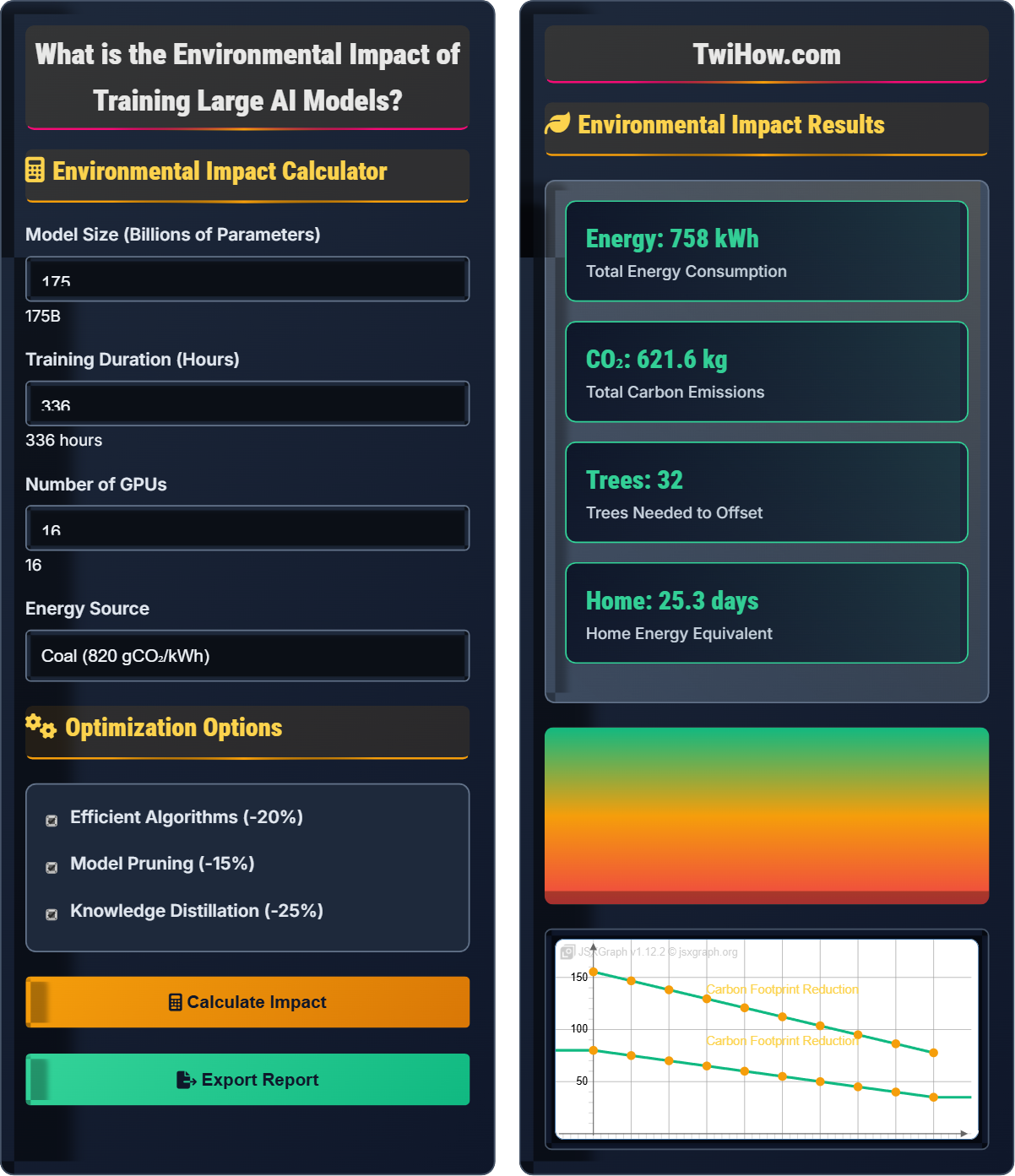
Environmental Impact Calculator
Optimization Options
Environmental Impact Results
AI Environmental Impact Explained
The environmental impact of AI refers to the energy consumption, carbon emissions, and resource usage associated with developing, training, and deploying artificial intelligence models. As AI models become increasingly large and complex, their environmental footprint grows substantially.
Total Energy = Σ(Power_per_GPU × Hours × Number_of_GPUs)
Where:
- Power_per_GPU: Energy consumption per graphics card (typically 250-400W)
- Hours: Total training time in hours
- Number_of_GPUs: Quantity of GPUs used in parallel
- Total Energy: Measured in kilowatt-hours (kWh)
Key areas of environmental concern:
- Direct Energy Use: Power consumed by GPUs, CPUs, and memory
- Cooling Systems: Air conditioning and liquid cooling requirements
- Data Centers: Infrastructure including lighting, networking, backup systems
- Hardware Manufacturing: Resource extraction and production
- Electronic Waste: Disposal of outdated equipment
- Efficient Architectures: Design models requiring fewer resources
- Renewable Energy: Power data centers with clean energy sources
- Model Compression: Reduce model size without performance loss
- Carbon Offsetting: Invest in environmental restoration projects
- Efficient Training: Optimize algorithms and hyperparameters
Environmental Impact Fundamentals
Carbon footprint, energy efficiency, GPU utilization, renewable energy, model compression.
CO₂ Emissions = Energy_Consumption × Emission_Factor
Where Emission_Factor = grams of CO₂ per kWh for energy source.
- Larger models consume exponentially more energy
- Training phase dominates environmental impact
- Energy source critically affects emissions
Applications
Large language models, computer vision systems, reinforcement learning, data centers, cloud computing.
- Cloud service providers
- AI research institutions
- Tech companies
- Academic researchers
- Corporate sustainability commitments
- Regulatory compliance
- Public accountability
- Cost implications
AI Environmental Impact Learning Quiz
Which factor has the greatest impact on the energy consumption of training large AI models?
The energy consumption of training large AI models is determined by the combination of all factors listed. The formula is: Total Energy = Power_per_GPU × Hours × Number_of_GPUs. While model size influences training time, the actual energy consumption depends on the product of power consumption, duration, and hardware count.
Research shows that training a large model like GPT-3 can consume over 1,287 MWh of electricity, equivalent to the energy usage of 120 average American homes for a year.
The answer is D) All of the above combined.
Understanding the relationship between these factors helps AI practitioners make informed decisions about resource allocation. For example, using more efficient hardware (lower power per GPU) can partially offset the increased consumption from longer training times or more GPUs. This multiplicative relationship means that small improvements in one area can have significant cumulative effects on overall energy consumption.
MWh: Megawatt-hour, a unit of energy equal to 1,000 kilowatt-hours
GPU Power Draw: Electrical power consumed by graphics cards during operation
Training Efficiency: Amount of computation performed per unit of energy
• Energy consumption scales multiplicatively with all factors
• Hardware efficiency varies significantly between models
• Renewable energy sources dramatically reduce emissions
• Calculate expected energy consumption before starting training
• Use the most efficient hardware available
• Schedule training during off-peak hours when renewable energy is more abundant
• Focusing only on model size while ignoring hardware and duration
• Not considering the energy source in emission calculations
• Underestimating the cumulative impact of multiple training runs
Calculate the carbon footprint of training a 175-billion parameter model using 16 A100 GPUs for 336 hours, assuming a grid electricity mix with 475g CO₂/kWh. Include the formula, step-by-step calculation, and environmental context.
Formula: Carbon Footprint = Total Energy × Emission Factor
Step 1 - Calculate Total Energy:
A100 GPU power consumption: ~400W (0.4 kW) per GPU
Energy per GPU: 0.4 kW × 336 hours = 134.4 kWh
Total energy: 134.4 kWh × 16 GPUs = 2,150.4 kWh
Step 2 - Calculate Carbon Emissions:
Carbon footprint: 2,150.4 kWh × 475g CO₂/kWh = 1,021,440g CO₂
Convert to kg: 1,021,440g ÷ 1,000 = 1,021.4 kg CO₂
Environmental Context: This is equivalent to driving approximately 2,500 miles in an average car or leaving 500 homes powered for one day. To offset this amount of CO₂, approximately 51 mature trees would need to grow for one year.
This calculation demonstrates the substantial environmental cost of large-scale AI training. The formula shows how energy consumption and carbon emissions scale with hardware usage and duration. By quantifying these impacts, organizations can make more informed decisions about resource allocation and implement strategies to reduce their environmental footprint. The conversion to familiar equivalents helps put the abstract number into perspective.
Emission Factor: Amount of CO₂ emitted per unit of energy consumed
Carbon Footprint: Total greenhouse gas emissions caused directly/indirectly
Offset: Action to compensate for emissions through environmental projects
• Always verify GPU power specifications for accurate calculations
• Use location-specific emission factors for precision
• Consider the entire lifecycle impact, not just training
• Use online calculators to estimate GPU power consumption
• Check your local grid's emission factor for accuracy
• Track and report environmental impact alongside performance metrics
• Using incorrect power consumption values for GPUs
• Forgetting to convert units properly
• Not accounting for supporting infrastructure energy use
A tech company plans to train 5 large AI models over the next quarter, each requiring 200 GPUs running continuously for 500 hours. Their data center uses a grid mix with 475g CO₂/kWh. Calculate the total quarterly carbon footprint and determine how many mature trees would be needed to offset this impact, assuming each tree absorbs 20kg CO₂ annually.
Given Information:
- 5 models to be trained
- 200 GPUs per model
- 500 hours per model
- 475g CO₂/kWh emission factor
- Assume 300W (0.3kW) per GPU
Calculations:
Energy per GPU: 0.3 kW × 500 hours = 150 kWh
Energy per model: 150 kWh × 200 GPUs = 30,000 kWh
Total energy: 30,000 kWh × 5 models = 150,000 kWh
Carbon footprint: 150,000 kWh × 475g CO₂/kWh = 71,250,000g CO₂
Convert to kg: 71,250,000g ÷ 1,000 = 71,250 kg CO₂
Trees needed: 71,250 kg ÷ 20 kg/tree = 3,563 trees
The company would need to plant 3,563 mature trees to offset the quarterly AI training emissions.
This problem demonstrates the significant environmental impact that can accumulate when training multiple large models. The calculation shows how organizational AI initiatives can contribute substantial carbon emissions. The tree offset calculation provides a tangible way to understand the scale of environmental impact. Companies often use these calculations to set sustainability targets and evaluate the cost-effectiveness of different mitigation strategies.
Carbon Offset: Reduction in emissions made to compensate elsewhere
Annual Sequestration: Amount of CO₂ absorbed by a tree per year
Organizational Impact: Cumulative environmental effect of all activities
• Scale calculations appropriately for organizational contexts
• Consider cumulative impact of multiple projects
• Verify assumptions about tree absorption rates
• Track energy consumption across all AI projects
• Implement efficiency measures to reduce cumulative impact
• Consider renewable energy options for data centers
• Not accounting for all models in organizational calculations
• Using inaccurate tree absorption figures
• Forgetting to aggregate results across multiple projects
A research lab wants to reduce the environmental impact of their AI training while maintaining performance. They currently train a 100B parameter model using 32 V100 GPUs for 240 hours. Propose a multi-pronged strategy including three technical solutions and calculate the potential environmental savings.
Current Baseline:
V100 GPU power: ~300W (0.3kW) per GPU
Total energy: 0.3 kW × 240 hours × 32 GPUs = 2,304 kWh
With 475g CO₂/kWh: 2,304 × 475 = 1,094,400g = 1,094.4 kg CO₂
Multi-Pronged Strategy:
1. Hardware Upgrade (A100 GPUs): More efficient hardware consuming ~25% less power for similar performance. Savings: 25% reduction in energy consumption.
New energy: 2,304 × 0.75 = 1,728 kWh
2. Model Pruning: Reduce model size by 30% without significant performance loss. Savings: 30% reduction in training time.
New energy: 1,728 × 0.70 = 1,210 kWh
3. Renewable Energy: Switch to grid with 50g CO₂/kWh emission factor (90% cleaner than average grid).
Final emissions: 1,210 × 50 = 60,500g = 60.5 kg CO₂
Environmental Savings: 1,094.4 - 60.5 = 1,033.9 kg CO₂ (94.5% reduction)
This strategy would save over 1 ton of CO₂ emissions per training run.
This problem illustrates how multiple approaches can work synergistically to dramatically reduce environmental impact. The combination of hardware efficiency, algorithmic optimization, and clean energy creates multiplicative benefits. Each intervention builds on the previous one, resulting in a much greater overall reduction than any single approach could achieve. This demonstrates the importance of holistic thinking in sustainable AI development.
Model Pruning: Removing unnecessary connections in neural networks
Energy Efficiency: Performance per unit of energy consumed
Cumulative Impact: Combined effect of multiple interventions
• Combine multiple strategies for maximum impact
• Consider both direct and indirect environmental effects
• Evaluate cost-effectiveness of different approaches
• Start with the most impactful interventions first
• Consider long-term investments in efficient hardware
• Partner with renewable energy providers
• Focusing on only one aspect of sustainability
• Not considering the synergistic effects of multiple interventions
• Underestimating the potential of efficiency improvements
Which of the following represents the most effective long-term strategy for reducing the environmental impact of AI training?
While all options contribute to environmental sustainability, developing more efficient algorithms and architectures represents the most effective long-term strategy. This approach addresses the root cause of high energy consumption by fundamentally changing how AI models are designed and trained.
Efficient algorithms can reduce energy consumption by orders of magnitude, benefiting not just individual organizations but the entire field of AI. Examples include sparse neural networks, neural architecture search, and efficient transformer variants like Reformer or Linformer.
Unlike carbon offsets (which don't prevent emissions) or renewable energy (which only addresses the source), algorithmic efficiency reduces the actual computational requirements, leading to proportional reductions in all associated environmental impacts.
The answer is C) Developing more efficient algorithms and architectures.
This question highlights the difference between treating symptoms and addressing root causes. While renewable energy and carbon offsets are valuable, they don't reduce the fundamental computational requirements of AI models. Algorithmic efficiency, however, reduces the need for computation itself, providing scalable benefits across the entire field. This approach also tends to improve performance and reduce costs, creating incentives for adoption.
Algorithmic Efficiency: Computational performance per unit of resource
Root Cause: Fundamental issue causing a problem
Scalable Solutions: Approaches that benefit the entire field
• Prioritize solutions that address root causes
• Consider scalability and field-wide impact
• Combine multiple approaches for comprehensive solutions
• Invest in research on efficient architectures
• Follow developments in algorithmic efficiency
• Consider both short-term and long-term impacts
• Focusing only on immediate fixes rather than systemic improvements
• Not considering the scalability of solutions
• Underestimating the potential of algorithmic innovations
FAQ
Q: What are the most effective techniques for reducing the environmental impact of AI training?
A: The most effective techniques for reducing AI's environmental impact include:
1. Algorithmic Efficiency: Developing more efficient architectures like sparse networks, efficient transformers, and neural architecture search to reduce computational requirements.
2. Hardware Optimization: Using more energy-efficient processors (like TPUs vs traditional GPUs) and optimizing hardware utilization through better scheduling.
3. Renewable Energy: Powering data centers with clean energy sources like solar, wind, or hydroelectric power.
4. Model Compression: Applying techniques like pruning, quantization, and knowledge distillation to create smaller, more efficient models.
5. Efficient Training Practices: Using optimal batch sizes, learning rates, and early stopping to reduce unnecessary computation.
The most effective approach combines multiple techniques, with algorithmic efficiency and renewable energy providing the largest long-term benefits.
Q: How can organizations balance AI performance with environmental sustainability?
A: Organizations can balance AI performance with environmental sustainability through:
1. Strategic Planning: Setting clear sustainability goals alongside performance metrics and tracking both.
2. Investment in Efficiency: Prioritizing research and development in efficient algorithms that maintain performance while reducing resource requirements.
3. Infrastructure Choices: Using data centers powered by renewable energy and efficient hardware.
4. Lifecycle Assessment: Considering the total environmental impact from model development to deployment.
5. Transparent Reporting: Publicly reporting both performance and environmental metrics to drive accountability.
Often, efficiency improvements that reduce environmental impact also reduce costs, creating alignment between sustainability and business objectives.