What Is the Future of AI in Creative Industries?
Complete creative AI guide • Step-by-step explanations
Creative AI Future:
Show Creative ForecastThe future of AI in creative industries represents a transformative shift where artificial intelligence becomes a powerful collaborator rather than a replacement for human creativity. From AI-generated artwork to algorithmic music composition, AI is revolutionizing how creative content is produced, distributed, and consumed.
Key creative AI applications:
- Visual Arts: Generative art, digital painting, 3D modeling assistance
- Music Production: Composition, arrangement, and sound design
- Writing & Literature: Story generation, content creation, poetry
- Design & Fashion: Pattern creation, trend forecasting, prototyping
- Film & Animation: Scriptwriting, visual effects, character animation
The future will likely see AI serving as an advanced creative partner, amplifying human imagination while raising new questions about authorship, authenticity, and the nature of creativity itself.
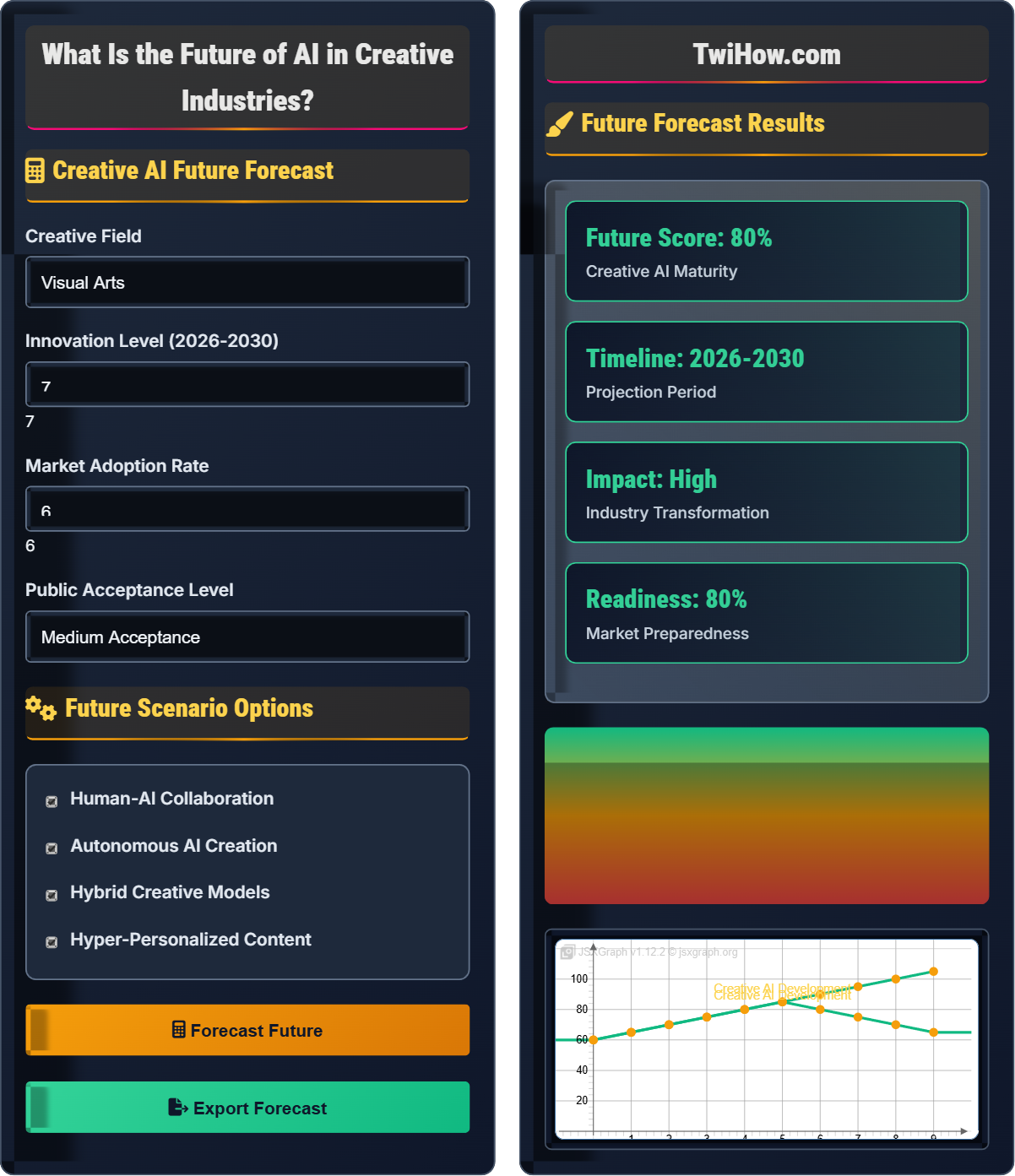
Creative AI Future Forecast
Future Scenario Options
Future Forecast Results
Creative AI Future Explained
The future of AI in creative industries represents a paradigm shift where artificial intelligence transforms from a tool to a creative collaborator. This evolution encompasses multiple domains including visual arts, music, literature, design, and film production.
Creative_Impact = (AI_Capability × Human_Collaboration × Market_Readiness) ÷ (Acceptance_Challenge × Regulation_Factors)
Where:
- AI_Capability: Technical sophistication and creative output quality
- Human_Collaboration: Effectiveness of human-AI partnerships
- Market_Readiness: Industry preparedness for AI integration
- Acceptance_Challenge: Public and professional resistance
- Regulation_Factors: Legal and ethical constraints
Key areas for creative AI implementation:
- Generative Art: AI-created visual artworks and digital paintings
- Music Composition: Algorithmic music generation and arrangement
- Content Writing: Automated article, story, and script generation
- Design Assistance: AI-powered design tools and pattern generation
- Video Production: AI-enhanced editing, effects, and animation
- Interactive Media: Procedural content in games and virtual worlds
- Collaborative Models: AI as creative partner amplifying human imagination
- Autonomous Creation: AI systems creating independently with minimal human input
- Personalization: Hyper-customized content tailored to individual preferences
- Real-time Generation: Live creative content generation during events
- Cross-media Synthesis: AI creating cohesive experiences across multiple media
- Democratization: Professional-quality tools accessible to everyone
Creative AI Fundamentals
Generative AI, creative algorithms, human-AI collaboration, procedural generation, neural creativity.
Creative_Impact = (AI_Capability × Human_Collaboration) ÷ (Acceptance_Challenges × Regulation_Factors)
Where each component is normalized to 0-100 scale.
- AI enhances rather than replaces human creativity
- Collaboration models will dominate future applications
- Regulatory frameworks will shape market development
Applications
Visual art, music composition, content writing, game development, film production, advertising.
- Entertainment industry
- Marketing and advertising
- Education and e-learning
- Architecture and design
- Intellectual property rights
- Authorship attribution
- Quality standards
- Market disruption
Creative AI Future Quiz
Which scenario is most likely to define the future relationship between AI and human creativity?
Human-AI collaborative partnerships (Option B) are most likely to define the future relationship. Current trends and expert analysis suggest that the most productive approach combines AI's computational power and pattern recognition with human creativity, intuition, and emotional intelligence.
Research indicates that hybrid models produce superior results compared to purely human or AI-only approaches. AI can handle repetitive tasks, generate variations, and process large datasets, while humans provide creative direction, emotional resonance, and cultural context.
Examples include AI-assisted music composition where musicians use AI for chord progressions while providing melody and lyrics, or AI-assisted visual art where artists use AI for texture and color suggestions while directing the overall composition.
The answer is B) Human-AI collaborative partnerships.
This question addresses one of the most important misconceptions about AI in creative industries. Rather than replacing human creativity, AI is more likely to augment and enhance it. The collaboration model leverages the strengths of both human and artificial intelligence, creating a symbiotic relationship where each complements the other. This understanding is crucial for creative professionals planning their careers in an AI-integrated future.
Augmented Creativity: Human creativity enhanced by AI tools and capabilities
Symbiotic Relationship: Mutual benefit between human and AI collaboration
Computational Creativity: AI systems designed to exhibit creative behaviors
• AI complements rather than replaces human creativity
• Hybrid approaches typically yield better results
• Human judgment remains essential for creative direction
• Embrace AI as a creative partner rather than competition
• Focus on skills that complement AI capabilities
• Learn to direct and refine AI-generated content
• Assuming AI will completely replace human creativity
• Ignoring the potential of human-AI collaboration
• Focusing only on AI's limitations rather than possibilities
Analyze how the visual arts industry will be transformed by AI between 2026-2030, including specific technologies, market impacts, and creative process changes.
Technological Developments (2026-2030):
- Advanced Generative Models: Improved GANs and diffusion models enabling photorealistic and stylistically diverse art generation
- Interactive AI Studios: Real-time AI painting and editing tools that respond to artist input
- Style Transfer Evolution: Sophisticated techniques for applying artistic styles to new content
- 3D Asset Generation: AI creating complex 3D models and environments for games and films
Market Impacts:
- Democratization: Professional-quality tools accessible to amateur artists
- Speed Revolution: Dramatic reduction in time from concept to finished artwork
- New Markets: Hyper-personalized art and dynamic content generation
- Value Shift: Increasing premium on human creativity and curation skills
Creative Process Changes:
- Iterative Design: Rapid generation of multiple variations for exploration
- Collaborative Workflow: Artists directing AI to execute specific visions
- Concept Refinement: Using AI to visualize and iterate on ideas quickly
- Hybrid Creation: Seamless integration of traditional and AI-assisted techniques
Challenges and Opportunities:
- Authenticity Questions: Determining authorship and originality in AI-assisted works
- Market Saturation: Potential oversupply of AI-generated content
- New Skills Required: Prompt engineering and AI direction capabilities
- Legal Frameworks: Evolving copyright and intellectual property laws
This analysis demonstrates how technological advancement drives industry transformation in predictable patterns. The visual arts industry exemplifies the broader trend of AI integration: initially supplementing human capabilities, then enhancing efficiency, and eventually creating entirely new forms of expression. Understanding these patterns helps creative professionals anticipate and prepare for changes in their respective fields.
GANs (Generative Adversarial Networks): AI models that generate new content by competing systems
Diffusion Models: AI that generates images by reversing a noise-adding process
Prompt Engineering: Crafting inputs to guide AI creative output
• Technology adoption follows predictable patterns in creative industries
• New tools create new forms of creative expression
• Legal and ethical frameworks evolve alongside technology
• Start experimenting with current AI art tools to understand capabilities
• Focus on skills that complement rather than compete with AI
• Stay informed about legal developments in AI-generated content
• Viewing AI as purely threatening to creative careers
• Not adapting skills to complement emerging technologies
• Ignoring the legal implications of AI-assisted creation
A record label wants to leverage AI for music production while maintaining artistic integrity and commercial appeal. They have a catalog of 10,000 songs and want to create personalized versions for streaming platforms. Design an AI implementation strategy that balances creativity, efficiency, and market demands, including specific technologies and workflow recommendations.
Implementation Strategy: AI-Assisted Music Enhancement
Phase 1: Catalog Analysis (Months 1-3)
- Audio Analysis: Use AI to analyze existing catalog for mood, tempo, genre, and instrumental components
- Metadata Enhancement: Automatically tag songs with detailed musical attributes
- Pattern Recognition: Identify successful song structures and arrangements
Phase 2: AI Tool Integration (Months 4-6)
- Harmony Generation: Use AI to create alternative harmonic progressions for existing melodies
- Arrangement Assistance: AI suggests instrument combinations and orchestration options
- Remix Creation: Generate variations of existing tracks for different audiences
Phase 3: Personalization Engine (Months 7-12)
- Platform-Specific Adaptation: AI modifies tracks for different streaming preferences
- Listener Profiling: Analyze listener preferences to inform personalization
- Dynamic Mixing: Real-time audio adjustments based on listening context
Technology Stack:
- Music Information Retrieval (MIR): Tools for analyzing musical content
- Neural Audio Synthesis: Models for generating and modifying audio
- Reinforcement Learning: Systems that learn from listener engagement data
- Cloud Infrastructure: Scalable processing for large catalog operations
Workflow Recommendations:
- Human-AI Collaboration: Producers direct AI tools rather than letting them operate independently
- Quality Control: Establish human review processes for all AI-generated content
- Artist Partnership: Involve original artists in AI-enhanced version creation
- Market Testing: A/B test AI-enhanced versions against originals
Expected Outcomes:
- Increased catalog value through expanded variations
- Improved listener engagement through personalization
- Maintained artistic integrity with AI assistance
- Enhanced competitive advantage in streaming markets
This problem demonstrates how to approach AI implementation strategically in creative industries. The phased approach ensures gradual integration while maintaining quality and artistic integrity. The emphasis on human-AI collaboration preserves the essential human elements of music while leveraging AI's efficiency and analytical capabilities. This balanced approach represents the most viable path for creative industry transformation.
Music Information Retrieval (MIR): Technology for analyzing and extracting musical features
Dynamic Mixing: Real-time audio adjustments based on context or preference
Personalization Engine: AI system that creates customized content versions
• Maintain human oversight in creative decision-making
• Balance efficiency with artistic integrity
• Gradually integrate AI tools to preserve quality
• Start with AI analysis before moving to generation
• Preserve original creative elements while adding AI enhancements
• Test AI-enhanced content with target audiences
• Implementing AI without proper human oversight
• Not preserving original artistic elements
• Rushing implementation without adequate testing
A film studio wants to integrate AI into their production pipeline to reduce costs and accelerate release schedules while maintaining high creative standards. They produce 12 films annually with budgets ranging from $10M-$100M. Design a comprehensive AI integration plan covering pre-production, production, and post-production phases, including ROI projections and creative impact assessments.
Comprehensive AI Integration Plan
Pre-Production Integration:
- Script Analysis: AI identifies plot holes, character inconsistencies, and audience engagement patterns
- Casting Optimization: AI suggests actors based on past performance, audience appeal, and budget considerations
- Location Scouting: AI analyzes satellite imagery and databases for optimal filming locations
- Story Visualization: AI generates preliminary storyboards and concept art
Production Integration:
- Virtual Sets: AI-generated environments reducing physical set construction costs
- Camera Assistance: AI-guided camera movements and framing suggestions
- Lighting Optimization: AI calculates optimal lighting setups for scenes
- Continuity Checking: Real-time AI monitoring for costume, prop, and scene continuity
Post-Production Integration:
- Automated Editing: AI suggests cuts and transitions based on pacing analysis
- Visual Effects: AI accelerates VFX creation and compositing processes
- Color Grading: AI applies consistent color schemes across scenes
- Audio Enhancement: AI removes noise and optimizes sound quality
ROI Projections:
- Pre-Production Savings: 15-20% reduction in development time and costs
- Production Efficiency: 25-30% faster shooting schedules
- Post-Production Acceleration: 40-50% reduction in editing time
- Overall Impact: $2M-$15M savings per film depending on budget scale
Creative Impact Assessment:
- Positive Impacts: More time for creative decision-making, enhanced visual possibilities
- Neutral Impacts: Maintained narrative quality with AI assistance
- Monitoring Areas: Preserving directorial vision and artistic authenticity
- Mitigation Strategy: Maintain human oversight in all creative decisions
Implementation Timeline:
- Months 1-3: Pilot program on one low-budget film
- Months 4-6: Gradual rollout to mid-budget productions
- Months 7-12: Full integration across all productions
Success Metrics:
- Reduction in production timeline while maintaining quality scores
- Cost savings achieved versus projected targets
- Positive audience reception of AI-enhanced films
- Creative team satisfaction with AI integration
This comprehensive plan demonstrates how to approach AI integration systematically across an entire creative workflow. The phased approach minimizes risk while maximizing benefits, and the focus on ROI ensures business viability. The creative impact assessment is crucial for maintaining artistic standards while realizing operational efficiencies. This model can be adapted to other creative industries facing similar transformation challenges.
Virtual Sets: Digitally created environments that replace physical sets
Continuity Checking: Ensuring consistency across different shots and scenes
Story Visualization: Converting narrative elements into visual representations
• Integrate AI gradually to minimize disruption
• Maintain human oversight in creative decisions
• Measure both financial and creative outcomes
• Start with AI tools that enhance rather than replace human creativity
• Pilot programs help identify challenges before full implementation
• Maintain creative team involvement in AI tool selection
• Implementing AI without considering creative team needs
• Not piloting programs before full-scale deployment
• Focusing only on cost reduction rather than quality enhancement
Which emerging technology is most likely to revolutionize creative AI in the next five years?
Multimodal AI that integrates text, image, and audio (Option B) is most likely to revolutionize creative AI in the next five years. This technology represents a convergence of multiple AI capabilities that will enable unprecedented creative possibilities.
Multimodal AI systems can simultaneously process and generate content across different media types, creating cohesive experiences that span visual, auditory, and textual elements. This capability will enable:
- Automated creation of multimedia presentations from text descriptions
- Real-time generation of synchronized video, audio, and visual content
- Enhanced creative tools that understand and respond to multiple input modalities
- Seamless integration of different creative disciplines in AI-assisted workflows
Current developments in models like GPT-4V, DALL-E 3, and multimodal transformers show rapid progress in this area, suggesting near-term practical applications.
The answer is B) Multimodal AI that integrates text, image, and audio.
This question highlights the importance of convergent technologies in creative AI evolution. Rather than single breakthroughs, the most transformative advances often come from combining existing capabilities in new ways. Multimodal AI represents this convergence, integrating previously separate AI capabilities into unified systems that can handle complex, cross-media creative tasks. This trend reflects the inherently multimodal nature of human creativity and communication.
Multimodal AI: Systems that process and generate content across multiple input/output types
Cross-Media Synthesis: Creating coherent experiences spanning different media types
Convergent Technology: Integration of multiple technological capabilities
• Convergence of technologies often creates transformative capabilities
• Creative AI will increasingly handle multiple media types simultaneously
• Cross-media capabilities reflect natural human creativity patterns
• Watch for developments in multimodal AI models
• Consider how different media types can be integrated in creative workflows
• Prepare for AI systems that handle multiple creative tasks simultaneously
• Focusing on single-technology breakthroughs rather than convergence
• Not preparing for cross-media creative AI capabilities
• Underestimating the impact of multimodal systems
FAQ
Q: Will AI replace human artists and creatives?
A: Current evidence and expert consensus suggest that AI will augment rather than replace human creativity. While AI can generate impressive content, it lacks the lived experience, emotional depth, and cultural context that drive meaningful creative expression.
Historical precedent shows that new creative tools (photography, digital art, etc.) expand rather than eliminate creative professions. AI is likely to become a powerful creative partner, handling routine tasks and generating possibilities while humans provide direction, meaning, and emotional resonance.
Successful creative professionals will likely be those who master AI tools as part of their creative arsenal, similar to how photographers learned to use digital editing software. The human element remains essential for creative vision, cultural relevance, and emotional connection.
Q: How can I prepare for an AI-integrated creative future?
A: To prepare for an AI-integrated creative future:
Learn AI Tools: Experiment with current AI creative tools (Midjourney, Stable Diffusion, ChatGPT, etc.) to understand their capabilities and limitations.
Develop Prompt Engineering Skills: Learn to craft effective instructions and guidance for AI systems.
Focus on Uniquely Human Skills: Emphasize creativity, emotional intelligence, storytelling, and cultural understanding.
Master Hybrid Workflows: Develop processes that combine traditional creative skills with AI assistance.
Stay Informed: Follow developments in creative AI and understand emerging trends.
Build a Portfolio: Showcase your ability to direct and refine AI-generated content while maintaining your unique creative vision.
The goal is to become a creative director who can effectively leverage AI tools rather than compete with them.