What is the Future of AI Regulation Globally?
Complete guide to global AI governance • Trends and policy insights
AI Regulation Overview:
Show Regulatory SimulatorAI regulation globally is evolving rapidly as governments seek to balance innovation with safety, ethics, and accountability. The future of AI governance involves comprehensive frameworks addressing transparency, bias, privacy, and security across various sectors.
Current regulatory approaches vary significantly by region:
- EU: Comprehensive AI Act focusing on risk-based approach
- US: Sector-specific regulations with emerging federal guidelines
- China: Rapidly developing frameworks emphasizing national security
- Other Nations: Increasing adoption of ethical AI principles
The future likely involves international cooperation, standardized compliance frameworks, and adaptive regulations that evolve with technological advancement while ensuring human rights protection.
Regulatory Parameters
Regulatory Options
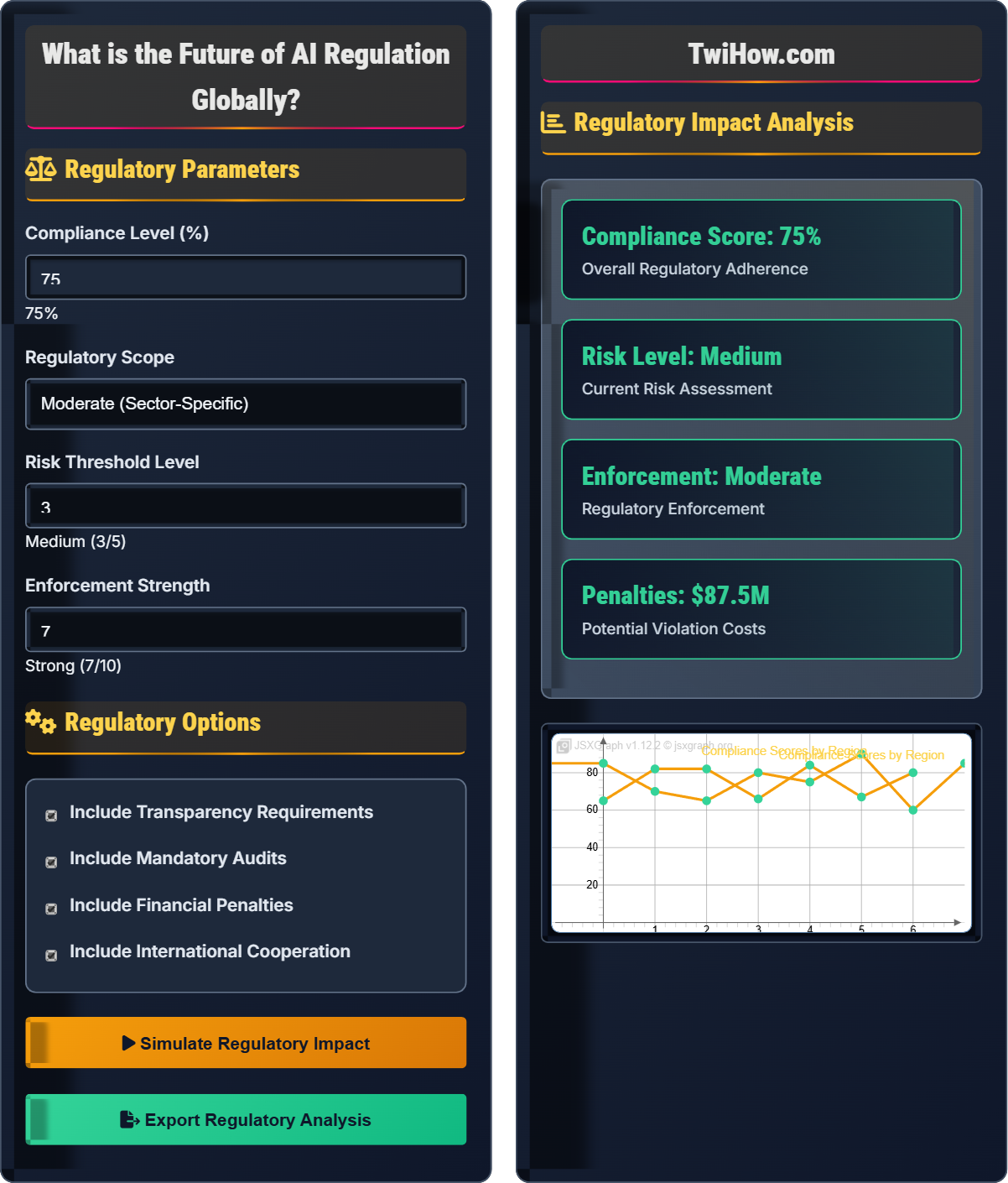
Regulatory Impact Analysis
| Region | Compliance | Risk Level | Penalties ($) |
|---|---|---|---|
| EU | 85% | High | $5M |
| US | 70% | Medium | $2M |
| China | 65% | High | $3M |
| UK | 80% | Medium | $1.5M |
| Canada | 75% | Low | $1M |
The Future of AI Regulation Explained
The future of AI regulation involves coordinated international efforts to establish consistent standards while respecting regional differences. Key trends include:
- Harmonization Efforts: International cooperation through organizations like OECD and G7
- Principle-Based Approaches: Flexible frameworks focusing on ethical principles
- Adaptive Regulations: Dynamic rules that evolve with technology
- Cross-Border Compliance: Unified standards for global AI deployment
Effective AI regulation frameworks typically include:
Where:
- Risk Assessment: Evaluation of potential harm from AI systems
- Compliance Requirements: Technical and procedural obligations
- Enforcement Mechanisms: Monitoring, penalties, and remediation
Future AI regulation will concentrate on:
- Algorithmic Accountability: Ensuring AI systems can be audited and explained
- Bias Prevention: Mitigating discriminatory outcomes in AI decision-making
- Data Governance: Protecting privacy and ensuring ethical data use
- Safety Standards: Preventing harmful AI behaviors and ensuring reliability
- Human Oversight: Maintaining human control over critical AI decisions
- Transparency: Requiring disclosure of AI use and capabilities
- Risk-Based Approach: Proportionate regulation based on potential harm
- Sandbox Frameworks: Controlled environments for testing innovative AI
- Soft Law: Non-binding principles and guidelines
- Co-Regulation: Industry self-regulation with government oversight
- Adaptive Regulation: Rules that update automatically with technology
Regulatory Fundamentals
Risk assessment, compliance frameworks, accountability mechanisms, transparency requirements, algorithmic audit standards.
Regulatory Impact = Risk Level × Compliance Burden × Enforcement Strength
Where Risk Level = Potential harm from AI system, Compliance Burden = Required measures, Enforcement Strength = Monitoring effectiveness.
- Regulations must balance innovation with protection
- Transparency enables accountability
- International coordination prevents regulatory arbitrage
Implementation Strategies
Principle-based, outcome-focused, technology-neutral, sector-specific, cross-border compliance.
- Stakeholder engagement and consultation
- Impact assessment and draft legislation
- Public review and revision
- Implementation and enforcement setup
- Ongoing monitoring and adaptation
- Technological neutrality
- Proportionality to risk
- International interoperability
- Stakeholder engagement
AI Regulation Learning Quiz
Which of the following represents the most effective approach for regulating AI systems with varying risk levels?
The risk-based approach is most effective because it tailors regulatory requirements to the potential harm of AI systems. Low-risk applications face minimal restrictions while high-risk systems undergo rigorous oversight. This approach balances innovation incentives with protection of public interests, allowing beneficial AI to flourish while safeguarding against significant risks.
The answer is B) Risk-based approach.
Understanding the risk-based approach is fundamental to grasping modern AI regulation. This approach recognizes that not all AI systems pose equal threats to society. By categorizing AI systems based on their potential for harm, regulators can apply proportionate oversight that doesn't stifle innovation while still protecting public welfare. This method allows for dynamic regulation that can adapt to new technologies.
Risk-Based Approach: Regulatory framework that scales requirements based on potential harm
Proportionality: Matching regulatory burden to actual risk level
Regulatory Arbitrage: Companies moving operations to avoid strict regulations
• Regulatory intensity should match risk level
• Flexibility allows adaptation to new technologies
• Clear categorization prevents confusion
• Consider potential consequences when evaluating AI systems
• Balance innovation with protection
• Look for successful implementations in other domains
• Applying uniform standards regardless of risk
• Over-regulating low-risk applications
• Under-regulating high-risk systems
Explain the challenges and opportunities of international coordination in AI regulation. Why is global cooperation essential for effective AI governance?
Challenges: Different political systems, cultural values, economic priorities, and legal traditions create diverse regulatory approaches. National sovereignty concerns limit willingness to cede authority to international bodies. Varying levels of technological development create different priorities and capabilities.
Opportunities: Shared standards prevent regulatory fragmentation, facilitate cross-border trade, and ensure consistent safety measures. Joint research initiatives accelerate regulatory science. Mutual recognition agreements reduce compliance burdens.
Essentiality: AI systems transcend borders, making unilateral regulation ineffective. Malicious actors can exploit weak regulatory jurisdictions. Global challenges like AI safety and bias require coordinated responses.
International coordination in AI regulation presents both significant challenges and unprecedented opportunities. The global nature of AI technology means that unilateral national approaches are insufficient. Effective governance requires balancing respect for national sovereignty with the need for consistent global standards. This challenge mirrors historical efforts in other global domains like finance and environmental protection.
Regulatory Harmonization: Aligning standards across different jurisdictions
Soft Law: Non-binding international agreements and principles
Regulatory Arbitrage: Exploiting differences in regulatory standards
• Technology transcends national boundaries
• Consistent standards prevent market fragmentation
• International cooperation requires trust-building
• Start with shared principles before detailed rules
• Build trust through transparency and dialogue
• Focus on minimum viable standards first
• Attempting immediate comprehensive harmonization
• Ignoring cultural and political differences
• Overlooking implementation challenges
A multinational tech company is developing an AI-powered hiring tool that will be deployed in multiple countries. The system analyzes resumes and conducts preliminary interviews. Describe the regulatory considerations they must address, including compliance strategies for different jurisdictions and potential challenges in meeting diverse requirements.
Regulatory Considerations: EU AI Act requires transparency and human oversight for high-risk systems affecting employment. US Equal Employment Opportunity Commission enforces anti-discrimination laws. Canadian AI systems must comply with privacy and human rights legislation.
Compliance Strategy: Implement highest common denominator standards across all markets. Establish local compliance teams for jurisdiction-specific requirements. Conduct regular bias audits and maintain documentation for regulatory scrutiny.
Challenges: Conflicting requirements between jurisdictions, high compliance costs, rapid regulatory changes, and technical complexity of ensuring fairness across different cultural contexts.
Recommendation: Proactive engagement with regulators, continuous monitoring of regulatory changes, and investment in explainable AI technologies.
Hiring AI systems represent one of the most challenging categories for regulation because they directly impact fundamental human rights. These systems must navigate complex legal landscapes involving employment law, anti-discrimination legislation, privacy rights, and due process. The stakes are particularly high because these systems can perpetuate or amplify existing societal biases.
High-Risk AI: Systems that significantly impact individuals' rights or safety
Algorithmic Bias: Systematic discrimination by AI systems
Due Process: Right to fair and transparent decision-making
• Employment AI faces strict scrutiny globally
• Anti-discrimination laws apply to AI systems
• Transparency requirements are increasing
• Conduct bias testing before deployment
• Maintain detailed audit trails
• Implement human oversight mechanisms
• Assuming AI is neutral and unbiased
• Failing to test across demographic groups
• Neglecting to document decision-making processes
A financial institution wants to deploy an AI system for credit scoring but faces regulatory pressure to ensure fairness and explainability. Propose a regulatory compliance framework that addresses transparency, bias prevention, and accountability requirements while maintaining business effectiveness.
Transparency Measures: Implement explainable AI techniques, provide clear reasons for credit decisions, and publish annual fairness reports detailing demographic impact.
Bias Prevention: Regular algorithmic auditing using diverse test datasets, adverse impact testing, and bias correction techniques during model training.
Accountability Framework: Establish clear responsibility chains, implement human review for marginal cases, and create appeal processes for rejected applicants.
Compliance Monitoring: Continuous fairness metrics tracking, regular third-party audits, and integration with regulatory reporting systems.
Credit scoring represents a critical application area where AI regulation has significant impact. Financial institutions face dual pressures: regulatory compliance requirements and competitive business needs. Success requires integrating regulatory considerations into the design phase rather than treating them as post-hoc additions. This approach, known as "regulation by design," is becoming increasingly important.
Adverse Impact: Disproportionate negative effect on protected groups
Regulation by Design: Integrating compliance requirements into system architecture
Fair Lending Laws: Legal requirements for non-discriminatory credit practices
• Algorithmic decisions must be explainable
• Fair lending laws apply to AI systems
• Regular auditing is mandatory
• Start with explainable models when possible
• Implement bias detection early in development
• Document all decision criteria and processes
• Using black-box models without explanation capability
• Neglecting to test for disparate impact
• Failing to maintain audit trails
Which trend is most likely to shape the future of AI regulation globally?
Risk-based, principle-driven frameworks offer the best balance between innovation and protection. This approach provides flexibility to address new technologies while maintaining clear guardrails. It allows for proportionate regulation that doesn't stifle beneficial AI while ensuring adequate safeguards. This model is already being adopted by major economies like the EU and US.
The answer is B) Risk-based, principle-driven frameworks.
The future of AI regulation lies in frameworks that can adapt to rapidly evolving technology. Purely prescriptive approaches become obsolete quickly, while completely flexible approaches lack necessary safeguards. Risk-based frameworks provide the optimal balance by establishing clear principles and risk categories while allowing flexibility in implementation. This approach is proving successful in other complex technological domains.
Principle-Driven Regulation: Framework based on ethical principles rather than technical specifics
Regulatory Agility: Ability to adapt rules to changing circumstances
Proportionate Response: Regulatory action matching risk level
• Regulations must adapt to technological change
• Risk-based approaches offer best balance
• International coordination is essential
• Focus on outcomes rather than specific technologies
• Build in review and adaptation mechanisms
• Engage with international standard-setting bodies
• Creating overly rigid technical specifications
• Failing to plan for technological evolution
• Neglecting international cooperation
FAQ
Q: How can we ensure AI regulations keep pace with technological advancement?
A: Effective AI regulation requires adaptive mechanisms:
1. Principle-Based Frameworks: Establish high-level ethical principles rather than specific technical requirements
2. Regular Review Cycles: Mandate periodic assessment and updates of regulatory frameworks
3. Regulatory Sandboxes: Create controlled environments for testing innovative applications
4. Expert Advisory Bodies: Establish ongoing consultation with technologists and ethicists
5. Post-Market Surveillance: Monitor real-world impacts and adjust accordingly
Success depends on building flexibility into regulatory structures while maintaining core protective principles.
Q: What's the difference between AI ethics and AI regulation?
A: These concepts work together but serve different functions:
AI Ethics: Moral principles and values that guide responsible AI development. Includes concepts like fairness, transparency, and accountability. Often voluntary and aspirational.
AI Regulation: Legally binding rules and requirements enforced by government authorities. Includes specific compliance obligations, penalties, and enforcement mechanisms.
Think of ethics as the "why" behind responsible AI and regulation as the "how" with enforceable requirements. Effective governance requires both: ethical foundations inform regulatory frameworks, while regulations ensure ethical principles are implemented.