How Do I Create an Incident Response Plan?
Complete security guide • Step-by-step explanations
Incident Response Plan:
Show Planning AssistantAn incident response plan is a documented set of procedures for detecting, responding to, and recovering from cybersecurity incidents. It defines roles, responsibilities, communication protocols, and specific actions to take during security events to minimize damage and restore operations.
A well-designed plan enables organizations to respond quickly and effectively to security incidents, reducing potential damage and downtime.
Key components:
- Preparation: Establishing team, tools, and procedures
- Identification: Detecting and analyzing security events
- Containment: Limiting incident impact and spread
- Eradication: Removing threats and vulnerabilities
- Recovery: Restoring normal operations
- Lessons Learned: Improving future response
Successfully creating an incident response plan requires understanding potential threats, defining clear roles, and establishing communication protocols that can be executed under pressure.
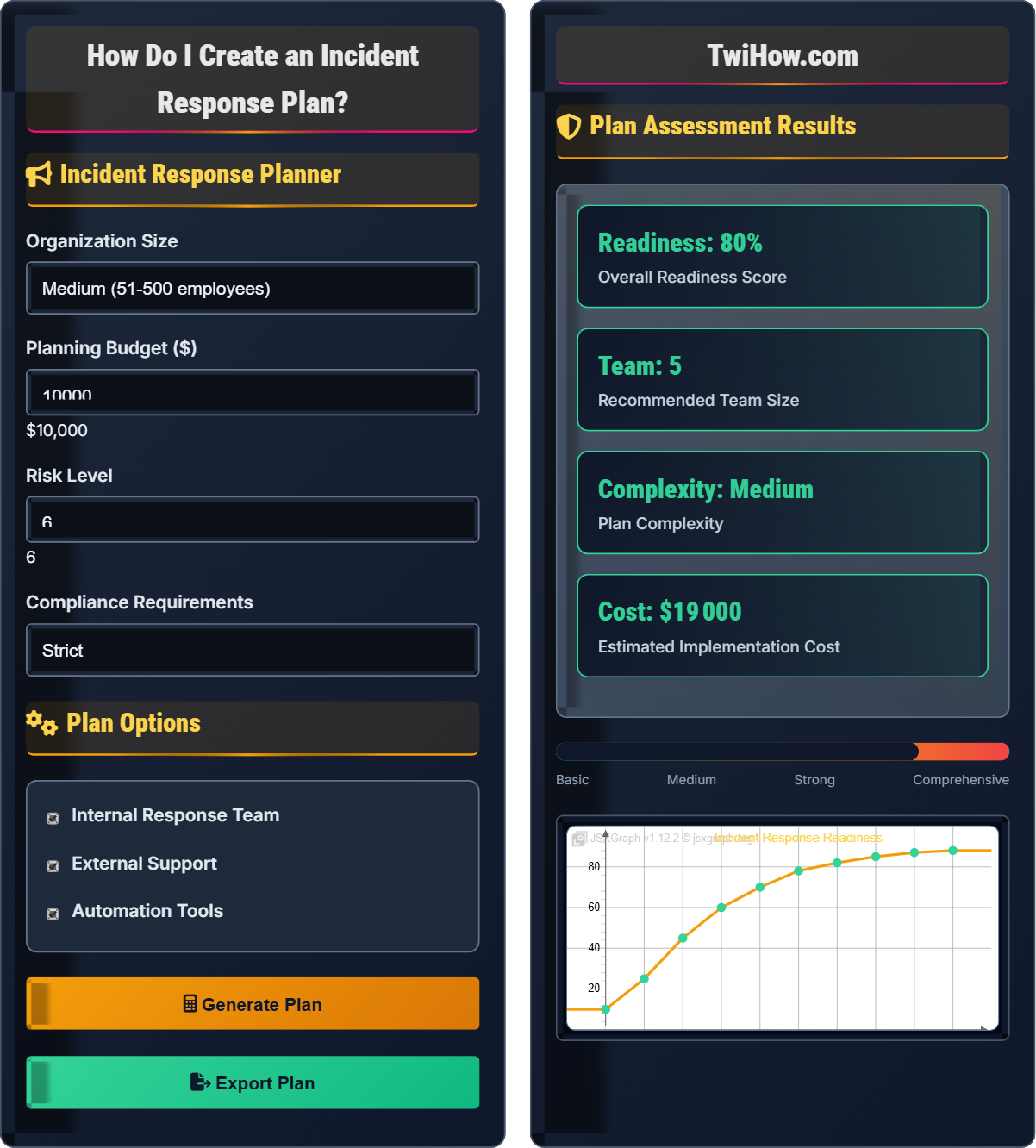
Incident Response Planner
Plan Options
Plan Assessment Results
| Phase | Duration | Priority | Resources |
|---|---|---|---|
| Preparation | 2-4 weeks | High | Training, Tools |
| Identification | Minutes-Hours | High | Monitoring, Analysis |
| Containment | Hours-Days | High | Isolation, Blocking |
| Eradication | Days-Weeks | Medium | Cleaning, Patching |
Incident Response Plan Explained
An incident response plan is a documented set of procedures for detecting, responding to, and recovering from cybersecurity incidents. It defines roles, responsibilities, communication protocols, and specific actions to take during security events to minimize damage and restore operations.
Incident Impact = (Time_to_Detect × Severity) + (Time_to_Respond × Spread_Factor)
Where:
- Incident Impact: Total damage caused by the security event
- Time to Detect: Duration between incident occurrence and detection
- Time to Respond: Duration between detection and initial response
- Spread Factor: Rate of incident propagation
- Remediation Time: Duration to fully resolve the incident
Key components of an effective incident response plan:
- Response Team Structure: Defined roles and responsibilities
- Communication Protocols: Internal and external communication procedures
- Incident Classification: Severity levels and response procedures
- Response Procedures: Step-by-step incident handling processes
- Resource Inventory: Tools, equipment, and contact information
- Training Programs: Regular drills and skill development
- Documentation: Incident tracking and post-mortem procedures
- Legal Compliance: Regulatory reporting and legal considerations
- Phase 1: Assessment and planning (2-4 weeks)
- Phase 2: Team formation and training (4-8 weeks)
- Phase 3: Tool acquisition and setup (2-4 weeks)
- Phase 4: Plan development and testing (4-6 weeks)
- Phase 5: Full implementation and maintenance (ongoing)
Incident Response Phases
Preparation, identification, containment, eradication, recovery, lessons learned.
Incident Impact = (Time_to_Detect × Severity) + (Time_to_Respond × Spread_Factor)
Where Incident Impact = total damage, Time_to_Detect = detection duration, Spread_Factor = propagation rate.
- Preparation is crucial for effective response
- Quick detection reduces impact
- Containment prevents spread
Team Structure
Small, medium, large, enterprise team structures.
- Identify critical roles
- Select qualified personnel
- Define responsibilities
- Provide training
- Conduct regular drills
- Review and update roles
- Assign clear roles
- Provide regular training
- Test response procedures
- Update plans regularly
Incident Response Process
| Phase | Description | Duration | Key Activities | Success Metrics |
|---|---|---|---|---|
| Preparation | Planning and readiness | 2-4 weeks | Team formation, training, tools | Plan completeness, team readiness |
| Identification | Detection and analysis | Minutes-hours | Monitoring, investigation | Detection time, accuracy |
| Containment | Limiting impact | Hours-days | Isolation, blocking | Containment speed, effectiveness |
| Eradication | Removing threats | Days-weeks | Cleaning, patching | Removal completeness |
| Recovery | Restoring operations | Days-weeks | System restoration | Recovery time, integrity |
| Lessons Learned | Improvement | Days-weeks | Analysis, updates | Plan improvements |
Incident Type Selection
1. Immediate Response: Isolate affected systems and disconnect from network
2. Analysis: Identify malware type and infection vector
3. Containment: Prevent spread to other systems
4. Eradication: Remove malware and clean systems
5. Recovery: Restore from clean backups
6. Lessons Learned: Update security measures to prevent recurrence
Response Team Structure
• Overall incident coordination and decision-making
• Resource allocation and stakeholder communication
• Escalation and authority for critical decisions
• Technical analysis and remediation
• Forensic investigation and evidence preservation
• System restoration and security measures
• Internal and external communication
• Press releases and stakeholder updates
• Legal and regulatory communication
• Regulatory compliance and reporting
• Legal implications and evidence handling
• Notification requirements and deadlines
• Clear Chain of Command: Single decision maker to avoid confusion
• Specialized Roles: Leverage expertise in specific areas
• Backup Personnel: Ensure continuity during absences
• Regular Training: Maintain readiness through exercises
• Communication Protocols: Establish clear reporting channels
Response Process Steps
Develop comprehensive incident response procedures, establish team roles, acquire necessary tools, and conduct regular training exercises. This phase is crucial for effective response when incidents occur.
Detect security events through monitoring systems, analyze potential incidents to confirm their validity, and assess their severity and potential impact on the organization.
Take immediate action to limit the incident's impact, isolate affected systems, and prevent further spread while preserving evidence for investigation.
Remove the root cause of the incident, eliminate threats from affected systems, and address vulnerabilities that allowed the incident to occur.
Safely restore affected systems to normal operation, verify integrity, and monitor for signs of residual threats or reinfection.
Conduct a post-incident review, document lessons learned, update procedures, and implement improvements to prevent similar incidents in the future.
Incident Response Planning Timeline
Incident Response Knowledge Quiz
What is the correct order of the six phases in the incident response lifecycle?
The correct order of incident response phases is: Preparation, Identification, Containment, Eradication, Recovery, and Lessons Learned. This sequence ensures that proper planning occurs before incidents, followed by detection, immediate response actions, threat removal, system restoration, and finally improvement based on experience.
The answer is A) Preparation, Identification, Containment, Eradication, Recovery, Lessons Learned.
The incident response lifecycle follows a logical sequence that maximizes effectiveness. Preparation must occur before incidents to ensure readiness. Identification comes next to confirm incidents. Containment limits damage, followed by eradication to remove threats. Recovery restores operations, and lessons learned improve future responses. This systematic approach ensures comprehensive incident handling.
Incident Response Lifecycle: Systematic approach to handling security incidents
Preparation Phase: Planning and readiness activities
Lessons Learned: Post-incident improvement activities
• Follow the established sequence
• Preparation is crucial
• Continuous improvement
• Memorize the phase sequence
• Practice each phase
• Regular plan updates
• Skipping preparation phase
• Confusing phase order
• Not conducting lessons learned
Explain the essential roles in an incident response team and their responsibilities.
Essential Incident Response Team Roles:
1. Incident Commander:
• Overall incident coordination and decision-making authority
• Resource allocation and stakeholder communication
• Escalation management and final decision authority
• Ensures all team members are executing their roles effectively
2. Technical Lead:
• Technical analysis and forensic investigation
• System remediation and evidence preservation
• Threat analysis and vulnerability assessment
• Technical recommendations to the commander
3. Communications Lead:
• Internal and external communication management
• Stakeholder updates and press relations
• Legal and regulatory communication coordination
• Maintains communication logs and documentation
4. Legal/Compliance Lead:
• Regulatory compliance and reporting requirements
• Legal implications and evidence handling procedures
• Notification requirements and deadline management
• Coordination with legal counsel
5. Operations Lead:
• Business continuity and operational impact assessment
• Coordination with business units and services
• Resource allocation and operational requirements
• Recovery planning and implementation
Role Characteristics:
• Each role should have defined backup personnel
• Clear escalation procedures for each role
• Regular training and skill maintenance
• Authority commensurate with responsibilities
A well-structured team ensures coordinated, effective response to security incidents.
Effective incident response requires specialized roles to handle different aspects of security incidents. The division of responsibilities ensures comprehensive coverage while preventing role conflicts or gaps. Each role contributes unique expertise to the response effort, and the structure provides clear accountability and decision-making authority. Understanding these roles is essential for creating an effective response team.
Incident Commander: Overall incident coordination authority
Technical Lead: Technical analysis and remediation specialist
Communications Lead: Internal and external communication coordinator
• Define clear roles and responsibilities
• Provide adequate training
• Maintain backup personnel
• Cross-train team members
• Regular team exercises
• Clear authority levels
• Unclear role definitions
• No backup personnel
• Inadequate training
A company discovers that ransomware has encrypted critical systems during a weekend. The incident was detected Monday morning. What is the immediate response plan and what are the key considerations for each phase?
Immediate Response Plan:
Phase 1: Immediate Actions (First 1-2 hours):
• Activate IR Team: Notify all team members and convene
• Confirm Incident: Verify ransomware and scope of infection
• Isolate Systems: Immediately disconnect affected systems from network
• Preserve Evidence: Document initial state before taking action
Phase 2: Containment (Next 2-4 hours):
• Network Segmentation: Isolate affected network segments
• System Shutdown: Power off infected systems to prevent spread
• Backup Verification: Check clean backups are accessible
• Communication: Inform leadership and key stakeholders
Phase 3: Analysis (Next 4-8 hours):
• Root Cause: Identify initial infection vector
• Scope Assessment: Determine full extent of compromise
• Impact Analysis: Evaluate business impact and recovery options
• Threat Assessment: Analyze ransomware variant and capabilities
Phase 4: Recovery Planning (Next 8-24 hours):
• Recovery Strategy: Decide between paying ransom or restoring from backups
• Resource Mobilization: Acquire necessary tools and expertise
• Communication Plan: Prepare stakeholder notifications
• Recovery Timeline: Develop restoration schedule
Key Considerations:
• Decision Making: Avoid hasty decisions under pressure
• Legal Implications: Consult legal counsel before paying ransoms
• Regulatory Requirements: Meet notification deadlines
• Business Continuity: Minimize operational disruption
Recovery Execution:
• System Restoration: Rebuild systems from clean backups
• Security Hardening: Apply patches and security measures
• Monitoring: Enhanced monitoring for reinfection
• Verification: Confirm system integrity before returning to operations
Lessons Learned:
• Post-Incident Review: Analyze response effectiveness
• Process Improvement: Update procedures based on experience
• Security Enhancement: Implement additional protective measures
Ransomware incidents require rapid, coordinated response to minimize damage. The key is to act decisively while maintaining clear thinking. Immediate containment is critical to prevent spread. Decision-making about ransom payment involves legal, financial, and operational considerations. The response demonstrates the importance of having pre-established procedures and trained personnel ready to execute them under pressure.
Ransomware: Malware that encrypts files demanding payment for decryption
Containment: Limiting incident impact and spread
Business Continuity: Maintaining operations during disruptions
• Act quickly but thoughtfully
• Preserve evidence
• Consider legal implications
• Maintain offline backups
• Regular security updates
• Employee training
• Panicking and making hasty decisions
• Paying ransom without legal consultation
• Not preserving evidence
Design a communication protocol for an incident response team that ensures effective coordination during security incidents. What channels, timing, and stakeholders should be included?
Communication Protocol Design:
1. Communication Channels:
• Primary Channel: Secure instant messaging (Slack, Teams) with encrypted channels
• Backup Channel: Conference bridge with dial-in capabilities
• Emergency Channel: SMS/text messaging for urgent notifications
• Documentation: Shared document repository for real-time updates
2. Communication Timing:
• Initial Alert: Within 15 minutes of incident detection
• Status Updates: Every 30 minutes during active response
• Major Milestones: Upon completing each response phase
• Final Update: When incident is resolved
3. Stakeholder Groups:
• Executive Leadership: C-level executives and board members
• Department Heads: IT, Operations, Legal, HR, Communications
• External Parties: Customers, partners, regulators, law enforcement
• Employees: All staff during significant incidents
4. Message Templates:
• Initial Alert: Incident type, severity, initial impact, response team status
• Status Update: Current status, actions taken, next steps, timeline
• Resolution: Incident summary, resolution details, lessons learned
• External Notification: Customer notification, regulatory filing, media statement
5. Communication Hierarchy:
• Internal Communications: Incident Commander to team leads
• Leadership Updates: Communications Lead to executive team
• External Communications: Legal/Compliance Lead with approval chain
• Technical Updates: Technical Lead to relevant teams
6. Escalation Procedures:
• Severity Levels: Define escalation triggers by incident severity
• Authority Matrix: Clear escalation paths and decision authority
• Time-Based Escalation: Automatic escalation if no response received
• After-Hours Procedures: Contact protocols for non-business hours
Implementation:
• Pre-incident: Establish contact lists, test communication channels
• During incident: Follow established protocols, maintain logs
• Post-incident: Review communication effectiveness, update procedures
Effective communication ensures coordinated response and stakeholder confidence during security incidents.
Communication during security incidents is critical for coordination and stakeholder confidence. The protocol must balance speed with accuracy, ensure all necessary parties are informed, and maintain clear authority structures. Having predefined templates and procedures reduces stress during incidents and ensures consistent, professional communication regardless of the responder.
Communication Protocol: Established procedures for information sharing
Stakeholder Groups: Individuals or organizations affected by incidents
Escalation Procedures: Processes for raising incident severity
• Establish protocols before incidents
• Test communication channels
• Maintain clear authority
• Use multiple communication channels
• Prepare message templates
• Regular communication drills
• No predefined communication protocols
• Unclear authority structures
• Inconsistent messaging
What is the most critical element of the preparation phase in incident response?
While all elements are important, establishing clear procedures and training is the most critical element of the preparation phase. Without clear, well-understood procedures and properly trained personnel, even the best tools and documentation will be ineffective during an actual incident. Training ensures that team members can execute procedures effectively under pressure and make critical decisions when needed.
The answer is B) Establishing clear procedures and training.
The preparation phase sets the foundation for effective incident response. While tools, documentation, and communication are all important, the human element is paramount. Procedures provide the roadmap for response, but training ensures that team members can execute those procedures effectively, especially under the stress of an actual incident. Regular training and drills build muscle memory and confidence, which are crucial during real emergencies.
Preparation Phase: Planning and readiness activities before incidents
Procedures: Step-by-step instructions for response activities
Training: Skill development and practice exercises
• Train before incidents occur
• Test procedures regularly
• Update training materials
• Conduct regular drills
• Cross-train team members
• Practice under stress
• Inadequate training
• Outdated procedures
• No regular testing
FAQ
Q: How much should a small business spend on incident response planning?
A: Small businesses should budget appropriately based on their risk profile and resources:
Basic Planning (Budget: $1,000-5,000):
• Develop written incident response procedures
• Designate key personnel and roles
• Create basic communication plans
• Implement basic monitoring tools
Enhanced Planning (Budget: $5,000-15,000):
• Purchase specialized incident response tools
• Conduct formal training for team members
• Engage external consultants for plan review
• Implement automated detection systems
Advanced Planning (Budget: $15,000-50,000+):
• Full-time incident response personnel
• Sophisticated monitoring and analysis tools
• Regular penetration testing and drills
• 24/7 incident response capability
Key Considerations:
• The cost of a security incident far exceeds prevention costs
• Consider cyber insurance coverage
• Leverage managed security services
• Start with basic planning and expand gradually
For most small businesses, investing $3,000-10,000 in incident response planning provides significant protection against cyber threats.
Q: How often should we test our incident response plan?
A: Regular testing is crucial for maintaining plan effectiveness:
Tabletop Exercises:
• Frequency: Quarterly for critical systems
• Purpose: Test decision-making and communication
• Participants: All response team members
• Duration: 2-4 hours per session
Functional Drills:
• Frequency: Semi-annually
• Purpose: Test technical procedures and tools
• Participants: Technical team members
• Duration: 4-8 hours per drill
Full-Scale Exercises:
• Frequency: Annually
• Purpose: Comprehensive plan validation
• Participants: Entire response team and stakeholders
• Duration: 8-24 hours
Ad-Hoc Testing:
• Frequency: Monthly informal tests
• Purpose: Validate communication and basic procedures
• Duration: 30-60 minutes
After-Action Reviews:
• Conduct immediately after each test
• Document lessons learned
• Update procedures based on findings
• Retest improved procedures
Regular testing ensures the plan remains current, effective, and that team members maintain their skills and readiness.
Q: What regulatory requirements apply to incident response planning?
A: Several regulatory frameworks mandate incident response planning:
Healthcare (HIPAA):
• Requirements: Security Rule mandates incident response procedures
• Notification: Breach notification within 60 days
• Documentation: Maintain incident response records
Financial Services (GLBA, SOX):
• Requirements: Safeguards Rule for information security
• Reporting: Federal banking agency notification
• Controls: Incident response as part of security program
Payment Processing (PCI DSS):
• Requirement: Incident response plan for card data
• Response: Immediate response to security incidents
• Reporting: Notification to payment brands
Government (FedRAMP, NIST):
• Standards: NIST SP 800-61 for incident handling
• Procedures: Six-phase incident response process
• Coordination: US-CERT notification requirements
State Laws (Breach Notification):
• Varies: 48 states have breach notification laws
• Timelines: Usually 30-60 days for notification
• Content: Specific information requirements
International (GDPR):
• Notification: 72-hour breach notification to authorities
• Documentation: Detailed record keeping
• Measures: Appropriate technical and organizational measures
Industry-Specific:
• Energy (NERC CIP): Cyber incident reporting
• Aviation (FAA): Cybersecurity incident reporting
• Manufacturing (NIST CSF): Incident response framework
Organizations should consult legal counsel to ensure compliance with applicable regulations and maintain proper documentation of incident response activities.