How Do I Encrypt My Files and Communications?
Encryption guide • Cybersecurity essentials
Encryption Fundamentals:
Encryption SimulatorEncryption is the process of converting readable data into an encoded format that can only be accessed by authorized parties. It protects your files and communications from unauthorized access, ensuring privacy and security. Modern encryption uses complex mathematical algorithms to scramble data.
Key encryption concepts:
- Symmetric Encryption: Same key used for encryption and decryption
- Asymmetric Encryption: Different keys for encryption and decryption (public/private key pairs)
- AES (Advanced Encryption Standard): Widely used symmetric encryption algorithm
- PGP (Pretty Good Privacy): Popular encryption program for email and file encryption
- End-to-End Encryption: Data encrypted from sender to recipient, unreadable by intermediaries
Encryption protects against data breaches, eavesdropping, and unauthorized access to sensitive information.
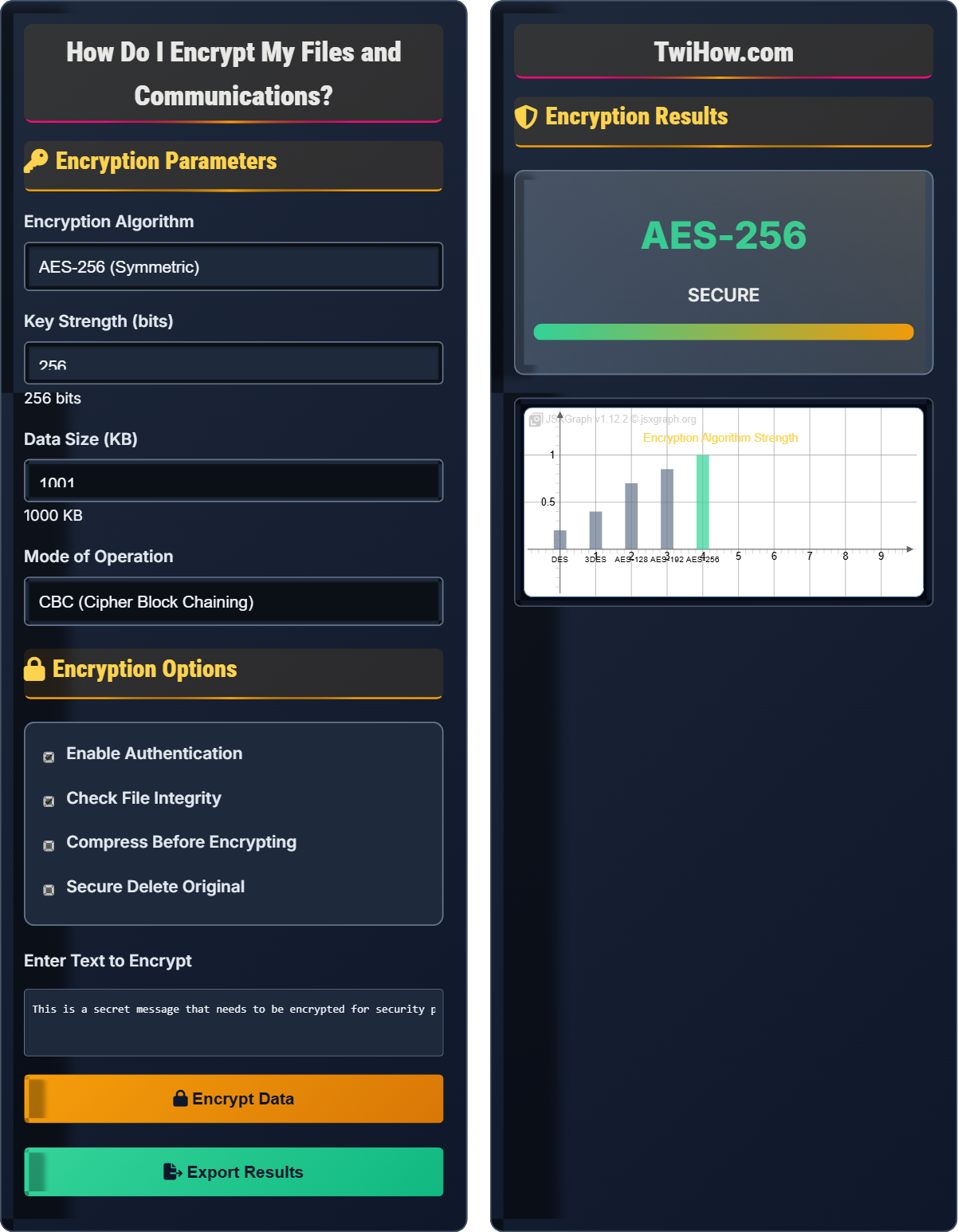
Encryption Parameters
Encryption Options
Encryption Results
Encrypted Data
Decryption Key
| Metric | Value |
|---|---|
| Encryption Time | 2.4s |
| Throughput | 417 KB/s |
| Security Level | Very High |
| File Size | 1.0 MB |
Encryption Fundamentals
Encryption is the process of converting plaintext (readable data) into ciphertext (encoded data) using an algorithm and a key. Only authorized parties with the correct key can decrypt the data back to its original form. Encryption ensures confidentiality, integrity, and authenticity of digital information.
Basic encryption formula:
Decryption formula:
Where:
- Plaintext: Original readable data
- Ciphertext: Encoded data after encryption
- Key: Secret value used to encrypt/decrypt data
- Algorithm: Mathematical procedure for encryption
Most widely used encryption standard, fast and secure.
Used for digital signatures and key exchange.
Popular for email and file encryption.
- ECB (Electronic Codebook): Simplest mode, encrypts blocks independently
- CBC (Cipher Block Chaining): Links blocks together for better security
- CTR (Counter): Turns block cipher into stream cipher
- GCM (Galois/Counter): Provides encryption and authentication
Encryption Methods
Uses the same key for encryption and decryption. Fast and efficient for large amounts of data.
Uses a pair of keys - public key for encryption and private key for decryption. Slower but enables secure key exchange.
Data is encrypted on the sender's device and only decrypted on the recipient's device. Even service providers cannot read the content.
Practical Encryption Tools
- VeraCrypt: Full disk encryption for drives and containers
- 7-Zip: File compression with AES encryption
- GNU Privacy Guard (GPG): Command-line encryption tool
- Bcrypt: Cross-platform encryption utility
- Signal: End-to-end encrypted messaging app
- ProtonMail: Encrypted email service
- WireGuard: Secure VPN protocol
- PGP Email: Email encryption using public keys
- WPA3: Latest Wi-Fi security standard
- TLS/SSL: Web traffic encryption (HTTPS)
- VPNs: Encrypt internet traffic
- SSH: Secure shell for remote connections
Encryption Knowledge Quiz
Which encryption method is most commonly used for securing web communications (HTTPS)?
Web communications use a hybrid approach combining RSA and AES. RSA is used for key exchange (asymmetric encryption), while AES encrypts the actual data (symmetric encryption). This provides both the security of key exchange and the efficiency of symmetric encryption for large data transfers.
The answer is C) Hybrid (RSA + AES).
In practical applications, we often combine different encryption methods to leverage their strengths. Asymmetric encryption like RSA solves the key distribution problem but is computationally expensive for large data. Symmetric encryption like AES is efficient but requires secure key sharing. The hybrid approach uses asymmetric encryption to securely exchange a symmetric key, then uses that key for efficient bulk encryption.
Symmetric Encryption: Same key used for encryption and decryption
Asymmetric Encryption: Different keys for encryption and decryption (public/private)
Hybrid Encryption: Combination of symmetric and asymmetric methods
• Symmetric = Speed, Asymmetric = Key Distribution
• Hybrid = Best of both worlds
• HTTPS uses TLS handshake with hybrid approach
• Remember: RSA for keys, AES for data
• Think of RSA as a secure envelope for the AES key
• Always use proven implementations
• Assuming single algorithm handles everything
• Not understanding key exchange process
• Confusing key sizes between algorithms
Explain the process of encrypting a file using AES-256 in CBC mode. What are the key components and why is this mode preferred over ECB?
AES-256 in CBC Mode:
Components: 256-bit key, initialization vector (IV), plaintext divided into 128-bit blocks
Process: 1) Divide plaintext into 128-bit blocks, 2) XOR first block with IV, 3) Encrypt with AES key, 4) Use previous ciphertext as next block's input, 5) Repeat for all blocks
Why CBC over ECB: CBC provides better security by linking blocks together. ECB produces identical ciphertext for identical plaintext blocks, revealing patterns. CBC uses an IV and previous ciphertext to ensure identical plaintext blocks encrypt differently.
Block cipher modes determine how algorithms handle data longer than their block size. ECB (Electronic Codebook) treats each block independently, leading to pattern preservation in the ciphertext. CBC (Cipher Block Chaining) chains blocks together, where each block depends on all previous blocks. This diffusion property makes CBC much more secure for general-purpose encryption, though it requires an initialization vector and doesn't support parallel processing.
Initialization Vector (IV): Random value used to ensure unique encryption
Block Cipher: Encrypts fixed-size blocks of data
Diffusion: Property where small changes affect many parts of output
• IV must be unique for each encryption
• CBC requires sequential processing
• Never use ECB for general encryption
• Use random IVs for each encryption
• Consider GCM for authenticated encryption
• Remember: patterns in ECB reveal information
• Reusing IVs with same key
• Using ECB for images/text
• Not handling padding correctly
Your company needs to securely transmit sensitive financial documents to a partner organization. The documents are approximately 50MB each and must be protected during transit and at rest. Design an encryption strategy that addresses key exchange, data protection, and verification of document integrity. Include specific algorithms and implementation details.
Strategy: Use hybrid encryption with RSA for key exchange and AES-256-GCM for data encryption.
Implementation:
1. Key Exchange: Partner generates RSA-2048 key pair, shares public key
2. Data Encryption: Generate random AES-256 key, encrypt document with AES-256-GCM
3. Key Protection: Encrypt AES key with partner's public RSA key
4. Transmission: Send encrypted document + encrypted AES key
5. Verification: Include SHA-256 hash for integrity checking
This approach provides confidentiality, integrity, and authentication while maintaining efficiency.
Real-world encryption requires balancing security, efficiency, and usability. For large files, symmetric encryption is essential for performance, but key distribution requires asymmetric methods. Authenticated encryption modes like GCM provide both confidentiality and integrity protection in a single operation. Including hash functions allows verification of data integrity without additional computational overhead.
Hybrid Encryption: Combines symmetric and asymmetric methods
Authenticated Encryption: Provides confidentiality and integrity
Key Exchange: Securely sharing encryption keys between parties
• Use proven cryptographic libraries
• Implement proper key management
• Always verify data integrity
• Use established protocols like S/MIME or PGP
• Implement key rotation schedules
• Consider using PKI infrastructure
• Rolling custom encryption implementations
• Not securing key exchange channels
• Ignoring integrity verification
You're designing a secure messaging app that requires end-to-end encryption. Users should be able to send messages that only the intended recipient can read, without the server storing decryption keys. Explain the cryptographic approach you would use and address key distribution, forward secrecy, and key recovery challenges.
Approach: Implement Signal Protocol or similar double-ratchet algorithm.
Key Distribution: Users publish long-term identity keys and signed prekeys on the server. Short-term ephemeral keys are exchanged directly during session establishment.
Forward Secrecy: Use Diffie-Hellman key exchanges with ephemeral keys that are discarded after use. Each message uses a new key derived from previous keys.
Key Recovery: Implement backup encryption with user-controlled recovery codes, or use trusted contact recovery methods.
This ensures that even if long-term keys are compromised, past communications remain secure.
End-to-end encryption for messaging requires sophisticated key management to balance security and usability. Forward secrecy ensures that compromising current keys doesn't reveal past communications. The double-ratchet mechanism combines the Diffie-Hellman ratchet (for forward secrecy) with the symmetric-key ratchet (for deniability) to achieve strong security properties. This demonstrates how complex real-world cryptographic systems combine multiple techniques.
Forward Secrecy: Compromising current keys doesn't affect past communications
Double Ratchet: Signal Protocol's key derivation mechanism
Identity Keys: Long-term keys for user identification
• Never store private keys on servers
• Implement perfect forward secrecy
• Use authenticated encryption
• Study existing secure messaging protocols
• Use established cryptographic libraries
• Implement proper key backup strategies
• Not implementing forward secrecy
• Storing keys on central servers
• Using weak key derivation methods
Which of the following is NOT a property provided by properly implemented AES-256-GCM encryption?
AES-256-GCM provides confidentiality (keeping data secret), integrity (ensuring data hasn't been tampered with), and authentication (verifying the sender's identity through the encryption key). However, it does not provide non-repudiation, which is the ability to prove that a specific party sent a message. Non-repudiation requires digital signatures with asymmetric cryptography, not just symmetric encryption.
The answer is D) Non-repudiation.
It's crucial to understand the differences between various security properties. While confidentiality, integrity, and authentication are related and can be provided simultaneously by authenticated encryption modes like GCM, non-repudiation is fundamentally different. Non-repudiation requires proof that can be verified by third parties, which symmetric encryption cannot provide since both parties share the same key. This is why digital signatures using asymmetric cryptography are needed for non-repudiation.
Confidentiality: Data remains secret from unauthorized parties
Integrity: Data hasn't been altered maliciously
Authentication: Verifying the identity of communicating parties
Non-repudiation: Proof that a party sent a message
• AES-GCM = Confidentiality + Integrity + Authentication
• Non-repudiation requires asymmetric cryptography
• Symmetric encryption doesn't provide non-repudiation
• Remember: Symmetric = Shared secrets
• Asymmetric = Individual keys
• Combine methods for complete security
• Confusing authentication with non-repudiation
• Assuming encryption provides all security properties
• Not understanding the differences between properties
FAQ
Q: What's the difference between encryption and hashing?
A: Encryption and hashing are both cryptographic techniques but serve different purposes:
Encryption: Reversible process that converts data into ciphertext using a key. The same key (or a related key) can decrypt the data back to its original form. Used for confidentiality.
Hashing: Irreversible process that converts data into a fixed-size hash value. The same input always produces the same hash, but you cannot reverse the process to get the original data. Used for integrity verification and password storage.
For example, AES encryption can be reversed with the key, but SHA-256 hashing cannot be reversed to obtain the original data.
Q: Should I encrypt all my business data, or just sensitive information?
A: While encrypting all data provides maximum security, it's often impractical and costly. Instead, implement a data classification scheme:
Highly Sensitive: Customer PII, financial records, intellectual property - ALWAYS encrypt
Moderately Sensitive: Internal communications, employee data - Encrypt in transit and at rest
Public/Non-sensitive: Marketing materials, press releases - May not require encryption
Focus on encrypting data that would cause harm if compromised. Use full-disk encryption on laptops and mobile devices, encrypt data in transit, and implement proper key management. The goal is to protect against reasonable threats while maintaining operational efficiency.
Q: What are the performance implications of encryption, and how can I optimize it?
A: Encryption does introduce performance overhead, but modern algorithms are quite efficient:
AES Performance: Modern CPUs include hardware acceleration (AES-NI) making encryption nearly free for most applications
Asymmetric Operations: RSA operations are slower than symmetric encryption; use hybrid approaches
Optimization Strategies:
1. Use hardware-accelerated algorithms when available
2. Implement encryption in chunks rather than all at once
3. Use streaming encryption for large files
4. Cache encrypted results when possible
5. Consider compression before encryption (smaller data = faster encryption)
For most applications, the security benefits far outweigh the minimal performance cost, especially with modern hardware.