What are the biggest cybersecurity threats in 2026?
Complete 2026 cybersecurity threat guide • Step-by-step explanations
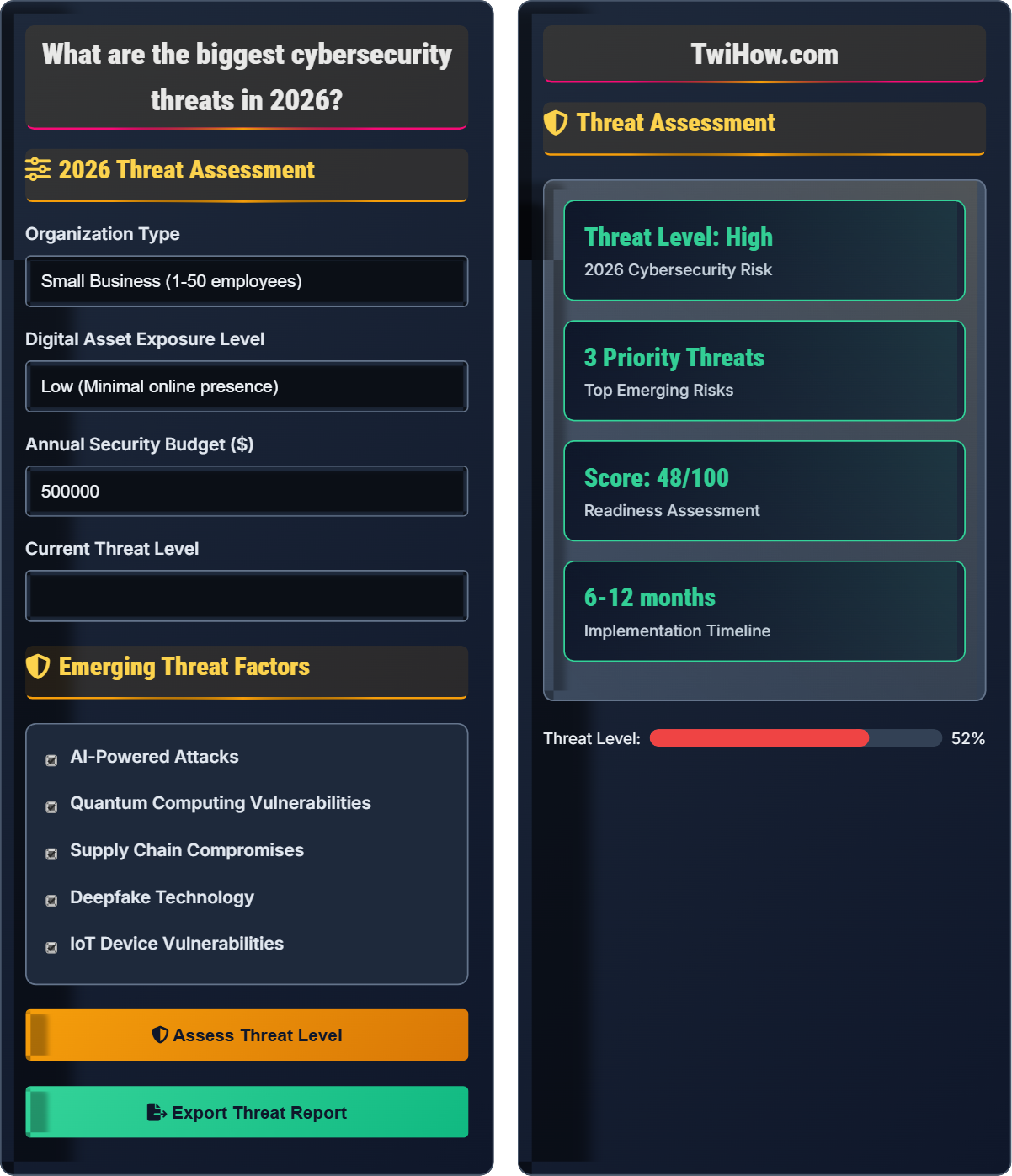
2026 Cybersecurity Threat Landscape:
Show Threat AssessmentThe cybersecurity landscape in 2026 will be shaped by emerging technologies, evolving threat actor strategies, and increased digital interconnectedness. Key threats include AI-powered attacks, quantum computing vulnerabilities, supply chain compromises, and nation-state cyber warfare. Organizations must prepare for sophisticated attacks leveraging machine learning, deepfakes, and automated social engineering.
Key concepts:
- AI-Powered Threats: Machine learning-enhanced attack vectors
- Quantum Computing: Cryptographic vulnerabilities and new attack methods
- Supply Chain Attacks: Third-party vulnerabilities and software compromises
- Deepfake Technology: Advanced social engineering and identity fraud
Proactive preparation and adaptive security measures will be essential for defending against these evolving threats. Organizations must invest in emerging security technologies, workforce training, and resilient infrastructure to maintain cyber resilience.
2026 Threat Assessment
Emerging Threat Factors
Threat Assessment
2024-2025: AI-enhanced attacks become mainstream
2025-2026: Quantum computing poses real cryptographic threats
2026-2027: Supply chain attacks evolve in sophistication
• Zero-trust architecture adoption accelerates
• Behavioral analytics and UEBA mature
• Autonomous security orchestration increases
• Privacy-preserving technologies advance
2026 Cybersecurity Threats Explained
The cybersecurity landscape in 2026 will be characterized by sophisticated attacks leveraging artificial intelligence, quantum computing capabilities, and advanced social engineering techniques. Threat actors will employ machine learning to automate attacks, create realistic deepfakes, and bypass traditional security measures. Organizations must prepare for threats that adapt and evolve in real-time, requiring dynamic defense strategies.
Effective threat assessment follows a comprehensive risk evaluation approach:
Where:
- Attack Sophistication: Complexity and capability of threat actors
- Asset Value: Criticality and sensitivity of digital assets
- Defense Capability: Effectiveness of security controls
- Exposure Factor: Degree of vulnerability to threats
Key threat categories expected to dominate in 2026:
- AI-Powered Attacks: Machine learning-enhanced phishing, social engineering, and malware
- Quantum Computing Threats: Cryptographic vulnerabilities and new attack methods
- Supply Chain Attacks: Third-party software and hardware compromises
- Deepfake Technology: Advanced social engineering and identity fraud
- IoT Vulnerabilities: Exploitation of connected devices and smart systems
- Nation-State Cyber Warfare: Sophisticated state-sponsored attacks
- Zero-Trust Architecture: Verify all users and devices before granting access
- AI-Powered Security: Deploy machine learning to detect and respond to threats
- Quantum-Resistant Cryptography: Prepare for post-quantum cryptographic standards
- Supply Chain Security: Validate and monitor third-party vendors
- Behavioral Analytics: Monitor user and system behavior for anomalies
- Autonomous Response: Implement automated incident response capabilities
2026 Threat Landscape
AI-powered attacks, quantum computing threats, supply chain vulnerabilities, deepfakes, IoT security, nation-state warfare.
Threat Level = (Sophistication × Asset Value) / (Defense Capability) × Exposure
Where Threat Level = risk assessment, Sophistication = attack complexity, Asset Value = criticality of assets, Defense Capability = security controls, Exposure = vulnerability level.
- Prepare for AI-enhanced attacks
- Implement quantum-resistant cryptography
- Secure supply chains rigorously
- Train workforce on deepfake detection
- Monitor IoT device vulnerabilities
Mitigation Strategies
Zero-trust architecture, behavioral analytics, autonomous response, privacy-preserving technologies, quantum-safe encryption.
- Threat intelligence gathering and analysis
- Asset inventory and risk assessment
- Technology selection and planning
- Workforce education and training
- Infrastructure implementation and testing
- Incident response preparation
- Technology evolution pace is accelerating
- Threat actors are increasingly sophisticated
- Regulatory compliance requirements are expanding
- Skills gaps continue to widen
2026 Cybersecurity Threat Quiz
What is the most significant cybersecurity threat posed by AI advancement in 2026?
The most significant cybersecurity threat from AI advancement is automated phishing and social engineering attacks. AI enables threat actors to create highly personalized, convincing attacks at scale, making traditional security awareness training less effective. AI can analyze social media, corporate communications, and other data sources to craft targeted attacks that are difficult to distinguish from legitimate communications.
The answer is B) Automated phishing and social engineering attacks.
AI's ability to process vast amounts of data and generate human-like content creates new attack vectors that traditional security measures may not detect. The sophistication of AI-generated content means that even security-aware individuals may fall victim to well-crafted attacks. This represents a fundamental shift in cybersecurity, where the human element becomes an even greater vulnerability.
AI-Powered Attacks: Threats enhanced by artificial intelligence
Phishing: Fraudulent attempts to obtain sensitive information
Social Engineering: Psychological manipulation to gain access
• AI attacks are highly personalized
• Traditional awareness training may be insufficient
• Technical controls are increasingly important
• Implement behavioral analytics
• Use AI-powered security tools
• Verify communications through secondary channels
• Relying solely on human judgment
Explain how quantum computing poses a cybersecurity threat in 2026 and describe the preparations organizations should make to address this threat.
Quantum Computing Cybersecurity Threats:
Quantum computers will be capable of breaking current cryptographic algorithms that secure most digital communications. RSA, ECC, and other widely-used encryption methods could be cracked in hours rather than centuries, rendering current security measures obsolete.
Organizational Preparations:
1. Inventory Cryptographic Assets: Identify all systems using current cryptographic standards
2. Implement Post-Quantum Cryptography: Begin transitioning to quantum-resistant algorithms
3. Hybrid Approaches: Deploy both current and quantum-resistant encryption during transition
4. Key Management: Update key management practices for new algorithms
5. Vendor Assessment: Evaluate third-party providers' quantum readiness
6. Staff Training: Educate IT teams on quantum security implications
Organizations should begin quantum-resistant transitions immediately, as the process will take several years to complete.
Quantum computing represents a paradigm shift in cybersecurity, as it threatens the fundamental assumption that current encryption is computationally infeasible to break. The threat is not just about quantum computers existing, but about adversaries potentially harvesting encrypted data today with the intention of decrypting it once quantum computers become available. This "harvest now, decrypt later" strategy makes preparation critical.
Quantum Computing: Computational systems using quantum mechanics
Post-Quantum Cryptography: Quantum-resistant encryption algorithms
Cryptographic Agility: Ability to update encryption methods
• Start preparation immediately
• Plan for multi-year transition
• Implement hybrid cryptographic approaches
• Monitor NIST standardization progress
• Pilot post-quantum algorithms
• Plan for cryptographic agility
• Waiting until quantum computers are widespread
• Not planning for data harvesting threats
• Underestimating transition complexity
A financial services company relies on 150+ software vendors and 50+ hardware suppliers. Calculate the potential impact of a supply chain attack and describe a comprehensive security strategy to mitigate this risk in 2026.
Supply Chain Attack Impact:
With 200+ vendors, the attack surface is enormous. A single compromised supplier could affect the entire organization, potentially leading to data breaches, system compromises, and regulatory violations. The financial and reputational impact could exceed $100 million based on similar incidents.
Comprehensive Security Strategy:
1. Vendor Risk Assessment: Implement continuous monitoring of all suppliers
2. Software Bill of Materials: Require detailed component inventories from vendors
3. Code Signing Verification: Validate authenticity of all software updates
4. Network Segmentation: Isolate vendor connections from critical systems
5. Supply Chain Mapping: Understand all upstream and downstream dependencies
6. Contractual Security Requirements: Mandate security standards in vendor agreements
7. Continuous Monitoring: Deploy tools to detect anomalous vendor behavior
8. Incident Response Planning: Develop specific response plans for supply chain compromises
9. Alternative Supplier Strategy: Maintain backup vendors for critical components
10. Security Automation: Implement AI-powered supply chain security monitoring
Supply chain security is exponentially complex due to the interconnected nature of modern business ecosystems. Each vendor represents a potential entry point for attackers, and the risk extends beyond direct suppliers to include their suppliers and partners. The SolarWinds attack demonstrated how a single compromised vendor can affect thousands of organizations globally.
Supply Chain Attack: Compromise of third-party vendors to access target
Bill of Materials: Detailed inventory of software components
Network Segmentation: Isolating vendor connections
• Treat all vendors as potential threats
• Implement continuous monitoring
• Maintain backup supplier relationships
• Use automated vendor risk platforms
• Implement software composition analysis
• Establish vendor security scorecards
• Not monitoring vendor security practices
• Lacking detailed supply chain visibility
• Inadequate incident response planning
Your organization has experienced an increase in deepfake audio/video attacks targeting executives for social engineering. Design a comprehensive defense strategy that incorporates both technological and procedural measures to protect against these threats in 2026.
Technological Defenses:
• Deepfake Detection Software: Deploy AI-powered tools to identify synthetic media
• Multi-Factor Authentication: Require multiple verification methods for sensitive requests
• Blockchain Verification: Use blockchain for authenticating critical communications
• Biometric Verification: Implement voice and facial recognition for identity confirmation
Procedural Measures:
• Communication Protocols: Establish formal verification procedures for financial requests
• Executive Training: Educate leadership on deepfake recognition and response
• Escalation Procedures: Define clear processes for suspicious communications
• Internal Communication Channels: Secure, verified channels for sensitive communications
Organizational Policies:
• Authorization Limits: Set spending thresholds requiring multiple approvals
• Emergency Procedures: Protocols for handling urgent requests from executives
• Incident Response: Rapid response team for suspected deepfake attacks
• Legal Preparedness: Legal framework for pursuing deepfake perpetrators
These combined measures create multiple layers of protection against sophisticated deepfake attacks.
Deepfake technology represents a fundamental challenge to the authenticity of digital communications. Traditional verification methods become inadequate when audio and video can be convincingly falsified. Defense requires a combination of advanced technology to detect fakes and procedural changes to verify the authenticity of critical communications through alternative means.
Deepfake: Synthetic media created using AI
Multi-Factor Authentication: Multiple verification methodsBiometric Verification: Identity confirmation using biological traits
• Never rely solely on audio/video for verification
• Implement multi-layered authentication
• Establish clear communication protocols
• Use unique verification phrases
• Implement time delays for critical requests
• Train staff on deepfake detection signs
• Treating video/audio as definitive proof
• Not updating verification procedures
• Lacking executive awareness training
Which of the following represents the most significant IoT security vulnerability in 2026?
The most significant IoT security vulnerability in 2026 is default passwords and weak authentication. Many IoT devices ship with default credentials that are never changed, and many lack robust authentication mechanisms. This creates an enormous attack surface where millions of devices can be easily compromised and used for botnets, data exfiltration, or lateral movement within networks.
The answer is B) Default passwords and weak authentication.
IoT security vulnerabilities often stem from the rapid deployment of devices without proper security consideration. The scale of IoT deployments means that even a small percentage of vulnerable devices can create massive security risks. Default credentials represent a fundamental security flaw that is easily exploited but often overlooked during device setup and management.
IoT: Internet of Things connected devices
Botnet: Network of compromised devices controlled by attackers
Default Credentials: Factory-set usernames and passwords
• Change all default passwords immediately
• Implement network segmentation for IoT devices
• Regularly update IoT device firmware
• Use IoT device management platforms
• Implement network access control
• Monitor IoT device behavior for anomalies
• Never changing default credentials
• Connecting IoT devices to main network
• Not monitoring device behavior
FAQ
Q: How much should we budget for cybersecurity in 2026 given these emerging threats?
A: Cybersecurity budget allocation should reflect the increased threat landscape in 2026:
Recommended Budget Allocation:
• Small businesses: 10-15% of IT budget (or $100-200 per employee annually)
• Medium businesses: 12-18% of IT budget (or $200-400 per employee annually)
• Large enterprises: 15-20% of IT budget (or $400-800 per employee annually)
Allocation Priorities for 2026:
• AI-powered security tools: 25-30% of security budget
• Threat intelligence and monitoring: 20-25%
• Staff training and awareness: 15-20%
• Incident response and forensics: 15-20%
• Emerging technology adoption (zero-trust, quantum-safe): 10-15%
• Compliance and governance: 5-10%
Consider that the cost of a major breach could exceed $10 million for large organizations, making security investments highly cost-effective.
Q: What specific technologies should we implement to defend against 2026 threats?
A: Essential technologies for 2026 cybersecurity defense include:
Zero-Trust Architecture Components:
• Identity and Access Management (IAM) with PAM and JIT access
• Network segmentation with micro-segmentation capabilities
• Device trust and posture management
• Continuous authentication and authorization
AI-Powered Security Tools:
• UEBA (User and Entity Behavior Analytics)
• XDR (Extended Detection and Response)
• SOAR (Security Orchestration, Automation, and Response)
• Threat hunting platforms with AI capabilities
Emerging Technologies:
• Quantum-resistant cryptographic solutions
• Blockchain for identity verification and data integrity
• Advanced endpoint detection and response (EDR)
• Cloud security posture management (CSPM)
• Container and Kubernetes security
Focus on integration between these tools to create a unified security ecosystem.
Q: How do we measure the effectiveness of our cybersecurity program against 2026 threats?
A: Effective cybersecurity measurement requires multiple metrics and assessment approaches:
Quantitative Metrics:
• Mean time to detect (MTTD) and mean time to respond (MTTR)
• Number of incidents detected and prevented
• Percentage of systems with up-to-date patches
• Number of successful phishing simulations
• Security tool coverage across infrastructure
Qualitative Assessments:
• Red team exercises and penetration testing results
• Third-party security assessments
• Security awareness training completion rates
• Incident response drill effectiveness
• Vendor security maturity assessments
Strategic Indicators:
• Threat intelligence integration effectiveness
• Security posture maturity score
• Regulatory compliance status
• Board-level security reporting quality
Conduct quarterly assessments and annual comprehensive security audits to ensure program effectiveness.