What are the Privacy Implications of Using Free Apps and Services?
Complete privacy guide • Step-by-step explanations
Privacy Fundamentals:
Show Privacy SimulatorFree apps and services often collect extensive personal data to monetize their offerings. While users pay with attention and data instead of money, the privacy implications can be significant, including data tracking, profiling, and potential misuse of personal information.
Understanding these implications helps users make informed decisions about their digital privacy and take protective measures.
Key privacy concerns:
- Data Collection: Extensive gathering of personal information
- User Tracking: Monitoring behavior across platforms
- Data Monetization: Selling or sharing data with third parties
- Security Risks: Potential data breaches and vulnerabilities
Modern free services rely on sophisticated data collection mechanisms to fund their operations, creating a complex ecosystem of data flow between users, apps, and third-party entities.
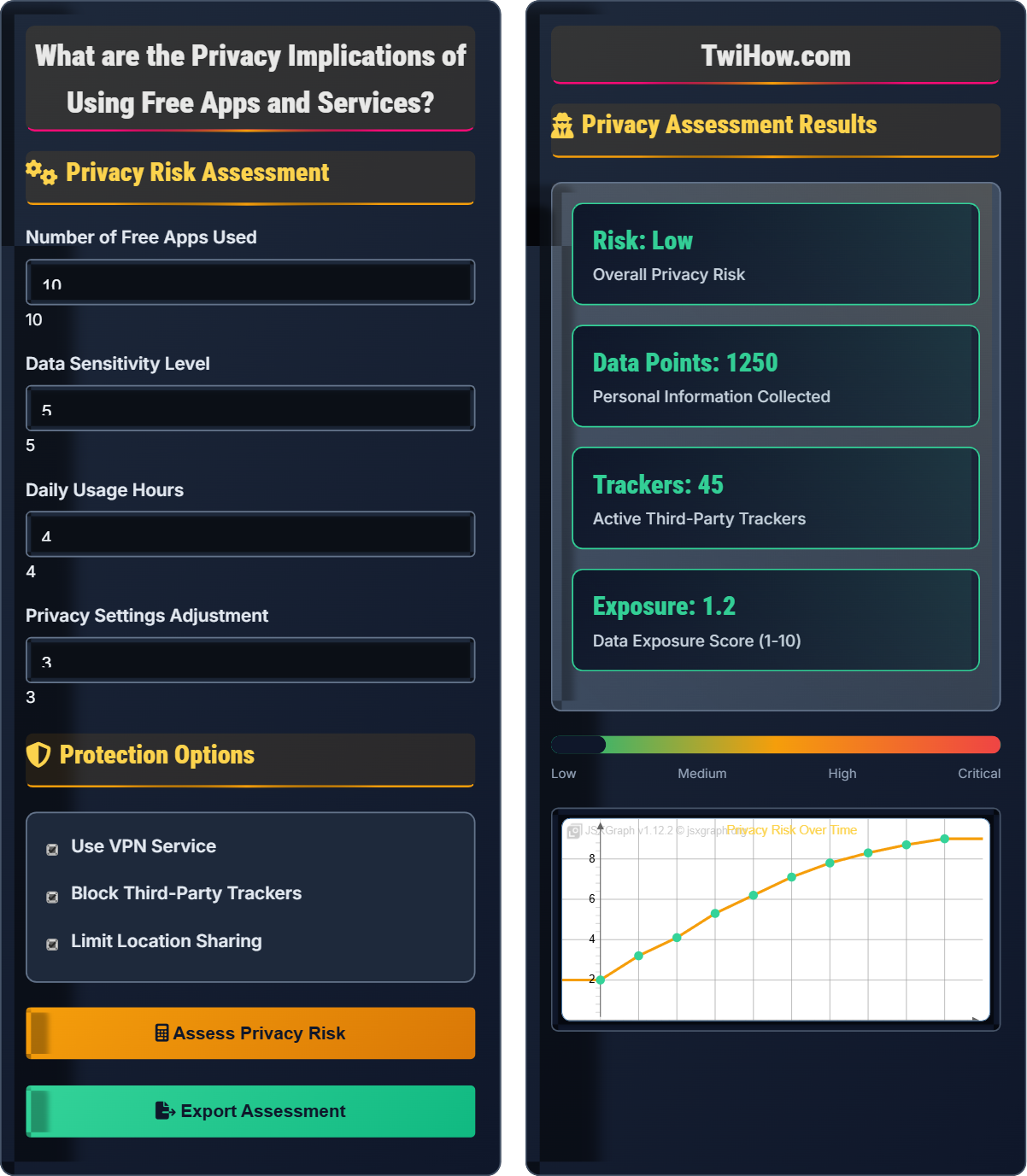
Privacy Risk Assessment
Protection Options
Privacy Assessment Results
| Risk Factor | Severity | Impact | Mitigation |
|---|---|---|---|
| Data Collection | High | Profile Creation | Review Permissions |
| Tracking | Medium | Behavioral Analysis | Use Ad Blocker |
| Data Sharing | High | Third-Party Access | Check Privacy Policy |
| Location | Medium | Geolocation Tracking | Limit Access |
Privacy Implications Explained
Privacy implications refer to the potential consequences of sharing personal information online. When using free apps and services, users often trade their privacy for convenience, functionality, or access. The collected data can be used for various purposes, from targeted advertising to behavioral analysis.
Free apps employ multiple data collection mechanisms:
Where:
- Explicit Data: Information users actively provide (profile details, preferences)
- Implicit Data: Behavioral data collected during usage (clicks, location, time spent)
- Derived Data: Insights inferred from collected data (interests, habits, social connections)
Risks associated with free apps and services:
- Data Breaches: Unauthorized access to personal information
- Identity Theft: Misuse of personal details for fraudulent purposes
- Targeted Scams: Personalized phishing attempts based on collected data
- Surveillance Capitalism: Exploitation of personal data for profit
- Discrimination: Algorithmic bias based on collected characteristics
- Loss of Control: Limited ability to manage personal information
- Read Privacy Policies: Understand what data is collected and how it's used
- Adjust Settings: Configure privacy controls to limit data sharing
- Use Security Tools: Install ad blockers, VPNs, and privacy-focused browsers
- Minimize Permissions: Grant only necessary app permissions
- Monitor Accounts: Regularly review connected services and data access
- Choose Alternatives: Consider privacy-focused apps and services
Data Collection Methods
App permissions, behavioral tracking, metadata collection, device fingerprinting.
Total Data = Explicit Data + Implicit Data + Derived Data
Where Total Data = comprehensive user profile, Explicit = provided info, Implicit = observed behavior.
- More apps = More data collection
- Sensitive data increases privacy risk
- Third-party sharing amplifies exposure
Protection Strategies
Privacy settings, VPN usage, permission management, secure browsers, data minimization.
- Assess app necessity
- Review privacy policies
- Configure privacy settings
- Monitor data access
- Use security tools
- Regular privacy audits
- Minimal data sharing
- Secure communication channels
- Stay informed about privacy laws
Data Flow Visualization
- Personal Information: Name, email, phone number
- Usage Data: App usage patterns, time spent, features used
- Location Data: GPS coordinates, IP address, movement patterns
- Device Information: Model, OS, hardware specifications
- Behavioral Data: Clicks, searches, preferences
Tracking Simulation
Simulation Result: Based on your app usage patterns, approximately 40 different tracking entities may have access to your data across the apps you use.
This demonstrates how multiple tracking systems work together to build a comprehensive profile of your online activities.
Recent Privacy Incidents Timeline
Privacy Implications Quiz
Which of the following is NOT a common method used by free apps to collect user data?
Free apps commonly collect data through app permissions (access to contacts, location, camera), device fingerprinting (creating unique identifiers), and behavioral tracking (monitoring user actions). Quantum encryption is a security technology used to protect data, not collect it.
The answer is D) Quantum encryption.
Understanding how apps collect data is crucial for protecting privacy. App permissions give explicit access to device features and data. Device fingerprinting creates unique identifiers based on device characteristics. Behavioral tracking monitors user interactions to build profiles. These methods work together to create comprehensive user profiles that can be monetized.
App Permissions: Access rights granted to applications for device features
Device Fingerprinting: Creating unique identifiers from device characteristics
Behavioral Tracking: Monitoring user actions and interactions
• Review permissions before installing apps
• Understand what data is being collected
• Regularly audit app permissions
• Use minimal permission approach
• Research apps before installation
• Check privacy policies regularly
• Accepting all permissions without review
• Installing apps from unknown sources
• Ignoring privacy settings updates
Explain the relationship between the number of free apps used and privacy risk. How does data sensitivity affect this relationship?
Relationship Between App Count and Privacy Risk: There is a direct proportional relationship between the number of free apps used and privacy risk. Each additional app introduces new data collection points, increasing the total amount of personal information gathered.
Mathematical Relationship: Privacy Risk ∝ Number of Apps × Data Sensitivity × Usage Frequency
Amplification by Data Sensitivity: Apps that collect sensitive data (financial, health, location) significantly amplify the risk compared to those collecting general behavioral data. Sensitive data has higher value for malicious actors and greater potential for harm if compromised.
Compounding Effect: Multiple apps can share data with each other, creating a compounding effect where the combination of data from different sources creates a more detailed profile than any single app could achieve.
The privacy risk equation demonstrates how multiple factors interact to create cumulative risk. Each app acts as a separate data collection point, and when combined, they create a comprehensive profile. The sensitivity of data multiplies the potential impact of any breach. This is why privacy-conscious users limit the number of apps they install and carefully consider the sensitivity of data each app accesses.
Privacy Risk: Potential for harm from unauthorized data access or misuse
Data Sensitivity: Degree to which data could cause harm if exposed
Data Compounding: Increased risk from combining data from multiple sources
• Limit the number of installed apps
• Prioritize apps with lower data sensitivity
• Regularly audit app necessity
• Consolidate functionality in fewer apps
• Choose apps with privacy by design
• Regular privacy assessments
• Installing apps without considering data needs
• Assuming all apps have similar privacy practices
• Not reviewing app necessity periodically
Sarah uses 15 free apps daily, including social media, fitness tracking, banking, and navigation apps. She shares location data, health metrics, financial information, and personal photos. Calculate her privacy risk level and recommend specific mitigation strategies.
Risk Assessment:
• Number of apps: 15 (High multiplier)
• Data sensitivity: Very High (financial, health, location)
• Daily usage: High (increases exposure frequency)
• Risk Level: Critical
Mitigation Strategies:
1. Financial App: Use official bank app only, avoid third-party financial aggregators
2. Health Data: Limit sharing to healthcare providers, use local storage options
3. Location Services: Disable when not needed, use approximate location when possible
4. Social Media: Adjust privacy settings, limit personal information sharing
5. General: Use VPN, enable two-factor authentication, regular privacy audits
Real-world privacy scenarios require comprehensive risk assessment considering multiple factors. Sarah's case demonstrates how combining multiple sensitive data types across numerous apps creates a critical risk profile. The mitigation strategies focus on reducing the most sensitive data exposure while maintaining necessary functionality. This approach balances usability with privacy protection.
Risk Assessment: Evaluation of potential privacy threats and vulnerabilities
Mitigation Strategy: Method to reduce privacy risks while maintaining functionality
Data Sensitivity: Classification of data based on potential harm from exposure
• Prioritize sensitive data protection
• Regular privacy setting reviews
• Multi-layered security approach
• Conduct quarterly privacy audits
• Use privacy-focused alternatives when available
• Enable security notifications
• Over-sharing sensitive information
• Not updating privacy settings regularly
• Using same credentials across apps
You're evaluating a new free weather app that requests access to location, contacts, calendar, and microphone. The privacy policy states data may be shared with "partners for analytics and advertising." Analyze the privacy implications and recommend whether to install the app.
Privacy Implications Analysis:
• Location access: Justified for weather data, but could enable tracking
• Contacts/calendar: Not necessary for weather functionality, indicates overreach
• Microphone: Completely unnecessary for weather app, major privacy concern
• Data sharing: Vague language allows broad third-party access
Recommendation: Do NOT install this app. The requested permissions far exceed what's necessary for weather functionality. The privacy policy's vague language about data sharing indicates poor privacy practices. Instead, look for a weather app that only requests location access and has a clear, specific privacy policy.
Red Flags: Unnecessary permissions, vague data sharing language, excessive access requests.
Evaluating apps requires critical analysis of both requested permissions and privacy policies. Necessary permissions should align with app functionality. Vague language in privacy policies often indicates poor data handling practices. Users should always question permissions that seem excessive for the app's core function and research alternative apps with better privacy practices.
Permission Overreach: Requesting more access than necessary for functionality
Vague Privacy Language: Unclear policies allowing broad data use
Privacy Red Flags: Indicators of poor privacy practices
• Match permissions to functionality
• Look for specific data use policies
• Avoid apps with excessive permissions
• Read privacy policies before installation
• Check app reviews for privacy concerns
• Use privacy-focused app stores
• Accepting all permissions without review
• Ignoring privacy policy language
• Installing apps based on popularity alone
Which of the following provides the MOST comprehensive protection against privacy risks from free apps?
No single method provides comprehensive protection against privacy risks. A VPN protects network traffic but doesn't limit app permissions. Permission limits reduce data collection but don't encrypt network traffic. Privacy browsers help with web tracking but don't affect app behavior. A comprehensive strategy combining multiple methods provides layered protection addressing different attack vectors.
The answer is D) Comprehensive privacy strategy including all methods.
Effective privacy protection requires a defense-in-depth approach. Different methods address different aspects of privacy risk: VPNs protect network traffic, permission management limits data access, privacy browsers block web trackers, and secure passwords prevent account compromise. Using multiple methods creates overlapping protection layers that are more effective than any single approach.
Defense-in-Depth: Multiple layers of security controls
Attack Vector: Pathway used to exploit security vulnerabilities
Privacy Layering: Combining multiple protection methods
• Use multiple protection methods
• Regular privacy assessments
• Stay updated on privacy threats
• Regular privacy audits
• Combine technical and behavioral methods
• Educate yourself on privacy best practices
• Relying on single protection method
• Not updating privacy practices regularly
• Ignoring behavioral privacy practices
FAQ
Q: If I'm not doing anything illegal, why should I care about privacy?
A: Privacy isn't just about hiding illegal activities; it's about maintaining control over your personal information and autonomy. Here's why it matters:
1. Data Aggregation: Seemingly innocent data points can be combined to reveal sensitive information about your life, relationships, and preferences.
2. Future Use: Today's "innocent" behavior might become problematic in the future due to changing laws, social norms, or personal circumstances.
3. Discrimination: Personal data can be used to discriminate against you in employment, insurance, credit, and other areas.
4. Manipulation: Detailed profiles can be used to manipulate your behavior, opinions, and decisions.
5. Security: Personal information can be used for identity theft, scams, and targeted attacks.
Privacy is a fundamental right that enables freedom of expression, thought, and association.
Q: Are paid apps more private than free apps?
A: Not necessarily, but there are important differences:
Free Apps: Typically monetize through data collection and targeted advertising. The business model relies on gathering user data to sell to advertisers or data brokers.
Paid Apps: Generate revenue directly from users, potentially reducing incentive to collect excessive data. However, some still collect data for analytics, improvement, or other purposes.
Important Considerations:
1. Privacy Policies: Both free and paid apps can have poor privacy practices regardless of pricing model.
2. Reputable Developers: Established companies may prioritize privacy to maintain customer trust, regardless of pricing.
3. Open Source: Open source apps (free or paid) offer transparency in data handling practices.
Always review privacy policies and permissions, regardless of pricing model. Paid doesn't automatically mean more private.
Q: How can I check what data an app has collected about me?
A: Many apps and platforms now provide data access tools thanks to privacy regulations:
For Major Platforms:
1. Google: Google Takeout allows downloading all your data
2. Facebook/Meta: Download your information feature
3. Apple: Privacy report in iOS settings
4. Android: Google Account privacy settings
General Methods:
1. Account Settings: Look for "Download my data" or "Privacy" sections
2. Privacy Requests: Contact companies to request your data under privacy laws
3. Permissions Review: Check what permissions each app has
4. Activity Logs: Review search history, location history, and other logs
Remember to also review browser history, cookies, and cached data for web-based tracking.