What Is End-to-End Encryption and Why Does It Matter?
Encryption guide • Digital privacy
E2E Encryption:
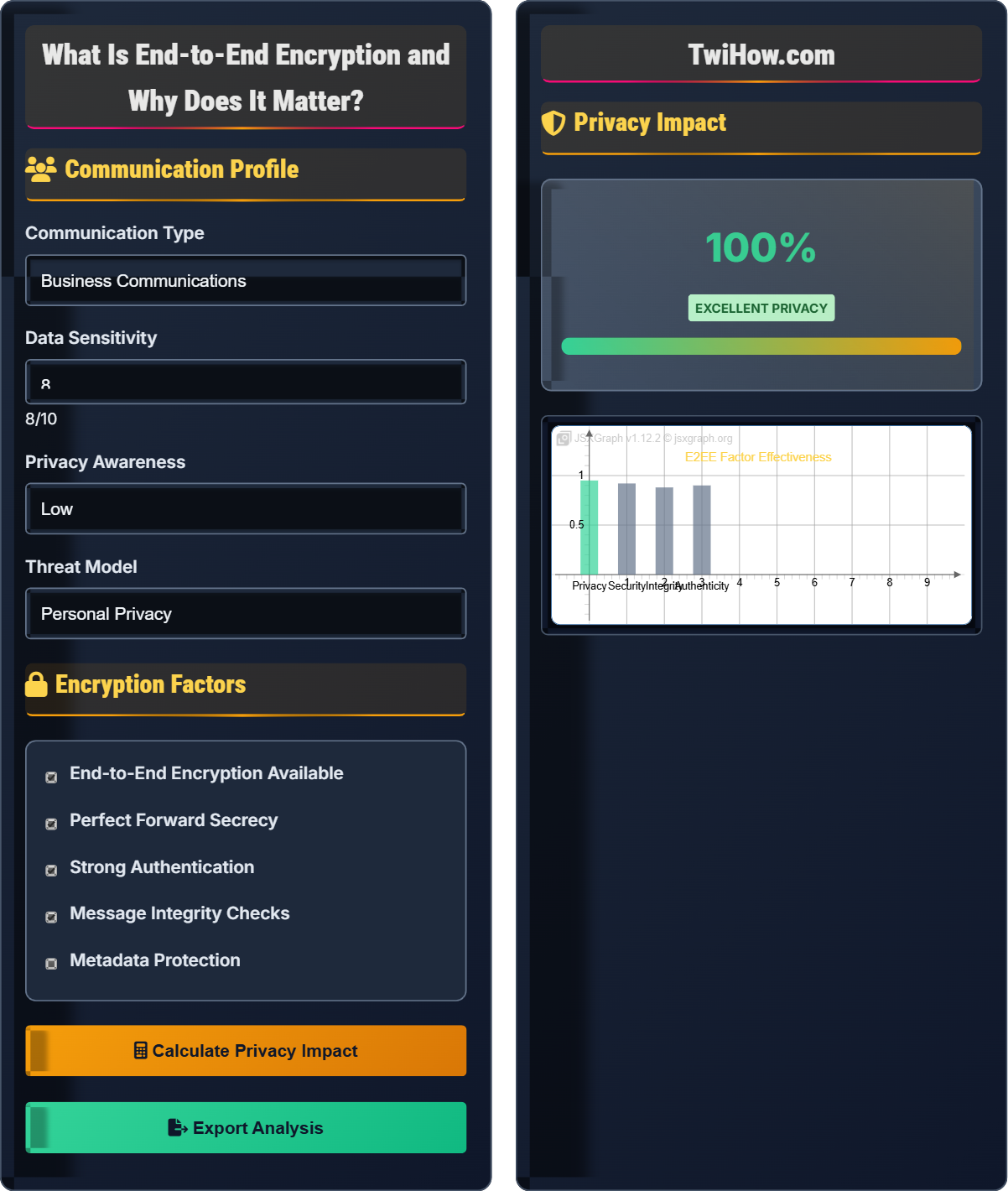
Privacy Impact CalculatorEnd-to-end encryption (E2EE) is a communication system where only the communicating users can read the messages. The data is encrypted on the sender's device and only decrypted on the recipient's device, ensuring that no intermediaries—including service providers—can access the content. This provides maximum privacy and security for digital communications.
Key E2EE concepts:
- Zero-Knowledge: Service providers cannot access message content
- Key Exchange: Secure sharing of encryption keys between parties
- Perfect Forward Secrecy: Compromised keys don't affect past communications
- Authentication: Verification of communicating parties' identities
- Integrity: Assurance that messages haven't been tampered with
E2EE is essential for protecting sensitive communications from interception, surveillance, and unauthorized access.
Communication Profile
Encryption Factors
Privacy Impact
Privacy Benefits
E2E Process
Risks Without E2E
End-to-End Encryption Fundamentals
End-to-end encryption ensures that data is encrypted on the sender's device and only decrypted on the recipient's device. Unlike transport encryption, which only protects data in transit, E2EE protects data throughout its entire journey. Even service providers cannot access the content, making it impossible for them to read, store, or share your communications.
End-to-end encryption process:
Where:
- Plaintext: Original readable message
- Ciphertext: Encrypted message content
- Public Key: Shared key for encryption
- Private Key: Secret key for decryption
Encryption occurs on sender's device and decryption on recipient's device.
Encryption only during transmission between client and server.
Server can access and process unencrypted data.
- Zero-Knowledge: Service providers cannot access content
- Perfect Forward Secrecy: Past communications remain secure if keys are compromised
- Authentication: Verification of communicating parties' identities
- Integrity: Assurance that messages haven't been altered
- Non-Repudiation: Proof of origin and delivery
E2EE Implementation Examples
- Double Ratchet: Combines Diffie-Hellman and symmetric-key ratchets
- Forward Secrecy: New keys generated for each message
- Deniability: Messages can't be proven to originate from specific users
- Authentication: Key fingerprint verification
- Hybrid Encryption: Combines symmetric and asymmetric encryption
- Web of Trust: Decentralized verification of public keys
- Digital Signatures: Authentication and integrity verification
- Key Management: Complex but secure key distribution
- SRTP: Secure Real-time Transport Protocol
- DTLS: Datagram Transport Layer Security
- Key Exchange: Secure negotiation of encryption keys
- Media Encryption: Audio and video streams encrypted
- Client-Side Encryption: Files encrypted before upload
- Key Management: Secure sharing of decryption keys
- Zero-Knowledge Storage: Providers cannot access files
- Link Sharing: Secure sharing with encryption key
Why E2EE Matters
- Personal Privacy: Protects intimate conversations and personal thoughts
- Freedom of Expression: Enables safe communication without fear of surveillance
- Whistleblowing: Protects sources and sensitive information sharing
- Journalism: Safeguards sources and confidential information
- Intellectual Property: Protects trade secrets and competitive information
- Financial Data: Secures transaction details and financial communications
- Client Confidentiality: Maintains attorney-client privilege and medical privacy
- Regulatory Compliance: Meets data protection requirements (GDPR, HIPAA)
- Mass Surveillance: Governments can access all communications
- Corporate Data Mining: Companies can analyze and monetize communications
- Data Breaches: Sensitive information in server databases vulnerable
- Targeted Attacks: Adversaries can intercept communications
E2EE Knowledge Quiz
What is the key difference between end-to-end encryption and transport encryption?
End-to-end encryption encrypts data on the sender's device and only decrypts it on the recipient's device, ensuring that even service providers cannot access the content. Transport encryption only protects data while it's traveling between the client and server, but the service provider can still access the data when it's stored on their servers.
The answer is B) E2EE encrypts data on sender's device and decrypts on recipient's device.
The fundamental distinction between E2EE and transport encryption lies in the scope of protection. E2EE provides protection throughout the entire communication lifecycle, from creation to consumption. This creates a "zero-knowledge" environment where service providers cannot access user communications, which is crucial for privacy protection.
End-to-End Encryption: Encryption from sender to recipient devices
Transport Encryption: Encryption during data transmission
Zero-Knowledge: Service providers cannot access content
• E2EE protects data throughout its lifecycle
• Service providers cannot access E2EE content
• Transport encryption has limited protection scope
• Look for E2EE indicators in messaging apps
• Verify encryption with contact verification
• Understand the difference in protection levels
• Confusing transport with end-to-end encryption
• Assuming all "secure" connections are E2EE
• Not verifying encryption implementation
Explain how perfect forward secrecy works in end-to-end encryption systems and why it's important. What happens if encryption keys are compromised without this feature?
Perfect Forward Secrecy: Each message or session uses a new, unique encryption key that's derived from previous keys but doesn't reveal them. Even if a current key is compromised, past communications remain secure because they used different keys.
Importance: Prevents mass compromise of historical communications if current keys are exposed.
Without PFS: If the master key or any long-lived key is compromised, all past and future communications encrypted with keys derived from it become vulnerable. This creates a single point of failure that can expose years of communications.
Perfect forward secrecy represents a critical security principle: limiting the damage from key compromise. Without PFS, a single key breach can expose all historical communications. With PFS, each communication session uses unique keys, so compromising one session doesn't affect others. This demonstrates how security systems should be designed with failure scenarios in mind.
Perfect Forward Secrecy (PFS): Future key compromise doesn't affect past communications
Key Derivation: Creating new keys from existing ones
Session Keys: Temporary keys for specific communications
• Each session should use unique keys
• PFS requires careful key management
• Look for PFS in secure communication tools
• Understand how keys are rotated
• Verify PFS implementation in protocols
• Not understanding PFS importance
• Assuming all encryption has PFS
• Not verifying PFS implementation
A healthcare organization needs to implement secure communication between doctors and patients for telemedicine consultations. They're considering various messaging platforms and must ensure HIPAA compliance. Evaluate the requirements for implementing end-to-end encryption in this scenario, including technical specifications, regulatory considerations, and potential challenges. What features should they look for in an E2EE solution?
Requirements:
1. Technical: True E2EE with authentication, integrity checks, and forward secrecy
2. Regulatory: HIPAA compliance with audit trails and access controls
3. Usability: Simple for non-technical patients to use
4. Integration: Compatible with existing medical systems
Features to Look For: Verified key exchange, message authentication, secure key storage, compliance certifications, audit capabilities, and integration APIs.
Challenges include ensuring patient adoption, maintaining compliance, and balancing security with accessibility.
Real-world E2EE implementation requires balancing multiple competing requirements. Healthcare adds complexity with regulatory compliance while maintaining usability for patients. This demonstrates how security must be integrated into broader system requirements rather than treated as an afterthought. The challenge lies in implementing robust security without sacrificing usability.
HIPAA: Health Insurance Portability and Accountability Act
Audit Trails: Records of all access and activities
Compliance: Meeting regulatory requirements
• Security must meet regulatory standards
• Usability affects security effectiveness
• Compliance requires documentation
• Test with actual users before deployment
• Verify compliance certifications
• Plan for ongoing compliance maintenance
• Not verifying true E2EE implementation
• Overlooking compliance requirements
• Not considering user experience
You're evaluating a messaging app that claims to offer end-to-end encryption. However, you notice that it allows message search across all conversations, cloud backup of messages, and integration with other services. How do these features potentially conflict with true end-to-end encryption, and what questions should you ask the service provider to verify the encryption implementation?
Potential Conflicts:
• Message Search: Requires server-side access to message content
• Cloud Backup: Messages must be stored unencrypted on servers
• Service Integration: Other services need access to message content
Questions to Ask: 1) How is search performed on encrypted content? 2) Where are backups stored and how are they encrypted? 3) What data is shared with integrated services? 4) Can the service provider access message content? 5) Are keys stored on servers? True E2EE should not require server-side access to message content.
This scenario highlights the tension between functionality and security. Many services claim E2EE while implementing features that inherently conflict with it. True E2EE means the service provider cannot access content, making features like search and backup challenging. Users must critically evaluate claims and ask specific technical questions to verify implementation.
Zero-Knowledge: Service provider cannot access content
Feature Conflict: Functionality that requires content access
Verification: Confirming encryption implementation
• True E2EE means zero-knowledge for providers
• Search requires content access
• Verify claims with technical questions
• Ask specific technical questions
• Look for open-source implementations
• Verify with independent security audits
• Accepting E2EE claims without verification
• Not understanding feature implications
• Assuming all "secure" services are equal
Which of the following is NOT a limitation or challenge of end-to-end encryption?
End-to-end encryption typically makes user experience more complex, not simpler. Users must manage encryption keys, verify contacts, and deal with technical complications. The other options are genuine challenges: message search is difficult because servers can't access encrypted content, computational overhead exists for encryption/decryption, and key management is complex in distributed systems.
The answer is C) Improved user experience and simplicity.
Security and usability often compete, and E2EE is a prime example. While it provides superior privacy, it also introduces complexity for users. This demonstrates the fundamental tension in security design between protection and convenience. Understanding these trade-offs is crucial for making informed decisions about security implementations.
Security-Usability Trade-off: Balance between protection and convenience
Key Management: Handling of encryption keys
Computational Overhead: Processing requirements for encryption
• Security often complicates usability
• Trade-offs must be carefully evaluated
• User experience affects security effectiveness
• Look for user-friendly E2EE implementations
• Consider training and support needs
• Balance security with usability requirements
• Assuming security improves usability
• Not considering user adoption challenges
• Overlooking support and training needs
FAQ
Q: Can end-to-end encryption be broken by governments or law enforcement?
A: When properly implemented, end-to-end encryption cannot be broken by governments or law enforcement using computational attacks. The math behind modern encryption is so strong that even nation-states cannot crack it within reasonable timeframes. However, they may attempt to access devices directly (at borders, through warrants), exploit implementation flaws, or use social engineering. The security depends on proper implementation, key management, and protecting devices from physical access.
Q: How does E2EE affect business operations and compliance requirements?
A: E2EE can complicate compliance with data retention laws and e-discovery requirements, as businesses may not be able to access encrypted communications. However, it helps meet privacy regulations like GDPR and HIPAA by protecting personal data. Organizations must balance privacy protection with legal obligations, often by implementing E2EE for routine communications while maintaining alternative communication channels for compliance purposes. Legal holds and data governance policies must account for E2EE limitations.
Q: Should I be concerned about my teenager's messaging apps and E2EE?
A: E2EE is generally positive for privacy, but it does create challenges for parental oversight. Focus on education about safe online behavior rather than monitoring encrypted communications. Encourage your teen to use E2EE apps with safety features like reporting mechanisms and content moderation. Have open conversations about online safety, digital citizenship, and what to do if they encounter concerning content or individuals. The goal is fostering responsible digital behavior rather than invasive monitoring.