What is identity theft and how do I recover from it?
Complete identity theft recovery guide • Step-by-step explanations
Identity Theft Fundamentals:
Show Recovery PlanIdentity theft occurs when someone wrongfully obtains and uses another person's personal information in a way that involves fraud or deception, typically for economic gain. This can include stealing Social Security numbers, credit card information, bank account details, and other sensitive data to commit fraud, make unauthorized purchases, or open new accounts in your name.
Key concepts:
- Personal Information: Name, SSN, address, birthdate, and financial details
- Methods of Theft: Data breaches, phishing, physical theft, and social engineering
- Impact: Financial loss, damaged credit, legal complications, and emotional distress
- Recovery Process: Systematic steps to restore your identity and financial standing
Recovery from identity theft requires immediate action, systematic documentation, and persistence through complex bureaucratic processes. The sooner you act, the easier it becomes to limit damage and restore your identity.
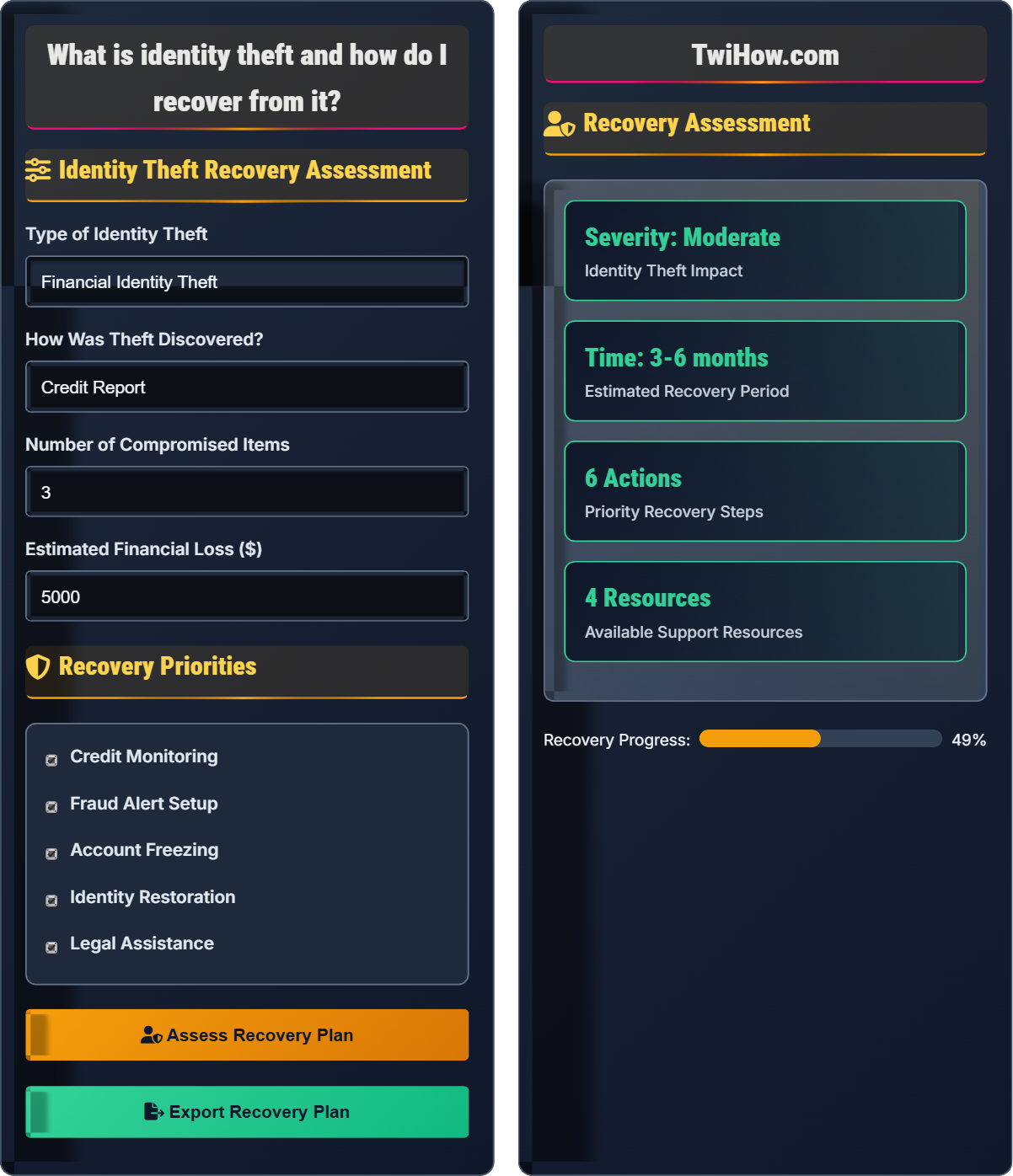
Identity Theft Recovery Assessment
Recovery Priorities
Recovery Assessment
Week 1: Immediate actions (alerts, reports)
Week 2-4: Account recovery
Month 2-3: Credit repair
Month 4-12: Ongoing monitoring
• Copy of FTC report
• Police report
• Bank statements
• Identity documents
• Correspondence logs
Identity Theft Recovery Explained
Identity theft occurs when someone wrongfully obtains and uses another person's personal identifying information in a way that involves fraud or deception, typically for economic gain. This can include using your name, Social Security number, credit card numbers, or other personal information to commit fraud, make unauthorized purchases, or open new accounts in your name.
Effective identity theft recovery follows a systematic approach:
Where:
- Response Speed: How quickly you take action after discovery
- Documentation Quality: Completeness of records and evidence
- Complexity Factors: Severity and scope of the theft
- Persistence: Continued effort throughout the recovery process
Key categories of identity theft that require different recovery approaches:
- Financial: Unauthorized use of financial accounts or creation of new accounts
- Medical: Use of personal information to obtain medical services
- Criminal: Using your identity during arrest or legal proceedings
- Tax: Filing fraudulent tax returns using your SSN
- Child: Using a child's SSN for employment or credit
- Synthetic: Combining real and fake information to create new identities
- Document Everything: Keep detailed records of all communications
- Follow Up Consistently: Regularly check the status of disputes
- Know Your Rights: Understand laws protecting identity theft victims
- Use Official Resources: Leverage government and industry resources
- Monitor Continuously: Watch for recurring fraudulent activity
- Seek Professional Help: Consider credit restoration services
Identity Theft Fundamentals
Identity theft, fraud alert, credit freeze, FTC report, police report, recovery plan, credit restoration.
Success = (Speed × Documentation) / (Complexity × Persistence)
Where Success = recovery outcome, Speed = response time, Documentation = evidence quality, Complexity = theft severity.
- Act immediately upon discovery
- Document all communications
- File reports with FTC and police
- Contact financial institutions promptly
- Monitor accounts continuously
Recovery Resources
IdentityTheft.gov, credit bureaus, financial institutions, legal aid, state attorney general offices.
- IdentityTheft.gov: Comprehensive recovery plan
- Credit bureaus: Fraud alerts and credit freezes
- Financial institutions: Account monitoring and dispute resolution
- Legal aid: Free legal assistance for victims
- State AG: Consumer protection and complaints
- Recovery can take months or years
- Patience and persistence are essential
- Keep detailed records of all actions
- Follow up consistently on disputes
Identity Theft Recovery Quiz
What is the FIRST action you should take when you discover identity theft?
While all these actions are important, the first priority should be to contact the credit bureaus to place fraud alerts. This provides immediate protection by requiring creditors to verify your identity before opening new accounts. A fraud alert remains active for one year and can be renewed.
The answer is C) Contact the credit bureaus to place fraud alerts.
Timing is critical in identity theft recovery. Placing fraud alerts immediately prevents new fraudulent accounts from being opened while you work on other recovery steps. The credit bureaus can place fraud alerts over the phone or online, making this the fastest protective measure available. Other actions like filing FTC reports and police reports are also important but serve different purposes in the recovery process.
Fraud Alert: Notice added to credit reports requiring identity verification
Identity Theft: Unauthorized use of personal information for fraud
Recovery Timeline: Sequence of steps to restore identity
• Act immediately upon discovery
• Place fraud alerts first
• Document everything systematically
• Contact all three credit bureaus
• Keep confirmation numbers
• Follow up within 90 days
• Delaying the response
Explain the difference between a credit freeze and a fraud alert, and describe when each is most appropriate to use during identity theft recovery.
Credit Freeze: Completely blocks creditors from accessing your credit report, preventing new accounts from being opened in your name. You must lift the freeze to apply for new credit.
Fraud Alert: Requires creditors to verify your identity before opening new accounts, but does not block access to your credit report.
When to Use Each:
1. Fraud Alert: Best for initial response and ongoing protection when you still need to apply for credit occasionally. Lasts one year and can be renewed.
2. Credit Freeze: Best for severe cases where you're not planning to apply for new credit. Provides stronger protection but requires unfreezing for legitimate credit applications.
Both can be placed free of charge for identity theft victims.
Understanding the difference between credit freezes and fraud alerts is crucial for effective identity theft protection. A fraud alert acts as a warning system, requiring creditors to take extra steps to verify identity. A credit freeze acts as a complete barrier, preventing access entirely. The choice depends on your credit needs during the recovery period.
Credit Freeze: Blocks access to credit reports completely
Fraud Alert: Requires identity verification for new credit
Credit Bureau: Company that maintains credit reports
• Both are free for identity theft victims
• Must contact each bureau individually
• Keep records of all actions
• Contact all three bureaus simultaneously
• Use online portals for faster processing
• Schedule periodic reviews
• Only contacting one credit bureau
• Not understanding the difference
• Forgetting to manage freezes properly
You receive a bill for medical services you never received, and later discover someone used your insurance information to obtain treatment. Calculate the complexity level of this medical identity theft case and explain the specific recovery steps required beyond standard financial identity theft recovery.
Complexity Level: High
Additional Recovery Steps for Medical Identity Theft:
• Contact your health insurance provider immediately to report fraud
• Obtain copies of medical records related to the fraudulent treatment
• Work with healthcare providers to correct medical records
• Request investigation from your state insurance commissioner
• Contact the Department of Health and Human Services
Why More Complex: Medical identity theft can affect your health records permanently, potentially leading to incorrect diagnoses or treatments based on fraudulent medical history. Unlike financial theft, medical records are harder to correct and can impact future healthcare.
Medical identity theft is particularly dangerous because it affects your medical records, which can impact your health and safety. Unlike financial identity theft, where the damage is primarily monetary, medical identity theft can lead to incorrect medical information being entered into your records, potentially affecting future medical care. Recovery requires coordination with healthcare providers, insurance companies, and regulatory agencies.
Medical Identity Theft: Use of personal info for medical services
Medical Records: Documentation of healthcare received
Insurance Provider: Company providing health coverage
• Act immediately on medical bills
• Obtain all related records
• Correct medical records promptly
• Keep detailed medical records
• Verify all medical bills
• Request corrections in writing
• Ignoring medical bills
• Not correcting medical records
• Not contacting insurance promptly
You discover that someone has been using your 8-year-old child's Social Security number to open credit accounts and obtain employment. Explain the unique challenges of child identity theft and outline a comprehensive recovery strategy for your child's identity.
Unique Challenges of Child Identity Theft:
1. Lack of Monitoring: Children typically don't monitor their credit
2. Delayed Discovery: Fraud may go undetected for years
3. Long-Term Impact: Damage can affect the child's financial future
4. Multiple Uses: SSN used for various fraudulent purposes
Recovery Strategy:
• Request credit reports for your child from all three bureaus
• File reports with FTC and local police as child identity theft
• Contact creditors to close fraudulent accounts
• Place fraud alerts or credit freezes on the child's reports
• Monitor the child's credit regularly until adulthood
• Consider ongoing credit monitoring services
• Document everything for potential legal action
Child identity theft is particularly devastating because children cannot monitor their credit and the damage may not be discovered until they reach adulthood. The Social Security number is often pristine and unused, making it valuable to identity thieves. Recovery requires long-term commitment and ongoing vigilance to protect the child's financial future.
Child Identity Theft: Using a minor's SSN for fraud
SSN: Social Security Number
Long-term Impact: Effects lasting into adulthood
• Request credit reports for all children
• Act immediately when discovered
• Monitor long-term into adulthood
• Request reports annually until age 18
• Consider credit monitoring
• Educate child about identity theft
• Not requesting child's credit reports
• Assuming children can't be victims
• Not monitoring long-term
Under federal law, what is the maximum amount an identity theft victim is liable for unauthorized charges made on existing accounts?
Under the Fair Credit Billing Act, consumers are liable for a maximum of $50 for unauthorized charges made on existing accounts. However, if you report the loss before any unauthorized charges are made, you are not liable for any charges. Many credit card companies offer zero-liability policies, meaning you won't be responsible for any unauthorized charges if you report them promptly.
The answer is A) $50.
Federal consumer protection laws provide significant safeguards for identity theft victims, limiting liability for unauthorized charges. The Fair Credit Billing Act establishes the $50 maximum liability for existing account fraud, while the Fair Credit Reporting Act provides rights for credit report disputes. Understanding these legal protections is crucial for victims to know their rights and responsibilities during recovery.
Fair Credit Billing Act: Law limiting liability for unauthorized charges
Zero Liability: No responsibility for unauthorized transactions
Consumer Protection: Laws safeguarding identity theft victims
• Report loss before unauthorized charges
• Know your legal protections
• Document all fraudulent activity
• Read credit card agreements
• Know your rights under FCBA
• Report immediately to minimize liability
• Not reporting promptly
• Not knowing legal protections
• Accepting liability unnecessarily
FAQ
Q: I discovered identity theft 6 months ago and I'm still dealing with it. Will I ever fully recover?
A: Yes, most identity theft victims do fully recover, though the timeline varies depending on the type and extent of the theft. Financial identity theft typically resolves within 6 months to 2 years with persistent effort. Medical identity theft may take longer due to the complexity of medical records. Criminal identity theft can be the most challenging, sometimes requiring legal intervention.
The key to successful recovery is:
1. Consistency: Continue following up on all disputes and reports
2. Documentation: Keep detailed records of all actions taken
3. Patience: Allow adequate time for processes to complete
4. Monitoring: Stay vigilant for recurring fraudulent activity
If you're experiencing unusual delays, consider seeking help from a consumer protection attorney or identity theft restoration service. Remember that you have legal protections under federal law that require companies to cooperate with your recovery efforts.
Q: How can I protect my children from identity theft?
A: Protecting children from identity theft requires proactive monitoring since they typically don't use credit:
Immediate Actions:
• Request credit reports for each child from all three credit bureaus (Equifax, Experian, TransUnion)
• If a report exists for a child under 18, it's likely fraudulent and should be investigated
• Place fraud alerts or credit freezes on any existing reports
Ongoing Protection:
• Monitor annually until the child reaches 18
• Be cautious about sharing your child's SSN - only provide when legally required
• Secure physical documents containing your child's information
• Educate your child about identity theft as they get older
• Consider identity monitoring services that include child protection
Remember that children are attractive targets because their credit histories are typically clean and unused, making fraudulent activity less likely to be detected quickly.
Q: What should businesses do to help employees who are victims of identity theft?
A: Businesses should provide comprehensive support to employees who are victims of identity theft:
Immediate Support:
• Allow flexible time off for recovery activities during business hours
• Provide information about identity theft resources and recovery steps
• Temporarily suspend access to sensitive company systems if employee credentials are compromised
Long-term Assistance:
• Offer Employee Assistance Programs (EAP) that include identity theft support
• Consider providing identity monitoring services as an employee benefit
• Review and update company policies regarding personal information handling
Security Measures:
• Assess whether the theft could impact company security
• Provide additional security training to the affected employee
• Review company systems for any potential compromises
Supporting employees through identity theft recovery helps maintain morale and productivity while demonstrating corporate responsibility.