What is Network Segmentation and Why Is It Important?
Complete security guide • Step-by-step explanations
Network Segmentation:
Show Segmentation PlannerNetwork segmentation is the practice of dividing a computer network into smaller subnets or segments to improve security, performance, and management. Each segment operates as a separate network with controlled access between them, limiting the spread of threats and enhancing overall network security.
By isolating network traffic and implementing security controls between segments, organizations can reduce their attack surface and contain potential security incidents.
Key benefits:
- Enhanced Security: Limits lateral movement of threats
- Improved Performance: Reduces broadcast traffic
- Better Management: Simplifies network administration
- Compliance: Helps meet regulatory requirements
Network segmentation is a fundamental cybersecurity practice that creates security boundaries within an organization's network infrastructure, making it harder for attackers to move laterally and access sensitive systems.
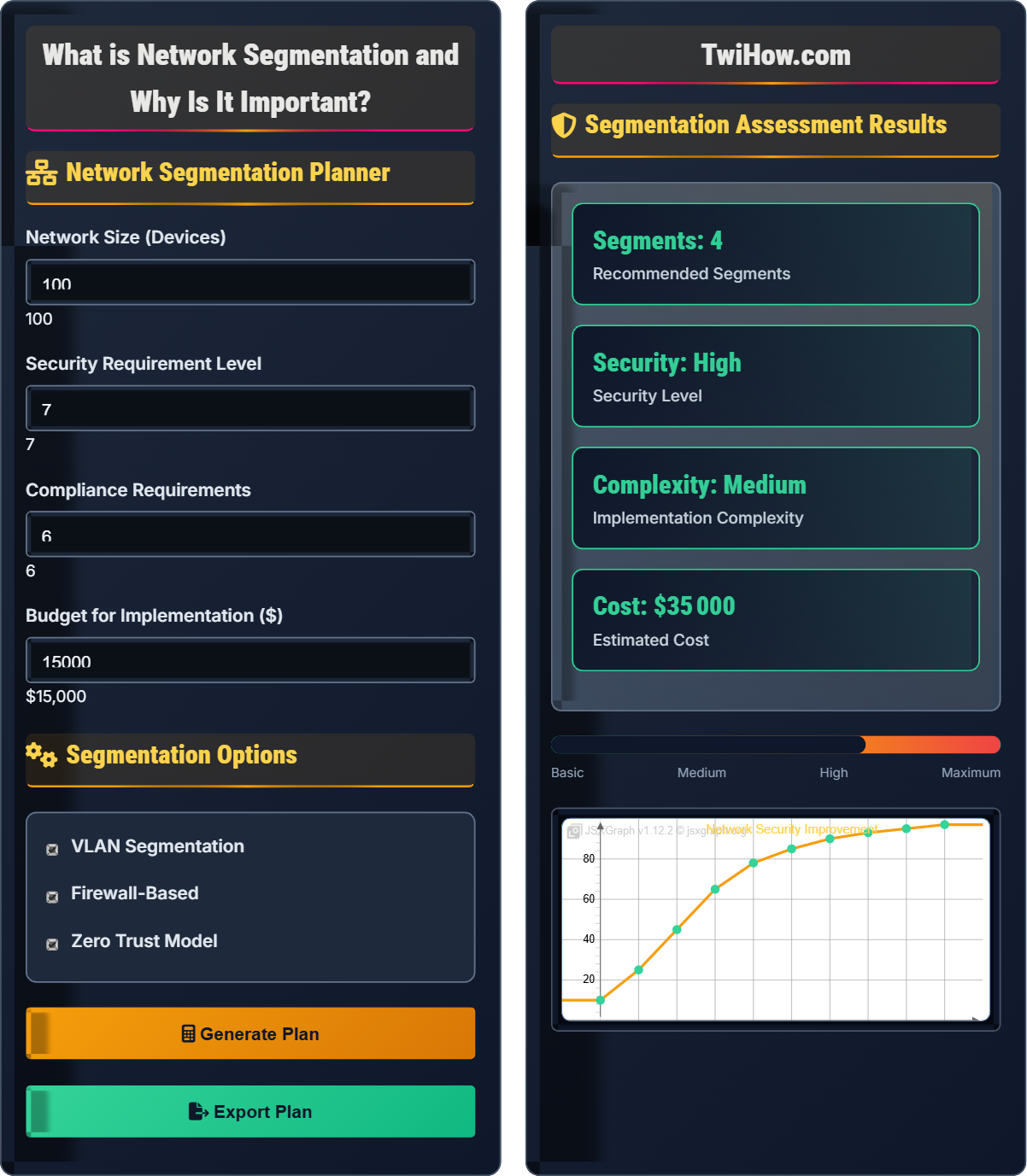
Network Segmentation Planner
Segmentation Options
Segmentation Assessment Results
| Segment | Devices | Security | Access |
|---|---|---|---|
| DMZ | 5 | High | Public |
| Employee | 75 | Medium | Restricted |
| Admin | 10 | Maximum | Privileged |
| IOT | 10 | Medium | Isolated |
Network Segmentation Explained
Network segmentation is the practice of dividing a computer network into smaller subnets or segments to improve security, performance, and management. Each segment operates as a separate network with controlled access between them, limiting the spread of threats and enhancing overall network security.
Security Improvement = 1 - (1 - Base_Risk)^(Segments)
Where:
- Security Improvement: Reduction in overall network risk
- Base Risk: Risk level without segmentation
- Segments: Number of network segments created
- Isolation: Effectiveness of segment boundaries
Various methods for network segmentation:
- VLAN Segmentation: Logical separation using virtual LANs
- Subnet Segmentation: Physical separation using IP subnets
- Firewall-Based: Policy-based segmentation with firewalls
- Micro-Segmentation: Granular segmentation at host level
- Zero Trust: Assume no trust between segments
- SDN Segmentation: Software-defined network segmentation
- Phase 1: Assessment and planning (2-4 weeks)
- Phase 2: Infrastructure setup (1-2 weeks)
- Phase 3: Configuration and testing (1-2 weeks)
- Phase 4: Rollout and monitoring (ongoing)
- Phase 5: Optimization and refinement (ongoing)
Segmentation Methods
VLAN, subnet, firewall, micro-segmentation, zero trust, SDN.
Security Improvement = 1 - (1 - Base_Risk)^(Segments)
Where Security Improvement = risk reduction, Base_Risk = original risk level, Segments = number of divisions.
- Match segmentation to security requirements
- Implement proper access controls
- Monitor segment boundaries
Implementation Strategies
Enterprise, SMB, cloud, hybrid, BYOD, IoT.
- Network assessment and mapping
- Segmentation planning
- Infrastructure setup
- Policy configuration
- Testing and validation
- Monitoring and optimization
- Start with critical assets
- Implement gradually
- Document all segments
- Regular security reviews
Network Segmentation Visualization
| Segment | Purpose | Devices | Security Level | Access Control |
|---|---|---|---|---|
| DMZ | Public-facing services | Web, mail servers | High | Strict |
| Employee | Workstation access | PCs, laptops | Medium | Controlled |
| Admin | Management access | Servers, network gear | Maximum | Privileged |
| IOT | IoT device isolation | Cameras, sensors | Medium | Isolated |
Sample Network Architecture
This diagram shows a typical enterprise network with four main segments:
1. Internet: External connectivity with perimeter security
2. DMZ: Demilitarized zone for public-facing services
3. Employee: General user access and workstation segment
4. Admin: Highly restricted administrative segment
Segmentation Types
VLAN (Virtual Local Area Network) segmentation allows you to create logical network segments within a physical network infrastructure. Devices in different VLANs are isolated from each other at Layer 2, requiring routing to communicate. This is cost-effective and flexible for medium-sized networks.
Benefits: Cost-effective, flexible, easy to implement
Use Cases: Departmental isolation, guest networks, VoIP
Implementation Process
Map your current network topology, identify all devices, services, and data flows. Document existing security controls and vulnerabilities. Understand business requirements and compliance needs that will influence segmentation decisions.
Define network segments based on security requirements, data classification, and business functions. Plan access controls between segments and determine the appropriate segmentation method for each area.
Deploy necessary hardware and software components such as VLAN-capable switches, firewalls, and network security appliances. Configure network devices to support the planned segmentation architecture.
Implement access control lists, firewall rules, and other security policies to enforce segment boundaries. Configure logging and monitoring to track cross-segment traffic.
Test segment isolation to ensure devices in different segments cannot communicate inappropriately. Validate that authorized cross-segment communication works as expected.
Continuously monitor network traffic, security events, and performance. Optimize segment boundaries and access controls based on operational experience.
Industry Standards and Compliance
Network Segmentation Knowledge Quiz
Which of the following is the PRIMARY security benefit of network segmentation?
The primary security benefit of network segmentation is preventing lateral movement of threats within the network. By creating isolated segments with controlled access, an attacker who compromises one system cannot easily move to other parts of the network. This containment significantly reduces the potential impact of security incidents.
The answer is C) Lateral movement prevention.
Network segmentation fundamentally changes the attack landscape by creating security boundaries. Instead of a flat network where any compromised system can potentially access all others, segmentation creates isolated zones. This concept is crucial for understanding modern cybersecurity strategies, as it directly addresses one of the most dangerous aspects of cyber attacks: lateral movement and privilege escalation.
Lateral Movement: Attacker progression across network segments
Segmentation: Dividing network into isolated zones
Containment: Limiting threat spread
• Segmentation creates security boundaries
• Lateral movement is a major threat vector
• Isolation reduces attack surface
• Start with critical assets
• Implement proper access controls
• Monitor cross-segment traffic
• Overlooking access control policies
• Not monitoring segment boundaries
• Creating overly complex architectures
Compare and contrast VLAN and subnet segmentation. In what scenarios would each be more appropriate, and what are the technical differences between these approaches?
VLAN Segmentation:
• Operates at Layer 2 (Data Link Layer)
• Uses 802.1Q tagging to separate traffic
• Requires managed switches that support VLANs
• Allows multiple VLANs on same physical infrastructure
• Isolation occurs at switch level
Subnet Segmentation:
• Operates at Layer 3 (Network Layer)
• Uses different IP address ranges
• Requires routers or Layer 3 switches
• Traffic between subnets must be routed
• Provides natural broadcast domain separation
Scenarios:
• VLANs: Cost-effective for medium-sized networks, departmental isolation, temporary segmentation
• Subnets: Enterprise networks, regulatory compliance, permanent network boundaries
Technical Differences:
• VLANs provide Layer 2 isolation, subnets require Layer 3 routing
• VLANs are easier to reconfigure, subnets may require IP changes
• Subnets provide better security isolation, VLANs rely on switch configuration
Understanding the OSI model layers is crucial for network segmentation. VLANs operate at Layer 2, creating logical separation within the same physical infrastructure. Subnets operate at Layer 3, requiring routing between segments. The choice between these approaches depends on security requirements, budget constraints, and operational complexity. Both methods can be used together for enhanced security.
VLAN: Virtual Local Area Network for Layer 2 segmentation
Subnet: Network division using IP addressing
OSI Model: Network communication framework
• Match method to security requirements
• Consider operational complexity
• Plan for scalability
• Use VLANs for flexibility
• Use subnets for strong isolation
• Consider hybrid approaches
• Not understanding Layer 2 vs Layer 3
• Poor VLAN ID management
• Inadequate routing configuration
A mid-size company with 500 employees needs to implement network segmentation for security and compliance. They have departments (sales, HR, IT), public-facing servers, IoT devices, and remote workers. Design a segmentation strategy that balances security, performance, and manageability.
Proposed Network Segments:
1. DMZ Segment:
• Purpose: Public-facing services
• Devices: Web servers, email gateways, load balancers
• Security: High firewall rules, intrusion detection
• Access: Internet access, limited internal access
2. Employee Segment:
• Purpose: General employee workstations
• Devices: Employee PCs, laptops, printers
• Security: Medium access controls, endpoint protection
• Access: Internal services, internet (filtered)
3. Administrative Segment:
• Purpose: IT infrastructure and management
• Devices: Servers, network equipment, management tools
• Security: Maximum access controls, privileged access
• Access: Highly restricted, admin-only
4. HR Segment:
• Purpose: Personnel and sensitive data
• Devices: HR workstations, personnel databases
• Security: High access controls, data loss prevention
• Access: Limited, HR-specific
5. IoT Segment:
• Purpose: Internet of Things devices
• Devices: Cameras, sensors, smart devices
• Security: Isolated, device-specific policies
• Access: Internet only, no internal access
6. Remote Access Segment:
• Purpose: VPN and remote worker access
• Devices: VPN concentrators, remote access servers
• Security: Strong authentication, network access control
• Access: Limited to authorized resources
Implementation Approach:
• Use VLANs for flexibility and cost-effectiveness
• Deploy next-generation firewalls for inter-segment control
• Implement network access control for device authentication
• Monitor all cross-segment traffic for anomalies
Enterprise network segmentation requires balancing multiple competing requirements: security, performance, manageability, and cost. The key is to group assets based on their function, sensitivity, and trust level. Critical assets should be in highly secured segments, while general-purpose devices can be in more accessible segments. The design should also consider future growth and changing business requirements.
DMZ: Demilitarized Zone for public-facing services
VLAN: Virtual Local Area Network for segmentation
NAC: Network Access Control for device authentication
• Group by function and sensitivity
• Implement proper access controls
• Plan for scalability
• Start with critical assets
• Use consistent naming conventions
• Document all segment relationships
• Over-segmentation creating complexity
• Inadequate access control planning
• Poor documentation practices
A company wants to implement a Zero Trust network model as part of their segmentation strategy. Explain how Zero Trust differs from traditional network segmentation and what additional controls are needed for implementation.
Traditional Network Segmentation:
• Trust model: Implicit trust inside the network perimeter
• Boundary: Perimeter-based security (castle and moat)
• Assumption: Once authenticated, users and devices are trusted
• Focus: Network-level controls and segmentation
Zero Trust Model:
• Trust model: Never trust, always verify
• Boundary: No implicit trust, validate every transaction
• Assumption: All users, devices, and transactions are untrusted
• Focus: Identity, device, and transaction verification
Additional Controls for Zero Trust:
1. Identity Verification:
• Multi-factor authentication for all access
• Continuous authentication monitoring
• Privileged access management
2. Device Trust:
• Endpoint detection and response
• Device compliance checking
• Certificate-based authentication
3. Micro-Segmentation:
• Application-level segmentation
• Host-based firewalls
• Software-defined perimeters
4. Continuous Monitoring:
• Behavioral analytics
• Real-time threat detection
• Automated response capabilities
Implementation Challenges:
• Higher complexity and cost
• Need for advanced security tools
• Cultural shift required
• Integration with existing systems
Benefits:
• Superior threat protection
• Better visibility and control
• Reduced impact of breaches
Zero Trust represents a fundamental shift from perimeter-based security to identity and transaction-based security. Rather than assuming trust based on network location, Zero Trust validates every access request. This approach is particularly valuable in modern environments where traditional perimeters are blurred by cloud services, mobile devices, and remote work. The integration of Zero Trust with network segmentation creates a comprehensive security architecture.
Zero Trust: Security model that assumes no implicit trust
Micro-Segmentation: Granular segmentation at host/app level
Perimeter Security: Castle-and-moat security model
• Verify all access requests
• Implement granular controls
• Monitor continuously
• Start with pilot implementation
• Focus on critical assets first
• Invest in proper tools
• Trying to implement everything at once
• Underestimating complexity
• Poor user experience planning
Which of the following technologies provides the MOST granular network segmentation capability?
Micro-segmentation provides the most granular network segmentation capability. It allows for security policies to be applied at the individual workload or application level, often down to the process level. Unlike traditional network segmentation methods that work at the network or subnet level, micro-segmentation can isolate individual virtual machines, containers, or applications within the same host or network segment.
The answer is C) Micro-segmentation.
Network segmentation has evolved from coarse-grained methods like VLANs and subnets to fine-grained approaches like micro-segmentation. This evolution reflects the increasing complexity of modern IT environments and the need for more precise security controls. Micro-segmentation leverages software-defined networking and virtualization technologies to create security boundaries that are independent of physical network topology, enabling unprecedented control over network traffic.
Micro-Segmentation: Granular segmentation at host/application level
Granularity: Level of detail in segmentation
Software-Defined Networking: Network control abstraction
• Match granularity to security needs
• Consider operational complexity
• Evaluate technology requirements
• Use micro-segmentation for critical assets
• Combine with other methods
• Plan for scalability
• Over-engineering for simple needs
• Not considering performance impact
• Poor integration planning
FAQ
Q: How does network segmentation affect network performance?
A: Network segmentation can have both positive and negative effects on performance:
Positive Effects:
• Reduced Broadcast Traffic: Segmentation limits broadcast domains, reducing unnecessary network traffic
• Improved Bandwidth Utilization: Segments can be optimized for specific traffic patterns
• Better Traffic Management: Different segments can have different QoS policies
Negative Effects:
• Increased Latency: Traffic between segments must traverse routing devices
• Processing Overhead: Firewalls and security devices add processing delays
• Complexity Overhead: More network devices and configurations
Best Practices:
• Properly size network equipment to handle segmented traffic
• Use high-performance firewalls and switches
• Implement appropriate Quality of Service (QoS) policies
• Regular performance monitoring and optimization
When properly implemented, the security benefits far outweigh the minor performance impacts.
Q: What are the costs associated with implementing network segmentation?
A: Costs vary significantly based on the scope and complexity of the implementation:
Initial Costs:
• Hardware: Managed switches with VLAN support ($500-$5,000 per device)
• Firewalls: Next-generation firewalls ($1,000-$50,000+)
• Software: Network management and security tools ($1,000-$20,000+)
• Professional Services: Design and implementation ($5,000-$50,000+)
Ongoing Costs:
• Management: Additional administrative overhead
• Maintenance: Software licenses and hardware support
• Training: Staff training on new systems
• Monitoring: Security operations center costs
Typical Ranges:
• Small Business (10-50 users): $5,000-$15,000
• Medium Business (50-500 users): $15,000-$100,000
• Enterprise (500+ users): $100,000-$1,000,000+
The investment is typically justified by reduced security risks and compliance benefits.
Q: How does network segmentation help with compliance requirements?
A: Network segmentation is a key requirement for many compliance frameworks:
PCI DSS (Payment Cards):
• Requires segmentation to isolate cardholder data environment
• Reduces scope of PCI compliance audits
• Mandates controls between connected networks
HIPAA (Healthcare):
• Requires protection of protected health information
• Segmentation helps control access to PHI
• Supports minimum necessary access principle
SOX (Financial):
• Requires controls over financial data processing
• Segmentation supports segregation of duties
• Helps protect financial systems from unauthorized access
GDPR (Data Privacy):
• Requires appropriate technical safeguards
• Segmentation helps limit data exposure
• Supports data minimization principles
Compliance Benefits:
• Reduces audit scope and costs
• Demonstrates commitment to security
• Provides evidence of security controls
• Helps meet regulatory deadlines
Segmentation not only meets compliance requirements but also reduces the overall compliance burden by limiting the scope of audits.