What Is Threat Intelligence and How Can I Use It?
Complete security guide • Step-by-step explanations
Threat Intelligence:
Show Intelligence AnalyzerThreat intelligence is the collection, analysis, and interpretation of information about potential or current threats to an organization's security. It transforms raw data into actionable insights that can be used to prevent, detect, and respond to cyber attacks. Threat intelligence helps organizations understand the tactics, techniques, and procedures (TTPs) of threat actors.
Effective threat intelligence enables proactive security measures and informed decision-making.
Key components:
- Data Collection: Gathering threat information from various sources
- Analysis: Processing and interpreting collected data
- Sharing: Distributing intelligence within and between organizations
- Application: Using intelligence to improve security posture
- Indicators: IOCs, TTPs, and attribution information
- Integration: Incorporating intelligence into security tools
Successfully leveraging threat intelligence requires understanding its types, sources, and implementation strategies to enhance organizational security.
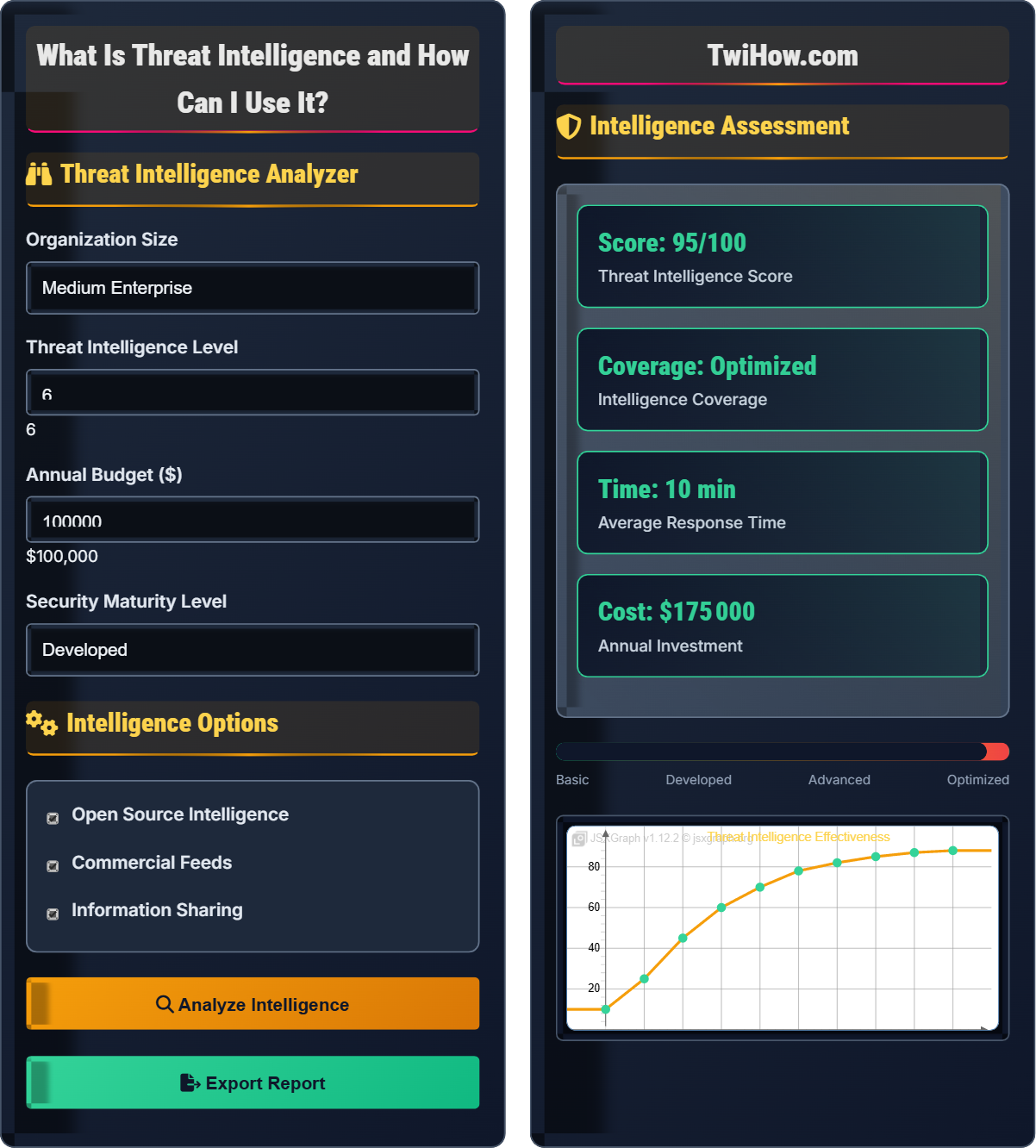
Threat Intelligence Analyzer
Intelligence Options
Intelligence Assessment
| Capability | Level | Priority | Cost |
|---|---|---|---|
| Collection | Advanced | High | $35,000 |
| Analysis | High | High | $45,000 |
| Sharing | Medium | Medium | $20,000 |
| Integration | High | High | $25,000 |
Threat Intelligence Explained
Threat intelligence is evidence-based knowledge about existing or emerging threats that can be used to inform decisions about responding to, defending against, or preventing cyber attacks. It transforms raw data about threats into actionable insights that can be used to improve security posture and make informed decisions about security investments.
Where:
- Intelligence Value: Overall effectiveness of threat intelligence
- Actionable Intelligence: Intelligence that leads to concrete actions
- Total Intelligence: All collected threat data
- Response Effectiveness: Success rate of actions taken
Key types of threat intelligence:
- Strategic Intelligence: High-level, long-term threat trends for executives
- Tactical Intelligence: Technical details about attack methods and tools
- Operational Intelligence: Information about specific campaigns and actors
- Technical Intelligence: Indicators of compromise and technical signatures
- Business Intelligence: Threats to business operations and assets
- Threat Hunting: Proactive search for hidden threats in systems
- Phase 1: Assessment and planning (2-4 weeks)
- Phase 2: Tool acquisition and setup (4-8 weeks)
- Phase 3: Data source integration (2-4 weeks)
- Phase 4: Process development (4-6 weeks)
- Phase 5: Implementation and optimization (ongoing)
Intelligence Types
Strategic, tactical, operational, technical, business intelligence, threat hunting.
Intelligence Value = (Actionable Intelligence / Total Intelligence) × Response Effectiveness
Where Intelligence Value = overall effectiveness, Actionable Intelligence = usable insights, Response Effectiveness = success rate.
- Focus on actionable intelligence
- Match intelligence to audience
- Integrate with security operations
Implementation Process
Small, medium, large, enterprise, government, military.
- Collection and data gathering
- Processing and structuring
- Analysis and interpretation
- Production of intelligence products
- Dissemination and sharing
- Feedback and improvement
- Start with open source intelligence
- Focus on relevant threats
- Integrate with existing tools
- Regular process review
Threat Intelligence Process
| Type | Focus | Audience | Timeframe | Examples |
|---|---|---|---|---|
| Strategic | Threat Landscape | Executives | Long-term | Annual reports, threat trends |
| Tactical | Attack Methods | Analysts | Medium-term | IOCs, TTPs, malware analysis |
| Operational | Campaigns | Security Teams | Short-term | APT reports, actor attribution |
| Technical | Indicators | SOCS | Immediate | IP addresses, hashes, domains |
| Business | Impact | Managers | Varies | Risk assessments, ROI |
| Threat Hunting | Proactive | Hunters | Ongoing | Behavioral analysis, anomalies |
Intelligence Level Selection
1. Focus: Long-term threat landscape and trends
2. Audience: Executive leadership and board members
3. Content: High-level threat assessments and strategic planning
4. Delivery: Quarterly reports, presentations, briefings
5. Examples: Annual threat reports, industry trends, risk assessments
6. Goals: Strategic decision-making and resource allocation
Threat Intelligence Structure
• Open Source: Public forums, social media, blogs
• Commercial: Threat feeds, vendor intelligence
• Government: CERT advisories, intelligence agencies
• Private: ISACs, information sharing communities
• Internal: Network logs, security events, incidents
• Statistical: Trend analysis and pattern recognition
• Behavioral: Anomaly detection and behavioral analysis
• Attribution: Actor identification and campaign tracking
• Temporal: Time-based correlation and forecasting
• Geographic: Location-based threat analysis
• Reports: Strategic, tactical, and operational reports
• Feeds: Real-time indicator and threat feeds
• Alerts: Timely notifications of emerging threats
• Playbooks: Response procedures for specific threats
• Visualizations: Dashboards and threat maps
• SIEM: Security event correlation and analysis
• Firewalls: Dynamic rule updates and blocking
• IPS/IDS: Signature updates and detection rules
• SOAR: Automated response and orchestration
• EDR: Endpoint detection and response integration
Collection: Gathering raw data from various sources including open source, commercial feeds, government advisories, and internal logs.
Processing: Organizing and structuring collected data for analysis, including normalization and enrichment.
Analysis: Interpreting data to identify threats, patterns, and trends using various analytical techniques.
Production: Creating actionable intelligence products tailored to different audiences and use cases.
Dissemination: Sharing intelligence with relevant stakeholders in appropriate formats and channels.
Feedback: Collecting feedback to improve the intelligence process and validate effectiveness.
Intelligence Implementation Process
Identify intelligence requirements based on organizational needs, threat landscape, and business objectives. Define what types of intelligence are needed and for what purposes.
Identify relevant data sources including open source intelligence, commercial feeds, government advisories, and internal sources. Evaluate source credibility and relevance.
Select appropriate tools for collection, processing, analysis, and dissemination. Consider open source and commercial options based on requirements and budget.
Develop processes for data ingestion, analysis, production, and sharing. Create playbooks and procedures for consistent intelligence operations.
Integrate intelligence into existing security tools and processes. Ensure intelligence feeds into decision-making and response procedures.
Continuously monitor intelligence effectiveness and optimize processes based on feedback and changing requirements.
Threat Intelligence Implementation Timeline
Sample Intelligence Data
IP: 192.168.1.100
Domain: malicious.example.com
Hash: 5d41402abc4b2a76b9719d911017c592
Description: C2 server for malware campaign
Confidence: 95%
Severity: High
First Seen: 2023-01-15
Last Seen: 2023-01-20
Actor: APT29
Alias: Cozy Bear
Motivation: Espionage
TTPs: Spear phishing, C2 infrastructure
Target Sectors: Government, Energy, Technology
Attribution Confidence: High
Associated Campaigns: Operation Grizzly Steppe
Threat Intelligence Knowledge Quiz
Which type of threat intelligence provides technical details about attack methods and tools?
Tactical intelligence provides technical details about attack methods, tools, and techniques used by threat actors. It focuses on the "how" of attacks and includes information about specific malware, attack vectors, and technical indicators that can be used to detect and prevent attacks.
The answer is B) Tactical Intelligence.
Threat intelligence is categorized by the type of information it provides and the intended audience. Tactical intelligence is aimed at security analysts and practitioners who need technical details to implement defensive measures. It bridges the gap between strategic intelligence (which informs executives) and operational intelligence (which focuses on specific campaigns).
Tactical Intelligence: Technical details about attack methods and tools
Indicators of Compromise (IOCs): Artifacts indicating malicious activity
TTPs: Tactics, Techniques, and Procedures used by attackers
• Match intelligence type to audience
• Focus on actionable information
• Provide appropriate level of detail
• Use standardized formats
• Include confidence levels
• Provide context and attribution
• Providing wrong level of detail
• Not specifying confidence levels
• Failing to provide actionable information
Explain the different categories of threat intelligence sources and their characteristics.
Open Source Intelligence (OSINT):
• Characteristics: Publicly available information from websites, forums, social media
• Advantages: Cost-effective, broad coverage, real-time updates
• Challenges: Information overload, credibility issues, false positives
• Examples: Security blogs, Twitter, GitHub repositories, PasteBin
Commercial Intelligence:
• Characteristics: Paid services providing curated threat intelligence
• Advantages: High quality, structured data, expert analysis
• Challenges: Cost, potential vendor lock-in, information sharing limitations
• Examples: FireEye, CrowdStrike, Recorded Future, ThreatConnect
Government Intelligence:
• Characteristics: Intelligence from government agencies and CERTs
• Advantages: High credibility, strategic insights, attribution
• Challenges: Limited availability, classification restrictions, delayed disclosure
• Examples: US-CERT, CISA, NCSC, national CERTs
Private Intelligence Sharing:
• Characteristics: Information sharing between organizations in same sector
• Advantages: Relevant to specific industry, trusted sources, actionable
• Challenges: Trust issues, competitive concerns, legal restrictions
• Examples: ISACs, ISAOs, vendor communities, security alliances
Internal Intelligence:
• Characteristics: Intelligence derived from organization's own environment
• Advantages: Highly relevant, immediate applicability, cost-effective
• Challenges: Limited scope, requires internal analysis capability
• Examples: Network logs, SIEM alerts, incident data, endpoint telemetry
Key Considerations:
• Diversity: Use multiple sources to avoid single points of failure
• Quality: Evaluate source credibility and timeliness
• Relevance: Focus on intelligence relevant to your threat landscape
• Integration: Combine sources for comprehensive view
Effective threat intelligence programs leverage multiple source types to create a comprehensive and actionable intelligence picture.
Threat intelligence sources vary significantly in terms of cost, quality, relevance, and availability. A mature intelligence program typically combines multiple source types to balance coverage, quality, and cost. The choice of sources depends on organizational requirements, budget, and risk tolerance. Understanding source characteristics helps organizations make informed decisions about intelligence investments.
OSINT: Open Source Intelligence from publicly available sources
ISAC: Information Sharing and Analysis Center
CERT: Computer Emergency Response Team
• Use diverse sources
• Evaluate source quality
• Focus on relevance
• Start with open sources
• Join industry communities
• Evaluate before investing
• Over-relying on single source
• Not evaluating source quality
• Focusing on quantity over quality
A mid-sized financial services company wants to implement a threat intelligence program. They have a security team of 5 people, a budget of $200,000, and need to focus on financial sector threats. Design an implementation plan that addresses their requirements.
Implementation Plan for Financial Services Company:
Phase 1: Assessment and Planning (Weeks 1-4):
• Requirements Gathering: Identify specific intelligence needs for financial sector
• Threat Landscape Analysis: Understand financial industry-specific threats
• Team Assessment: Evaluate current team skills and capabilities
• Budget Allocation: Plan $200,000 across tools, services, and training
Phase 2: Source Identification (Weeks 5-8):
• Financial ISAC Membership: Join FS-ISAC for industry-specific intelligence
• Open Source Monitoring: Set up monitoring of financial threat forums
• Commercial Feed Selection: Choose financial sector-focused feeds
• Government Partnerships: Establish connections with financial regulators
Phase 3: Tool Acquisition (Weeks 9-12):
• Intel Platform: Deploy open-source platform like MISP for intelligence management
• Threat Feed Integration: Connect commercial and open source feeds
• Analytics Tools: Implement tools for pattern recognition and correlation
• Visualization: Dashboard for intelligence consumption
Phase 4: Process Development (Weeks 13-16):
• Collection Procedures: Automated ingestion of threat feeds
• Analysis Workflows: Procedures for intelligence analysis and validation
• Production Guidelines: Templates for intelligence reports
• Dissemination Process: Distribution to relevant teams and stakeholders
Phase 5: Integration (Weeks 17-20):
• SIEM Integration: Feed intelligence into security event correlation
• Network Security: Update firewall and IPS rules with IOCs
• Endpoint Security: Share indicators with EDR solutions
• Threat Hunting: Use intelligence for proactive hunting activities
Phase 6: Training and Optimization (Weeks 21-24):
• Team Training: Train security team on intelligence tools and processes
• Metrics Definition: Establish KPIs for intelligence program effectiveness
• Feedback Loop: Create mechanisms for continuous improvement
• Incident Response: Integrate intelligence into incident response procedures
Budget Allocation Recommendation:
• FS-ISAC Membership: $15,000 (premium membership)
• Commercial Feeds: $80,000 (financial sector focused)
• Software/Licenses: $40,000 (platforms and tools)
• Training: $15,000 (team development)
• Personnel Augmentation: $50,000 (consulting and expertise)
Expected Outcomes:
• Improved Detection: 30-50% increase in threat detection capabilities
• Reduced Response Time: 40-60% improvement in incident response
• Enhanced Awareness: Better understanding of financial sector threats
• Compliance Support: Improved regulatory compliance reporting
This implementation plan balances the need for financial sector-specific intelligence with available budget and team size.
This scenario demonstrates the practical application of threat intelligence principles in a real-world context. The implementation plan shows how to balance budget constraints, team capabilities, and specific industry requirements. The phased approach ensures steady progress while allowing for adjustments based on early results. The budget allocation demonstrates the need to balance different intelligence components for optimal effectiveness.
FS-ISAC: Financial Services Information Sharing and Analysis Center
IOCs: Indicators of Compromise for threat detection
KPIs: Key Performance Indicators for program measurement• Match intelligence to industry
• Balance budget across components
• Focus on actionable intelligence
• Start with industry communities
• Use open-source tools initially
• Focus on relevant threats
• Generic intelligence approach
• Not industry-specific
• Poor budget allocation
Compare the benefits and challenges of different threat intelligence sharing models. When would you recommend each model?
Information Sharing and Analysis Centers (ISACs):
• Benefits: Industry-specific intelligence, trusted members, structured sharing
• Challenges: Membership fees, competitive concerns, limited scope
• Recommendation: For organizations in critical sectors (finance, energy, healthcare)
Information Sharing and Analysis Organizations (ISAOs):
• Benefits: Flexible membership, cross-sector collaboration, voluntary participation
• Challenges: Varying member engagement, less structured governance
• Recommendation: For organizations seeking broader collaboration
Vendor Communities:
• Benefits: High-quality intelligence, technical focus, vendor expertise
• Challenges: Vendor lock-in, potential bias, cost considerations
• Recommendation: For organizations using specific security vendors
Open Source Sharing:
• Benefits: Cost-effective, broad reach, real-time sharing
• Challenges: Quality concerns, attribution issues, false positives
• Recommendation: For organizations with strong analytical capabilities
Peer-to-Peer Sharing:
• Benefits: Direct relationships, customized sharing, mutual benefits
• Challenges: Limited scale, trust establishment, resource intensive
• Recommendation: For organizations with trusted partnerships
Government-Private Sector:
• Benefits: Strategic intelligence, attribution, regulatory compliance
• Challenges: Classification, legal restrictions, timing issues
• Recommendation: For organizations with government contracts or critical infrastructure
Sharing Standards and Formats:
• STIX/TAXII: Structured Threat Information eXpression and Trusted Automated eXchange of Indicator Information
• OpenIOC: Open Indicator of Compromise format
• CybOX: Cyber Observable eXpression for describing cyber observables
• MAEC: Malware Attribute Enumeration and Characterization
Best Practices for Intelligence Sharing:
• Standardization: Use common formats and vocabularies
• Automation: Implement automated sharing mechanisms
• Quality Control: Validate intelligence before sharing
• Privacy Protection: Remove sensitive information while preserving value
• Trust Building: Establish trusted relationships with sharing partners
Success Factors:
• Reciprocity: Share as much as you consume
• Relevance: Focus on intelligence relevant to community
• Timeliness: Share intelligence while it's actionable
• Context: Provide sufficient context for effective use
The choice of sharing model depends on organizational requirements, industry, and trust relationships.
Threat intelligence sharing is crucial for collective defense, but different models serve different purposes. The effectiveness of intelligence sharing depends on trust, standardization, and the quality of shared information. Organizations should participate in multiple sharing communities to maximize coverage while contributing to the collective good. The choice of sharing model should align with organizational security objectives and risk tolerance.
ISAC: Information Sharing and Analysis Center
STIX/TAXII: Standardized threat intelligence formats
IOCs: Indicators of Compromise for threat detection
• Share as much as you consume
• Use standardized formats
• Focus on actionable intelligence
• Join relevant ISACs
• Use automation for sharing
• Validate before sharing
• Not sharing intelligence
• Sharing without context
• Ignoring privacy concerns
Which metric is most important for measuring the effectiveness of a threat intelligence program?
The number of incidents prevented is the most important metric for measuring threat intelligence effectiveness. While volume of data and number of indicators are important operational metrics, the ultimate goal of threat intelligence is to prevent security incidents. The ability to prevent incidents demonstrates that intelligence is actionable and that the organization is successfully using intelligence to improve its security posture.
The answer is C) Number of incidents prevented.
Measuring threat intelligence effectiveness requires focusing on outcomes rather than inputs. While metrics like data volume and indicator count are easy to measure, they don't necessarily correlate with improved security. The ultimate measure of intelligence value is whether it leads to actionable insights that prevent incidents or improve response. This outcome-based approach ensures that intelligence programs focus on practical security improvements rather than just collecting data.
Threat Intelligence Effectiveness: Impact of intelligence on security outcomes
Outcome Metrics: Measures of actual security improvements
Operational Metrics: Measures of intelligence program operations
• Focus on outcome metrics
• Measure actionable intelligence
• Correlate with security improvements
• Track incident prevention
• Measure response time improvements
• Monitor false positive rates
• Measuring volume instead of value
• Not tracking outcomes
• Ignoring false positive rates
FAQ
Q: Do small businesses need threat intelligence?
A: Yes, small businesses can benefit from threat intelligence, though at a different scale than large enterprises:
Free/Open Source Intelligence:
• US-CERT Alerts: Free government security advisories
• Open Threat Feeds: Free indicators from security vendors
• Security Blogs: Follow reputable security researchers
• Twitter Security Community: Real-time threat information
Low-Cost Commercial Options:
• Entry-Level Feeds: Basic threat feeds at affordable prices
• Cloud-Based Solutions: SaaS threat intelligence platforms
• Industry Groups: Small business security communities
• Managed Services: Outsourced threat intelligence
Implementation for Small Business:
• Focus on Basics: Prioritize essential security measures
• Automate Where Possible: Use tools that require minimal management
• Industry-Specific: Focus on threats relevant to your sector
• Simple Integration: Use existing security tools for intelligence
Key Benefits:
• Early Warning: Advance notice of threats targeting your industry
• Resource Optimization: Focus security efforts on relevant threats
• Compliance: Demonstrate due diligence for regulations
• Protection: Defend against known attack patterns
Getting Started:
• Subscribe to US-CERT: Free government security alerts
• Join Sectors: Industry-specific information sharing
• Use Free Tools: MISP, OpenCTI for intelligence management
• Focus on Indicators: Start with IP addresses and domains
Small businesses can leverage threat intelligence effectively by focusing on free/open sources and relevant threats rather than trying to implement enterprise-level programs.
Q: How do I measure the ROI of a threat intelligence program?
A: Measuring threat intelligence ROI requires both quantitative and qualitative metrics:
Quantitative Metrics:
• Incident Prevention: Calculate prevented incidents and their estimated cost
• Response Time: Reduction in time to detect and respond to threats
• False Positive Reduction: Decrease in false alarms and wasted resources
• Cost Avoidance: Savings from prevented breaches and incidents
Qualitative Benefits:
• Improved Visibility: Better understanding of threat landscape
• Enhanced Decision-Making: Informed security investments
• Compliance Support: Meeting regulatory requirements
• Reputation Protection: Avoiding public breach incidents
ROI Calculation Formula:
• Cost Avoidance: (Average breach cost × Prevented incidents)
• Time Savings: (Reduced response time × Analyst hourly rate × Incidents)
• Efficiency Gains: (Reduced false positives × Time saved × Hourly rate)
• ROI = (Benefits - Investment) / Investment × 100
Example Calculation:
• Program Investment: $150,000 annually
• Prevented Incidents: 3 major incidents prevented
• Average Breach Cost: $3.86M (based on industry studies)
• Cost Avoidance: $11.58M
• Time Savings: $50,000 annually
• ROI = ($11.63M - $150K) / $150K × 100 = 7,653%
Key Performance Indicators:
• Mean Time to Detect (MTTD): Reduction in detection time
• Mean Time to Respond (MTTR): Faster incident response
• Threat Coverage: Percentage of relevant threats covered
• Intelligence Quality: Accuracy and relevance of intelligence
Qualitative Measurements:
• Stakeholder Confidence: Improved security team confidence
• Strategic Awareness: Better understanding of strategic threats
• Regulatory Compliance: Meeting compliance requirements
• Competitive Advantage: Better security posture than competitors
Challenges in Measurement:
• Attribution Difficulty: Hard to prove specific prevention
• Opportunity Cost: Benefits of prevented hypothetical incidents
• Qualitative Value: Hard to quantify strategic benefits
• Comparative Analysis: Without program, what would happen?
Effective ROI measurement combines tangible cost avoidance with intangible security improvements to demonstrate comprehensive value.
Q: What are the most important threat intelligence tools and platforms?
A: Essential threat intelligence tools and platforms:
Open Source Platforms:
• MISP (Malware Information Sharing Platform): Community-driven threat intelligence platform for sharing IOCs and threat information
• OpenCTI: Open-source platform for threat intelligence management and analysis
• YETI: Yet Another Threat Intelligence Platform for organizing and sharing threat data
• ThreatIngestor: Automated threat intelligence ingestion and processing
Commercial Platforms:
• ThreatConnect: Comprehensive threat intelligence platform with case management
• CrowdStrike Falcon Intel: Real-time threat intelligence and indicators
• Recorded Future: AI-powered threat intelligence with predictive analytics
• FireEye Intelligence: Comprehensive threat intelligence with attribution
Analysis Tools:
• Velociraptor: Endpoint monitoring and threat hunting platform
• Osquery: SQL-based endpoint and infrastructure monitoring
• Volatility: Memory forensics and analysis framework
• Maltego: Link analysis and data visualization tool
Feed Aggregation:
• AlienVault OTX: Open Threat Exchange community platform
• Abuse.ch: Malware and threat intelligence feeds
• VirusTotal Intelligence: Malware analysis and threat intelligence
• IBM X-Force: Threat intelligence and security research
Integration Platforms:
• SOAR Platforms: Security Orchestration, Automation, and Response (Splunk Phantom, IBM Resilient)
• SIEM Integration: Splunk, QRadar, LogRhythm with TI feeds
• EDR Integration: Carbon Black, CrowdStrike, SentinelOne
• Firewall/IPS: Palo Alto, Fortinet, Cisco with TI integration
Standards and Formats:
• STIX/TAXII: Structured Threat Information eXpression
• OpenIOC: Open Indicator of Compromise format
• CybOX: Cyber Observable eXpression
• MAEC: Malware Attribute Enumeration and Characterization
Specialized Tools:
• Threat Hunting: Elastic Stack, Splunk, GreyNoise for hunting
• Dark Web Monitoring: Recorded Future, IntSights, Cyble
• Brand Monitoring: DigitalShadows, ZeroFOX for brand protection
• Infrastructure Monitoring: Shodan, Censys for exposure monitoring
Selection Criteria:
• Integration Capability: Compatibility with existing security tools
• Cost Effectiveness: Value relative to budget and requirements
• Quality of Intelligence: Accuracy, relevance, and timeliness
• Support and Community: Vendor support and user community
Successful threat intelligence programs often combine multiple tools and platforms to create a comprehensive intelligence ecosystem.