How do I balance speed and quality in agile development?
Complete agile development guide • Step-by-step explanations
Speed vs Quality in Agile:
Show Agile SimulatorBalancing speed and quality in agile development is one of the most critical challenges facing development teams. Agile methodologies emphasize delivering working software frequently while maintaining high quality standards. This balance requires implementing practices that accelerate delivery without compromising code quality, user experience, or system reliability.
Effective balance involves incorporating quality practices into the development process itself, rather than treating quality as a separate phase. This includes automated testing, continuous integration, code reviews, and iterative refinement. The goal is to deliver value quickly while building sustainable, maintainable systems.
Key concepts:
- Continuous Integration: Merging code changes frequently
- Automated Testing: Ensuring quality through automation
- Definition of Done: Clear quality criteria for features
- Technical Debt Management: Balancing short-term speed with long-term quality
Successful agile teams develop practices that make quality a natural part of the development rhythm, enabling both rapid delivery and high-quality outcomes.
Agile Parameters
Development Options
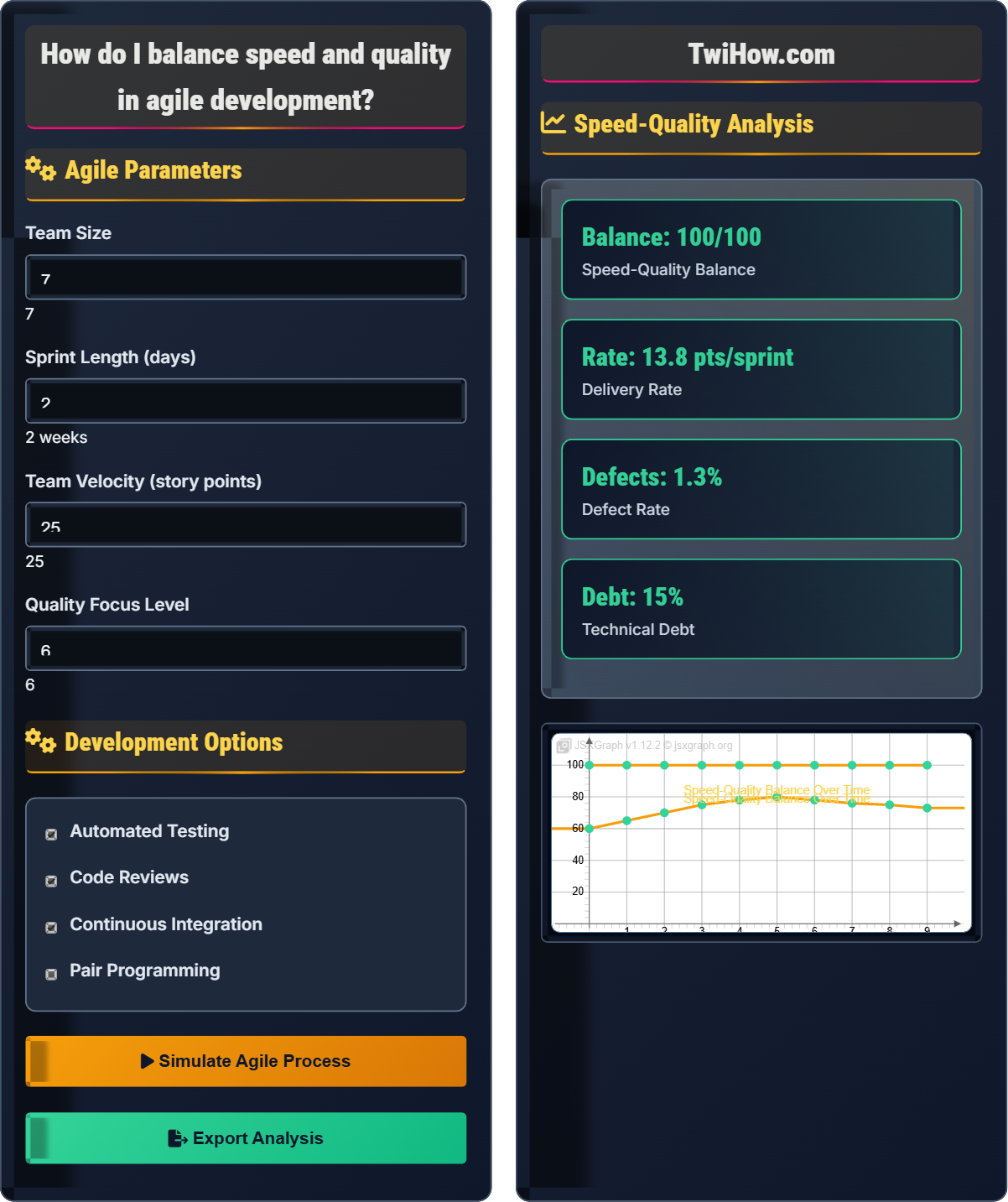
Speed-Quality Analysis
| Aspect | Speed | Quality | Balance |
|---|---|---|---|
| Code Delivery | 85% | 70% | 78% |
| Testing Coverage | 60% | 90% | 75% |
| Review Process | 75% | 85% | 80% |
| Deployment Frequency | 90% | 65% | 78% |
Balancing Speed and Quality in Agile Development
Balancing speed and quality in agile development is one of the most critical challenges facing development teams. Agile methodologies emphasize delivering working software frequently while maintaining high quality standards. This balance requires implementing practices that accelerate delivery without compromising code quality, user experience, or system reliability.
Key concepts in balancing speed and quality:
Core concepts include:
- Continuous Integration: Merging code changes frequently
- Automated Testing: Ensuring quality through automation
- Definition of Done: Clear quality criteria for features
- Technical Debt Management: Balancing short-term speed with long-term quality
- Iterative Development: Delivering in small, frequent increments
Major practices for balancing speed and quality:
- Test-Driven Development: Writing tests before code
- Continuous Integration: Merging code multiple times per day
- Code Reviews: Peer review of all code changes
- Pair Programming: Two developers working together
- Automated Testing: Unit, integration, and end-to-end tests
- Definition of Done: Clear criteria for completed work
- Automate Everything: Automate testing, building, and deployment
- Fail Fast: Detect issues early in the development process
- Incremental Delivery: Deliver small, working features frequently
- Quality Gates: Ensure code meets standards before merging
- Refactor Regularly: Improve code quality continuously
- Monitor Metrics: Track both speed and quality indicators
Agile Fundamentals
Agile methodology, scrum, kanban, continuous integration, definition of done.
Agile_Efficiency = (Delivery_Speed × Quality_Score) ÷ Technical_Debt_Factor
Where Agile_Efficiency = overall effectiveness, Delivery_Speed = feature delivery rate.
- Quality is built-in, not added later
- Automate repetitive tasks
- Measure what matters
Implementation
CI/CD, TDD, BDD, code reviews, pair programming, automated testing.
- Set up CI/CD pipeline
- Implement automated testing
- Establish quality gates
- Train team on practices
- Team adoption rate
- Tooling investment
- Cultural change
- Initial learning curve
Agile Learning Quiz
What is the primary purpose of a "Definition of Done" in agile development?
The primary purpose of a "Definition of Done" is to establish clear quality criteria that must be met for a feature to be considered complete. It ensures that all team members have a shared understanding of what "done" means, preventing features from being deployed with missing functionality, insufficient testing, or other quality issues. This practice helps balance speed with quality by ensuring consistent quality standards.
The answer is B) To establish clear quality criteria that must be met for a feature to be considered complete.
Definition of Done is a critical practice for balancing speed and quality. It prevents teams from rushing to deliver features that don't meet quality standards. Without a clear Definition of Done, teams might sacrifice quality for speed, leading to technical debt and future problems.
Definition of Done: Checklist of criteria for completed work
Quality Gate: Checkpoint ensuring standards are met
Shared Understanding: Common definition among team members
• Everyone must understand DoD
• DoD should be visible
• Consistently applied
• Make DoD visible to team
• Evolve as team learns
• Include testing criteria
• Inconsistent application
• Too vague or incomplete
• Not evolving over time
Explain how continuous integration helps balance speed and quality in agile development. What are the key practices and benefits?
Continuous Integration Benefits:
For Speed:
• Early Issue Detection: Problems are found immediately, reducing debugging time
• Automated Testing: Fast feedback on code changes
• Reduced Integration Problems: Frequent merges prevent conflicts
For Quality:
• Automated Quality Checks: Code analysis, testing, and validation run automatically
• Consistent Environments: Standardized build and test processes
• Regression Prevention: Automated tests catch regressions early
Key Practices:
• Commit code frequently (at least once daily)
• Run automated tests on every commit
• Maintain a fast, reliable build process
• Fix broken builds immediately
• Use automated deployment pipelines
By integrating continuously, teams can move fast while maintaining quality through automated checks and early problem detection.
Continuous Integration exemplifies how agile practices can simultaneously improve both speed and quality. Rather than waiting until the end of a sprint to integrate code, CI ensures that integration happens continuously, making issues visible immediately rather than accumulating until they become difficult to resolve.
Continuous Integration: Practice of frequently merging code
Automated Testing: Tests run automatically on code changes
Regression: Previously working functionality breaking
• Integrate frequently
• Keep builds fast
• Use feature flags
• Implement branch strategies
• Infrequent commits
• Slow build processes
• Not fixing broken builds
Your team consistently delivers features quickly but faces quality issues in production. Users report bugs and the team spends significant time on hotfixes. How would you adjust your sprint planning and development practices to improve quality without significantly slowing delivery?
Adjustments to Sprint Planning:
1. Revisit Definition of Done:
• Include more comprehensive testing requirements
• Add code review criteria
• Require automated test coverage thresholds
2. Balance Sprint Capacity:
• Reserve 15-20% of capacity for quality activities
• Include time for refactoring and technical debt
• Plan for testing and review time
3. Implement Quality Practices:
• Strengthen CI/CD pipeline with quality gates
• Implement peer code reviews
• Add automated testing coverage
4. Adjust Velocity Expectations:
• Lower initial sprint commitments to accommodate quality
• Focus on sustainable pace over short-term speed
5. Monitor Quality Metrics:
• Track defect rates and escape rates
• Monitor test coverage and code quality metrics
• Measure customer satisfaction and bug reports
This approach trades some immediate speed for sustainable delivery with higher quality.
This scenario illustrates the common mistake of optimizing for short-term speed at the expense of long-term sustainability. The solution involves rebalancing priorities to incorporate quality practices into the development rhythm, ultimately leading to more efficient delivery over time.
Definition of Done: Criteria for completed work
Quality Gates: Checks ensuring standards are met
Sustainable Pace: Delivery rate that can be maintained
• Quality is everyone's responsibility
• Invest in prevention
• Measure outcomes, not just output
• Build quality into process
• Focus on root causes
• Regular retrospectives
• Sacrificing quality for speed
• Not measuring quality metrics
• Ignoring technical debt
Your team has accumulated significant technical debt to meet aggressive deadlines. The codebase is becoming harder to maintain and new features take longer to implement. How would you approach managing technical debt while continuing to deliver new features?
Technical Debt Management Strategy:
1. Assess and Categorize:
• Conduct a technical debt audit
• Categorize debt by impact and urgency
• Identify debt affecting most critical features
2. Balanced Approach:
• Dedicate 20% of each sprint to debt reduction
• Refactor during feature development
• Implement "boy scout rule" (leave code cleaner)
3. Prevention Strategy:
• Strengthen Definition of Done
• Implement stricter code review standards
• Add automated quality checks
4. Stakeholder Communication:
• Explain impact of technical debt
• Show how debt reduction improves delivery
• Get buy-in for debt reduction time
5. Measurement:
• Track code quality metrics
• Monitor development velocity over time
• Measure defect rates and time to market
This approach balances immediate feature delivery with long-term maintainability.
Technical debt management requires a strategic approach that acknowledges the need for both immediate delivery and long-term sustainability. The key is to make debt reduction a consistent part of the development process rather than a separate activity that competes with feature development.
Technical Debt: Shortcuts that create future maintenance costs
Boy Scout Rule: Leave code cleaner than you found it
Refactoring: Improving code without changing functionality
• Pay down debt gradually
• Don't accumulate more debt
• Make it visible to stakeholders
• Refactor during feature work
• Use debt tracking tools
• Prioritize by impact
• Ignoring debt accumulation
• Trying to fix all at once
• Not measuring debt impact
Which of the following practices best demonstrates the correct approach to balancing speed and quality in agile development?
Investing in automated testing and continuous integration to maintain quality while delivering quickly demonstrates the correct approach. This practice embodies the agile principle of building quality into the development process rather than treating it as a separate phase. Automation allows teams to maintain high quality standards while delivering at a sustainable pace, avoiding the false trade-off between speed and quality.
The answer is B) Investing in automated testing and continuous integration to maintain quality while delivering quickly.
The key insight in agile development is that speed and quality are not mutually exclusive. By investing in practices that make quality a natural part of the development process (like automation), teams can achieve both rapid delivery and high quality. This is fundamentally different from traditional approaches that treat quality as a separate phase.
False Trade-off: Perceived conflict that doesn't actually exist
Automation: Using tools to perform repetitive tasks
Sustainable Pace: Delivery rate that can be maintained
• Build quality in, don't add it later
• Invest in automation
• Make quality everyone's concern
• Automate everything possible
• Test early and often
• Integrate continuously
• Treating quality as separate phase
• Not investing in automation
• Sacrificing quality for speed
FAQ
Q: How do I convince my team to invest in quality practices when there's pressure to deliver features quickly?
A: Convince your team by showing the value:
Quantify the Benefits:
• Track time spent on bug fixes vs. feature development
• Measure deployment frequency and lead time
• Show correlation between quality practices and velocity
Start Small:
• Implement one practice at a time
• Show immediate benefits
• Build momentum gradually
Focus on Outcomes:
• Emphasize faster delivery in the long term
• Highlight improved customer satisfaction
• Show reduced stress and firefighting
Lead by Example:
• Demonstrate practices in your own work
• Share success stories from other teams
• Involve team in improvement decisions
Quality investments pay dividends in sustained delivery speed.
Q: How do I measure the balance between speed and quality in my development team?
A: Key metrics for measuring speed-quality balance:
Speed Indicators:
• Delivery velocity (story points per sprint)
• Cycle time (from start to completion)
• Deployment frequency
• Time to market for features
Quality Indicators:
• Defect escape rate (bugs reaching production)
• Code coverage and quality scores
• Customer-reported issues
• Time spent on technical debt
Combined Metrics:
• Defect density per feature
• Mean time to recovery (MTTR)
• Customer satisfaction scores
• Team satisfaction and sustainability
Look for correlations between these metrics to understand your team's balance.
Q: What are the warning signs that my team is sacrificing quality for speed?
A: Warning signs of quality sacrifice:
Development Indicators:
• Increasing number of bugs in production
• Growing technical debt
• Longer time to implement new features
• Frequent hotfixes and patches
Team Indicators:
• Constantly working overtime to meet deadlines
• Skipping code reviews or testing
• Complaints about "technical shortcuts"
• High developer turnover
Product Indicators:
• Decreasing customer satisfaction
• Increased support tickets
• Performance degradation over time
• Difficulty in adding new features
Address these signs early to prevent long-term damage to the product and team morale.