How Do I Choose Between React, Vue, and Angular?
Complete framework guide • Step-by-step explanations
Framework Comparison:
Show Framework SelectorChoosing between React, Vue, and Angular requires understanding their unique characteristics, learning curves, and use cases. Each framework has distinct advantages depending on your project requirements, team size, and development experience. React offers flexibility and a rich ecosystem, Vue provides gentle learning curve and simplicity, and Angular delivers comprehensive solutions with strong opinions.
Key framework differences:
- React: Component-based, virtual DOM, extensive ecosystem
- Vue: Progressive framework, gentle learning curve, flexible
- Angular: Full-featured framework, TypeScript-based, opinionated
Selection should be based on project complexity, team expertise, performance requirements, and long-term maintenance considerations.
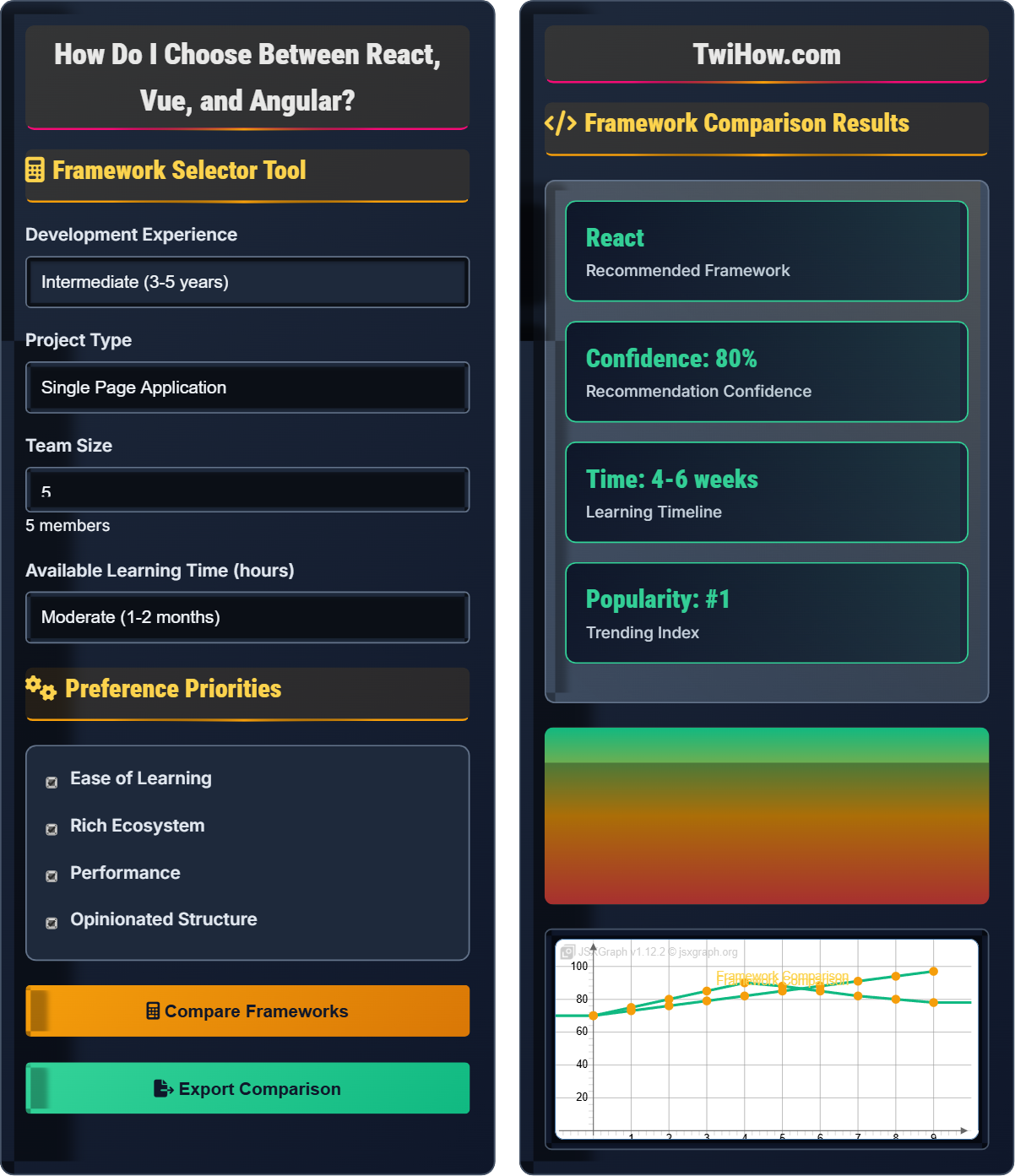
Framework Selector Tool
Preference Priorities
Framework Comparison Results
Framework Selection Explained
React, Vue, and Angular are three of the most popular frontend frameworks/libraries, each with distinct philosophies, architectures, and use cases. Understanding their differences helps developers make informed decisions about which technology best suits their project requirements and team capabilities.
Framework_Selection = (Project_Needs × Team_Expertise × Ecosystem_Support) ÷ (Learning_Curve × Maintenance_Cost)
Where:
- Project_Needs: Complexity, scale, and specific requirements
- Team_Expertise: Current skills and learning capacity
- Ecosystem_Support: Available libraries and community
- Learning_Curve: Time required to become proficient
- Maintenance_Cost: Long-term development and support
Key characteristics of each framework:
- React: Component-based architecture, virtual DOM, extensive ecosystem
- Vue: Progressive framework, gentle learning curve, flexible integration
- Angular: Full-featured framework, TypeScript-based, opinionated architecture
- React: Best for large teams, complex applications, and rich ecosystems
- Vue: Ideal for smaller teams, rapid prototyping, and gentle learning curve
- Angular: Suited for enterprise applications with strong structure requirements
- Hybrid: Consider framework-agnostic approaches for flexibility
- Migration: Plan for gradual framework adoption and migration
- Long-term: Consider maintenance, community support, and evolution
Framework Fundamentals
Component-based architecture, virtual DOM, state management, reactive programming.
Framework_Choice = (Requirements × Team × Ecosystem) ÷ (Complexity × Learning_Time)
Where each component is normalized to 0-100 scale.
- Match framework to project requirements
- Consider team experience and learning curve
- Evaluate long-term maintenance needs
Applications
Web applications, SPAs, mobile apps, enterprise systems, dashboards, e-commerce.
- Technology companies
- Financial services
- Healthcare
- E-commerce
- Performance requirements
- Team size and expertise
- Project timeline
- Maintenance costs
Framework Selection Quiz
Which statement accurately describes the key differences between React, Vue, and Angular?
The correct answer is B) React is a library, Vue is a progressive framework, Angular is a full framework. This accurately describes the fundamental nature of each technology.
Framework Classification:
- React: A JavaScript library focused on building user interfaces, particularly components
- Vue: A progressive framework that can be adopted incrementally, from small widgets to full applications
- Angular: A comprehensive framework that provides a complete solution for building applications
Key Differences:
- React: Library focused on view layer, requires additional libraries for routing, state management
- Vue: Framework that can scale from simple to complex applications, includes core features
- Angular: Opinionated framework with built-in solutions for most needs
Analysis of Other Options:
Option A is incorrect - React is a library, not a full framework. Option C is incorrect - they have different philosophies and feature sets. Option D is incorrect - Angular uses TypeScript by default, not Vue.
The answer is B) React is a library, Vue is a progressive framework, Angular is a full framework.
This question addresses a fundamental misunderstanding about the nature of these technologies. Understanding whether a technology is a library, framework, or toolkit is crucial for making informed decisions. Libraries provide specific functionality and are integrated into existing code, while frameworks provide complete solutions with prescribed ways of doing things. This distinction affects how you structure your applications and what decisions you need to make.
Library: Collection of functions and features to be used in applications
Framework: Complete solution with prescribed architecture and conventions
Progressive Framework: Can be adopted incrementally from simple to complex
• Understand the fundamental nature of each technology
• Consider how each approach affects application architecture
• Match the technology to your project requirements
• Libraries offer more flexibility but require more decisions
• Frameworks provide structure but less flexibility
• Progressive frameworks allow incremental adoption
• Confusing libraries with frameworks
• Not understanding the implications of each approach
• Choosing based on popularity rather than requirements
Analyze how team size affects the choice between React, Vue, and Angular, including specific advantages and challenges for different team sizes.
Team Size Impact on Framework Selection
Small Teams (1-5 developers):
- Vue Advantages:
- Gentle learning curve reduces onboarding time
- Less configuration required
- Single-file components simplify development
- Smaller decision overhead for small teams
- React Considerations:
- Requires more decisions about architecture and tools
- Steeper learning curve for beginners
- More flexibility but requires more expertise
- Rich ecosystem can be overwhelming for small teams
- Angular Considerations:
- Opinionated structure reduces decision overhead
- Comprehensive documentation and tooling
- Steep learning curve for beginners
- May be overkill for simple applications
Medium Teams (6-15 developers):
- React Advantages:
- Flexibility to accommodate different development styles
- Rich ecosystem for specialized needs
- Strong community support
- Component-based architecture promotes reusability
- Vue Advantages:
- Consistent development patterns
- Good balance of flexibility and structure
- Relatively easy to maintain consistency
- Good documentation and learning resources
- Angular Advantages:
- Strong structure promotes consistency across team
- Comprehensive tooling reduces setup time
- TypeScript integration catches errors early
- Clear patterns for common scenarios
Large Teams (16+ developers):
- React Considerations:
- Requires strong architectural governance
- Consistent patterns must be enforced
- Multiple approaches can lead to inconsistency
- Requires experienced developers to guide decisions
- Vue Considerations:
- Generally good for large teams with proper governance
- Less rigid structure than Angular
- Good documentation helps maintain consistency
- Requires clear architectural patterns
- Angular Advantages:
- Strong opinions help maintain consistency
- Comprehensive CLI and tooling
- TypeScript catches errors before they reach production
- Clear patterns reduce onboarding time
Team Experience Factors:
- Beginner Teams: Vue or Angular (more guidance) over React (more decisions)
- Experienced Teams: All three are viable, preference for React's flexibility
- Mixed Experience: Angular's structure helps less experienced developers
Collaboration Considerations:
- React: Requires more communication about architecture decisions
- Vue: Good balance of flexibility and consistency
- Angular: Built-in patterns promote collaboration
Conclusion: Vue is often best for small teams due to its gentle learning curve and simplicity. Angular is often preferred for large teams due to its strong structure and opinionated approach. React works well for medium-sized teams with experienced developers who can make architectural decisions.
This analysis demonstrates how organizational factors significantly impact technology decisions. The key insight is that different team sizes have different needs: small teams need simplicity and quick ramp-up, while large teams need structure and consistency. This shows that technology decisions should consider human factors, not just technical capabilities. The framework choice affects team dynamics, communication patterns, and development velocity.
Opinionated Framework: Prescribes specific ways of doing things
Progressive Adoption: Can be integrated incrementally into existing code
Component Architecture: Building applications from reusable UI components
• Match framework complexity to team size and experience
• Consider communication overhead for different team sizes
• Structure needs vary with team size
• Small teams benefit from frameworks with less decision overhead
• Large teams benefit from frameworks with strong structure
• Consider team experience when choosing complexity
• Not considering team size in framework selection
• Choosing frameworks that don't match team experience
• Underestimating the impact of team dynamics
A large enterprise with 500+ developers wants to standardize on a single frontend framework. They have 200+ applications built with various technologies (jQuery, vanilla JavaScript, AngularJS, React). Design a migration strategy that minimizes disruption while standardizing on the best framework for their needs.
Enterprise Framework Standardization Strategy
Assessment Phase (Months 1-3):
- Inventory Analysis:
- Comprehensive audit of all 200+ applications
- Assessment of current technology stack
- Business criticality and maintenance schedules
- Development team expertise and preferences
- Framework Evaluation:
- POC implementations for each framework
- Performance testing with enterprise-scale data
- Security compliance verification
- Integration with existing enterprise systems
Framework Selection Rationale:
- Angular Recommended:
- Strong structure for large teams
- TypeScript integration for type safety
- Comprehensive tooling reduces setup time
- Enterprise-focused features and security
- Strong governance and consistency
Migration Strategy (Months 4-18):
- Phase 1: New Projects (Months 4-6):
- All new applications built with Angular
- Training programs for developers
- Establishment of Angular Center of Excellence
- Creation of reusable components and libraries
- Phase 2: Critical Applications (Months 7-12):
- Migration of most business-critical applications
- Parallel development during transition period
- Comprehensive testing and validation
- Gradual traffic switching using feature flags
- Phase 3: Remaining Applications (Months 13-18):
- Migration of remaining applications
- Retirement of old technologies
- Final consolidation and optimization
- Documentation and knowledge transfer
Training and Enablement (Ongoing):
- Comprehensive Training Program:
- Angular certification program
- Hands-on workshops and bootcamps
- Peer mentoring and knowledge sharing
- Internal documentation and best practices
- Change Management:
- Executive sponsorship and communication
- Addressing resistance and concerns
- Providing support and resources
- Celebrating early wins and success stories
Infrastructure and Tooling:
- Enterprise Platform:
- Standardized Angular CLI configuration
- Internal component library and design system
- Automated testing and deployment pipelines
- Performance monitoring and optimization tools
- Developer Experience:
- Internal Angular schematics for project setup
- Code generation tools and templates
- Integrated development environment
- Performance optimization guidelines
Risk Mitigation:
- Parallel Development:
- Maintain existing applications during migration
- Gradual traffic switching to reduce risk
- Rollback procedures for critical failures
- Comprehensive testing at each phase
- Knowledge Preservation:
- Documentation of business logic
- Preservation of critical functionality
- Knowledge transfer between teams
- Legacy system integration where needed
Success Metrics:
- Technical Metrics:
- Performance improvements
- Code maintainability scores
- Deployment frequency increases
- Security vulnerability reduction
- Business Metrics:
- Development velocity improvements
- Time-to-market reductions
- Developer satisfaction scores
- Operational cost savings
Expected Outcomes:
- Standardized development platform
- Improved team collaboration and consistency
- Enhanced security and compliance
- Reduced maintenance overhead
- Accelerated time-to-market for new features
This comprehensive strategy ensures a smooth transition while minimizing business disruption and maximizing long-term benefits.
This problem demonstrates the complexity of technology decisions in large organizations. The solution shows how to balance technical requirements with organizational needs, considering factors like team size, existing investments, and business continuity. The phased approach minimizes risk while ensuring steady progress. The emphasis on training and change management reflects the human element of large-scale migrations. This illustrates that enterprise decisions require more than just technical evaluation.
Center of Excellence (CoE): Central team providing expertise and standards
Feature Flags: Technique for controlling feature availability without deployment
Parallel Development: Maintaining old and new systems simultaneously during transition
• Consider organizational factors in technology decisions
• Implement gradual, phased transitions for large organizations
• Prioritize training and change management
• Start with new projects during migration
• Maintain existing systems during transition
• Focus on critical applications first
• Attempting to migrate everything at once
• Not considering organizational readiness
• Underestimating training and change management needs
A startup with 5 developers and limited budget needs to choose a frontend framework for their first product. They want to move quickly, have a small team, and need to attract investors with a working prototype. Design a technology strategy that balances speed of development with long-term maintainability.
Startup Framework Strategy: Vue.js Recommendation
Framework Selection Rationale:
- Vue.js Advantages for Startups:
- Gentle learning curve allows rapid onboarding
- Minimal setup and configuration required
- Single-file components improve development speed
- Good documentation and community support
- Progressive adoption allows incremental integration
- Why Not React:
- Requires more decisions about architecture
- Steeper learning curve for beginners
- More complex ecosystem to navigate
- Overhead for small team and simple application
- Why Not Angular:
- Too heavy for simple startup application
- Steep learning curve for small team
- Opinionated structure may limit flexibility
- Over-engineering for prototype phase
Development Strategy (Months 1-3):
- Rapid Prototype Phase:
- Build MVP with Vue.js and Vue Router
- Use Vuetify or Element UI for rapid UI development
- Implement Vuex for state management
- Focus on core user flows and functionality
- Technology Stack:
- Vue.js 3.x for latest features
- Vue CLI for project scaffolding
- Composition API for better code organization
- Pinia for state management (modern alternative to Vuex)
Scalability Considerations:
- Architecture Planning:
- Component-based architecture from the start
- Proper folder structure and naming conventions
- Reusable component library planning
- API integration patterns for backend services
- Performance Optimization:
- Lazy loading for route components
- Code splitting for bundle optimization
- Tree shaking for smaller bundles
- Performance monitoring setup
Team Productivity:
- Development Speed:
- Vue DevTools for debugging
- Hot module replacement for instant feedback
- Single-file components for organization
- Template syntax familiar to HTML developers
- Collaboration:
- ESLint and Prettier for code consistency
- Git hooks for code quality enforcement
- Component documentation with Storybook
- Code review processes and standards
Future Flexibility:
- Framework Migration Path:
- Component architecture facilitates migration if needed
- Separation of concerns in design
- Modular architecture for flexibility
- API-first design for future changes
- Technology Evolution:
- Stay updated with Vue ecosystem
- Consider Nuxt.js for server-side rendering
- Plan for mobile app development
- Prepare for team growth and complexity
Budget Considerations:
- Free and Open Source:
- Vue.js core is free and open source
- Rich ecosystem of free libraries
- No licensing costs for development
- Large community for free support
- Development Costs:
- Reduced learning time = lower training costs
- Faster development = quicker time to market
- Less complex tooling = lower setup costs
- Good developer productivity = better ROI
Risk Mitigation:
- Technology Risk:
- Vue has strong community and corporate backing
- Large talent pool of Vue developers
- Good long-term prospects for framework
- Easy to migrate to other technologies if needed
- Market Risk:
- Focus on product-market fit first
- Framework choice won't significantly impact market success
- Technology can be changed if needed
- Speed to market is more important than technology choice
Expected Outcomes:
- Rapid prototype development for investor presentations
- Scalable architecture for future growth
- Good team productivity and morale
- Cost-effective development approach
- Prepared for future technology decisions
This strategy balances the immediate need for rapid development with long-term maintainability and scalability considerations.
This problem demonstrates how business constraints affect technology decisions. The solution shows how to balance competing priorities: speed of development, long-term maintainability, team size, and budget constraints. The emphasis on Vue for startups reflects its strengths in rapid development and gentle learning curve. The strategy also shows how to plan for future growth while meeting immediate needs. This illustrates that technology decisions must consider business context, not just technical capabilities.
MVP (Minimum Viable Product): Product with just enough features to gather feedback
Composition API: Vue 3 feature for organizing component logic
Single-File Component: Vue file containing template, script, and style
• Match technology to business stage and constraints
• Balance immediate needs with long-term goals
• Choose technologies that match team experience level
• Focus on speed to market for early-stage startups
• Plan for growth and complexity from the beginning
• Over-engineering for early-stage products
• Not considering team experience in technology choices
• Focusing too much on technology instead of product-market fit
Which statement best describes the performance characteristics of React, Vue, and Angular?
The correct answer is C) Performance depends more on implementation than framework choice. This reflects the reality that proper implementation, optimization, and architecture decisions have a much greater impact on performance than the choice of framework.
Performance Reality:
- Implementation Matters Most:
- How components are structured and optimized
- Proper state management and data flow
- Efficient rendering and update strategies
- Code splitting and lazy loading implementation
- Framework Overhead:
- All frameworks have similar virtual DOM performance
- Differences are usually negligible in real applications
- Bundle size depends more on usage than framework
- Runtime performance is comparable across frameworks
Analysis of Other Options:
Option A is incorrect - Angular's architecture isn't necessarily the fastest, and performance depends on implementation. Option B is incorrect - bundle size varies greatly based on implementation, not framework choice. Option D is incorrect - Vue performs comparably to other frameworks when properly implemented.
Key Performance Factors:
- Bundle Optimization: Tree shaking, code splitting, lazy loading
- Component Optimization: Memoization, proper re-rendering
- State Management: Efficient data flow and updates
- Rendering Strategy: Server-side rendering, static generation
Framework-Specific Performance:
- React: Excellent for complex UIs with frequent updates
- Vue: Good performance with simpler optimization requirements
- Angular: Consistent performance with built-in optimization tools
While there are minor performance differences between frameworks, they are typically overshadowed by implementation quality and architectural decisions.
The answer is C) Performance depends more on implementation than framework choice.
This question addresses a common misconception about framework performance. The key insight is that implementation quality, architecture decisions, and optimization strategies have far greater impact on performance than the choice of framework. This understanding helps developers focus on the right areas for performance improvement rather than getting distracted by framework comparisons. The question also demonstrates that all modern frameworks are capable of excellent performance when used properly.
Virtual DOM: Programming concept where UI is kept in memory
Tree Shaking: Elimination of unused code during build process
Bundle Size: Size of JavaScript files loaded by browser
• Implementation quality matters more than framework choice
• Focus on optimization strategies rather than framework selection
• Performance is influenced by many factors beyond the framework
• Optimize components for re-rendering efficiency
• Use code splitting and lazy loading
• Implement proper state management patterns
• Focusing on framework performance over implementation quality
• Not optimizing components and state management
• Ignoring bundle size optimization techniques
FAQ
Q: Which framework should I learn first as a beginner?
A: For beginners, I recommend starting with Vue.js:
Why Vue for Beginners:
- Gentle Learning Curve: Intuitive syntax similar to HTML/CSS
- Comprehensive Documentation: Well-written guides and examples
- Progressive Adoption: Can be used incrementally in existing projects
- Good Community: Helpful and welcoming community
Learning Path:
- Start with Vue basics (templates, data binding)
- Learn components and props
- Understand Vue CLI and tooling
- Explore Vue Router and state management
Alternative Paths:
- React if you prefer more flexibility and larger ecosystem
- Angular if you want comprehensive framework with strong structure
Vue strikes the best balance between simplicity and power for beginners, providing a solid foundation for learning modern frontend development concepts.
Q: How do I evaluate if my team is ready for a framework transition?
A: Evaluate team readiness with these criteria:
Technical Readiness:
- Current skill level assessment
- Learning capacity and time availability
- Understanding of current framework limitations
- Experience with JavaScript/TypeScript fundamentals
Organizational Readiness:
- Management support and budget allocation
- Timeline flexibility for learning curve
- Availability of training resources
- Risk tolerance for the transition
Project Considerations:
- Project timeline and deadlines
- Criticality of applications
- Team bandwidth for learning
- Impact on current deliverables
Assessment Process:
- Conduct team survey on interest and concerns
- Run pilot project with new framework
- Estimate learning time and resource impact
- Plan for knowledge sharing and mentoring
Transition readiness requires both technical capability and organizational support. Start with small pilot projects to assess feasibility.