How to Collaborate Effectively with Remote Development Teams?
Complete remote collaboration guide • Step-by-step strategies
Remote Team Collaboration:
Show Collaboration CalculatorRemote development team collaboration requires intentional strategies, effective communication tools, and structured processes to ensure productivity and team cohesion. Success depends on establishing clear communication protocols, leveraging appropriate technologies, and fostering trust among distributed team members.
Effective remote collaboration combines asynchronous and synchronous communication, utilizes shared digital workspaces, and implements agile methodologies adapted for distributed teams. The key is creating transparency and accountability while respecting different time zones and work schedules.
Key components of remote collaboration:
- Communication: Regular standups, documentation, and virtual meetings
- Tools: Project management, version control, and communication platforms
- Processes: Agile workflows, code reviews, and continuous integration
- Trust: Psychological safety and outcome-based expectations
Modern remote collaboration strategies emphasize flexibility, empathy, and outcome-focused metrics rather than time-based supervision.
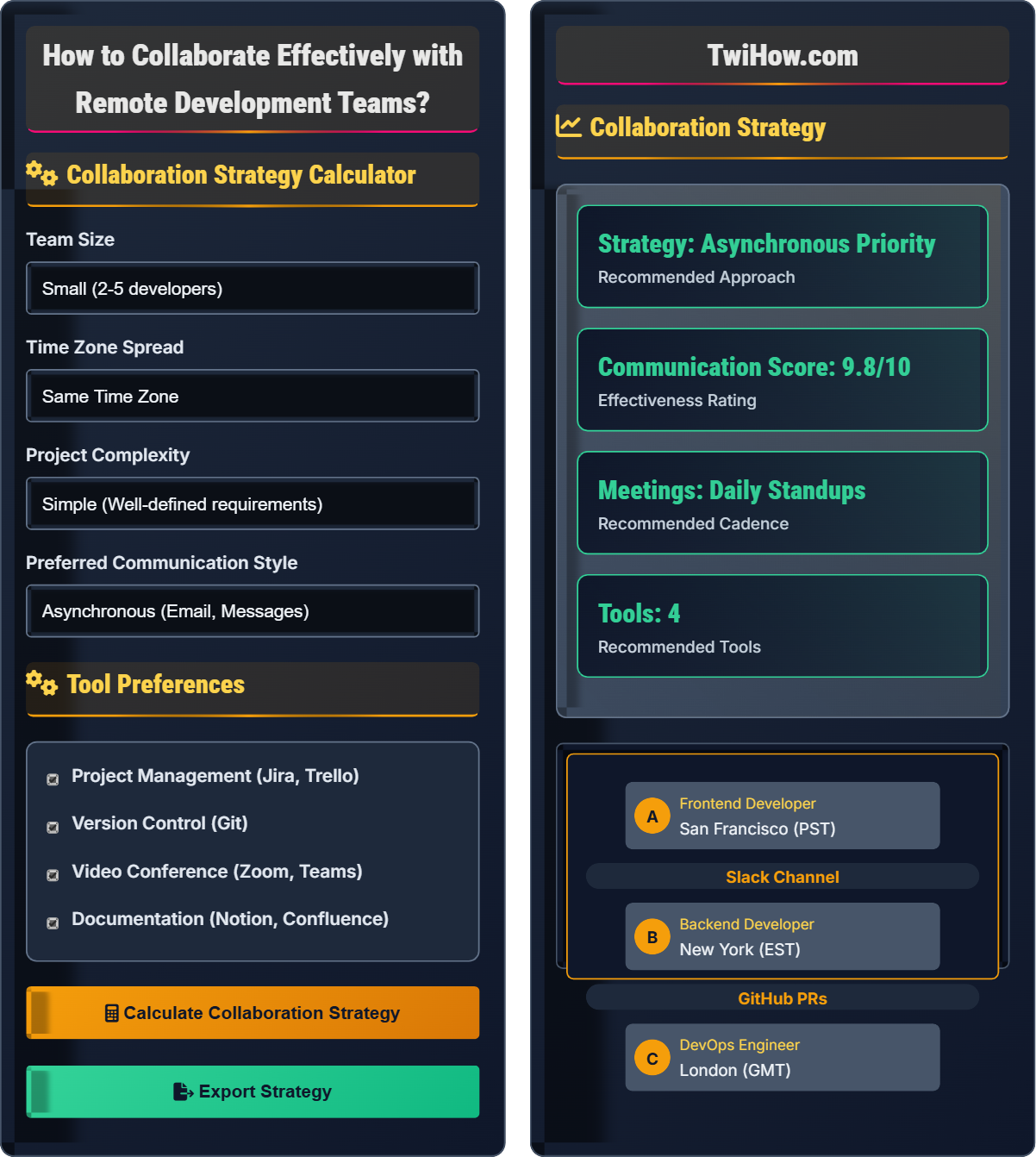
Collaboration Strategy Calculator
Tool Preferences
Collaboration Strategy
Collaboration Strategy
Based on your inputs, a hybrid approach is recommended that balances synchronous and asynchronous communication. Establish overlapping hours for critical discussions while allowing flexible work schedules for individual tasks.
Implement structured documentation and clear handoff procedures to ensure continuity across time zones.
| Process | Frequency | Participants |
|---|---|---|
| Daily Standup | Every Day | Entire Team |
| Sprint Planning | Every Sprint | Entire Team |
| Code Reviews | Ongoing | Peer Developers |
| Retrospective | Every Sprint | Entire Team |
Remote Development Team Collaboration Fundamentals
Effective remote development team collaboration consists of four core components that work together to ensure productivity and team cohesion:
Where:
- Communication: Clear, frequent, and transparent exchanges
- Tools: Technology stack for coordination and productivity
- Processes: Structured workflows and methodologies
- Culture: Trust, psychological safety, and shared values
Successful remote teams employ multiple communication strategies:
- Asynchronous Communication: Email, Slack, documentation for non-urgent matters
- Synchronous Communication: Video calls, screensharing for real-time collaboration
- Written Communication: Clear, detailed documentation to reduce misunderstandings
- Regular Check-ins: Daily standups and one-on-ones to maintain connection
- Context Sharing: Status updates and progress reports for visibility
Remote collaboration succeeds when teams focus on these factors:
- Trust Building: Psychological safety and outcome-based expectations
- Clear Expectations: Defined deliverables and accountability measures
- Time Zone Coordination: Overlapping hours for collaboration
- Technology Reliability: Stable tools and backup communication methods
- Work-Life Balance: Respect for personal time and boundaries
- Communication Gaps: Implement structured communication channels
- Coordination Issues: Use shared calendars and project management tools
- Isolation: Regular team building activities and informal interactions
- Productivity Concerns: Focus on outcomes rather than hours worked
- Knowledge Silos: Centralized documentation and knowledge sharing
Collaboration Fundamentals
Communication protocols, distributed workflows, asynchronous collaboration, trust building, psychological safety.
Effectiveness = (Clear Communication × Reliable Tools) / (Distance × Time Zone Difference)
Where Clear Communication = Transparency + Context, Reliable Tools = Stability + Accessibility.
- Overcommunicate rather than undercommunicate
- Document decisions and rationale
- Respect time zone differences
Implementation Strategies
Version control, CI/CD, communication platforms, project management tools, documentation systems.
- Establish communication protocols and expectations
- Select and configure collaboration tools
- Set up version control and CI/CD pipelines
- Define project management workflows
- Implement documentation standards
- Train team members on processes
- Bandwidth and connectivity issues
- Security and data protection
- Team member technical proficiency
- Cost of tools and infrastructure
Remote Collaboration Quiz
What is the most effective communication strategy for remote development teams with members in multiple time zones?
The most effective strategy is a hybrid approach that balances synchronous communication for critical discussions and asynchronous communication for ongoing work. This allows teams to leverage overlapping hours for real-time collaboration while accommodating different time zones through written communication, documentation, and structured handoffs.
The answer is B) Use a hybrid approach of synchronous and asynchronous communication.
Remote teams must adapt their communication strategies to accommodate geographic distribution. Pure synchronous communication can exclude team members due to time zone differences, while pure asynchronous communication can slow down critical decision-making. The hybrid approach maximizes the benefits of both approaches by using synchronous communication for complex discussions and team bonding, while relying on asynchronous methods for routine updates and individual work.
Synchronous Communication: Real-time interaction (calls, chats)
Asynchronous Communication: Delayed interaction (email, documentation)
Hybrid Approach: Combination of both communication types
• Use synchronous communication for complex discussions
• Document decisions made asynchronously
• Respect time zone boundaries
• Establish "core hours" for collaboration
• Use video calls for important announcements
• Maintain detailed meeting notes
• Assuming everyone is available at any time
• Not documenting decisions made in meetings
• Scheduling meetings outside reasonable hours
Explain how to conduct effective code reviews in a remote development team, including specific practices and tools that facilitate this process.
Remote Code Review Best Practices:
1. Pull Request Standards: Require detailed descriptions explaining the purpose, changes made, and testing performed. Include screenshots or GIFs for UI changes.
2. Review Assignment: Use automated assignment tools or rotate reviewers to distribute workload evenly. Assign multiple reviewers for critical changes.
3. Review Process: Set clear expectations for response times (e.g., 24 hours for initial feedback). Use line comments for specific suggestions and general comments for architectural concerns.
4. Tools: GitHub/GitLab for pull requests, Slack/Discord for discussing complex changes, and video calls for pair programming when needed.
5. Async-Friendly: Allow threaded discussions on comments, encourage detailed feedback rather than brief comments, and use emoji reactions to indicate agreement.
6. Knowledge Sharing: Encourage junior developers to review senior code and vice versa. Use code reviews as learning opportunities.
This approach ensures thorough reviews while accommodating different time zones and work schedules.
Code reviews in remote teams require extra attention to process and documentation. Without face-to-face interaction, reviewers must be more explicit in their feedback and authors must provide more context. The asynchronous nature of remote work means that feedback loops may be longer, so it's important to provide constructive, actionable feedback that can be understood without immediate clarification.
Pull Request: Proposed changes to code submitted for review
Line Comment: Feedback attached to specific lines of code
Async Review: Review process that doesn't require real-time interaction
• Provide context in pull request descriptions
• Respond to reviews within agreed timeframes
• Focus on constructive feedback
• Use templates for pull request descriptions
• Schedule regular review time in your calendar
• Use screenshots for UI changes
• Submitting pull requests without proper description
• Providing vague feedback like "this looks wrong"
• Not following up on requested changes
Your remote development team spans 3 continents: San Francisco (UTC-8), London (UTC+0), and Bangalore (UTC+5:30). You need to coordinate a critical release involving frontend, backend, and DevOps engineers across all locations. How would you structure the communication and coordination to ensure smooth collaboration despite the time zone differences?
Coordination Strategy:
1. Identify Overlap Hours: San Francisco-London overlap: 8am-12pm SF time. London-Bangalore overlap: 9am-3pm London time. These are prime slots for real-time coordination.
2. Handoff Protocol: End-of-day updates in each region serve as beginning-of-day inputs for the next region. Use shared dashboards to track progress.
3. Release Schedule: Plan critical release activities during overlapping hours. Use automation to minimize manual intervention needed during off-hours.
4. Communication Channels: Dedicated Slack channel for release coordination. Live dashboard showing status across all regions.
5. Escalation Process: Define clear escalation paths for issues that arise outside overlapping hours.
6. Documentation: Maintain detailed release notes and decision logs accessible to all regions.
7. Rotation: Rotate weekend/on-call duties to share the burden of off-hour coordination.
This approach leverages time zone differences as a 24-hour development cycle while ensuring critical coordination happens during overlapping hours.
Global teams can be viewed as a 24-hour development cycle where work continues across time zones. The key is to establish clear handoff protocols and shared visibility into progress. Rather than fighting time zone differences, successful global teams use them to their advantage by having work continue while other regions sleep, provided there are adequate handoff procedures and documentation.
Handoff Protocol: Procedures for transferring work between shifts/time zones
Overlap Hours: Time periods when multiple regions are available
24-Hour Cycle: Continuous development across time zones
• Maximize use of overlapping hours for critical discussions
• Document everything for non-overlapping periods
• Share on-call responsibilities fairly
• Use world clock tools to visualize overlaps
• Create shift handover reports
• Schedule rotating meetings to share burden
• Scheduling meetings outside reasonable hours for some regions
• Not documenting decisions made in overlapping hours
• Failing to plan for handoff between regions
How can you build trust and team cohesion in a remote development team? Propose specific activities, practices, and tools that help foster relationships and psychological safety among distributed team members.
Trust Building Activities:
1. Virtual Coffee Chats: Informal 15-minute calls between team members to build personal connections.
2. Digital Watercooler: Slack channel for non-work conversations, sharing interesting articles, or virtual team lunches.
3. Screen Share Sessions: Pair programming or code walkthroughs that build technical trust and collaboration.
4. Virtual Team Building: Online games, escape rooms, or trivia sessions during team meetings.
5. Personal Introductions: Video introductions where team members share personal interests and backgrounds.
Psychological Safety Practices:
1. Safe Failure Environment: Normalize mistakes as learning opportunities during retrospectives.
2. Open Feedback Culture: Regular 360-degree feedback sessions and anonymous suggestion boxes.
3. Vulnerability Modeling: Leaders share their own challenges and learning experiences.
4. Recognition Programs: Public acknowledgment of contributions and achievements.
5. Inclusive Decision Making: Ensure all voices are heard in virtual meetings through round-robin discussions.
Tools: Donut for random coffee pairings, Miro for collaborative activities, Zoom breakout rooms for small group interactions.
These practices help recreate the informal interactions that naturally occur in physical offices, fostering stronger team bonds and trust.
Trust and psychological safety are even more critical in remote environments where team members can't rely on informal interactions to build relationships. In physical offices, trust develops naturally through shared experiences, casual conversations, and observing colleagues' work habits. Remote teams must intentionally create these opportunities through structured activities and practices that promote vulnerability and shared experiences.
Psychological Safety: Feeling safe to take risks and speak up without fear
Vulnerability: Being open about challenges and uncertainties
Virtual Team Building: Activities designed to build relationships remotely
• Make time for relationship building
• Normalize mistakes as learning opportunities
• Create safe spaces for honest feedback
• Start meetings with personal check-ins
• Celebrate both wins and learning moments
• Use video calls to build personal connections
• Focusing only on work-related interactions
• Not addressing conflicts that arise virtually
• Assuming trust will develop naturally
Which of the following is the most effective way to measure productivity in remote development teams?
The most effective way to measure productivity is by focusing on delivered value and achieved outcomes rather than activity metrics. This approach evaluates whether the team is meeting its goals, delivering quality features, and solving user problems. Outcome-based metrics include completed user stories, bug resolution rates, customer satisfaction scores, and business impact of delivered features.
Activity metrics like hours in meetings, lines of code, or commit counts don't correlate with actual value delivered and can encourage counterproductive behaviors. Outcome-focused measurement trusts team members to manage their time effectively while ensuring accountability for results.
The answer is C) Delivered value and achieved outcomes.
Remote work requires a shift from activity-based to outcome-based management. Traditional office environments often relied on visibility and time-based metrics, but remote work demands trust and results-oriented evaluation. Measuring outcomes encourages innovation, efficiency, and work-life balance while maintaining accountability for results. This approach aligns with agile principles of delivering working software and continuous value to customers.
Outcome-Based Metrics: Measures of achieved results rather than activities
Activity Metrics: Measures of effort or time spent
Value Delivery: Impactful results for users and business
• Focus on results rather than activities
• Measure customer impact
• Track quality along with quantity
• Use sprint burndown charts to track progress
• Monitor customer satisfaction metrics
• Track defect rates and resolution times
• Micromanaging hours worked
• Measuring busy-ness instead of productivity
• Ignoring quality metrics
FAQ
Q: How do I ensure accountability in remote development teams?
A: Accountability in remote teams is built through clear expectations, transparent processes, and outcome-based metrics. Establish SMART goals, use shared dashboards to track progress, implement regular check-ins, and maintain detailed documentation. Focus on deliverables rather than hours worked. Use project management tools to provide visibility into work progress. Most importantly, hire trustworthy people and give them autonomy to manage their time while holding them accountable for results. Regular one-on-ones help address issues early and provide support when needed.
Q: What are the best tools for remote development collaboration?
A: Essential tools include: 1) Version Control (GitHub/GitLab) for code collaboration, 2) Communication (Slack/Microsoft Teams) for real-time discussion, 3) Project Management (Jira/Trello) for task tracking, 4) Video Conferencing (Zoom/Google Meet) for meetings, 5) Documentation (Notion/Confluence) for knowledge sharing. For development specifically, consider pair programming tools like Tuple or VS Code Live Share, and CI/CD platforms like GitHub Actions or Jenkins. The key is choosing tools that integrate well together and match your team's workflow rather than adopting every available tool.
Q: How do I stay motivated working remotely with development teams?
A: Maintain motivation by establishing routines, setting clear daily goals, and creating a dedicated workspace. Participate actively in team communications and virtual meetings to stay connected. Break large tasks into smaller milestones for regular achievement. Take scheduled breaks and maintain work-life boundaries. Seek regular feedback from teammates and managers. Engage in virtual team building activities. Celebrate accomplishments both individually and as a team. Finally, remember that motivation fluctuates, so be patient with yourself during challenging periods and focus on progress rather than perfection.