How to Handle Technical Debt in Legacy Systems
Complete technical debt guide • Step-by-step explanations
Technical Debt Fundamentals:
Show Debt AnalyzerTechnical debt is the implied cost of additional rework caused by choosing an easy or quick solution now instead of using a better approach that would take longer. Like financial debt, it accumulates "interest" over time in the form of maintenance costs, complexity, and reduced agility.
Legacy systems often carry significant technical debt due to years of shortcuts, outdated technologies, and changing requirements. Managing this debt requires strategic planning, prioritization, and disciplined refactoring practices.
Key technical debt concepts:
- Interest Payments: Ongoing costs of maintaining debt-ridden code
- Principal Reduction: Efforts to eliminate root causes of debt
- Code Smells: Indicators of deeper structural problems
- Refactoring: Improving code without changing functionality
- Architectural Decay: Deterioration of system design over time
Effective technical debt management balances delivering new features with paying down debt to maintain long-term system health and development velocity.
Debt Assessment Parameters
Debt Management Features
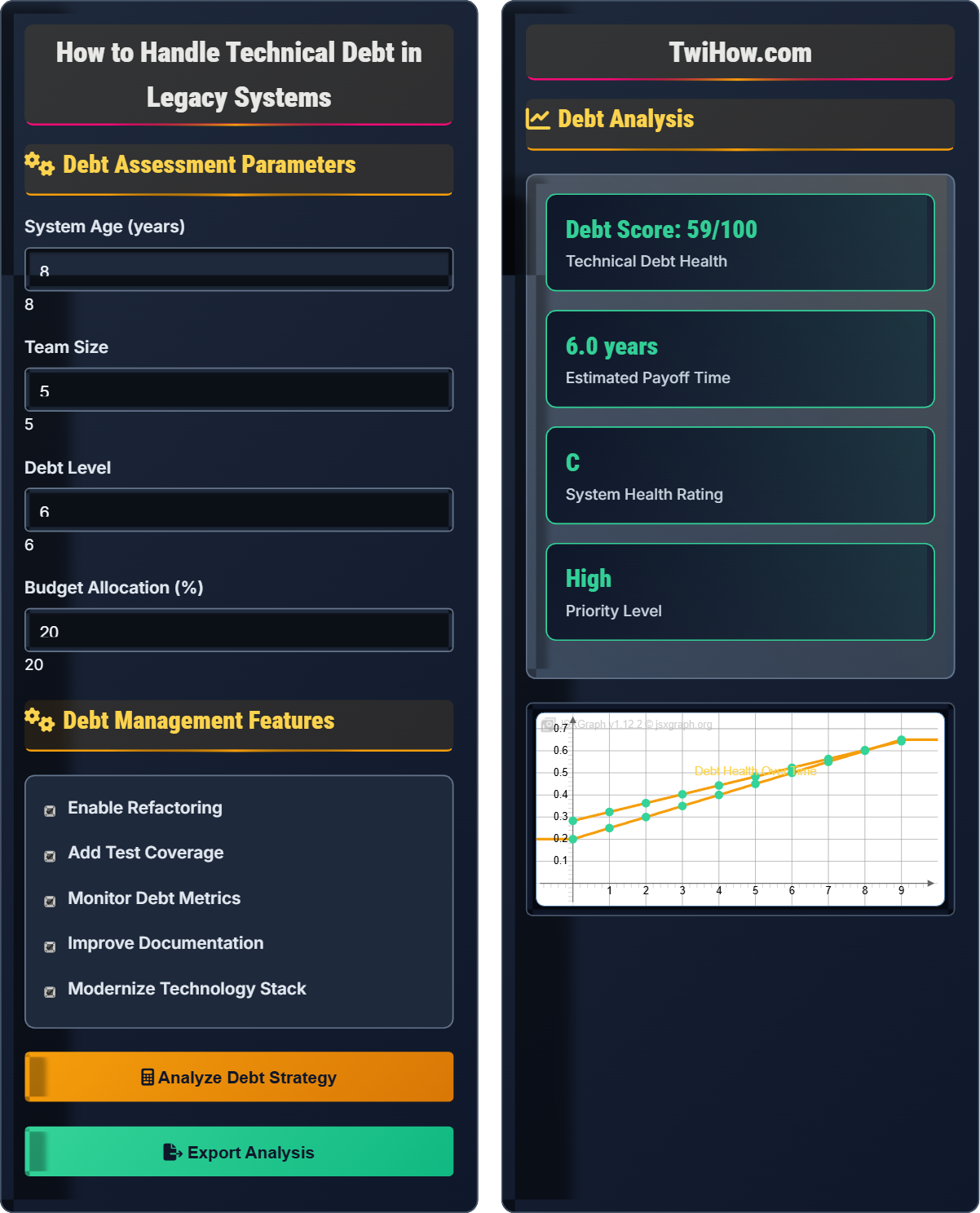
Debt Analysis
| Category | Score | Impact | Priority |
|---|---|---|---|
| Code Quality | 65% | High | High |
| Architecture | 45% | Very High | Urgent |
| Test Coverage | 25% | Medium | Medium |
| Documentation | 30% | Low | Low |
| Dependencies | 55% | High | High |
Technical Debt in Legacy Systems Explained
Technical debt is the implied cost of additional rework caused by choosing an easy or quick solution now instead of using a better approach that would take longer. Like financial debt, it accumulates "interest" over time in the form of maintenance costs, complexity, and reduced agility.
Common categories of technical debt in legacy systems:
Where:
- Design Debt: Architectural decisions that don't scale
- Code Debt: Poor implementation choices
- Test Debt: Insufficient test coverage
- Documentation Debt: Missing or outdated documentation
- Technology Debt: Outdated tools and frameworks
Effective strategies for managing technical debt:
- Boy Scout Rule: Leave code cleaner than you found it
- Strangler Fig: Gradually replace system components
- Refactoring: Systematic code improvement
- Testing: Increase coverage to enable safe changes
- Documentation: Improve understanding and maintainability
- Modernization: Update outdated technologies
- Duplicated Code: Identical or similar code fragments
- Long Methods: Methods that are too long to understand
- Large Classes: Classes with too many responsibilities
- Primitive Obsession: Excessive use of primitive types
- Feature Envy: Methods that use other classes' data
- Data Clumps: Groups of data that travel together
Debt Fundamentals
Technical Debt, Code Smells, Refactoring, Legacy Code, Debt Interest, Paydown Strategy.
Debt Interest = (Maintenance Cost × Time) + (Opportunity Cost × Velocity Loss)
Where Debt Interest = ongoing cost of carrying technical debt.
- Assess before acting
- Prioritize by impact
- Pay down gradually
Management Strategies
Refactoring, Strangler Pattern, Documentation, Testing, Modernization, Prevention.
- Identify critical debt
- Estimate effort and impact
- Create refactoring plan
- Execute in small increments
- Monitor progress
- Establish prevention practices
- Don't ignore debt
- Balance features and debt
- Track debt metrics
- Involve stakeholders
Technical Debt Quiz
Which of the following is NOT a type of technical debt?
Feature debt is not a recognized type of technical debt. The common types are design debt, code debt, test debt, documentation debt, and technology debt. While feature creep can be problematic, it's not considered a form of technical debt. The answer is C) Feature Debt.
Technical debt specifically refers to implementation decisions that trade short-term gains for long-term maintainability. Features themselves aren't debt, but poorly implemented features can contribute to code debt.
Understanding the different types of technical debt helps in categorizing and addressing specific problems. Each type requires different strategies for remediation. Recognizing what constitutes technical debt helps teams focus on the right problems.
Design Debt: Architectural shortcuts that cause problems
Code Debt: Implementation shortcuts in code
Test Debt: Insufficient test coverage
• Identify the type of debt
• Address root causes
• Don't confuse features with debt
• Use static analysis tools
• Regular code reviews
• Track debt metrics
• Misclassifying problems as debt
Explain the "Strangler Fig" pattern and how it can be used to handle technical debt in legacy systems.
Strangler Fig Pattern: Named after the strangler fig tree that grows around other trees, this pattern involves gradually replacing parts of a legacy system with new components while keeping the old system running. The new system slowly "strangles" the old one.
Implementation: Start by creating a facade or API gateway that routes requests between old and new systems. Begin replacing the least critical components first, gradually moving to more critical ones. Use feature flags to control which system handles each request.
Benefits: Allows for safe, incremental changes without downtime. Reduces risk by maintaining the old system as a fallback. Enables teams to learn from new implementations.
Steps:
1. Create a facade/gateway to route traffic
2. Identify and replace the simplest components first
3. Use feature flags to control routing
4. Gradually migrate functionality to new system
5. Decommission old components as they're replaced
6. Monitor performance and functionality during transition
This approach is particularly effective for legacy systems where a complete rewrite is too risky or expensive.
The Strangler Fig pattern is a risk-averse approach to dealing with legacy systems. Rather than attempting a risky big-bang rewrite, it allows for gradual, safe improvements. This pattern is particularly valuable when dealing with critical systems that cannot afford downtime.
Facade: Simplifies complex subsystem interfaces
Feature Flag: Switch to control functionality
Incremental Migration: Gradual replacement approach
• Start with simple components
• Maintain backward compatibility
• Monitor during transition
• Use API gateways for routing
• Implement comprehensive logging
• Plan for data synchronization
• Attempting full rewrite instead
A company has a 10-year-old monolithic e-commerce system with significant technical debt. The system handles $50M in annual revenue but is becoming increasingly difficult to maintain. Propose a comprehensive strategy to address the debt while maintaining business continuity.
Phase 1 - Assessment (Months 1-2): Conduct comprehensive technical audit. Use static analysis tools to identify code smells, measure cyclomatic complexity, assess test coverage, and map dependencies. Create debt inventory with severity ratings.
Phase 2 - Prioritization (Month 2): Rank debt items by business impact (customer-facing vs. internal), frequency of changes (hot spots), and effort to fix. Focus on areas that block feature development or cause frequent production issues.
Phase 3 - Safety Net (Months 2-3): Increase test coverage on critical paths. Write characterization tests to capture existing behavior before refactoring. Set up comprehensive monitoring and alerting.
Phase 4 - Gradual Refactoring (Months 3-18): Apply Strangler Fig pattern. Start with non-critical services like email notifications or logging. Gradually extract business logic into new microservices or modules.
Phase 5 - Architecture Evolution (Months 6-24): Begin decomposing the monolith. Create bounded contexts and gradually migrate functionality. Use API gateways for routing between old and new systems.
Phase 6 - Prevention (Ongoing): Establish code review standards, technical debt budget (15-20% of sprint time), and automated quality gates. Implement pair programming and mentoring programs.
Metrics to Track: Defect rates, deployment frequency, lead time for changes, test coverage, cyclomatic complexity, and team velocity.
This approach balances the need for business continuity with gradual improvement, allowing the system to continue generating revenue while reducing technical debt.
Managing technical debt in critical systems requires a careful, phased approach. The key is to maintain business continuity while gradually improving the system. The strategy should address both immediate pain points and long-term architectural improvements.
Monolithic Architecture: Single large application
Characterization Tests: Capture existing behavior
Bounded Context: Domain-driven design concept
• Never stop the business
• Focus on customer impact
• Plan for reversibility
• Start with non-critical components
• Use feature flags extensively
• Implement comprehensive monitoring
• Attempting full rewrite
• Not measuring progress
• Ignoring business impact
A development team needs to measure and track technical debt. Explain how to calculate a technical debt ratio and what metrics should be monitored to assess debt levels.
Technical Debt Ratio: Calculated as (Cost to Fix Debt) / (Cost to Rewrite from Scratch). This gives a percentage indicating how much extra effort is required due to debt.
Common Metrics:
Cyclomatic Complexity: Measures code complexity. Higher values indicate harder-to-maintain code.
Code Coverage: Percentage of code covered by tests. Lower coverage indicates higher risk in changes.
Duplicate Code: Amount of repeated code blocks that increase maintenance burden.
Code Churn: How frequently code is changed, which may indicate instability.
Hotspots: Files that are frequently modified and cause defects.
Testability: How easily code can be tested.
Architectural Drift: Deviation from intended architecture.
Tools: Use SonarQube, CodeClimate, or custom scripts to automatically calculate these metrics.
Tracking: Establish baselines, set targets, and track metrics over time. Use dashboards to visualize trends and alert when thresholds are exceeded.
Regular measurement enables data-driven decisions about debt prioritization and progress tracking.
Quantifying technical debt is crucial for making business cases and tracking progress. Metrics provide objective measures that help prioritize work and demonstrate the value of debt reduction efforts to stakeholders.
Cyclomatic Complexity: Number of linearly independent paths
Code Churn: Frequency of code changes
Hotspot: Frequently changed code with defects
• Track metrics consistently
• Set realistic targets
• Correlate with business metrics
• Use automated tools
• Focus on actionable metrics
• Visualize trends
• Tracking too many metrics
• Not correlating with business impact
• Ignoring metric drift
Which refactoring approach is most effective for reducing technical debt in legacy systems?
Incremental refactoring is the most effective approach for reducing technical debt in legacy systems. This involves making small, safe changes continuously while maintaining system functionality. It allows for steady improvement without the risks associated with a complete rewrite. The answer is B) Incremental Refactoring.
Incremental refactoring reduces risk, maintains business continuity, and allows for continuous learning and adaptation. It also provides immediate benefits and demonstrates progress to stakeholders.
Incremental refactoring aligns with Agile principles and allows teams to make continuous improvements while delivering value. It's more practical and safer than attempting large-scale changes to critical systems.
Incremental: Small, continuous improvements
Big Bang: Complete system replacement
Refactoring: Improving code without changing behavior
• Make small, safe changes
• Maintain functionality
• Test continuously
• Use the "boy scout rule"
• Refactor in small steps
• Add tests before refactoring
• Attempting too much at once
• Not having tests before refactoring
• Not measuring progress
FAQ
Q: How do I convince management to allocate time for technical debt reduction?
A: Frame the conversation in business terms:
Velocity Impact: Show how technical debt is slowing feature delivery. Present data on how long it takes to implement features compared to similar systems.
Defect Rate: Track how many bugs are related to legacy code. Demonstrate the cost of fixing production issues versus preventive refactoring.
Time-to-Market: Compare how long it takes to implement similar features in different parts of the system.
Risk Mitigation: Explain the business risk of system failures and security vulnerabilities.
Propose Solutions: Suggest a "technical debt budget" of 15-20% of sprint time. Present specific, measurable improvements with timelines.
Start Small: Begin with a pilot project showing tangible improvements in a critical area. Success stories build credibility for larger initiatives.
Q: How much time should we allocate to technical debt vs. new features?
A: The optimal allocation depends on your current debt level:
Healthy System (Low Debt): 10-15% for continuous improvement and prevention.
Moderate Debt: 20-25% for active debt reduction while maintaining features.
High Debt (Legacy System): 30-40% initially, gradually reducing as debt decreases.
Emergency Situation: Up to 50% if system stability is at risk.
Key Considerations:
Business Impact: Prioritize debt that affects customer-facing functionality.
Compound Interest: Address high-impact debt first to prevent exponential growth.
Team Capacity: Balance debt work with team morale and skill development.
Measurable Outcomes: Track improvements in velocity, defect rates, and deployment frequency to validate the investment.
Remember that debt reduction ultimately accelerates feature delivery by improving system stability and developer productivity.