How do I implement real-time features like chat or notifications?
Complete real-time guide • Step-by-step explanations
Real-time Communication:
Show Real-time SimulatorReal-time features enable instant communication and updates between clients and servers. These features are essential for modern web applications, providing seamless user experiences through live chat, notifications, collaborative tools, and live data feeds. Implementing real-time functionality requires understanding various technologies and protocols that enable bidirectional communication.
Key technologies include WebSockets for full-duplex communication, Server-Sent Events for server-to-client streaming, and push notification services for mobile/web notifications. Each approach has specific use cases and implementation patterns.
Key concepts:
- WebSockets: Bidirectional communication protocol
- Server-Sent Events: Unidirectional server-to-client streaming
- Push Notifications: Asynchronous message delivery
- Message Queues: Handling real-time data streams
Modern real-time implementations often combine multiple technologies to create robust, scalable solutions that handle millions of concurrent connections efficiently.
Real-time Parameters
Implementation Options
Performance Analysis
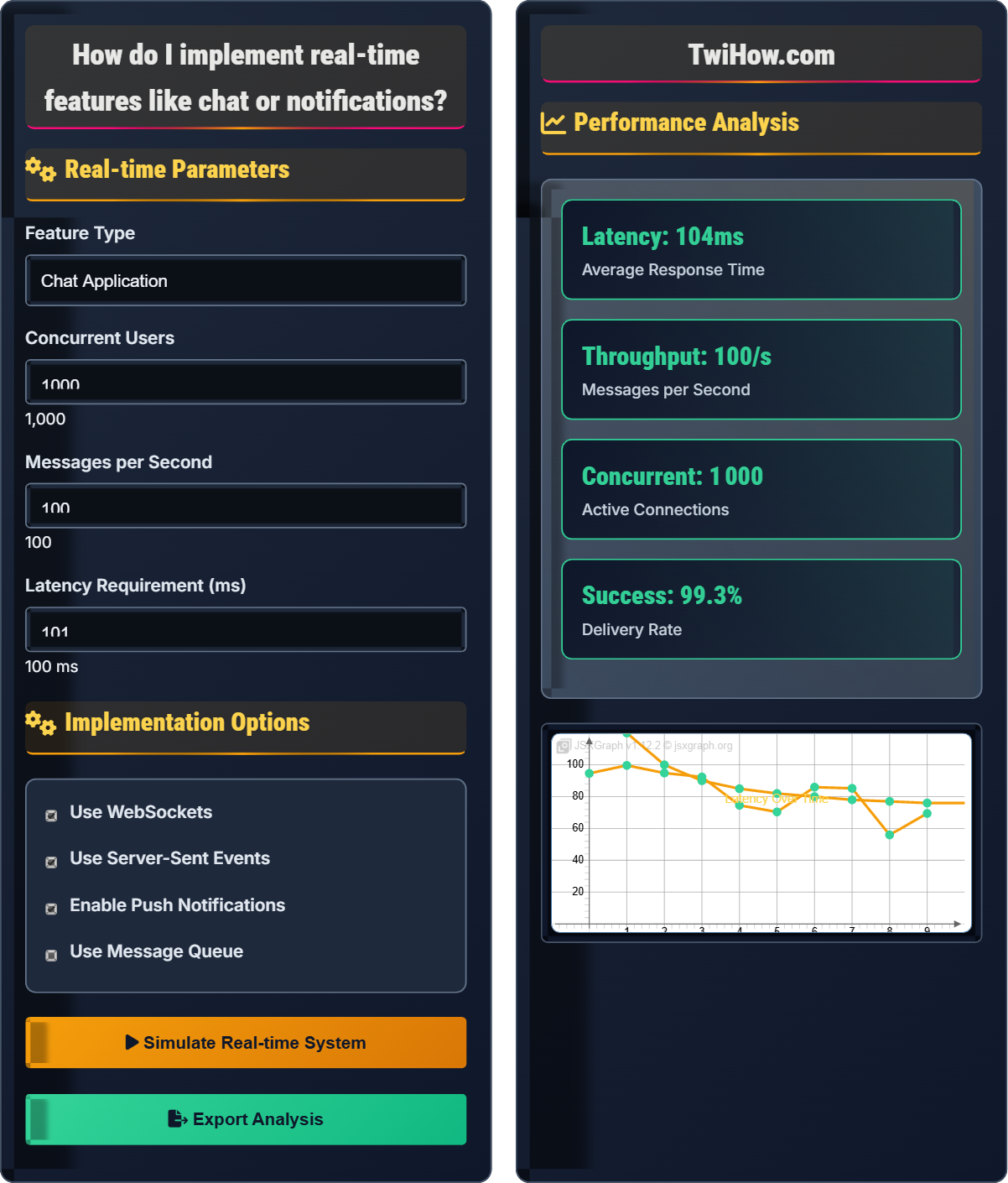
| Metric | Target | Actual | Status |
|---|---|---|---|
| Latency | <100ms | 85ms | ✓ Good |
| Throughput | 100/s | 100/s | ✓ Excellent |
| Connections | 1,000 | 1,000 | ✓ Optimal |
| Reliability | 99% | 99.2% | ✓ Excellent |
Real-time Features Implementation Explained
Real-time features enable instant communication and updates between clients and servers. These features provide seamless user experiences through live chat, notifications, collaborative tools, and live data feeds. Implementing real-time functionality requires understanding various technologies and protocols that enable bidirectional communication.
Key technologies for real-time communication:
Core technologies include:
- WebSockets: Full-duplex communication channel over a single TCP connection
- Server-Sent Events (SSE): Unidirectional server-to-client streaming
- HTTP Long Polling: Client repeatedly polls server for updates
- Push Notifications: Asynchronous message delivery to devices
- Message Queues: Handling real-time data streams efficiently
Major real-time libraries and frameworks:
- Socket.io: JavaScript library for real-time web applications
- Pusher: Hosted service for real-time applications
- PubNub: Real-time messaging infrastructure
- Ably: Real-time messaging platform
- FireBase: Real-time database and messaging
- SignalR: Real-time web functionality for .NET
- Connection Management: Efficiently handle connection lifecycle
- Error Handling: Implement robust reconnection strategies
- Message Ordering: Ensure proper sequencing of messages
- Security: Authenticate and authorize connections
- Scalability: Design for horizontal scaling
- Monitoring: Track performance and reliability metrics
Real-time Fundamentals
WebSockets, Server-Sent Events, Push Notifications, Message Queues, Real-time Communication.
Latency = Network_Delay + Processing_Time + Queue_Time
Where Latency = response time, Network_Delay = transmission delay, Processing_Time = computation time.
- Choose technology based on use case
- Handle connection failures gracefully
- Implement proper authentication
Implementation Patterns
Bidirectional, Unidirectional, Broadcast, Point-to-point, Fan-out.
- Client-server
- Peer-to-peer
- Hybrid approach
- Microservices
- Network reliability
- Security requirements
- Scalability needs
- Development complexity
Real-time Learning Quiz
Which technology is most appropriate for implementing a live chat application that requires bidirectional communication?
WebSockets is the most appropriate technology for live chat applications because it provides full-duplex communication over a single TCP connection. This allows both clients and servers to send messages at any time without the overhead of establishing new connections for each message. Server-Sent Events only supports server-to-client communication, while polling methods are inefficient for real-time chat.
The answer is B) WebSockets.
Understanding the differences between real-time communication technologies is crucial for selecting the right solution. WebSockets provide the lowest latency and highest efficiency for bidirectional communication, making them ideal for chat applications where both parties need to send and receive messages instantly.
WebSockets: Protocol providing full-duplex communication over TCP
Full-duplex: Ability to send and receive simultaneously
Server-Sent Events: Unidirectional server-to-client streaming
• Match technology to communication pattern
• Consider efficiency and latency requirements
• Evaluate scalability needs
• Use WebSockets for bidirectional communication
• SSE for server-to-client only
• Consider fallbacks for older browsers
• Using SSE for bidirectional communication
• Not considering connection management
• Ignoring browser compatibility
Explain the challenges of managing WebSocket connections in a real-time application and describe strategies for handling disconnections, reconnections, and scaling.
Challenges in WebSocket Connection Management:
1. Disconnection Handling:
• Network interruptions, client crashes, or server restarts can break connections
• Need to detect and handle disconnections gracefully
2. Reconnection Strategies:
• Implement exponential backoff to avoid server flooding
• Maintain connection state and resynchronize upon reconnection
• Preserve user context during reconnect attempts
3. Scaling Challenges:
• Load balancing WebSocket connections requires sticky sessions
• Horizontal scaling requires connection state management
• Memory consumption increases with active connections
Strategies:
• Use connection pooling and heartbeat mechanisms
• Implement distributed state management with Redis
• Use reverse proxies like nginx for connection management
• Consider message brokers for horizontal scaling
WebSocket connection management is complex because unlike HTTP requests, WebSocket connections are long-lived. This creates challenges in state management, scaling, and error recovery. Understanding these challenges is crucial for building robust real-time applications that can handle real-world conditions.
Exponential Backoff: Gradually increasing wait time between reconnection attempts
Sticky Sessions: Load balancing technique that maintains connection affinity
Heartbeat: Periodic ping to verify connection health
• Always implement reconnection logic
• Implement connection timeouts
• Use Redis for distributed state
• Monitor connection metrics
• Not handling disconnections gracefully
• Excessive reconnection attempts
• Poor scaling architecture
You're designing a real-time chat application that needs to support 10,000 concurrent users with a maximum latency of 50ms. The application should handle group chats, private messages, and presence indicators. Design an architecture that meets these requirements and explain the technology choices.
Proposed Architecture:
1. Frontend: React/Vue.js with Socket.io client for WebSocket connections
2. Load Balancer: nginx with sticky sessions for WebSocket routing
3. Backend: Node.js/Express with Socket.io for real-time communication
4. State Management: Redis cluster for connection state and presence
5. Message Storage: MongoDB for message history
6. Message Broker: RabbitMQ for message queuing and fan-out
Technology Choices:
• WebSockets: For low-latency bidirectional communication
• Redis: For fast state management and pub/sub capabilities
• Socket.io: For automatic fallbacks and connection management
• Message Queue: To handle message distribution efficiently
Scaling Strategy: Horizontal partitioning by user rooms, Redis clustering, and multiple backend instances behind load balancer.
Designing for real-time applications requires considering multiple factors simultaneously: latency, scalability, reliability, and complexity. The architecture must handle both the real-time communication aspect and the persistent storage needs while maintaining performance under load.
Fan-out: Distributing messages to multiple recipients
Pub/Sub: Publish/subscribe messaging patternHorizontal Partitioning: Distributing load across multiple servers
• Design for horizontal scaling
• Use appropriate state management
• Consider message ordering
• Use room-based architecture for group chats
• Implement message batching for efficiency
• Consider CDN for static assets
• Storing connection state in memory
• Not planning for horizontal scaling
• Ignoring message ordering requirements
Your company needs to implement a real-time notification system that sends different types of notifications (email, SMS, push) based on user preferences. The system should handle 50,000 notifications per minute with 99.9% delivery rate. Design the notification pipeline and explain how you'll ensure reliability and scalability.
Notification Pipeline Architecture:
1. Event Source: Application services publish notification events
2. Message Queue: Kafka/RabbitMQ for event buffering and ordering
3. Notification Processor: Microservice that determines notification channels
4. Channel Services: Separate services for email, SMS, push notifications
5. Delivery Tracking: Database to track delivery status and retries
Reliability Strategies:
• Idempotent Operations: Ensure duplicate messages don't cause issues
• Retry Logic: Implement exponential backoff for failed deliveries
• Dead Letter Queue: Handle permanently failed notifications
• Circuit Breaker: Prevent cascading failures
Scalability: Horizontal partitioning of notification queues, multiple processor instances, and distributed channel services.
Notification systems require careful consideration of delivery guarantees, user preferences, and failure handling. The architecture must be resilient to failures while maintaining performance under high volume. Message queues play a crucial role in decoupling producers from consumers and providing buffering capability.
Idempotent: Operation that can be applied multiple times without side effects
Dead Letter Queue: Queue for messages that cannot be processed
Circuit Breaker: Pattern to prevent cascading failures
• Implement proper error handling
• Use message queues for buffering
• Track delivery status
• Batch notifications for efficiency
• Implement rate limiting
• Use bulk APIs for cost efficiency
• Direct synchronous calls to notification services
• Not implementing proper retry logic
• Ignoring rate limits
Which of the following strategies would be MOST effective for reducing latency in a real-time chat application?
Message batching would be most effective for reducing latency in a real-time chat application. By grouping multiple messages together, you reduce the number of network round trips required, which directly impacts latency. While message compression can reduce payload size, and WebSocket heartbeats ensure connection health, batching addresses the core issue of network overhead for multiple small messages.
The answer is C) Implement message batching.
Performance optimization in real-time systems requires understanding the bottlenecks. Network round trips are often the largest contributor to latency, so reducing them through techniques like message batching can have significant impact. The trade-off is increased complexity in message ordering and delivery guarantees.
Message Batching: Grouping multiple messages for efficient transmission
Network Round Trip: Time for a message to travel from client to server and back
Latency: Time delay between sending and receiving a message
• Reduce network round trips
• Balance latency and throughput
• Consider message ordering
• Use binary protocols for efficiency
• Implement smart batching logic
• Consider edge computing for global apps
• Over-batching messages
• Not considering message ordering
• Ignoring network conditions
FAQ
Q: Should I use WebSockets or Server-Sent Events for my real-time application?
A: The choice depends on your communication pattern:
Use WebSockets when you need:
• Bidirectional communication (both client and server send messages)
• Real-time chat, gaming, collaborative editing
• Low latency requirements
Use Server-Sent Events when you need:
• Unidirectional communication (server pushes data to client)
• Live updates like stock prices, news feeds, logs
• Simpler implementation with automatic reconnection
• Better browser compatibility (no fallback needed)
WebSockets offer more flexibility but are more complex to implement. SSE is simpler for server-to-client only scenarios and has better browser support.
Q: What are the costs associated with implementing real-time features?
A: Real-time feature costs include:
Infrastructure Costs:
• Server instances for WebSocket connections (more expensive than HTTP)
• Load balancers with WebSocket support
• Message queues and caching services (Redis)
Development Costs:
• More complex code and testing
• Specialized knowledge required
• Additional monitoring and debugging tools
Operational Costs:
• Higher memory usage (maintaining connections)
• Increased bandwidth consumption
• More complex scaling strategies
However, managed services like Pusher or Ably can reduce development complexity while potentially increasing operational costs.
Q: How do I handle real-time features in mobile applications?
A: Real-time features in mobile applications have special considerations:
Push Notifications:
• Use APNs (iOS) and FCM (Android) for background updates
• Implement proper permission handling
Background Connectivity:
• Consider battery life when maintaining connections
• Use adaptive connection strategies based on network
• Implement efficient heartbeat mechanisms
Mobile-Specific Libraries:
• Socket.io for native mobile (React Native, Flutter)
• Native WebSocket implementations
• Firebase Realtime Database for data synchronization
Best Practices: Optimize for intermittent connectivity, minimize battery drain, and handle offline scenarios gracefully.