How to Prepare for Technical Interviews at Top Tech Companies?
Complete interview prep guide • Step-by-step strategies
Interview Preparation:
Show Interview Prep CalculatorPreparing for technical interviews at top tech companies requires a strategic approach combining algorithm mastery, system design skills, behavioral preparation, and mock interviews. Success depends on consistent practice, understanding company expectations, and developing problem-solving intuition.
Top tech companies evaluate candidates across multiple dimensions: coding proficiency, system architecture knowledge, communication skills, and cultural fit. The preparation process typically spans 3-6 months of focused effort.
Key preparation areas:
- Coding Challenges: Data structures, algorithms, and optimization
- System Design: Scalability, architecture, and trade-offs
- Behavioral Questions: STAR method and leadership principles
- Mock Interviews: Practice with real interview scenarios
Modern preparation strategies leverage online platforms, peer practice, and structured study plans to maximize success rates.
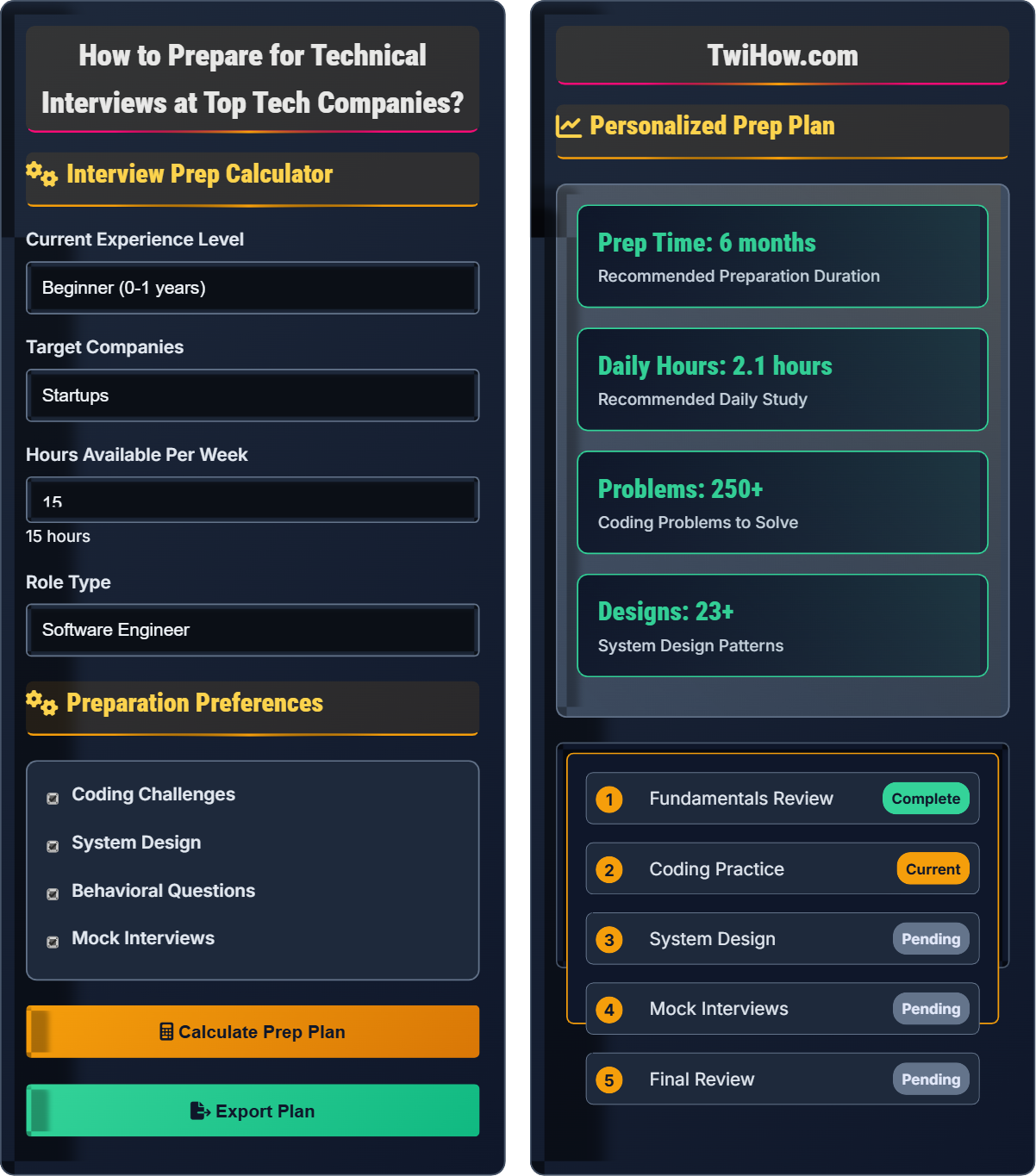
Interview Prep Calculator
Preparation Preferences
Personalized Prep Plan
Skills Assessment
| Week | Focus Area | Hours | Goal |
|---|---|---|---|
| 1-2 | Fundamentals | 20 hrs | Review basics |
| 3-6 | Coding Practice | 30 hrs | 50 problems |
| 7-10 | System Design | 25 hrs | 8 patterns |
| 11-14 | Mock Interviews | 20 hrs | 10 sessions |
| 15-16 | Final Review | 15 hrs | Polish skills |
Recommended Resources
- LeetCode (Premium for company-specific questions)
- Cracking the Coding Interview book
- System Design Primer (GitHub repository)
- Pramp or InterviewBit for mock interviews
- Grokking the System Design Interview course
Technical Interview Preparation Strategy
Top tech companies typically follow a multi-round interview process:
- Screening Round: Initial phone/video screen with basic technical questions
- Coding Rounds: 1-2 rounds of algorithm/data structure problems
- System Design: Architecture and scalability discussions (for senior roles)
- Behavioral: Cultural fit and leadership principle questions
- Bar Raiser: Final round with senior engineers focusing on overall fit
Effective preparation follows a structured timeline:
Where:
- Fundamentals: Review of data structures and algorithms
- Coding Practice: Solving problems on platforms like LeetCode
- System Design: Understanding scalable architecture patterns
- Mock Interviews: Practice with real interview scenarios
Essential areas for technical interview success:
- Data Structures: Arrays, linked lists, trees, graphs, hash tables
- Algorithms: Sorting, searching, dynamic programming, recursion
- System Design: Load balancing, caching, databases, microservices
- Communication: Explaining thought process clearly
- Optimization: Time and space complexity analysis
- Testing: Edge cases and error handling
- Think Aloud: Verbalize your thought process during interviews
- Start Simple: Begin with brute force solutions, then optimize
- Ask Clarifying Questions: Understand the problem fully before coding
- Test Your Solution: Walk through examples with your code
- Handle Edge Cases: Consider empty inputs, null values, etc.
- Practice Communication: Explain complex concepts simply
Interview Fundamentals
Data structures, algorithms, system design, communication, problem-solving, time complexity.
Success Rate = (Consistent Practice × Strategic Planning) / Anxiety
Where Consistent Practice = Daily Coding + Weekly Mock Interviews, Strategic Planning = Target Company Research.
- Master the fundamentals before advanced topics
- Practice under timed conditions
- Explain your approach before coding
Career Applications
Successful technical interviews lead to opportunities at top tech companies with competitive compensation packages.
- Prepare thoroughly for interviews
- Apply strategically to target companies
- Negotiate offers effectively
- Continue learning in role
- Advance within the company
- Compensation varies significantly by company
- Work-life balance differs across organizations
- Stock options can be significant compensation component
- Learning opportunities vary by team and manager
Interview Preparation Quiz
What is the most effective approach when facing a difficult coding problem during an interview?
The most effective approach is to communicate clearly with the interviewer. This demonstrates problem-solving skills, communication ability, and thought process. Asking clarifying questions shows attention to detail. Starting with a simple solution demonstrates understanding and provides a foundation for optimization.
The answer is B) Ask clarifying questions, explain your approach, then start with a simple solution.
Technical interviews evaluate not just the correct answer but also the problem-solving process. Interviewers want to see how you think, communicate, and handle challenges. The "think aloud" approach helps interviewers understand your reasoning and allows them to guide you if needed. Starting with a simple solution shows methodical thinking and provides a baseline for improvements.
Clarifying Questions: Questions to better understand problem requirements
Brute Force Solution: Simple, direct approach before optimization
Communication: Articulating thoughts and reasoning clearly
• Always clarify problem requirements first
• Explain your approach before coding
• Start with a simple solution, then optimize
• Use the "think aloud" approach throughout
• Draw diagrams to visualize problems
• Consider edge cases early in the process
• Jumping straight to code without planning
• Not asking clarifying questions
• Getting stuck on optimization too early
Explain how to approach system design preparation for senior-level technical interviews at top tech companies. Include specific steps and resources.
System Design Preparation Steps:
1. Learn Core Concepts: Understand distributed systems, databases, caching, load balancing, message queues, and microservices architecture.
2. Study Design Patterns: Learn common patterns like sharding, CDN, pub-sub, leader-follower, etc.
3. Practice Design Problems: Work on problems like designing Twitter, Uber, Netflix, or Google Search.
4. Learn Trade-offs: Understand pros/cons of different approaches and when to use each.
Specific Resources:
Books: "Designing Data-Intensive Applications" by Martin Kleppmann
Courses: "Grokking the System Design Interview" on Educative.io
Websites: System Design Primer GitHub repository, HiredInTech
Practice Platforms: Pramp for mock system design interviews
Approach: Use the "clarify requirements → estimate scale → design high-level → dive deep → discuss trade-offs" framework.
System design interviews assess your ability to architect scalable solutions. Unlike coding interviews, these are open-ended discussions that evaluate your understanding of real-world constraints, trade-offs, and architectural decisions. The goal is not to arrive at a perfect solution but to demonstrate systematic thinking and awareness of complexity in large-scale systems.
Distributed Systems: Systems running on multiple machines
Scalability: Ability to handle increased load
Trade-offs: Balancing competing requirements
• Start with requirements clarification
• Estimate scale and constraints
• Discuss trade-offs openly
• Draw diagrams to illustrate your design
• Think about failure scenarios
• Consider cost implications
• Starting with low-level details instead of high-level overview
• Not considering scalability requirements
• Forgetting about failure cases
You have 3 months to prepare for technical interviews at top tech companies. You can dedicate 20 hours per week to preparation. Calculate how you should allocate your time between coding practice, system design, behavioral preparation, and mock interviews to maximize your chances of success. Assume that coding practice should take 50% of your time, system design 25%, behavioral 15%, and mock interviews 10%.
Total Preparation Time:
3 months × 4 weeks/month × 20 hours/week = 240 total hours
Time Allocation:
• Coding Practice: 50% × 240 = 120 hours (5 hours/day, 5 days/week)
• System Design: 25% × 240 = 60 hours (2.5 hours/day, 5 days/week)
• Behavioral: 15% × 240 = 36 hours (1.5 hours/day, 5 days/week)
• Mock Interviews: 10% × 240 = 24 hours (1 hour/day, 5 days/week)
Weekly Breakdown:
Week 1-4: Focus on fundamentals and coding practice (40 hours coding, 10 system design)
Week 5-8: Continue coding while adding system design (30 hours coding, 15 system design)
Week 9-10: Emphasize system design and behavioral (20 hours coding, 20 system design, 10 behavioral)
Week 11-12: Mock interviews and final preparation (20 hours mock interviews, 10 review)
This allocation ensures comprehensive preparation while emphasizing the most critical areas.
Effective interview preparation requires strategic time allocation based on the importance and difficulty of each component. Coding practice typically requires the most time because it involves developing problem-solving intuition and familiarity with patterns. System design becomes increasingly important for senior roles. Behavioral preparation ensures you can articulate your experiences effectively. Mock interviews provide practice in the actual interview format.
Time Allocation: Distributing study time across different topics
Priority Setting: Determining what to focus on first
Preparation Strategy: Systematic approach to studying
• Allocate time based on role requirements
• Maintain consistency in study schedule
• Balance learning with practice
• Track your progress weekly
• Adjust allocation based on weak areas
• Schedule regular breaks to avoid burnout
• Spending too much time on one area
• Not practicing enough mock interviews
• Ignoring behavioral preparation
You're preparing for interviews at Google and Amazon. Compare and contrast their technical interview processes and explain how you should tailor your preparation for each company's specific requirements and culture.
Google Interview Process:
• Heavy emphasis on algorithmic coding problems
• Focus on efficiency (time/space complexity)
• Whiteboard-style coding during interviews
• Culture of innovation and "Googleyness"
Amazon Interview Process:
• Leadership principles heavily emphasized
• System design for senior roles
• Behavioral questions tied to Amazon's 14 leadership principles
• Customer obsession and ownership mindset
Preparation Differences:
For Google: Focus heavily on LeetCode medium/hard problems, practice whiteboard coding, understand Google's products and culture.
For Amazon: Emphasize behavioral preparation using STAR method, study Amazon's leadership principles, practice system design for senior roles.
Common Preparation:
Both require strong coding skills, system design knowledge (for senior roles), and communication skills. Both value problem-solving approach over getting the perfect answer.
Each top tech company has distinct interview processes that reflect their culture and priorities. Understanding these differences allows candidates to tailor their preparation accordingly. While core technical skills remain important across companies, the emphasis on specific aspects (like behavioral questions at Amazon or pure algorithmic skills at Google) varies. Researching the company's culture, products, and interview format is crucial for success.
Leadership Principles: Amazon's behavioral evaluation framework
Googleyness: Google's cultural fit assessment
STAR Method: Situation, Task, Action, Result framework
• Research company-specific interview format
• Tailor behavioral answers to company values
• Practice with company-specific questions
• Use Glassdoor to research interview experiences
• Connect with employees on LinkedIn
• Practice with company-specific question sets
• Treating all companies the same way
• Not researching company culture
• Generic behavioral answers
Which of the following is the most common mistake made by candidates preparing for technical interviews at top tech companies?
The most common mistake is focusing only on getting the correct answer without explaining the approach. Technical interviews evaluate problem-solving process, communication skills, and thought patterns as much as the final solution. Interviewers want to see how you think, handle challenges, and collaborate. Simply arriving at the right answer without articulating your reasoning limits your evaluation potential.
Many candidates solve problems perfectly on their own but struggle to communicate their approach effectively during interviews.
The answer is B) Focusing only on getting correct answers without explaining approach.
This mistake stems from approaching interview preparation like academic exams rather than collaborative problem-solving sessions. In real engineering work, communication and collaboration are as important as technical skills. Interviewers want to see how you approach unfamiliar problems, handle feedback, and work with others. The "think aloud" approach demonstrates these soft skills while showing your technical competency.
Think Aloud: Verbalizing thought process during problem-solving
Collaborative Problem-Solving: Working together to find solutions
Soft Skills: Communication, teamwork, and interpersonal abilities
• Always explain your thought process
• Communicate assumptions clearly
• Ask for feedback during the process
• Practice explaining solutions out loud
• Record yourself solving problems
• Practice with friends or mentors
• Silent problem-solving
• Not asking clarifying questions
• Jumping to optimizations immediately
FAQ
Q: How many LeetCode problems should I solve before interviewing at top tech companies?
A: The number of problems isn't as important as the depth of understanding. Aim for 150-200 problems covering various patterns and difficulty levels. Focus on understanding patterns rather than memorizing solutions. Quality over quantity - deeply understanding 150 problems is better than superficially knowing 300. Make sure to cover all major categories: arrays/strings, linked lists, trees/graphs, dynamic programming, backtracking, and system design patterns.
Q: How important is system design for junior-level positions at top tech companies?
A: For junior positions (L3/L4), system design is typically not a major focus, but having basic knowledge is beneficial. Junior candidates are primarily evaluated on coding skills and problem-solving ability. However, understanding fundamental concepts like databases, caching, and basic scalability principles shows broader technical awareness. As you advance to senior levels (L5+), system design becomes increasingly important. Start learning system design early in your career as it will benefit your growth regardless of immediate interview needs.
Q: What's the difference between preparing for big tech vs smaller company interviews?
A: Big tech companies (FAANG) have more standardized, rigorous interview processes focused on algorithmic problem-solving and system design. They often have multiple rounds and specific evaluation criteria. Smaller companies may focus more on practical skills, cultural fit, and domain expertise relevant to their specific product. Big tech interviews are more predictable and can be prepared for systematically, while smaller company interviews might include more open-ended questions about your previous projects and real-world problem-solving. However, both value strong technical fundamentals and clear communication skills.