How to Secure Web Applications from Common Vulnerabilities
Complete security guide • Step-by-step explanations
Web Security Fundamentals:
Show Security AnalyzerWeb application security is the practice of protecting websites and web apps from various cyber threats and attacks. It involves implementing security measures to safeguard sensitive data, prevent unauthorized access, and ensure the integrity and availability of web applications.
Common web vulnerabilities include Cross-Site Scripting (XSS), SQL Injection, Cross-Site Request Forgery (CSRF), and many others. These vulnerabilities can lead to data breaches, financial losses, and reputation damage.
Key security concepts:
- Input Validation: Sanitizing user inputs to prevent malicious code
- Authentication: Verifying user identity
- Authorization: Controlling access to resources
- Encryption: Protecting data in transit and at rest
- OWASP Top 10: Standard awareness document of critical security risks
Modern web security combines multiple layers of protection including firewalls, secure coding practices, regular security testing, and continuous monitoring to protect against evolving threats.
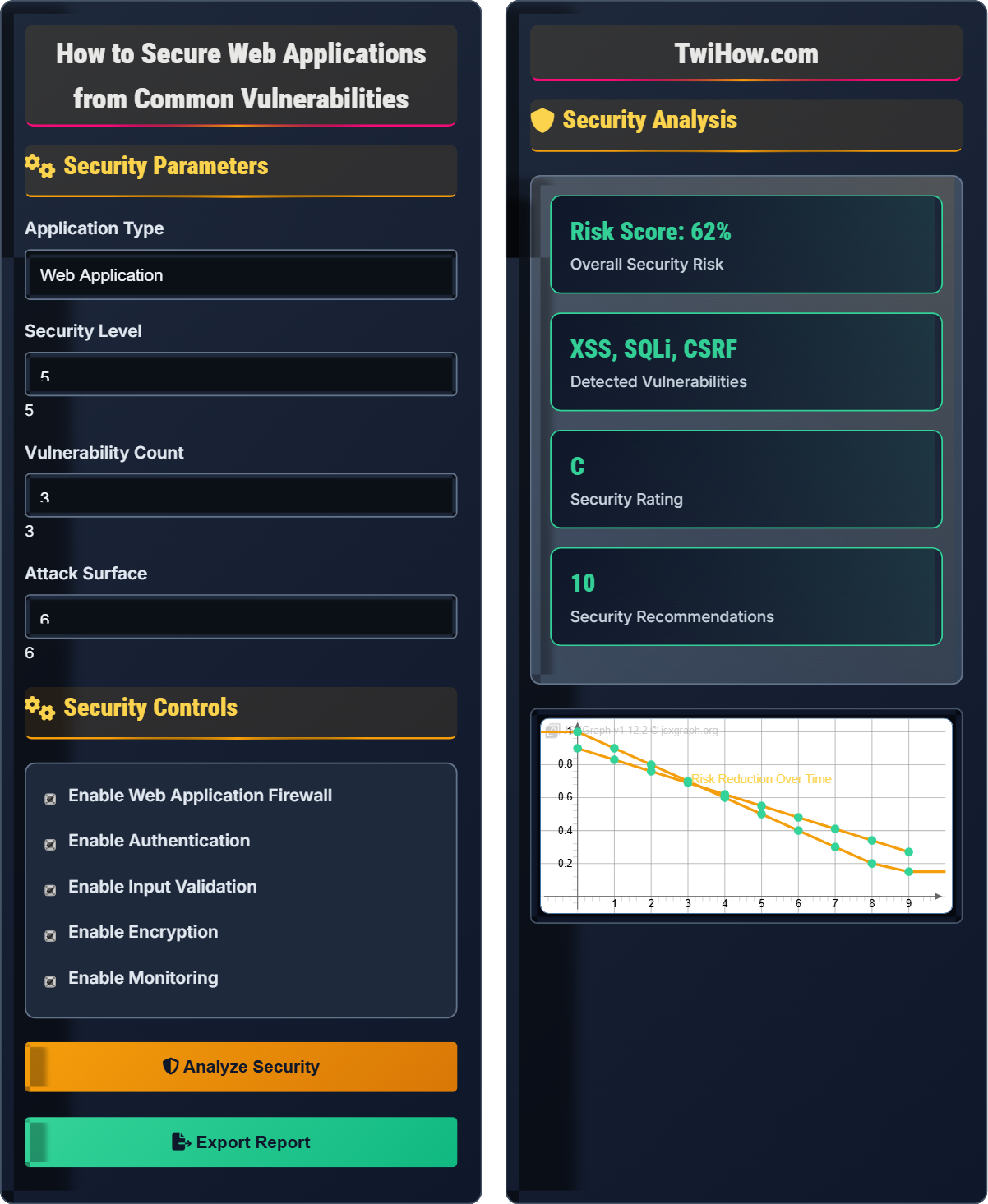
Security Parameters
Security Controls
Security Analysis
| Vulnerability | Severity | Risk Level | Action Required |
|---|---|---|---|
| XSS | High | Critical | Immediate Fix |
| SQL Injection | High | Critical | Immediate Fix |
| CSRF | Medium | Medium | Implement Tokens |
Web Application Security Explained
Web application security is the practice of protecting websites and web apps from various cyber threats and attacks. It encompasses a range of strategies, technologies, and best practices designed to safeguard sensitive data, prevent unauthorized access, and ensure the integrity and availability of web applications.
The OWASP Top 10 is a standard awareness document that represents a broad consensus about the most critical security risks to web applications. The latest version includes:
Where:
- Injection: Inserting malicious code into commands or queries
- Broken Authentication: Flaws in authentication and session management
- Sensitive Data Exposure: Poor protection of sensitive data
- XML External Entities (XXE): Exploiting XML processors
- Broken Access Control: Restrictions on resource access
- Security Misconfiguration: Improperly configured security settings
- Cross-Site Scripting (XSS): Injecting malicious scripts
- Insecure Deserialization: Manipulating deserialized objects
- Using Components with Known Vulnerabilities: Outdated libraries
- Insufficient Logging & Monitoring: Poor incident detection
Essential security controls for web applications:
- Input Validation: Sanitize and validate all user inputs
- Output Encoding: Encode data before displaying it
- Authentication: Verify user identity through secure methods
- Authorization: Control access to resources based on permissions
- Session Management: Securely manage user sessions
- Error Handling: Prevent information leakage through error messages
- Defense in Depth: Implement multiple layers of security
- Principle of Least Privilege: Grant minimal necessary permissions
- Regular Updates: Keep all components updated
- Security Headers: Implement proper HTTP security headers
- Penetration Testing: Regularly test for vulnerabilities
- Incident Response: Have a plan for security incidents
Security Fundamentals
XSS, SQL Injection, CSRF, Authentication, Authorization, Encryption, OWASP.
Risk = Likelihood × Impact × Vulnerability
Where Risk = potential damage, Likelihood = probability of attack, Impact = consequences.
- Never trust user input
- Implement defense in depth
- Follow principle of least privilege
Vulnerabilities
Cross-Site Scripting, SQL Injection, Cross-Site Request Forgery, Broken Authentication.
- Input fields
- URL parameters
- Headers
- Cookies
- Input validation
- Output encoding
- Parameterized queries
- Secure session management
Web Security Learning Quiz
Which of the following is NOT part of the OWASP Top 10 vulnerabilities?
The OWASP Top 10 is a standard awareness document that represents a broad consensus about the most critical security risks to web applications. While buffer overflow is a serious vulnerability, it is not specifically listed in the OWASP Top 10, which focuses on web application-specific vulnerabilities. The correct answer is C) Buffer Overflow.
The OWASP Top 10 includes: Injection, Broken Authentication, Sensitive Data Exposure, XML External Entities (XXE), Broken Access Control, Security Misconfiguration, Cross-Site Scripting (XSS), Insecure Deserialization, Using Components with Known Vulnerabilities, and Insufficient Logging & Monitoring.
The OWASP Top 10 is crucial for understanding web application security priorities. It helps developers focus on the most prevalent and dangerous vulnerabilities in web applications. While buffer overflows are critical in system programming, they are less common in web applications compared to injection flaws, authentication issues, and cross-site scripting.
OWASP: Open Web Application Security Project
Buffer Overflow: When more data is written to a buffer than it can hold
Injection: Inserting malicious code into commands or queries
• Focus on the most common web vulnerabilities
• Prioritize security controls based on risk
• Stay updated with the latest OWASP Top 10
• Remember the acronym "ISSEA" for injection, security misconfiguration, etc.
• Regularly review the current OWASP Top 10 list
• Focus on prevention rather than detection
• Confusing system-level vulnerabilities with web app vulnerabilities
Explain the difference between client-side and server-side input validation. Why is server-side validation considered more important for security?
Client-Side Validation: Performed on the user's browser using JavaScript or HTML5 attributes. Provides immediate feedback to users and improves user experience by catching obvious errors before submission.
Server-Side Validation: Performed on the server after receiving data from the client. Validates all inputs regardless of whether client-side validation was bypassed.
Server-side validation is more important for security because:
- Client-side validation can be easily bypassed by disabling JavaScript or using tools like browser developer consoles
- Malicious users can craft requests directly to the server without going through the client interface
- Client-side validation provides no security protection since it runs in an untrusted environment
- Server-side validation is the last line of defense against malicious input
Client-side validation is like having a polite doorman who asks nicely if you have identification, while server-side validation is like having a security guard who checks your credentials regardless of what you say. Both serve purposes: client-side validation improves user experience, while server-side validation ensures security. The key principle is never to trust anything that comes from the client side.
Client-Side Validation: Input validation performed in the user's browser
Server-Side Validation: Input validation performed on the server
Defense in Depth: Multiple layers of security controls
• Always validate on the server side
• Client-side validation is for UX only
• Never trust client input
• Use both client and server validation
• Implement white-list validation when possible
• Log validation failures for monitoring
• Relying solely on client-side validation
• Assuming client input is safe
• Not validating API endpoints
A fintech startup is developing a mobile banking application that handles sensitive financial transactions. Describe a comprehensive security strategy they should implement, including authentication, data protection, and monitoring requirements.
Authentication Strategy: Multi-factor authentication (MFA) with biometric verification, strong password policies, and account lockout mechanisms. Implement OAuth 2.0 with PKCE for mobile applications.
Data Protection: Encrypt data both in transit (TLS 1.3) and at rest (AES-256). Implement tokenization for sensitive data like account numbers. Use parameterized queries to prevent SQL injection.
Application Security: Input validation, output encoding, secure session management, and proper error handling. Implement Content Security Policy (CSP) and security headers.
Monitoring & Compliance: Continuous security monitoring, intrusion detection systems, audit logging, and compliance with PCI-DSS and SOX regulations. Regular penetration testing and security assessments.
Additional Measures: Rate limiting, IP whitelisting, transaction monitoring, and incident response plans.
Financial applications require the highest level of security due to the sensitive nature of the data and regulatory requirements. The security strategy must address multiple layers: network security, application security, data security, and operational security. Each layer must work together to create a comprehensive defense against various attack vectors.
MFA: Multi-Factor Authentication
PCI-DSS: Payment Card Industry Data Security Standard
PKCE: Proof Key for Code Exchange
• Financial apps require multi-layered security
• Compliance with industry standards is mandatory
• Regular security assessments are required
• Start security planning early in development
• Implement security by design
• Regular employee security training
• Adding security as an afterthought
• Not considering regulatory compliance
• Insufficient logging and monitoring
A developer has written a login function that concatenates user input directly into a SQL query. Explain why this is vulnerable to SQL injection and provide three different technical approaches to fix it.
Vulnerability: Direct concatenation allows attackers to inject malicious SQL code. For example, entering ' OR '1'='1 in the username field would make the query always return true, bypassing authentication.
Approach 1 - Parameterized Queries: Use prepared statements with parameter placeholders instead of string concatenation. The database treats parameters as data, not executable code.
Approach 2 - Stored Procedures: Use stored procedures with parameterized inputs. The database engine validates the procedure structure separately from the data.
Approach 3 - Input Validation: Implement strict input validation to reject potentially malicious characters. However, this should be combined with other approaches as it's not foolproof.
The most effective approach is parameterized queries combined with input validation.
SQL injection occurs when an application fails to properly sanitize user input before using it in database queries. The fundamental issue is treating user input as executable code rather than data. Parameterized queries solve this by sending the query structure and data separately to the database, ensuring that user input cannot alter the query's intended purpose.
SQL Injection: Code injection technique that exploits database vulnerabilities
Parameterized Query: Query with placeholders for user input
Prepared Statement: Precompiled SQL statement with parameters
• Never concatenate user input into SQL
• Always use parameterized queries
• Validate input at every layer
• Use ORM frameworks that prevent injection
• Implement database user privileges
• Regularly audit database queries
• Using string concatenation for queries
• Not escaping special characters
• Assuming input validation is enough
Which of the following is the most effective way to prevent Cross-Site Scripting (XSS) attacks?
Cross-Site Scripting (XSS) occurs when an application includes untrusted data in a web page without proper validation or escaping. The most effective prevention method is output encoding, which converts special characters into their encoded equivalents so they're displayed as text rather than executed as code. While input validation helps, it's not sufficient since XSS can occur through various vectors. The answer is B) Output encoding.
Output encoding ensures that any potentially malicious script is rendered harmlessly as text rather than executed by the browser.
XSS prevention follows the principle of "contextual output encoding." Different contexts (HTML, JavaScript, CSS, URLs) require different encoding methods. The key is to encode data based on where it will be placed in the output, not just where it came from. This is why output encoding is more effective than input validation alone.
XSS: Cross-Site Scripting vulnerability
Output Encoding: Converting special characters to safe equivalents
Contextual Encoding: Using appropriate encoding for output context
• Encode output based on context
• Never trust user input
• Use frameworks that auto-encode
• Use Content Security Policy (CSP)
• Implement proper HTTP headers
• Use frameworks with built-in protection
• Confusing input validation with output encoding
• Not considering all output contexts
• Assuming filtering prevents all XSS
FAQ
Q: What's the difference between authentication and authorization, and why is both important?
A: Authentication and authorization are two distinct but complementary security concepts:
Authentication: The process of verifying the identity of a user or system. It answers the question "Who are you?" This is typically done through passwords, biometrics, certificates, or multi-factor authentication.
Authorization: The process of determining what an authenticated user is allowed to do. It answers the question "What can you do?" This defines permissions and access rights to specific resources or operations.
Both are essential because authentication without authorization means anyone who logs in has unlimited access, while authorization without authentication means you can't verify who is requesting access. Together, they form the foundation of access control systems.
Q: How often should we conduct security testing for our web applications?
A: Security testing frequency should follow a multi-tiered approach:
Automated Testing: Integrate security scanning tools into your CI/CD pipeline to run with every build or daily. This catches basic vulnerabilities early in the development cycle.
Manual Penetration Testing: Conduct comprehensive manual penetration tests quarterly for critical applications, or annually for standard applications.
Vulnerability Scanning: Perform automated vulnerability scans monthly to identify known security weaknesses.
After Major Changes: Any significant code changes, infrastructure updates, or new feature releases should trigger additional security testing.
Additionally, consider compliance requirements which may mandate specific testing frequencies for regulated industries.