How Do I Start a Career in Software Development?
Complete career guide • Step-by-step explanations
Software Development Career:
Show Career PlannerStarting a career in software development requires strategic planning, continuous learning, and practical experience. The field offers diverse opportunities in web development, mobile apps, data science, cybersecurity, and more. Success depends on mastering programming fundamentals, building a strong portfolio, and developing both technical and soft skills.
Key career pathways:
- Frontend Development: User interfaces and web experiences
- Backend Development: Server-side logic and databases
- Full-Stack Development: Complete application development
- Data Science: Data analysis and machine learning
- Cybersecurity: Security systems and protection
- Mobile Development: iOS and Android applications
The software development industry continues to grow with high demand for skilled professionals. Entry-level positions often require 6-12 months of focused learning and project building to become competitive in the job market.
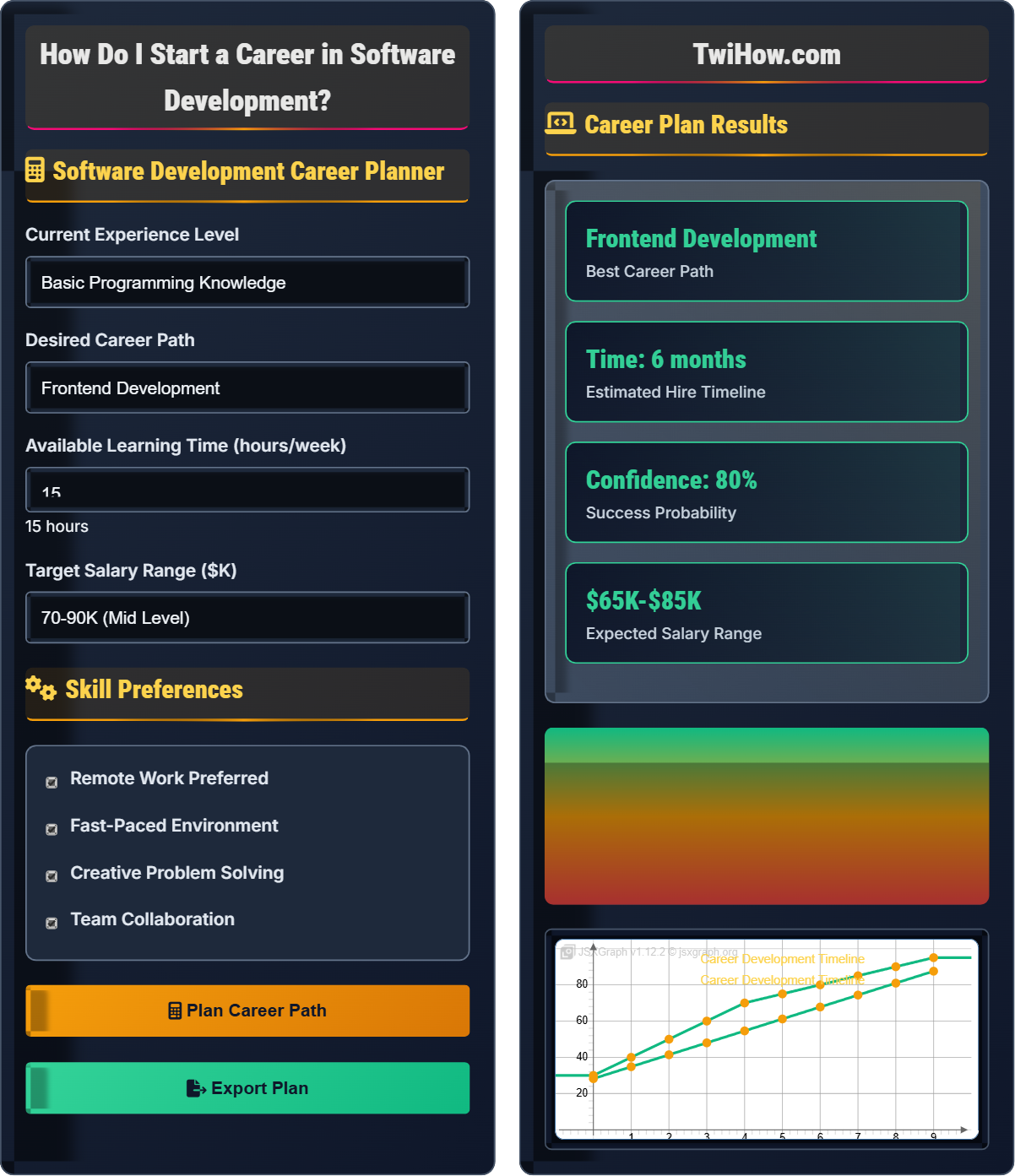
Software Development Career Planner
Skill Preferences
Career Plan Results
Software Development Career Path Explained
Starting a career in software development involves learning programming fundamentals, building practical projects, and developing both technical and professional skills. The field offers diverse opportunities with competitive salaries and flexible work arrangements.
Success_Rate = (Skills × Experience × Portfolio_Quality) ÷ (Market_Competition × Learning_Time)
Where:
- Skills: Technical proficiency in relevant technologies
- Experience: Practical project development and problem solving
- Portfolio_Quality: Demonstrated work and coding abilities
- Market_Competition: Number of candidates for available positions
- Learning_Time: Time invested in skill development
Popular career paths in software development:
- Frontend Developer: User interfaces, web technologies, UX design
- Backend Developer: Server-side logic, databases, APIs
- Full-Stack Developer: Complete application development
- Data Scientist: Data analysis, machine learning, statistics
- DevOps Engineer: Deployment, automation, infrastructure
- Mobile Developer: iOS, Android, cross-platform development
- Programming Languages: Python, JavaScript, Java, C++, etc.
- Version Control: Git and GitHub for code management
- Problem Solving: Algorithmic thinking and debugging skills
- Database Knowledge: SQL, NoSQL, data modeling
- Web Technologies: HTML, CSS, frameworks, APIs
- Soft Skills: Communication, teamwork, continuous learning
Career Fundamentals
Programming fundamentals, software engineering principles, version control, testing, debugging.
Success_Rate = (Skills × Experience × Portfolio) ÷ (Competition × Time)
Where each component is normalized to 0-100 scale.
- Start with fundamentals before specializing
- Build a strong portfolio of projects
- Contribute to open-source projects
Applications
Web development, mobile apps, enterprise software, gaming, AI, data analysis.
- Technology companies
- Financial services
- Healthcare
- Entertainment
- Job market trends
- Salary potential
- Work-life balance
- Remote work options
Software Development Career Quiz
What is the most important requirement for entering a software development career?
A strong portfolio of projects (Option B) is the most important requirement for entering a software development career. While a Computer Science degree can be helpful, many successful developers enter the field through self-teaching, coding bootcamps, or alternative paths.
Employers in the tech industry prioritize demonstrated skills and practical experience over formal education. A well-curated portfolio showing your ability to solve real problems, write clean code, and complete projects is often more valuable than a degree.
Key portfolio elements include:
- Projects that showcase different technologies
- Well-documented code repositories
- Applications that solve actual problems
- Contributions to open-source projects
The answer is B) Strong portfolio of projects.
This question addresses a common misconception about software development careers. The tech industry values practical skills and problem-solving abilities over formal credentials. This creates opportunities for career changers and self-taught developers, but also means that candidates must invest time in building tangible proof of their abilities. The portfolio serves as a demonstration of both technical skills and the ability to deliver completed projects.
Portfolio: Collection of projects demonstrating programming abilities
Technical Interview: Coding challenges and system design questions
Git Repository: Version-controlled code storage and collaboration
• Portfolio quality matters more than formal education
• Practical experience is highly valued
• Continuous learning is essential
• Start building projects early in your learning journey
• Document your code and explain your thought process
• Contribute to open-source projects to gain experience
• Waiting to finish education before building projects
• Not showcasing practical problem-solving abilities
• Neglecting to document and explain code
Outline a comprehensive strategy for transitioning from a non-technical career to software development, including timeline, learning approach, and portfolio development.
Comprehensive Career Transition Strategy (12-Month Plan)
Months 1-3: Foundation Building
- Learning Focus: Python or JavaScript fundamentals, basic programming concepts
- Daily Commitment: 2-3 hours of focused learning and practice
- Resources: FreeCodeCamp, Codecademy, online courses, YouTube tutorials
- First Project: Simple calculator or to-do list application
- Portfolio Element: GitHub account with basic projects
Months 4-6: Web Development Basics
- Learning Focus: HTML, CSS, JavaScript, basic frameworks
- First Web Project: Personal portfolio website
- Additional Skills: Git version control, responsive design
- Portfolio Expansion: 3-5 web-based projects
- Networking: Join developer communities and attend virtual meetups
Months 7-9: Specialization and Advanced Topics
- Learning Focus: Backend development, databases, APIs, or front-end frameworks
- Major Project: Full-stack application (blog, e-commerce, social app)
- Soft Skills: Technical writing, communication, problem-solving
- Open Source: Contribute to 1-2 open-source projects
- Portfolio Enhancement: Deploy projects to production environments
Months 10-12: Job Preparation
- Resume Building: Technical resume highlighting projects and skills
- Interview Prep: LeetCode, HackerRank, system design fundamentals
- Mock Interviews: Practice technical interviews with peers
- Job Applications: Apply for internships, junior developer roles
- Continuous Learning: Stay updated with industry trends
Learning Approach:
- Project-Based Learning: Learn by building real applications
- Consistent Practice: Code daily, even if only for 30 minutes
- Community Engagement: Participate in forums, Discord channels, Stack Overflow
- Documentation: Write README files and comment code properly
- Version Control: Use Git from the beginning for all projects
Portfolio Development Strategy:
- Diverse Technologies: Showcase different programming languages and frameworks
- Problem-Solving: Address real-world problems with your projects
- Professional Presentation: Clean, well-documented code and UI
- Deployment: Make projects accessible online with live demos
- Collaboration: Include projects that demonstrate teamwork
Expected Outcomes:
- 8-12 diverse projects in your portfolio
- Strong foundation in chosen technology stack
- Experience with professional development tools
- Network of contacts in the tech industry
- Confidence in technical interview skills
This comprehensive strategy demonstrates how to approach a major career change systematically. The phased approach ensures foundational skills are built before advancing to complex topics. The emphasis on project-based learning aligns with industry expectations and provides tangible evidence of abilities. The timeline reflects realistic expectations for career transitions, acknowledging that meaningful skill development takes time and consistent effort.
Project-Based Learning: Educational approach emphasizing practical application
Full-Stack Development: Proficiency in both frontend and backend technologies
Version Control: System for managing changes to source code over time
• Build projects that demonstrate your abilities
• Maintain consistent daily practice
• Engage with developer communities
• Start with technologies that match your target career path
• Document your learning journey in a blog or journal
• Seek mentorship from experienced developers
• Trying to learn everything at once without focus
• Not building enough practical projects
• Neglecting to network with other developers
A tech startup is seeking a full-stack developer for their team. They need someone who can work independently, contribute to both frontend and backend development, and help scale their platform. The role offers $75K-$95K salary with equity options. You have 8 months of self-taught programming experience and have completed 5 personal projects. Design a 4-month plan to become a competitive candidate for this position, including specific technologies to learn and projects to build.
4-Month Intensive Preparation Plan for Full-Stack Developer Role
Month 1: Deepen Full-Stack Fundamentals
- Frontend Mastery: React.js or Vue.js for component-based architecture
- Backend Development: Node.js with Express.js or Python with Django
- Database Skills: PostgreSQL or MongoDB for data persistence
- Project: Build a task management application with user authentication
- Learning Goals: Master state management and API integration
Month 2: Advanced Full-Stack Development
- Authentication: JWT tokens, OAuth, password hashing
- Testing: Unit testing with Jest, integration testing
- Deployment: Heroku, Netlify, or AWS for hosting
- Project: Create a social media platform clone with real-time features
- Learning Goals: Implement secure authentication and testing
Month 3: Scaling and Performance
- Performance: Caching strategies, optimization techniques
- Security: OWASP security principles, input validation
- DevOps: CI/CD pipelines, Docker basics
- Project: Build a scalable e-commerce platform with payment integration
- Learning Goals: Handle high-traffic scenarios and security concerns
Month 4: Professional Preparation
- System Design: Microservices, load balancing, database sharding
- Interview Prep: LeetCode, system design interviews, behavioral questions
- Portfolio Polish: Optimize existing projects, create professional READMEs
- Networking: Connect with startup developers, attend virtual tech talks
- Application Prep: Technical resume, cover letter, portfolio website
Essential Technologies to Master:
- Frontend: React.js, Redux, HTML5, CSS3, JavaScript ES6+
- Backend: Node.js, Express.js, REST APIs, GraphQL
- Databases: PostgreSQL, MongoDB, database design principles
- Tools: Git, GitHub, VS Code, Postman, Chrome DevTools
- Deployment: Heroku, AWS, Docker, CI/CD pipelines
Target Portfolio Projects:
- Task Management Application (Month 1)
- Social Media Platform Clone (Month 2)
- E-commerce Platform (Month 3)
- Real-time Chat Application (Bonus)
- Personal Portfolio Website (Ongoing)
Daily Schedule Recommendation:
- Monday-Wednesday-Friday: New concept learning and implementation
- Tuesday-Thursday: Practice problems and code reviews
- Weekend: Project work and portfolio enhancement
Success Metrics:
- Ability to build full-stack applications independently
- Strong GitHub presence with 8+ well-documented projects
- Competency in system design principles
- Confidence in technical interviews
This problem demonstrates how to approach a specific job opportunity with targeted preparation. The plan balances learning new technologies with practical application through projects. The emphasis on full-stack development aligns with the job requirements, while the progression from basic to advanced concepts ensures comprehensive skill development. The approach shows how to build a portfolio that directly addresses employer needs.
Full-Stack Developer: Professional skilled in both frontend and backend technologies
JWT Token: JSON Web Token for secure authentication
CI/CD Pipeline: Continuous Integration and Deployment automation
• Align learning with specific job requirements
• Build projects that demonstrate relevant skills
• Focus on practical application over theory
• Study the company's tech stack before applying
• Build projects similar to the company's products
• Practice explaining your code to others
• Learning technologies that don't match job requirements
• Not practicing enough real-world scenarios
• Neglecting system design for startup roles
You're deciding between enrolling in a 6-month coding bootcamp ($15,000) or pursuing a self-directed learning path to become a software developer. You have no programming experience, $20,000 in savings, and want to start earning within 10 months. Analyze both approaches, including costs, timelines, outcomes, and risks, and recommend the best strategy for your situation.
Bootcamp vs Self-Learning Analysis
Bootcamp Approach:
- Cost: $15,000 upfront, plus living expenses during 6 months
- Timeline: 6 months intensive + 2-3 months job search = 8-9 months total
- Structure: Guided curriculum, scheduled learning, instructor support
- Network: Cohort of peers, alumni network, career services
- Outcomes: 75-85% job placement rate for graduates (industry average)
- Risks: High upfront cost, variable quality between bootcamps, no guarantee of job
- Best For: Those who prefer structured learning and can afford the investment
Self-Learning Approach:
- Cost: $500-1,000 for resources, courses, and tools
- Timeline: 8-12 months depending on dedication and learning pace
- Structure: Flexible schedule, self-paced learning, choose own curriculum
- Network: Online communities, meetups, self-built connections
- Outcomes: Variable success rate, depends on self-discipline and strategy
- Risks: Potential for procrastination, missing key concepts, lack of career support Best For: Self-motivated learners with strong discipline and time management
Financial Analysis:
- Bootcamp: $15,000 + $12,000 living expenses = $27,000 (exceeds savings)
- Self-Learning: $1,000 + $16,000 living expenses = $17,000 (within savings)
Recommendation for Your Situation:
Given your $20,000 savings and 10-month timeline, the self-learning approach with bootcamp supplements is recommended:
Hybrid Strategy:
- Months 1-3: Intensive self-learning using free and paid resources
- Months 4-6: Consider a part-time bootcamp or intensive course ($3,000-5,000)
- Months 7-8: Portfolio development and open-source contributions
- Months 9-10: Job applications and interview preparation
Self-Learning Plan:
- Resources: FreeCodeCamp, Udemy courses, YouTube, GitHub, documentation
- Track: Full-stack JavaScript (Node.js, React) for broad market appeal
- Projects: Build 8-10 diverse projects showcasing different skills
- Community: Join Discord servers, Reddit communities, attend virtual meetups
- Accountability: Partner with another learner, set weekly goals
Success Factors:
- Consistent daily practice (2-3 hours minimum)
- Building projects that solve real problems
- Active participation in developer communities
- Regular portfolio updates and GitHub activity
- Preparation for technical interviews
This problem demonstrates the importance of making informed decisions based on personal circumstances. The analysis shows how financial constraints, learning preferences, and timeline requirements should influence educational choices. The recommended hybrid approach balances cost-effectiveness with structured learning, showing how to adapt strategies based on individual constraints and goals.
Coding Bootcamp: Intensive, accelerated learning program for programming skills
Self-Directed Learning: Independent education without formal instruction
Return on Investment (ROI): Financial benefit compared to educational cost
• Consider financial constraints in educational decisions
• Evaluate learning style preferences honestly
• Research bootcamp outcomes and reputation
• Research bootcamp job placement rates and alumni outcomes
• Start building projects immediately regardless of learning path
• Create a structured schedule for self-learning
• Choosing educational path without considering financial impact
• Not researching the quality of bootcamp programs
• Underestimating the discipline required for self-learning
What is the most important skill for long-term career growth in software development?
Problem-solving and analytical thinking (Option B) is the most important skill for long-term career growth in software development. While technical skills are essential, the ability to break down complex problems, design solutions, and think critically is what distinguishes exceptional developers.
Why problem-solving is crucial:
- Technology Changes: Programming languages and frameworks evolve, but problem-solving remains constant
- Complex Challenges: Senior roles require solving increasingly complex architectural problems
- Innovation: New solutions emerge from strong analytical thinking
- Leadership: Technical leadership requires problem analysis and decision-making
- Debugging: Most of development time is spent solving unexpected problems
While communication skills (Option D) and technical knowledge are important, problem-solving is the foundational skill that enables developers to adapt to new technologies, tackle novel challenges, and advance to senior positions.
Other important skills include:
- Continuous learning ability
- System design thinking
- Attention to detail
- Collaboration and teamwork
The answer is B) Problem-solving and analytical thinking.
This question addresses the difference between tactical skills (specific technologies) and strategic skills (problem-solving ability). While knowing current technologies is important for immediate job requirements, problem-solving ability enables long-term career growth. This skill allows developers to adapt to new technologies, tackle increasingly complex challenges, and eventually move into leadership roles. Understanding this distinction helps prioritize learning efforts for maximum long-term impact.
Problem-Solving: Process of finding solutions to difficult or complex issues
System Design: Process of defining architecture for software systems
Continuous Learning: Ongoing process of acquiring new skills and knowledge
• Prioritize foundational skills over trendy technologies
• Develop problem-solving abilities early in your career
• Balance technical and soft skills development
• Practice coding challenges to improve problem-solving
• Study how experienced developers approach problems
• Break complex problems into smaller, manageable parts
• Focusing only on learning the latest frameworks
• Not developing fundamental problem-solving skills
• Neglecting to practice algorithmic thinking
FAQ
Q: Do I need a computer science degree to become a software developer?
A: No, you do not need a computer science degree to become a software developer. Many successful developers are self-taught or come from non-technical backgrounds. What matters most is:
Essential Requirements:
- Strong programming skills demonstrated through projects
- Problem-solving abilities and analytical thinking
- Understanding of software development principles
- Continuous learning mindset
Alternative Paths:
- Coding bootcamps (3-6 months intensive training)
- Self-directed learning (online courses, tutorials, practice)
- Associate's degree in related field
- Computer science certificate programs
Advantages of Non-Degree Paths:
- Lower cost and shorter time to employment
- Focus on practical, job-relevant skills
- Flexibility to learn at your own pace
- Opportunity to build portfolio while learning
Many top tech companies (Google, Apple, IBM, etc.) now hire developers without CS degrees, focusing instead on demonstrated abilities and skills.
Q: How long does it take to become job-ready as a software developer?
A: The time to become job-ready varies based on your approach and dedication:
Intensive Bootcamp (Full-time): 3-6 months to develop basic skills and build portfolio
Self-Learning (Part-time): 6-12 months of consistent practice and project building
Traditional Education: 2-4 years for associate or bachelor's degree
Key Milestones for Job-Readiness:
- Ability to build complete applications independently
- Understanding of version control (Git/GitHub)
- Knowledge of testing and debugging practices
- Experience with deployment and production environments
- Strong portfolio of 5-8 diverse projects
- Confidence in technical interview skills
Factors That Influence Timeline:
- Previous technical experience
- Amount of time dedicated to learning daily
- Quality of learning resources and mentorship
- Focus on practical project building vs. theoretical learning
- Networking and community engagement
Most successful career changers spend 6-9 months in focused preparation before landing their first role. The key is consistent practice and building projects that demonstrate your abilities to potential employers.