How to Stay Relevant as Technology Evolves Rapidly?
Complete tech evolution guide • Step-by-step strategies
Staying Relevant:
Show Relevance CalculatorStaying relevant in rapidly evolving technology requires a strategic approach combining continuous learning, skill diversification, and adaptability. Success comes from developing a growth mindset, building a strong professional network, and focusing on foundational skills that remain valuable across technological shifts.
The pace of technological change demands that professionals continuously update their knowledge and skills. This involves staying informed about industry trends, investing time in learning new technologies, and developing transferable skills that remain valuable regardless of specific tools or platforms.
Key strategies for staying relevant:
- Continuous Learning: Regular skill development and knowledge updates
- Network Building: Professional relationships and community engagement
- Adaptability: Flexibility to pivot and learn new technologies
- Foundational Skills: Focus on enduring concepts over trendy tools
Modern professionals must balance specialization with versatility, building deep expertise in core areas while maintaining breadth across emerging technologies and methodologies.
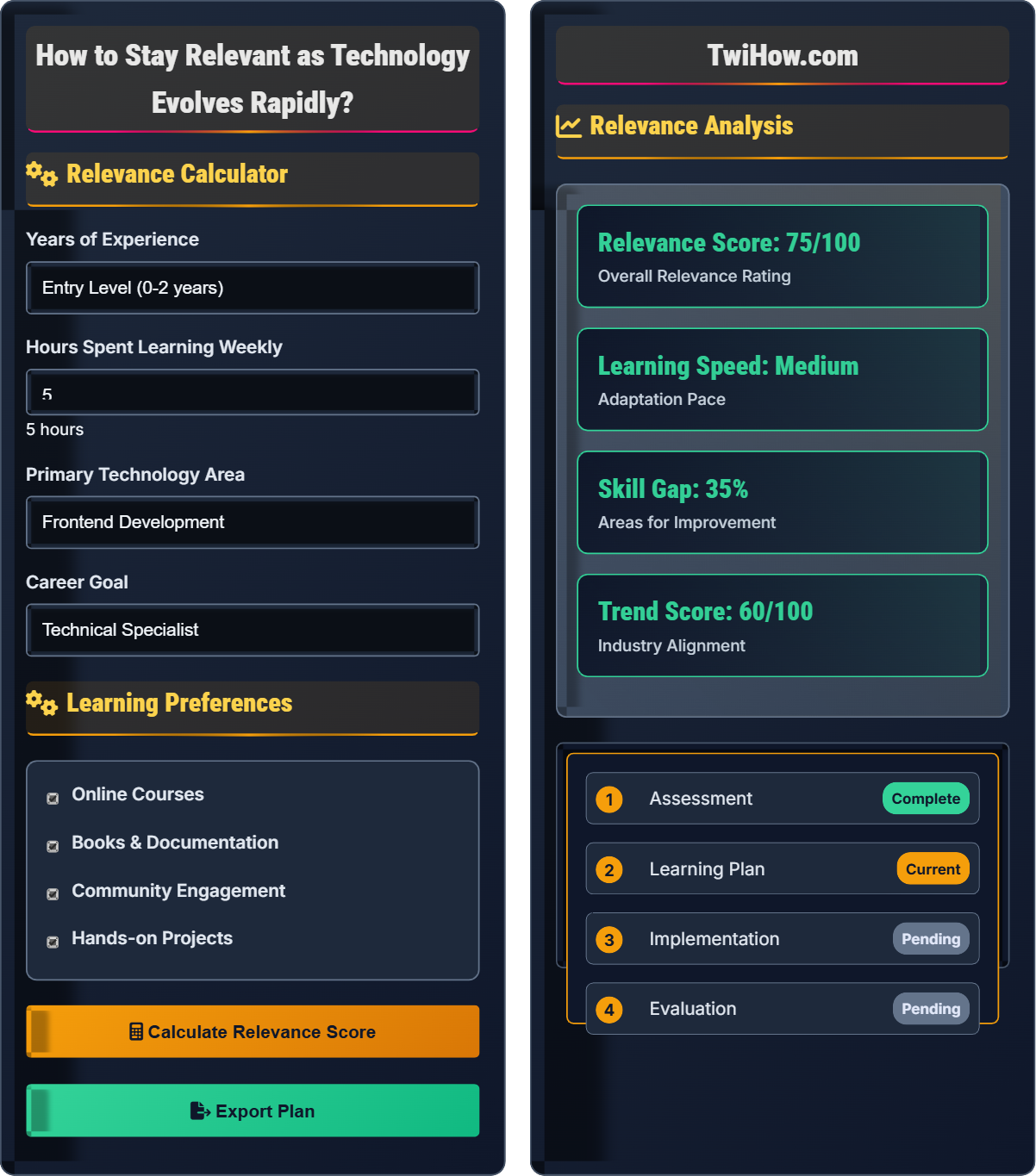
Relevance Calculator
Learning Preferences
Relevance Analysis
Skill Levels
| Month | Focus Area | Learning Goal | Resources |
|---|---|---|---|
| Jan | AI/ML Basics | Complete course | Udemy, Coursera |
| Feb | Cloud Computing | Certification | AWS, Azure |
| Mar | Security | Hands-on projects | OWASP, GitHub |
| Apr | Leadership | Soft skills | Books, Mentoring |
Trending Technologies
- AI/ML: Large Language Models, Generative AI
- Cloud: Serverless, Edge Computing
- DevOps: GitOps, Infrastructure as Code
- Security: Zero Trust, Container Security
Staying Relevant in Technology Evolution
Staying relevant in technology requires a systematic approach:
Where:
- Learning Rate: How quickly you acquire new skills
- Adaptability: Your ability to pivot and apply knowledge
- Technology Velocity: The pace of technological change
Essential strategies for maintaining relevance:
- Continuous Learning: Dedicate time weekly to learning new technologies
- Network Building: Engage with communities and industry leaders
- Foundational Focus: Master enduring concepts over temporary tools
- Practical Application: Build projects to solidify new knowledge
- Specialization Balance: Develop depth in core areas while maintaining breadth
- Future Anticipation: Identify and prepare for emerging trends
Key technologies shaping the future:
- Artificial Intelligence: Machine learning, natural language processing
- Quantum Computing: Next-generation computational power
- Edge Computing: Distributed processing closer to data sources
- Blockchain: Decentralized systems and smart contracts
- Extended Reality: Virtual and augmented reality applications
- Sustainable Tech: Green computing and energy-efficient solutions
- Focus on Fundamentals: Core principles remain stable across technologies
- Build a Learning Network: Surround yourself with curious, knowledgeable peers
- Document Your Learning: Create notes and tutorials to reinforce knowledge
- Contribute Back: Share knowledge through writing, speaking, or mentoring
- Stay Curious: Maintain genuine interest in new developments
- Balance Depth and Breadth: Specialize while maintaining versatility
Relevance Fundamentals
Continuous learning, adaptability, networking, foundational skills, career planning, professional growth.
Success = (Learning Investment × Network Value) / (Technology Obsolescence Rate)
Where Learning Investment = Time + Resources, Network Value = Relationships + Opportunities.
- Never stop learning new technologies
- Build and maintain professional networks
- Focus on transferable skills over trendy tools
Career Applications
Continuous learning leads to advancement opportunities, higher compensation, and job security in evolving markets.
- Identify skill gaps and opportunities
- Develop learning plans and goals
- Acquire new skills through practice
- Apply skills in professional settings
- Share knowledge and build reputation
- Advance to new opportunities
- Market demand varies by technology
- Learning curve affects adoption rate
- Industry specialization impacts career path
- Personal interests should align with professional goals
Tech Evolution Quiz
Which approach is most effective for staying relevant in rapidly evolving technology?
The most effective approach is to develop a consistent learning routine and maintain curiosity about trends. This allows you to adapt to changes as they happen rather than falling behind. The technology landscape changes too quickly to rely on a single technology, and waiting for stability means missing opportunities for growth and innovation.
The answer is B) Develop a learning routine and stay curious about trends.
Successful technology professionals develop meta-skills around learning itself. Rather than focusing on specific tools, they cultivate the ability to quickly learn and adapt to new technologies. This involves creating sustainable learning habits, staying informed about industry trends, and building a network of learning resources. The goal is to become comfortable with constant change rather than resistant to it.
Meta-Skills: Skills that help you develop other skills
Learning Routine: Consistent practice of acquiring new knowledge
Technology Lifecycle: The stages of adoption and obsolescence
• Establish regular learning time
• Stay curious about emerging trends
• Build diverse learning networks
• Set aside 5-10 hours weekly for learning
• Follow industry blogs and newsletters
• Join professional communities and forums
• Focusing only on popular technologies
• Not creating sustainable learning habits
• Isolating yourself from learning communities
Explain the balance between specializing deeply in one area versus maintaining broad technical knowledge. How should this balance change throughout your career?
Early Career: Focus on building foundational skills across multiple areas while developing competence in 1-2 specific technologies. This provides flexibility and helps identify interests.
Mid Career: Develop deeper expertise in a primary area while maintaining breadth in complementary technologies. This creates value as a specialist with cross-functional knowledge.
Senior Career: Become a subject matter expert in your primary area while expanding into adjacent domains and leadership skills. This positions you as a strategic contributor.
Strategic Balance: Maintain 70% depth in your primary specialty, 20% breadth in related areas, and 10% exploration of emerging technologies. Adjust this ratio based on career stage and market demands.
Benefits of Each Approach:
Specialization: Higher compensation potential, recognized expertise, focused career path
Generalization: Greater flexibility, adaptability, broader problem-solving perspective
The key is maintaining both depth and breadth while adjusting the balance based on career stage and market needs.
The specialization vs. generalization debate reflects the tension between depth and breadth of knowledge. Early in careers, breadth provides flexibility and helps identify passions. Later, specialization creates competitive advantage. However, the most successful professionals maintain both - deep expertise in core areas combined with awareness of adjacent technologies. This balance helps navigate technological shifts while building career value.
Specialization: Deep expertise in a specific area
Generalization: Broad knowledge across multiple areas
Subject Matter Expert: Recognized authority in a field
• Balance depth with breadth
• Adjust strategy by career stage
• Maintain foundational knowledge
• Identify 1-2 core specializations
• Learn adjacent technologies
• Explore emerging trends regularly
• Sticking too rigidly to one approach
• Not adapting strategy to career stage
• Neglecting foundational skills
You work full-time as a software engineer and want to learn AI/ML to stay relevant. You have 10 hours per week available for learning. How should you allocate this time between different learning activities (courses, projects, reading, networking) to maximize your relevance in 6 months?
Recommended Time Allocation (10 hours/week):
40% (4 hours): Hands-on projects - Build AI/ML models, work with real datasets
30% (3 hours): Online courses - Structured learning of concepts and techniques
20% (2 hours): Reading - Research papers, blog posts, and industry news
10% (1 hour): Networking - Join AI/ML communities, attend virtual meetups
6-Month Learning Plan:
Month 1-2: Complete introductory AI/ML course, practice with basic datasets
Month 3-4: Work on intermediate projects, join Kaggle competitions
Month 5-6: Build portfolio projects, contribute to open source AI tools
Success Metrics: Complete at least 3 meaningful projects, contribute to 2 open source repositories, and present findings to your team. This approach balances theoretical knowledge with practical application while building a professional network.
Effective learning requires a balanced approach that combines multiple modalities. Hands-on projects provide practical experience and portfolio material. Structured courses ensure comprehensive coverage of concepts. Reading keeps you informed about latest developments. Networking connects you with opportunities and insights. The 40-30-20-10 rule provides a framework that can be adjusted based on individual learning style and goals.
Learning Modalities: Different approaches to acquiring knowledge
Portfolio Projects: Demonstrable work samples
Structured Learning: Organized educational programs
• Prioritize hands-on practice
• Balance theory with application
• Build portfolio of work
• Start with small, achievable projects
• Document your learning journey
• Share progress with your network
• Only taking courses without practicing
• Not building portfolio projects
• Isolating yourself from the community
You're a backend developer with 5 years of experience in traditional monolithic applications. Cloud-native development and microservices are becoming the standard, and you feel your skills are becoming obsolete. Outline a 12-month plan to transition your skills and maintain career relevance.
12-Month Transition Plan:
Months 1-3: Foundation Building
• Complete cloud certification (AWS, Azure, or GCP)
• Learn containerization (Docker, Kubernetes)
• Study microservices architecture patterns
Months 4-6: Practical Application
• Refactor existing monolith features into microservices
• Build personal projects using cloud-native patterns
• Contribute to open-source microservices projects
Months 7-9: Integration & Learning
• Learn CI/CD pipelines and DevOps practices
• Study API design and service communication
• Explore observability and monitoring tools
Months 10-12: Professional Application
• Propose microservices migration at work
• Present findings to team and leadership
• Update resume and portfolio with new skills
Key Success Metrics:
• Obtain cloud certification
• Build 3-5 cloud-native projects
• Successfully refactor 1-2 services in current role
• Expand professional network in cloud-native space
This plan transforms existing backend skills into modern cloud-native expertise while maintaining career continuity.
Successful career transitions involve leveraging existing knowledge while acquiring new skills. Backend developers already understand application logic, data management, and system architecture - these foundations remain valuable. The transition focuses on learning new deployment patterns, infrastructure-as-code, and distributed systems concepts. The key is gradual skill accumulation while maintaining current job performance.
Cloud-Native: Applications designed for cloud environments
Microservices: Architecture using small, independent servicesInfrastructure-as-Code: Managing infrastructure through code
• Leverage existing foundational skills
• Learn systematically with clear milestones
• Apply new skills in current role
• Start with small experiments
• Document your learning journey
• Seek mentorship from cloud experts
• Trying to learn everything at once
• Not applying new skills practically
• Neglecting to update professional profile
Which soft skill is most important for staying relevant in rapidly evolving technology?
Adaptability and learning agility are most important for staying relevant in rapidly evolving technology. While technical expertise is important, it can become obsolete quickly. Communication skills and leadership are valuable, but without the ability to adapt and learn new technologies, these skills become less effective. Adaptability enables professionals to pivot as technologies change, while learning agility ensures they can quickly acquire new skills.
These skills compound over time, making individuals more resilient to technological disruption.
The answer is B) Adaptability and learning agility.
In rapidly changing fields, meta-skills become more valuable than specific technical skills. Adaptability allows professionals to adjust their approach as circumstances change. Learning agility enables rapid acquisition of new competencies. These skills create a foundation for continuous growth regardless of specific technological shifts. They represent a growth mindset that embraces change rather than resisting it.
Adaptability: Ability to adjust to new conditions
Learning Agility: Speed of acquiring new skills
Meta-Skills: Skills that enable other skills
• Cultivate a growth mindset
• Embrace change as opportunity
• Focus on learning how to learn
• Practice learning new things regularly
• Seek diverse experiences
• Reflect on learning effectiveness
• Focusing only on technical skills
• Resisting change and new approaches
• Not developing learning systems
FAQ
Q: How much time should I spend learning new technologies each week?
A: Aim for 5-10 hours per week of focused learning. This can be broken down into 1-2 hours daily or concentrated on weekends. The key is consistency rather than intensity. Focus on building a sustainable routine that doesn't burn you out. Early in your career, prioritize foundational skills and technologies that are widely adopted. As you advance, you can afford to explore more niche or emerging technologies.
Q: How do I balance learning new technologies with delivering business value?
A: Integrate learning with business objectives. Allocate 20% of development time for experimentation with new technologies. Look for opportunities to pilot new approaches in low-risk projects. Encourage team members to present new technologies they've learned. Create a culture where learning is valued and supported. The goal is to make learning part of the job, not something separate from it. This ensures that learning directly contributes to business value.
Q: Should I focus on trending technologies or proven solutions?
A: Maintain a 70-30 balance: 70% proven solutions for stability and reliability, 30% emerging technologies for growth and innovation. Use proven technologies for production systems where reliability is critical. Experiment with trending technologies in personal projects or proof-of-concepts. This approach provides both stability and growth. Monitor trending technologies to understand their potential impact, but be selective about which ones to adopt professionally.