How do I transition from junior to senior developer?
Complete career advancement guide • Step-by-step explanations
From Junior to Senior Developer:
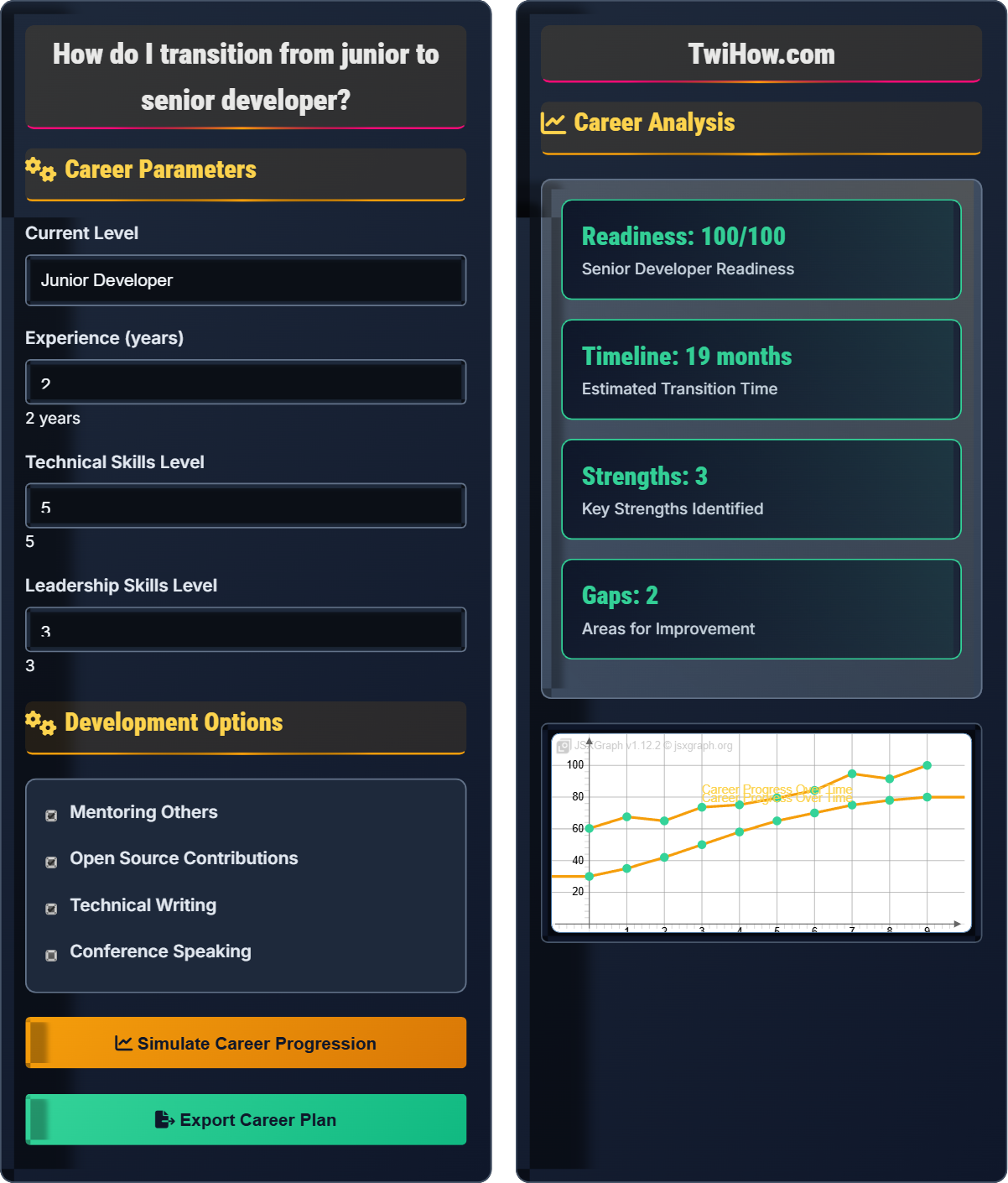
Show Career SimulatorTransitioning from junior to senior developer requires developing both technical and soft skills. Senior developers are expected to write clean, efficient code, mentor junior colleagues, make architectural decisions, and take ownership of complex features. The journey involves continuous learning, building expertise in your domain, and demonstrating leadership qualities.
Key differences include: problem-solving approach (junior seeks help vs. senior guides others), code quality expectations, system design capabilities, and mentoring responsibilities. The transition is not just about technical skills but also about becoming a trusted advisor and technical leader.
Key concepts:
- Technical Leadership: Guiding technical decisions and mentoring
- System Design: Architecting scalable solutions
- Code Quality: Writing maintainable, efficient code
- Ownership: Taking responsibility for features and outcomes
Successful transition requires deliberate practice, seeking feedback, building relationships, and continuously expanding your technical and leadership capabilities.
Career Parameters
Development Options
Career Analysis
| Skill Area | Current | Target | Gap |
|---|---|---|---|
| Technical Proficiency | 5 | 8 | 3 |
| System Design | 3 | 7 | 4 |
| Leadership | 3 | 6 | 3 |
| Communication | 4 | 7 | 3 |
Transitioning from Junior to Senior Developer Explained
Senior developers are expected to write clean, efficient code, mentor junior colleagues, make architectural decisions, and take ownership of complex features. They demonstrate deep technical knowledge, strong problem-solving abilities, and leadership qualities. The transition involves moving from completing assigned tasks to driving technical decisions and mentoring others.
Key concepts in the transition from junior to senior:
Core concepts include:
- Technical Leadership: Guiding technical decisions and mentoring
- System Design: Architecting scalable solutions
- Code Quality: Writing maintainable, efficient code
- Ownership: Taking responsibility for features and outcomes
- Communication: Articulating technical concepts clearly
Major skills needed for senior developer transition:
- System Architecture: Designing scalable, maintainable systems
- Code Review: Providing constructive feedback to peers
- Technical Decision Making: Evaluating trade-offs and making choices
- Mentoring: Guiding and teaching junior developers
- Communication: Articulating technical concepts clearly
- Problem Solving: Tackling complex, ambiguous problems
- Continuous Learning: Stay updated with industry trends and technologies
- Seek Feedback: Actively ask for and act on feedback
- Build Relationships: Network with peers and mentors
- Take Ownership: Volunteer for challenging projects
- Document Knowledge: Share expertise with the team
- Lead by Example: Demonstrate best practices
Career Fundamentals
Senior developer, technical leadership, mentoring, system design, ownership.
Seniority_Level = (Technical_Skills + Leadership + Problem_Solving) ÷ Experience_Factor
Where Seniority_Level = readiness for senior role, Technical_Skills = coding proficiency.
- Focus on impact, not just output
- Learn to mentor others
- Take ownership of outcomes
Skill Development
Technical skills, leadership, communication, system design, mentoring.
- Deliberate practice
- Seek mentorship
- Volunteer for challenges
- Continuous learning
- Balance breadth and depth
- Focus on impact
- Build relationships
- Document progress
Career Transition Learning Quiz
Which of the following is a key difference between junior and senior developers?
Senior developers focus on problem-solving and mentoring, which distinguishes them from junior developers. While juniors primarily focus on completing assigned tasks, seniors are expected to solve complex problems, make architectural decisions, mentor teammates, and drive technical direction. This shift represents a move from individual contribution to leadership and guidance.
The answer is B) Senior developers focus on problem-solving and mentoring.
The transition from junior to senior involves a fundamental shift in mindset and responsibilities. Junior developers focus on execution, while senior developers focus on strategy, mentorship, and problem-solving. This evolution requires developing both technical depth and leadership capabilities.
Senior Developer: Experienced engineer with leadership responsibilities
Problem Solving: Identifying and resolving complex technical challenges
Mentoring: Guiding and teaching less experienced developers
• Focus on impact over output
• Develop leadership skills
• Mentor others actively
• Seek out mentoring opportunities
• Take on complex problems
• Lead by example
• Thinking more code equals seniority
• Not seeking mentorship
• Avoiding leadership responsibilities
Explain why system design skills are crucial for senior developers and describe how to develop these skills effectively.
Importance of System Design:
• Scalability: Senior developers must architect systems that grow with demand
• Reliability: Design systems that handle failures gracefully
• Maintainability: Create systems that are easy to modify and extend
• Cost Optimization: Balance performance with resource usage
Development Strategies:
1. Study Existing Systems: Analyze successful system designs
2. Practice Design Problems: Solve system design interview questions
3. Hands-on Experience: Work on projects requiring scalable architecture
4. Learn Patterns: Study common architectural patterns
Key Skills:
• Understanding trade-offs between different approaches
• Knowledge of distributed systems concepts
• Ability to communicate design decisions effectively
• Experience with cloud platforms and services
System design skills represent a crucial differentiator for senior developers. While junior developers implement features, senior developers architect the systems that enable those features. This requires understanding how components interact, how systems scale, and how to make decisions that impact the entire application.
System Design: Process of defining architecture and components
Scalability: Ability to handle increased load
Trade-offs: Balancing competing requirements
• Understand business requirements
• Start with simple designs
• Iterate and improve
• Learn from failures
• Over-engineering solutions
• Not considering trade-offs
• Ignoring business context
You're a mid-level developer asked to mentor a junior colleague who is struggling with debugging complex issues. The junior developer gets frustrated easily and often asks for help immediately instead of trying to solve problems independently. How would you approach this mentoring situation?
Approach:
1. Build Trust and Rapport:
• Create a safe environment for asking questions
• Acknowledge that debugging is challenging
2. Teach Problem-Solving Framework:
• Encourage systematic debugging approaches
• Teach tools and techniques (logs, debugging tools, etc.)
3. Balance Support with Independence:
• Use the "Ask, Don't Tell" approach
• Guide them to discover solutions themselves
4. Set Clear Expectations:
• Define when to ask for help vs. try independently
• Establish regular check-ins
Example Response: "Before coming to me, try to spend 15-20 minutes exploring the issue yourself. Document what you've tried, what you observed, and any error messages. Then we can discuss it together, and I'll guide you through the debugging process rather than just giving you the answer."
Effective mentoring balances support with independence. The goal is to teach problem-solving skills rather than just providing answers. This approach builds confidence and develops critical thinking abilities that are essential for growth.
Mentoring: Guiding and developing less experienced professionals
Problem-Solving Framework: Systematic approach to solving issues
Knowledge Transfer: Sharing expertise and skills
• Be patient and supportive
• Encourage independent thinking
• Provide constructive feedback
• Use pair programming
• Share debugging techniques
• Celebrate small wins
• Giving direct answers too quickly
• Being impatient with learning pace
• Not setting clear expectations
Your team needs to choose between two database solutions for a new feature: a traditional SQL database with ACID compliance or a NoSQL database with better scalability. The feature requires complex queries but also needs to handle high traffic. How would you approach making this technical decision as a senior developer?
Decision-Making Framework:
1. Requirements Analysis:
• Identify specific requirements (consistency, availability, query complexity)
• Consider data access patterns and traffic patterns
2. Trade-off Evaluation:
• SQL: ACID compliance, complex queries, established tools
• NoSQL: Scalability, performance, flexibility
3. Research and Validation:
• Prototype with both options
• Consult with database experts
• Review similar decisions in the industry
4. Stakeholder Communication:
• Present pros and cons clearly
• Explain reasoning behind recommendation
• Outline risks and mitigation strategies
5. Implementation Plan:
• Define success metrics
• Plan for monitoring and adjustment
• Prepare rollback strategy if needed
In this case, you might recommend a hybrid approach or choose SQL with sharding for scalability.
Senior developers must make complex technical decisions that consider multiple factors. The key is using a systematic approach that evaluates requirements, trade-offs, and long-term implications. Good decisions are well-reasoned, documented, and communicated to stakeholders.
Technical Decision Making: Evaluating options based on requirements
Trade-offs: Balancing competing requirements
ACID Properties: Atomicity, Consistency, Isolation, Durability
• Consider long-term implications
• Evaluate trade-offs objectively
• Communicate reasoning clearly
• Document decision rationale
• Consider future growth
• Involve relevant stakeholders
• Making decisions in isolation
• Not considering alternatives
• Ignoring business requirements
Which of the following best demonstrates leadership skills expected of senior developers?
Identifying problems and proposing solutions for the team demonstrates leadership skills expected of senior developers. Leadership involves looking beyond individual tasks to see broader team and organizational challenges. Senior developers should proactively identify issues, propose solutions, and help improve processes for everyone's benefit.
The answer is B) Identifying problems and proposing solutions for the team.
Leadership in software development isn't about managing people, but about taking initiative, improving processes, and helping the team succeed. Senior developers lead by example, contribute to team success, and think about the bigger picture rather than just individual contributions.
Technical Leadership: Guiding technical direction and decisions
Proactive Problem Solving: Identifying and addressing issues early
Team Contribution: Contributing to overall team success
• Think beyond individual tasks
• Contribute to team success
• Drive improvements proactively
• Speak up in meetings
• Propose process improvements
• Share knowledge actively
• Staying silent in discussions
• Focusing only on individual work
• Not sharing insights
FAQ
Q: How long does it typically take to transition from junior to senior developer?
A: The transition timeline varies based on several factors:
Typical Range: 3-5 years of focused development
Accelerating Factors:
• Taking on stretch assignments
• Seeking mentorship and feedback
• Building expertise in specific areas
• Contributing to open source projects
Individual Variations:
• Some transition in 2-3 years with aggressive learning
• Others take 5-7 years focusing on steady growth
• Company culture and promotion practices affect timelines
Quality of growth matters more than speed. Focus on building deep skills and demonstrating leadership qualities.
Q: What should I look for when promoting someone to senior developer?
A: Key indicators for senior promotion:
Technical Competencies:
• Solves complex problems independently
• Writes clean, maintainable code
• Makes sound architectural decisions
• Understands system-level implications
Leadership Qualities:
• Mentors junior team members
• Takes ownership of features/products
• Communicates effectively with stakeholders
• Drives technical initiatives
Impact Measurement:
• Consistent delivery of quality work
• Positive influence on team productivity
• Recognition from peers and stakeholders
• Demonstrates problem-solving beyond assigned tasks
Q: How can I help my junior developers advance to senior level?
A: Effective strategies for developing junior developers:
Provide Growth Opportunities:
• Assign progressively challenging tasks
• Include them in architectural discussions
• Rotate them through different system components
Offer Guidance and Feedback:
• Conduct regular one-on-ones
• Provide specific, actionable feedback
• Share your own learning experiences
Encourage Learning:
• Recommend books, courses, and conferences
• Support conference attendance and speaking
• Facilitate cross-team learning
Measure Progress:
• Set clear expectations and milestones
• Recognize achievements and improvements
• Address gaps in a supportive manner
Patience and consistent support are key to helping developers grow.