What are Microservices and When Should I Use Them?
Complete microservices guide • Step-by-step architecture
Microservices Architecture:
Show Architecture CalculatorMicroservices is an architectural approach where a software application is developed as a collection of small, independent services that communicate over well-defined APIs. Each service runs in its own process and is responsible for a specific business capability.
Microservices enable organizations to build complex applications by decomposing them into smaller, manageable pieces that can be developed, deployed, and scaled independently. This approach contrasts with monolithic architectures where all functionality exists in a single application.
Key characteristics of microservices:
- Independence: Services can be developed and deployed separately
- Specialization: Each service focuses on a specific business capability
- Communication: Services interact through APIs and messaging
- Scalability: Individual services can be scaled based on demand
Modern microservices implementations leverage containerization, orchestration platforms, and cloud infrastructure to maximize flexibility and operational efficiency.
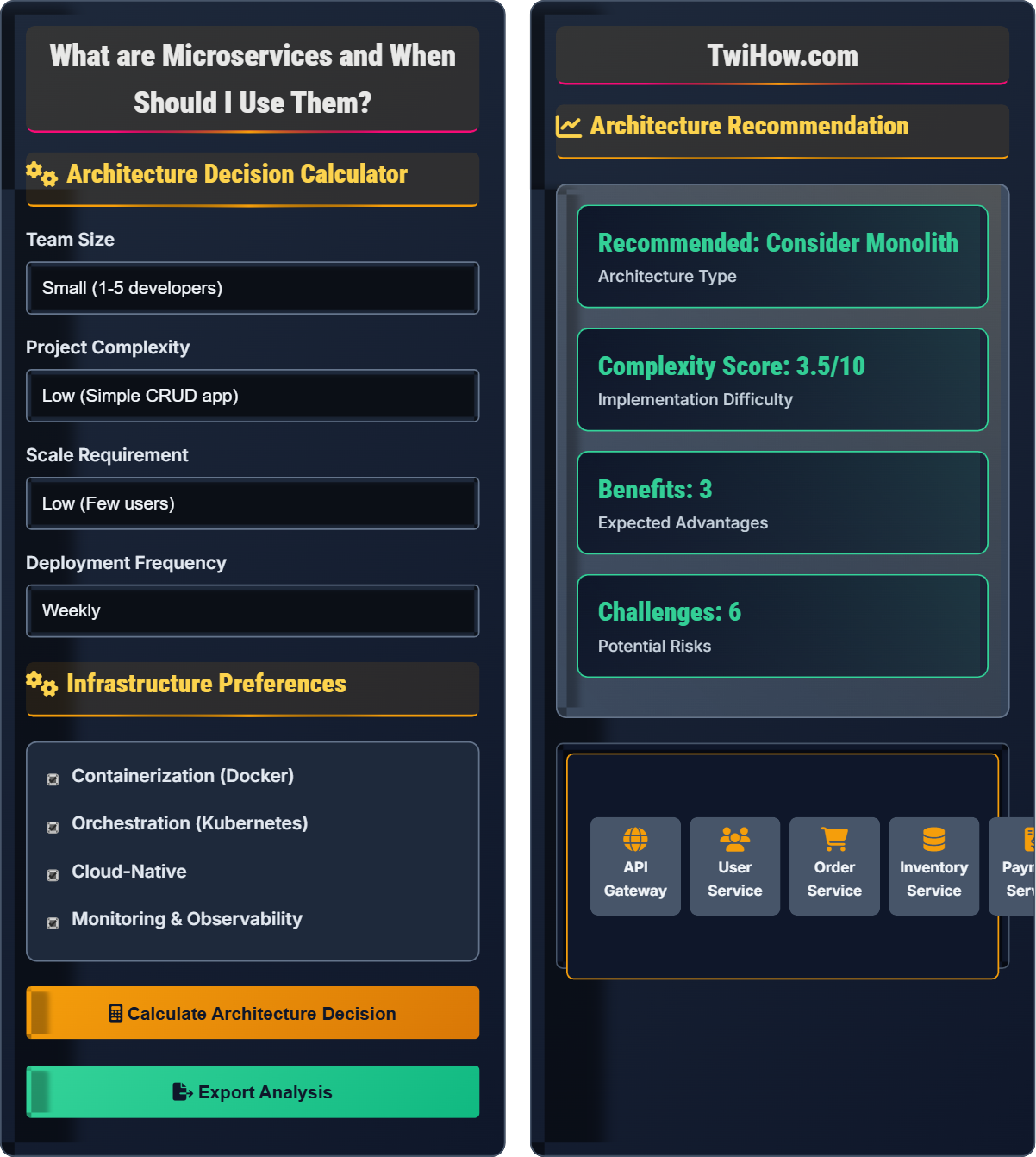
Architecture Decision Calculator
Infrastructure Preferences
Architecture Recommendation
Architecture Analysis
Based on your inputs, microservices architecture is recommended for your project. This approach will allow for independent scaling of services, easier maintenance, and improved fault isolation.
Consider implementing containerization with Docker and orchestration with Kubernetes to manage your microservices effectively.
| Challenge | Impact | Mitigation |
|---|---|---|
| Network Latency | Medium | Implement caching |
| Data Consistency | High | Eventual consistency |
| Operational Complexity | High | Invest in tooling |
Microservices Architecture Fundamentals
Microservices is an architectural approach where a software application is developed as a collection of small, independent services that communicate over well-defined APIs. Each service runs in its own process and is responsible for a specific business capability.
Where each Service_i is independently deployable, scalable, and maintainable.
- Independence: Services can be developed and deployed separately
- Specialization: Each service focuses on a specific business capability
- Communication: Services interact through APIs and messaging
- Scalability: Individual services can be scaled based on demand
Microservices architectures exhibit several defining characteristics:
- Decentralized Data Management: Each service manages its own database
- Infrastructure Automation: CI/CD pipelines for deployment
- Design for Failure: Resilient systems that handle partial failures
- Evolutionary Design: Systems that can evolve over time
- Technology Diversity: Services can use different technologies
Microservices are most beneficial in these scenarios:
- Large Teams: Multiple teams working on different features
- Scaling Requirements: Need to scale different parts of the application differently
- Technology Diversity: Different services require different technologies
- Deployment Flexibility: Need to deploy features independently
- Geographic Distribution: Teams distributed across locations
- Small Teams: Lack of resources to manage complexity
- Simple Applications: Minimal business logic
- Tight Deadlines: Short development cycles
- Unclear Domain Boundaries: Difficult to decompose business logic
- Limited Operations Expertise: Lack of infrastructure knowledge
Architecture Fundamentals
Services, APIs, containers, orchestration, resilience, scalability, bounded contexts, service mesh.
Success = (Team Capabilities × Domain Complexity) / (Operational Overhead)
Where Team Capabilities = Skills + Resources, Domain Complexity = Business Logic + Scaling Needs.
- Design services around business capabilities
- Keep services loosely coupled and highly cohesive
- Implement failure isolation between services
Implementation Considerations
Containerization, orchestration, service discovery, load balancing, monitoring, security.
- Define service boundaries based on business domains
- Design service APIs and communication protocols
- Set up containerization and orchestration
- Implement monitoring and observability
- Establish deployment and CI/CD pipelines
- Network latency between services
- Data consistency across services
- Operational complexity increases
- Debugging becomes more challenging
Microservices Quiz
What is the primary characteristic that distinguishes microservices from monolithic architectures?
The primary distinguishing characteristic of microservices is the ability to independently deploy and scale individual services. This allows different parts of an application to be developed, deployed, and scaled independently based on their specific requirements. While containers, APIs, and other technologies are commonly used with microservices, they aren't the defining characteristic.
The answer is B) Independent deployment and scaling of services.
Microservices architecture fundamentally changes how applications are structured and managed. Instead of having one large application that must be deployed as a whole, microservices break the application into smaller, independent pieces. This enables teams to work on different services simultaneously, deploy updates without affecting the entire system, and scale specific services based on demand rather than scaling the entire application.
Monolithic Architecture: Application built as a single, unified unit
Microservices: Application built as a collection of small, independent services
Independent Deployment: Ability to deploy services separately
• Services should be independently deployable
• Services should have loose coupling
• Each service should have a single responsibility
• Design services around business capabilities
• Keep services small and focused
• Define clear service boundaries
• Creating services that are too granular
• Tight coupling between services
• Not considering data consistency across services
Explain how to determine appropriate service boundaries in a microservices architecture. Include specific techniques and considerations.
Techniques for Determining Service Boundaries:
1. Domain-Driven Design (DDD): Use bounded contexts to define service boundaries. Each service should correspond to a specific domain or subdomain.
2. Business Capability: Group functionality based on business capabilities (e.g., user management, order processing, payment).
3. Data Ownership: Each service should own its data and have exclusive access to its database.
4. Team Structure: Align services with team responsibilities (Conway's Law).
Key Considerations:
Cohesion: Each service should have high internal cohesion - related functionality grouped together.
Coupling: Minimize dependencies between services to ensure independence.
Scalability: Consider how different parts of the system will scale independently.
Performance: Evaluate the impact of network calls between services.
Maintainability: Ensure each service is small enough to be understood and maintained by a team.
Defining service boundaries is one of the most critical decisions in microservices architecture. Poorly defined boundaries can lead to tight coupling, making services difficult to develop and deploy independently. The goal is to create services that are cohesive internally but loosely coupled externally. Domain-Driven Design provides a systematic approach to identifying these boundaries by modeling the business domain and identifying natural partitions.
Bounded Context: Explicit boundary around a domain model
Cohesion: Degree to which elements belong together
Coupling: Degree of interdependence between components
• Each service should have a single responsibility
• Services should own their data exclusively
• Minimize cross-service communication
• Start with larger services and decompose gradually
• Use business terminology to define boundaries
• Consider future scaling requirements
• Creating services that are too fine-grained
• Sharing databases between services
• Ignoring team structure in service design
Your startup has 5 developers building an e-commerce platform with 50,000 monthly active users. The platform handles user accounts, product catalog, shopping cart, order processing, and payment. Currently, you have a monolithic application. Should you migrate to microservices? Justify your answer with specific considerations regarding team size, complexity, and scaling needs.
Recommendation: Gradual migration toward microservices
Positive Factors:
• User base (50K MAU) indicates growing demand for scalability
• Multiple distinct business domains (users, products, orders, payments) map well to services
• Different components have varying scaling requirements (payments vs. catalogs)
Concerning Factors:
• Small team size (5 developers) may struggle with operational complexity
• Risk of over-engineering for current scale
• Need for significant investment in infrastructure and tooling
Recommended Approach:
• Start with horizontal decomposition - separate the most critical services first (e.g., payment processing)
• Invest in containerization and orchestration gradually
• Focus on building operational capabilities alongside service decomposition
• Consider using managed services (AWS Lambda, Azure Functions) to reduce operational overhead
This approach allows you to gain the benefits of microservices while managing complexity appropriately for your team size.
The decision to adopt microservices should be based on specific business and technical requirements rather than following trends. The team size, current scale, and growth projections are critical factors. For smaller teams, the operational complexity of microservices can outweigh the benefits. However, if the application has clear domain boundaries and anticipated growth, a gradual migration strategy can provide the benefits of microservices while managing complexity.
MAU: Monthly Active Users metric
Horizontal Decomposition: Breaking down by business functionality
Gradual Migration: Incremental approach to architecture change
• Match architecture to team capabilities
• Consider operational overhead
• Plan for gradual migration
• Start with the most problematic parts of your monolith
• Invest in tooling and automation first
• Focus on observability early
• Migrating too early without clear benefits
• Underestimating operational complexity
• Not investing in team training
In a microservices architecture, how do you maintain data consistency across services? Explain the challenges and solutions, including specific patterns like Saga and CQRS that address these challenges.
Challenges with Data Consistency:
• Each service owns its database, preventing ACID transactions across services
• Network failures can leave data in inconsistent states
• Maintaining referential integrity across services is complex
Solutions and Patterns:
Saga Pattern: Sequence of local transactions where each transaction updates data within one service. If a transaction fails, compensating transactions are executed to undo previous actions. Example: Order service creates order, Inventory service reserves items, Payment service processes payment. If payment fails, inventory reservation is cancelled.
CQRS (Command Query Responsibility Segregation): Separates read and write operations. Commands update the main database, while queries read from optimized read models. Event sourcing often accompanies CQRS to maintain consistency.
Event Sourcing: Stores state changes as a sequence of events. Services can replay events to reconstruct current state and maintain eventual consistency.
API Composition: Aggregate service composes data from multiple services for read operations, handling eventual consistency through caching and timeouts.
Outbox Pattern: Ensures reliable event publication by storing events in the same transaction as business data changes.
These patterns help achieve eventual consistency rather than strong consistency, which is often sufficient for microservices applications.
Data consistency in microservices is fundamentally different from monolithic applications. In a monolith, you can use database transactions to ensure consistency across multiple tables. In microservices, each service has its own database, making distributed transactions complex and potentially harmful to performance. The solution is to embrace eventual consistency and use patterns that help manage the complexity of coordinating state changes across services.
Eventual Consistency: System reaches consistency over time
Saga: Sequence of local transactions with compensating actions
CQRS: Separating read and write operations
• Each service owns its data exclusively
• Design for eventual consistency
• Implement compensating actions for failures
• Use events to communicate state changes
• Implement idempotent operations
• Design for partial failures
• Attempting distributed transactions across services
• Sharing databases between services
• Ignoring eventual consistency implications
Which of the following is the most effective strategy for migrating from a monolithic application to microservices?
The Strangler Fig pattern is the most effective approach for migrating from monolithic to microservices architecture. This pattern involves gradually replacing parts of the monolith with new services, allowing the old and new systems to coexist until the monolith is completely replaced. This approach minimizes risk and allows for continuous operation of the application during the migration.
Complete rewrites are risky and often fail. Immediate decomposition requires a deep understanding of the monolith's architecture and can cause significant disruption. Adding new features as microservices while keeping the monolith doesn't address the existing monolith's problems.
The answer is B) Strangler Fig pattern - gradually replace parts of the monolith.
The Strangler Fig pattern gets its name from the way strangler figs grow around trees in nature. In software, this pattern involves creating new functionality as microservices while routing traffic between the old monolith and new services. This allows for incremental migration, reducing risk and enabling continuous delivery. The pattern provides a safe path from monolith to microservices without requiring a complete rewrite.
Strangler Fig Pattern: Gradual replacement of monolith with microservices
Incremental Migration: Phased approach to architecture change
Continuous Operation: Maintaining service availability during migration
• Minimize risk during migration
• Maintain system availability
• Plan for gradual transition
• Start with less critical components
• Use feature flags to control routing
• Maintain API compatibility during transition
• Attempting complete rewrite without business justification
• Not planning for data migration
• Underestimating operational complexity
FAQ
Q: What are the main challenges of implementing microservices?
A: The main challenges include: 1) Operational complexity - managing multiple services requires sophisticated monitoring, logging, and deployment infrastructure. 2) Distributed system complexity - handling network failures, latency, and data consistency across services. 3) Testing complexity - integration testing becomes more challenging with multiple interacting services. 4) Data management - maintaining consistency and querying across services. 5) Team coordination - ensuring services communicate effectively and maintain compatibility. 6) Security - securing communication between services and managing identity. Success requires significant investment in tooling, infrastructure, and team training.
Q: How do microservices impact development velocity?
A: The impact on development velocity depends on the organization's maturity. Initially, microservices can slow down development due to increased operational complexity, infrastructure setup, and coordination requirements. However, once properly implemented, microservices can accelerate development by enabling independent team scaling, parallel development, and technology diversity. Teams can deploy features independently without coordinating with other teams, leading to faster iteration cycles. The key is investing in the right tooling, automation, and team practices to realize these benefits. Organizations with strong DevOps practices tend to see positive velocity impacts.
Q: Should we start our new startup with microservices?
A: Generally, startups should avoid microservices initially. Start with a monolithic architecture that can be easily modified as your business requirements evolve. Microservices introduce significant operational complexity that can slow down your ability to iterate quickly, which is crucial for startups. Focus on validating your product-market fit first. You can always decompose your monolith into microservices later as you scale. Premature adoption of microservices often leads to unnecessary complexity that distracts from building the product users want. The exception might be if you have specific scaling requirements from day one or if your team already has significant experience with microservices.