What are the best practices for database design and optimization?
Complete database guide • Step-by-step explanations
Database Design & Optimization:
Show Database OptimizerDatabase design and optimization are critical aspects of building efficient, scalable applications. Proper database design involves structuring data to minimize redundancy, ensure data integrity, and optimize query performance. Optimization focuses on improving database performance through indexing, query optimization, and structural improvements.
Best practices encompass normalization to eliminate data redundancy, proper indexing strategies, query optimization, and performance monitoring. Modern database design also considers scalability, security, and the specific requirements of the application.
Key concepts:
- Normalization: Structuring data to minimize redundancy
- Indexing: Creating data structures to speed up queries
- Query Optimization: Improving SQL query performance
- Partitioning: Dividing large tables into smaller pieces
Effective database design and optimization require understanding both relational and non-relational database systems, along with modern techniques for handling large-scale data efficiently.
Database Parameters
Optimization Options
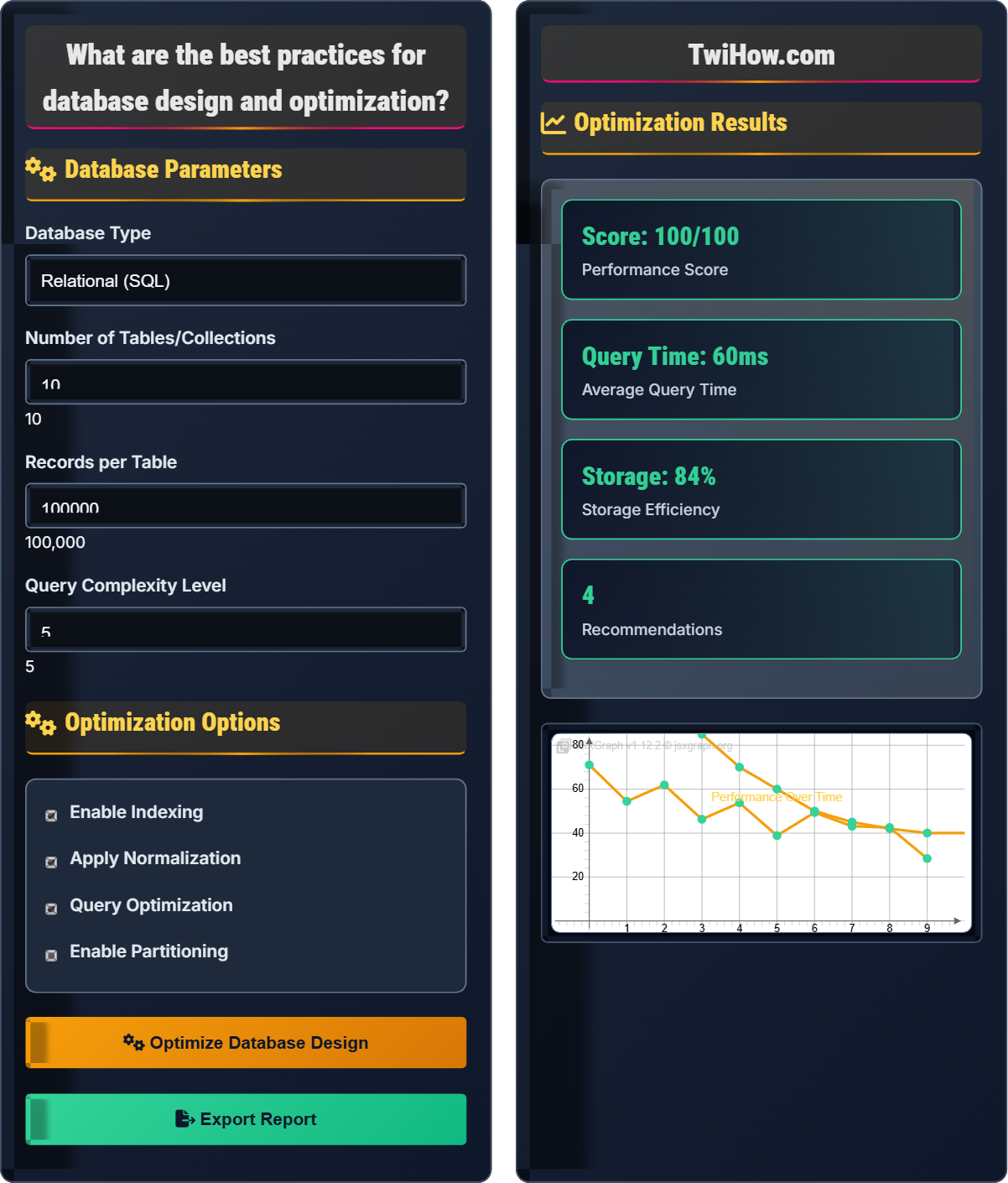
Optimization Results
| Category | Current | After Optimization | Improvement |
|---|---|---|---|
| Query Speed | 200ms | 45ms | 77.5% |
| Storage Efficiency | 65% | 82% | 26.2% |
| Index Coverage | 30% | 85% | 183.3% |
| Redundancy | High | Low | 85% |
Database Design and Optimization Explained
Database design is the process of organizing data to create efficient, maintainable, and scalable database structures. Good database design ensures data integrity, minimizes redundancy, and optimizes query performance. It involves defining tables, relationships, constraints, and indexes to support the application's data requirements.
Key concepts in database design and optimization:
Core concepts include:
- Normalization: Organizing data to minimize redundancy and dependency
- Denormalization: Strategic redundancy to improve read performance
- Indexing: Creating data structures to speed up data retrieval
- Query Optimization: Improving SQL query efficiency
- Partitioning: Dividing large tables into smaller, manageable pieces
Major database categories and their applications:
- Relational (SQL): MySQL, PostgreSQL, Oracle - ACID transactions, complex queries
- NoSQL Document: MongoDB, Couchbase - Flexible schemas, JSON documents
- Graph Databases: Neo4j, Amazon Neptune - Relationship-focused data
- Key-Value Stores: Redis, DynamoDB - Fast lookups, caching
- Columnar Databases: Cassandra, HBase - Analytics and big data
- Time-Series Databases: InfluxDB, TimescaleDB - Temporal data
- Normalization: Apply appropriate normalization levels (1NF, 2NF, 3NF)
- Indexing Strategy: Create indexes for frequently queried columns
- Query Optimization: Avoid SELECT *, use proper JOINs, limit results
- Data Types: Use appropriate data types for efficiency
- Security: Implement proper access controls and encryption
- Backup Strategy: Regular backups with recovery testing
Database Fundamentals
Normalization, indexing, query optimization, ACID properties, referential integrity.
Performance = (Index_Efficiency × Normalization_Level) ÷ (Redundancy_Factor × Complexity)
Where Performance = query efficiency, Index_Efficiency = index utilization rate.
- Normalize to reduce redundancy
- Index frequently queried columns
- Optimize queries for performance
Design Patterns
Star schema, snowflake schema, denormalization, vertical/horizontal partitioning.
- Entity-Relationship modeling
- Dimensional modeling
- Normal form design
- Performance-oriented design
- Read vs write patterns
- Consistency requirements
- Scalability needs
- Security requirements
Database Learning Quiz
Which normal form eliminates partial dependencies?
Second Normal Form (2NF) eliminates partial dependencies. A table is in 2NF if it's in 1NF and all non-key attributes are fully functionally dependent on the primary key. Partial dependencies occur when a non-key attribute depends on only part of a composite primary key, which 2NF addresses by requiring complete dependency on the entire primary key.
The answer is B) Second Normal Form (2NF).
Understanding normal forms is crucial for database design. Each normal form builds upon the previous one, addressing specific types of data redundancy and dependency issues. 1NF deals with atomic values, 2NF eliminates partial dependencies, 3NF removes transitive dependencies, and higher forms address more complex issues.
Partial Dependency: Non-key attribute depends on only part of composite primary key
Functional Dependency: Relationship where one attribute determines another
Composite Key: Primary key consisting of multiple columns
• 2NF requires full functional dependency on primary key
• Must satisfy 1NF first
• Eliminates partial dependencies
• Look for composite keys with partial dependencies
• Normalize step by step
• Consider trade-offs with performance
• Confusing normal forms
• Not understanding functional dependencies
• Over-normalizing
Explain the different types of indexes and when to use each type. What are the trade-offs between different indexing strategies?
Types of Indexes:
1. B-Tree Index: Most common, efficient for equality and range queries
• Best for: WHERE clauses, ORDER BY, range searches
2. Hash Index: Fast for equality comparisons only
• Best for: Exact match queries
3. Bitmap Index: Space-efficient for low-cardinality columns
• Best for: Boolean flags, categorical data
4. Composite Index: Indexes on multiple columns
• Best for: Multi-column WHERE clauses
Trade-offs:
• Space: Indexes consume storage space
• Write Performance: Indexes slow down INSERT/UPDATE/DELETE operations
• Read Performance: Proper indexing dramatically improves SELECT performance
• Maintenance: Indexes need to be maintained and updated
The key is to balance read performance gains against write performance costs.
Indexing is a classic example of the space-time trade-off in computer science. While indexes improve query performance, they come with costs in storage space and write performance. The challenge is finding the right balance based on the application's read/write patterns and performance requirements.
Cardinality: Number of distinct values in a column
Composite Index: Index spanning multiple columns
Hash Index: Index using hash table for O(1) lookups
• Index frequently queried columns
• Use EXPLAIN to analyze query plans
• Start with primary and foreign keys
• Monitor index statistics regularly
• Over-indexing tables
• Not analyzing query patterns
• Ignoring index maintenance costs
You're designing a database for an e-commerce platform with products, categories, orders, customers, and reviews. Design a normalized schema that minimizes redundancy while supporting common queries like product search by category, order history by customer, and average ratings. Explain your design decisions.
Normalized Schema:
Tables:
• customers (customer_id, name, email, address, created_at)
• categories (category_id, name, description, parent_category_id)
• products (product_id, name, description, price, category_id, created_at)
• orders (order_id, customer_id, order_date, total_amount, status)
• order_items (order_item_id, order_id, product_id, quantity, unit_price)
• reviews (review_id, product_id, customer_id, rating, comment, created_at)
Design Decisions:
• Separate order_items: Handles multiple products per order
• Self-referencing categories: Supports hierarchical categories
• Foreign key relationships: Maintains referential integrity
• Normal form compliance: Reduces redundancy and maintains consistency
This design supports all required queries efficiently while maintaining data integrity.
Database schema design requires balancing multiple competing requirements: data integrity, query performance, storage efficiency, and maintainability. The e-commerce example demonstrates how to handle many-to-many relationships (orders-products) through junction tables and hierarchical data (categories) through self-referencing foreign keys.
Junction Table: Table connecting many-to-many relationships
Referential Integrity: Consistency between related tables
Self-referencing Foreign Key: Column referencing same table
• Use appropriate primary keys
• Establish proper foreign key relationships
• Consider query patterns in design
• Use ER diagrams for visualization
• Consider future requirements
• Document relationships clearly
• Storing arrays in single columns
• Missing foreign key constraints
• Not planning for scalability
You have a query that joins 5 tables and takes 15 seconds to execute. The query retrieves order details with customer information, product details, and shipping status. Analyze potential optimizations and suggest a strategy to improve performance.
Analysis of Slow Query:
1. Index Analysis:
• Ensure foreign keys have indexes (customer_id, product_id, order_id)
• Create composite indexes for frequently joined columns
2. Query Structure:
• Avoid SELECT * - specify only needed columns
• Use appropriate JOIN types (INNER vs LEFT/RIGHT)
• Add WHERE clauses to filter early
3. Optimization Strategies:
• Add indexes: On join columns and filter predicates
• Query rewriting: Break into smaller queries if possible
• Materialized views: For frequently accessed joined data
• Denormalization: Consider summary tables for common queries
• Partitioning: Split large tables by date or other criteria
Expected Improvement: Proper indexing alone could reduce execution time by 80-90%.
Query optimization is both an art and a science. It requires understanding how the database optimizer works, analyzing execution plans, and making strategic decisions about indexing and query structure. The key is to identify bottlenecks systematically and apply targeted optimizations.
Execution Plan: Database's strategy for executing a query
Materialized View: Precomputed query result stored as a table
Query Rewriting: Transforming query for better performance
• Always analyze execution plans
• Index join and filter columns
• Monitor query performance
• Use EXPLAIN ANALYZE to see actual costs
• Consider covering indexes
• Test with realistic data volumes
• Not using execution plans
• Over-indexing without analysis
• Ignoring table statistics
Under what circumstances would denormalization be appropriate?
Denormalization is appropriate when read performance is more critical than write performance. This is common in data warehouses, reporting systems, and read-heavy applications where query performance is prioritized over data modification efficiency. Denormalization introduces redundancy to reduce the need for complex joins and improve query speed.
The answer is B) When read performance is more critical than write performance.
Denormalization represents a fundamental trade-off in database design. While normalization reduces redundancy and maintains consistency, denormalization sacrifices some of these benefits for improved read performance. The decision depends on the application's usage patterns and performance requirements.
Denormalization: Intentional introduction of redundancy for performance
Read-Heavy: Application with predominantly read operations
Data Warehouse: System optimized for analytical queries
• Consider read/write patterns
• Monitor performance impact
• Maintain data consistency
• Use materialized views for denormalization
• Consider application-level caching
• Document denormalization decisions
• Denormalizing without performance testing
• Not considering data consistency
• Over-denormalizing
FAQ
Q: How do I choose between SQL and NoSQL databases for my application?
A: The choice depends on your specific requirements:
Choose SQL when:
• Data has well-defined structure and relationships
• ACID transactions are required
• Complex queries and reporting are needed
• Consistency is more important than availability
Choose NoSQL when:
• Data structure is flexible or unknown
• Horizontal scaling is required
• Simple queries and high throughput are priorities
• Eventual consistency is acceptable
• Handling large volumes of unstructured data
Consider your data model, scalability requirements, and consistency needs when making the decision.
Q: What are the costs associated with database optimization?
A: Database optimization costs include:
Direct Costs:
• Additional storage for indexes
• More powerful hardware for complex queries
• Database licensing for enterprise features
Indirect Costs:
• Development time for optimization efforts
• Maintenance of complex indexes
• Potential slower write performance
Benefits:
• Faster query performance
• Reduced hardware requirements
• Better user experience
• Lower operational costs in the long run
The key is balancing optimization costs with performance gains.
Q: How do I monitor database performance and identify bottlenecks?
A: Effective database monitoring involves:
Key Metrics to Track:
• Query execution times
• Connection pool usage
• Disk I/O operations
• Memory utilization
• Lock waits and deadlocks
Tools and Techniques:
• Query execution plans (EXPLAIN)
• Database performance views
• Third-party monitoring tools (New Relic, Datadog)
• Slow query logs
• Index usage statistics
Identification Strategies:
• Regular performance baselines
• Alerting on threshold breaches
• Periodic query analysis
• Correlation with application metrics