What Are the Most In-Demand Tech Skills Right Now?
Complete skills guide • Step-by-step explanations
In-Demand Tech Skills:
Show Skills AnalyzerThe technology landscape is constantly evolving, with new skills becoming essential as industries adapt to digital transformation. Currently, artificial intelligence, cloud computing, cybersecurity, and data science dominate the in-demand skills list. Understanding these trends helps professionals make informed decisions about career development and skill acquisition.
Top in-demand skills include:
- Artificial Intelligence & Machine Learning: AI/ML development, prompt engineering, model deployment
- Cloud Computing: AWS, Azure, Google Cloud, containerization, serverless
- Cybersecurity: Security architecture, threat analysis, compliance
- Data Science: Analytics, visualization, big data processing
- Software Development: Full-stack development, DevOps, APIs
- Emerging Technologies: Blockchain, IoT, quantum computing
These skills command premium salaries and offer excellent career growth opportunities across various industries and company sizes.
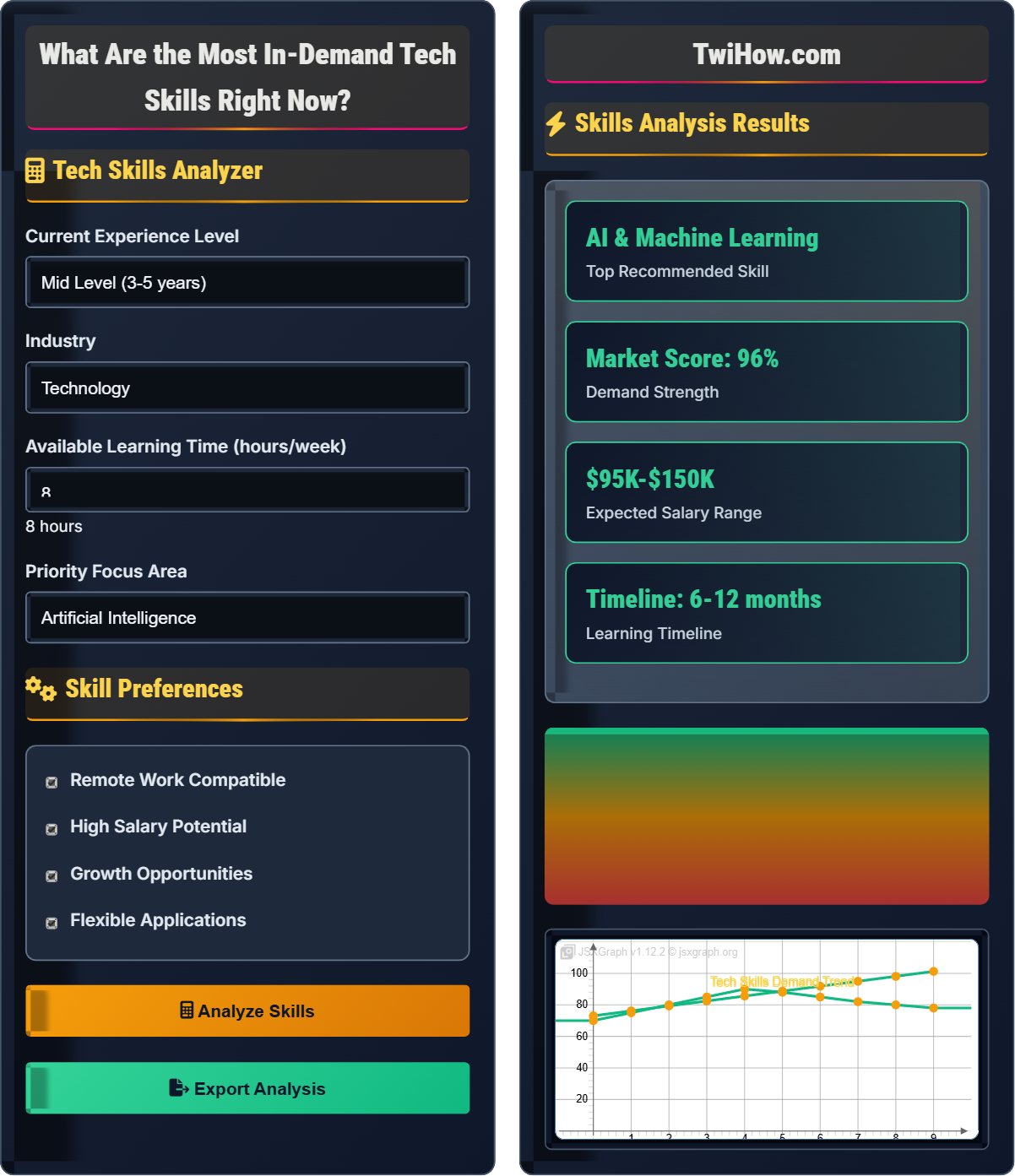
Tech Skills Analyzer
Skill Preferences
Skills Analysis Results
In-Demand Tech Skills Explained
The technology job market is rapidly evolving, with certain skills commanding premium compensation and offering exceptional career growth opportunities. Understanding which skills are most in-demand helps professionals make informed decisions about their career development and educational investments.
Market_Demand = (Industry_Growth × Job_Postings × Salary_Premium) ÷ (Supply_of_Talent × Learning_Barrier)
Where:
- Industry_Growth: Expansion rate of the technology sector
- Job_Postings: Number of open positions requiring specific skills
- Salary_Premium: Compensation above market average
- Supply_of_Talent: Available qualified professionals
- Learning_Barrier: Difficulty level for skill acquisition
Top skills commanding premium salaries and high demand:
- Artificial Intelligence & Machine Learning: AI/ML development, LLMs, computer vision
- Cloud Computing: AWS, Azure, Google Cloud, containerization
- Cybersecurity: Security architecture, threat analysis, compliance
- Data Science: Analytics, visualization, big data processing
- DevOps & Automation: CI/CD, infrastructure as code, monitoring
- Software Engineering: Full-stack development, APIs, microservices
- Structured Learning: Online courses, bootcamps, certifications
- Hands-On Practice: Personal projects, open source contributions
- Industry Engagement: Networking, conferences, communities
- Continuous Education: Staying updated with emerging technologies
- Mentorship: Learning from experienced professionals
- Portfolio Development: Showcasing skills through projects
Skills Fundamentals
Market demand, skill assessment, career planning, technology trends, job market analysis.
Demand_Score = (Growth × Jobs × Salary) ÷ (Supply × Difficulty)
Where each component is normalized to 0-100 scale.
- Skills evolve rapidly in technology
- Continuous learning is essential
- Market demand changes frequently
Applications
Career planning, job searching, skill development, education planning, market analysis.
- Technology companies
- Financial services
- Healthcare
- Government agencies
- Industry-specific requirements
- Geographic market variations
- Experience level considerations
- Learning investment required
Tech Skills Demand Quiz
Which technology skill is currently commanding the highest premium in the job market?
The correct answer is B) Artificial Intelligence & Machine Learning. AI/ML skills are currently commanding the highest premiums in the job market, with median salaries often exceeding $150,000 and significant growth projections.
Why AI/ML Leads the Market:
- High Demand: Every industry is seeking to implement AI solutions
- Short Supply: Limited pool of qualified AI/ML professionals
- Business Value: AI can generate significant ROI for companies
- Specialization: Requires advanced mathematical and programming skills
Salary Comparisons:
- AI/ML Engineers: $120K-$200K+
- Traditional Web Developers: $60K-$120K
- Database Administrators: $70K-$130K
- Network Administrators: $50K-$90K
While other skills remain important, AI/ML offers the highest compensation potential and fastest-growing demand in 2026.
The answer is B) Artificial Intelligence & Machine Learning.
This question addresses the fundamental concept of supply and demand in the tech job market. The high compensation for AI/ML professionals reflects the scarcity of qualified candidates relative to demand. Understanding these market dynamics helps professionals make informed decisions about skill development investments. The key insight is that emerging technologies with high business value and low supply command premium compensation.
Market Premium: Additional compensation above standard market rates
Supply-Demand Gap: Difference between available talent and market need
ROI (Return on Investment): Business value generated per dollar spent
• High demand + low supply = high compensation
• Business value impacts salary premiums
• Emerging technologies often offer growth opportunities
• Research salary data from multiple sources
• Consider growth potential, not just current compensation
• Look for skills with business value impact
• Focusing only on current trends without considering longevity
• Not researching actual market compensation
• Ignoring the learning investment required
Develop a comprehensive strategy for assessing which tech skills to prioritize based on market demand, personal interests, and career goals.
Comprehensive Tech Skills Assessment Strategy
Phase 1: Market Research (Weeks 1-2)
- Job Market Analysis:
- Review 100+ job postings in your target field
- Identify most frequently requested skills
- Analyze salary ranges for different skill sets
- Track growth trends in job postings over time
- Industry Reports:
- Review Stack Overflow Developer Survey
- Analyze GitHub State of the Octoverse
- Study LinkedIn Emerging Jobs Report
- Review Dice Tech Salary Report
Phase 2: Personal Assessment (Weeks 3-4)
- Interest Alignment:
- Identify technologies that genuinely interest you
- Assess your aptitude for different types of work
- Consider your learning style preferences
- Evaluate your current skill foundation
- Career Goals Mapping:
- Define your 5-year career vision
- Identify required skills for target roles
- Consider industry transition possibilities
- Assess geographic market requirements
Phase 3: Feasibility Analysis (Weeks 5-6)
- Learning Investment:
- Estimate time required for skill acquisition
- Calculate cost of training and certification
- Assess required learning resources
- Consider opportunity cost of learning time
- Market Competition:
- Research the number of qualified candidates
- Assess barrier to entry for different skills
- Consider the uniqueness of your value proposition
- Evaluate differentiation opportunities
Phase 4: Prioritization Matrix (Week 7)
- Scoring Criteria:
- Market demand (0-100 scale)
- Salary potential (0-100 scale)
- Personal interest (0-100 scale)
- Learning difficulty (0-100 scale)
- Long-term viability (0-100 scale)
- Weight Assignment:
- Market demand: 30% weight
- Salary potential: 25% weight
- Personal interest: 20% weight
- Learning difficulty: 15% weight
- Long-term viability: 10% weight
Phase 5: Implementation Plan (Week 8)
- Skill Development Roadmap:
- Rank skills by composite score
- Select top 3-5 skills to pursue
- Create learning timeline for each skill
- Identify prerequisite skills
- Plan skill development sequence
- Resource Allocation:
- Allocate learning time proportionally
- Budget for training and certification
- Identify mentorship opportunities
- Plan project-based learning
Ongoing Monitoring Strategy:
- Quarterly Reviews: Reassess market trends and adjust priorities
- Salary Tracking: Monitor compensation changes for target skills
- Job Posting Analysis: Track demand fluctuations
- Industry Events: Attend conferences to stay informed
Success Metrics:
- Number of interviews received for target roles
- Salary increase achieved
- Professional network expansion
- Project portfolio growth
- Industry recognition and opportunities
This comprehensive strategy demonstrates how to approach tech skill selection systematically rather than randomly. The phased approach ensures thorough analysis before making learning investments. The scoring matrix provides objective criteria for decision-making, while the implementation plan ensures actionable steps. The monitoring component ensures the strategy remains relevant as market conditions change.
Feasibility Analysis: Assessment of practicality and viability of skill acquisition
Market Research: Systematic investigation of market conditions and trends
Opportunity Cost: Value of next best alternative when making decisions
• Research market demand before investing in skills
• Align skill development with personal interests
• Consider long-term viability of skills
• Use multiple data sources for market research
• Test interest with small learning projects
• Network with professionals in target areas
• Learning skills without market research
• Not considering personal interests and aptitudes
• Failing to reassess as markets change
You're a traditional software developer with 8 years of experience in legacy systems and want to transition to an in-demand skill area. You have 10 hours per week for learning, $5,000 budget for training, and need to maintain current income while transitioning. Design a strategy to acquire the most valuable skills for your career transition while minimizing risk.
Strategic Career Transition Plan for Experienced Developer
Assessment of Current Position:
- Strengths: 8 years of software development experience, problem-solving skills, code architecture understanding
- Challenges: Legacy system experience may not align with modern demands, need to learn new paradigms
- Constraints: Must maintain current income, limited learning time, budget considerations
Recommended Transition Path: Cloud-Native Development
This path leverages existing development skills while acquiring highly demanded cloud and DevOps skills.
Phase 1: Foundation Building (Months 1-2)
- Learning Focus: Cloud computing fundamentals (AWS, Azure, or GCP)
- Time Allocation: 6 hours/week on learning, 4 hours/week on practice
- Resources:
- AWS Cloud Practitioner certification ($100)
- Online courses (Udemy, Coursera) - $500 budget
- Official cloud documentation and tutorials
- Projects: Migrate a simple application to cloud platform
Phase 2: Containerization & Orchestration (Months 3-4)
- Learning Focus: Docker, Kubernetes, containerized application deployment
- Time Allocation: 5 hours/week on learning, 5 hours/week on hands-on projects
- Resources:
- Kubernetes certifications - $300 budget
- Interactive learning platforms (Katacoda, Play with Docker)
- Open source projects for hands-on practice
- Projects: Containerize and deploy a multi-service application
Phase 3: Infrastructure as Code (Months 5-6)
- Learning Focus: Terraform, Ansible, CI/CD pipelines
- Time Allocation: 4 hours/week on learning, 6 hours/week on automation projects
- Resources:
- Terraform Associate certification - $200 budget
- GitHub Actions and Jenkins for CI/CD
- CloudFormation (AWS) or ARM Templates (Azure)
- Projects: Create automated deployment pipeline for application
Phase 4: Specialization & Portfolio Development (Months 7-8)
- Learning Focus: Advanced cloud architecture, security, monitoring
- Time Allocation: 3 hours/week on learning, 7 hours/week on portfolio projects
- Resources:
- Advanced cloud certifications - remaining budget
- Security and monitoring tools (Prometheus, Grafana)
- Serverless technologies (Lambda, Functions)
- Projects: Build comprehensive cloud-native application with monitoring and security
Income Maintenance Strategy:
- Freelance Projects: Offer cloud migration consulting to current contacts
- Internal Projects: Propose cloud initiatives at current company
- Side Consulting: Help small businesses with cloud adoption
- Training Services: Offer training on legacy systems while learning new skills
Portfolio Development:
- GitHub Repositories: Document all learning projects with detailed READMEs
- Blog Posts: Write about your transition experience and lessons learned
- Speaking Opportunities: Present at local meetups about your journey
- Open Source Contributions: Contribute to cloud-related projects
Job Search Preparation:
- Resume Update: Highlight new cloud skills and projects
- LinkedIn Profile: Emphasize cloud expertise and certifications
- Network Expansion: Connect with cloud architects and DevOps engineers
- Interview Preparation: Practice cloud architecture and DevOps questions
Success Metrics:
- Number of cloud certifications earned
- Quality and complexity of portfolio projects
- Income from cloud-related consulting
- Job offers in cloud/DevOps roles
- Salary increase achieved
Alternative Paths Considered:
- AI/ML: Higher compensation potential but steeper learning curve
- Cybersecurity: High demand but requires different skill set
- Data Science: Requires strong mathematical background
This cloud-native path provides the best balance of leveraging existing development skills while acquiring highly demanded cloud and DevOps capabilities.
This strategy demonstrates how to approach a career transition systematically, considering multiple constraints and objectives. The phased approach allows for gradual skill development while maintaining current income. The emphasis on portfolio development shows how to demonstrate new skills without formal experience. The strategy balances learning new skills with leveraging existing experience for a smoother transition.
Cloud-Native Development: Applications designed specifically for cloud computing platforms
Infrastructure as Code: Managing and provisioning infrastructure through code
DevOps: Cultural and professional movement emphasizing collaboration
• Leverage existing skills when transitioning
• Maintain income during skill acquisition
• Document learning through portfolio projects
• Start with foundational cloud certifications
• Practice with free tier cloud services
• Build projects that showcase new skills
• Quitting current job before securing new position
• Not leveraging existing experience in new field
• Failing to document learning journey
You're evaluating tech skills for joining a Series A startup focused on AI-powered customer service solutions. The startup needs engineers who can work across multiple areas and move quickly. Analyze the specific skill requirements for this environment and recommend a learning path that prepares you for this type of role, considering the startup's resource constraints and rapid iteration needs.
Tech Skills Analysis for AI Customer Service Startup
Startup-Specific Requirements:
- Full-Stack Capability: Need to work on both frontend and backend systems
- AI/ML Skills: Natural language processing, conversational AI, model deployment
- Cloud Infrastructure: Scalable, cost-effective deployments
- Real-Time Systems: Low-latency customer interactions
- Security & Compliance: Customer data protection and privacy
- Agile Development: Rapid iteration and continuous deployment
Priority Skill Categories:
Category 1: AI/ML (Highest Priority)
- Natural Language Processing:
- Libraries: spaCy, NLTK, Transformers
- Concepts: Intent recognition, entity extraction, sentiment analysis
- Tools: Hugging Face, OpenAI API
- Conversational AI:
- Frameworks: Rasa, Dialogflow, Microsoft Bot Framework
- Concepts: Dialogue management, context preservation
- Techniques: Sequence-to-sequence models, attention mechanisms
- Model Deployment:
- Platforms: SageMaker, Vertex AI, custom solutions
- Optimization: Model compression, quantization
- Monitoring: ML model performance tracking
Category 2: Full-Stack Development (High Priority)
- Frontend:
- React.js for customer-facing interfaces
- Real-time communication (WebSocket, Socket.io)
- Chat interface development
- Backend:
- Python/Node.js for AI service APIs
- FastAPI/Express for high-performance endpoints
- Database design for conversation histories
- Integration:
- CRM system integrations (Salesforce, HubSpot)
- Communication platform APIs (Slack, Teams, WhatsApp)
- Third-party service integrations
Category 3: Infrastructure & DevOps (Medium Priority)
- Cloud Services:
- Container orchestration (Kubernetes, ECS)
- Auto-scaling configurations
- Cost optimization strategies
- Observability:
- Logging and monitoring (Prometheus, Grafana)
- Error tracking and alerting
- Performance optimization
- Security:
- Data encryption and privacy compliance
- Secure API development
- GDPR/CCPA compliance implementation
Learning Path (6-Month Timeline):
Month 1-2: AI/ML Foundation
- Complete Natural Language Processing course (Coursera/Udacity)
- Build simple chatbot using Rasa or Dialogflow
- Learn TensorFlow/PyTorch basics
- Implement text classification project
Month 3-4: Advanced AI & Full-Stack Integration
- Build conversational AI system with context management
- Develop React frontend for chat interface
- Implement real-time communication features
- Deploy AI model using cloud services
Month 5-6: Production & Optimization
- Implement monitoring and logging
- Optimize model performance and latency
- Build CRM integrations
- Create comprehensive portfolio project
Startup-Specific Considerations:
- Resource Constraints: Focus on free/affordable learning resources
- Rapid Iteration: Build MVP versions first, then optimize
- Cost Consciousness: Learn cost-effective cloud deployment strategies
- Multi-Role Capability: Develop skills across multiple areas
- Problem-Solving: Focus on practical, implementable solutions
Portfolio Projects for Startup Application:
- AI-Powered Chatbot: Demonstrates NLP and conversational AI skills
- Real-Time Dashboard: Shows full-stack development capabilities
- Integration Project: Displays API and third-party integration skills
- Scalable Deployment: Illustrates infrastructure and DevOps knowledge
Success Indicators:
- Ability to build end-to-end AI customer service solution
- Understanding of startup resource constraints
- Experience with rapid prototyping and iteration
- Knowledge of customer data privacy requirements
- Capability to work across multiple technology stacks
This analysis demonstrates how to approach skill development for specific company types. The startup environment requires broader skills and faster adaptation than larger corporations. The priority categorization shows how to focus learning efforts on the most critical skills first. The learning path balances depth in AI/ML with breadth in full-stack development, reflecting the startup's need for versatile engineers.
Series A Startup: Early-stage company that has raised significant venture funding
Conversational AI: Artificial intelligence designed to have human-like conversations
Full-Stack Capability: Ability to work on both frontend and backend systems
• Align skills with company stage and needs
• Develop breadth as well as depth
• Focus on practical, implementable solutions
• Research the startup's specific technology stack
• Focus on skills that solve their immediate problems
• Demonstrate ability to work with constraints
• Not understanding startup vs corporate environment differences
• Focusing only on technical skills without business context
• Not demonstrating ability to work with resource constraints
Which emerging technology is most likely to become a top in-demand skill by 2027?
The correct answer is D) All of the above. All three technologies are positioned to become top in-demand skills by 2027, each for different reasons and market drivers.
Quantum Computing:
- Market Drivers: Cryptography, optimization, drug discovery, financial modeling
- Current Status: Moving from research to commercial applications
- Skills in Demand: Quantum algorithms, Qiskit, Cirq, quantum programming
- Projected Growth: Expected to create 40,000+ jobs by 2027
Edge Computing and IoT:
- Market Drivers: 5G deployment, smart cities, industrial automation, real-time processing
- Current Status: Already showing significant growth and adoption
- Skills in Demand: Embedded systems, sensor networks, distributed computing
- Projected Growth: IoT market expected to reach $1.6 trillion by 2027
Augmented Reality Development:
- Market Drivers: Gaming, retail, education, remote work, industrial applications
- Current Status: Rapid adoption across multiple industries
- Skills in Demand: Unity, Unreal Engine, ARKit, ARCore, 3D modeling
- Projected Growth: AR market expected to reach $300 billion by 2027
Common Factors Driving Demand:
- Business Value: Each technology offers significant ROI potential
- Scarcity of Talent: Limited number of professionals with these skills
- Industry Adoption: Multiple sectors investing in these technologies
- Infrastructure Investment: Major companies investing in supporting infrastructure
Strategic Considerations:
- Quantum Computing: Best for those with strong mathematical backgrounds
- Edge/IoT: Good for embedded systems and distributed computing enthusiasts
- AR Development: Ideal for those interested in visual and interactive technologies
While all three will be in demand, the best choice depends on your background, interests, and career goals.
The answer is D) All of the above.
This question addresses the importance of understanding emerging technology trends. Rather than focusing on a single "winner," the answer recognizes that multiple technologies will drive demand simultaneously. This reflects the complex, multi-faceted nature of the tech industry where different technologies serve different market needs. The analysis shows how to evaluate emerging technologies based on market drivers, adoption rates, and skill scarcity.
Edge Computing: Processing data near the source rather than in centralized cloud
Quantum Computing: Computing based on quantum mechanics principles
Augmented Reality: Technology overlaying digital information on real world
• Multiple technologies can be in demand simultaneously
• Consider personal fit when choosing emerging technologies
• Evaluate market drivers and adoption rates
• Follow industry reports and analyst predictions
• Consider the maturity level of emerging technologies
• Evaluate your background fit for different technologies
• Focusing on only one emerging technology
• Not researching the business case for emerging technologies
• Ignoring personal interests and background
FAQ
Q: How often should I reassess my tech skills to stay current?
A: Regular skill reassessment is crucial for career success in technology:
Quarterly Reviews: Assess market trends and job postings in your field.
Semi-Annual Deep Dives: Evaluate your skill portfolio against industry standards.
Annual Strategic Planning: Set learning goals for the coming year.
Trigger-Based Updates: When major technology shifts occur or new frameworks emerge.
Key Indicators for Reassessment:
- Changes in job posting requirements
- New technology announcements from major companies
- Shifts in your company's technology stack
- Salary trends for different skill sets
- Industry conference announcements and trends
Reassessment Process:
- Review 20-30 recent job postings in your target area
- Survey salary data from multiple sources
- Attend industry events and conferences
- Network with professionals in your field
- Track your professional development goals
Technology moves quickly, so staying current requires continuous awareness and periodic strategic planning.
Q: Should I focus on learning one in-demand skill deeply or multiple skills broadly?
A: The answer depends on your career stage and goals:
For Beginners: Start with one foundational skill and build depth. This provides a solid base for future learning.
For Mid-Career Professionals: Develop 2-3 complementary skills that work together (e.g., frontend + backend + database).
For Senior Roles: Broad knowledge across multiple areas with deep expertise in your specialty.
Strategic Approach:
- Depth First: Master one skill before adding others
- Complementary Skills: Choose skills that reinforce each other
- Market Demand: Focus on skills that are currently in demand
- Personal Interest: Learn skills that genuinely interest you
- Learning Capacity: Don't spread yourself too thin initially
Recommended Combinations:
- Frontend Developer: HTML/CSS → JavaScript → React → Node.js
- Data Professional: SQL → Python → Data Visualization → Machine Learning
- Cloud Professional: Cloud Fundamentals → Infrastructure as Code → Security → DevOps
The key is to build a coherent skill portfolio that tells a story about your capabilities and career direction.