What Is DevOps and Why Is It Important?
Complete DevOps guide • Step-by-step explanations
DevOps Explained:
Show DevOps AnalyzerDevOps is a set of practices that combines software development (Dev) and IT operations (Ops) to shorten the development life cycle and provide continuous delivery with high software quality. It emphasizes collaboration, automation, and continuous improvement between development and operations teams.
Key DevOps practices include:
- Continuous Integration: Automated building and testing of code
- Continuous Delivery: Automated deployment to production
- Infrastructure as Code: Managing infrastructure through code
- Monitoring and Logging: Observing system performance
- Collaboration: Breaking down silos between teams
DevOps transforms how organizations build, test, and release software, enabling faster delivery, improved quality, and enhanced collaboration between traditionally separate teams.
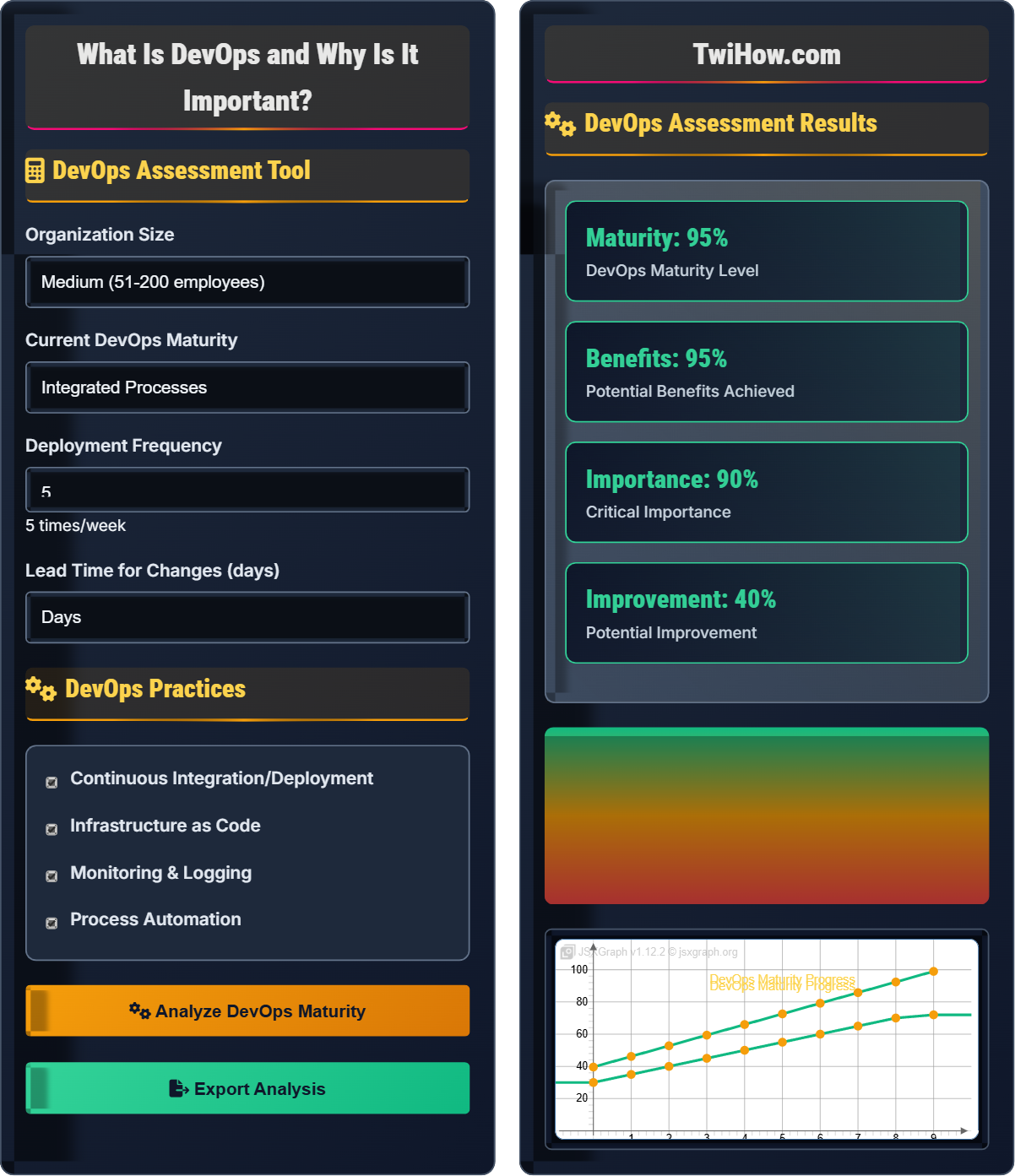
DevOps Assessment Tool
DevOps Practices
DevOps Assessment Results
DevOps Explained
DevOps is a cultural and technical movement that emphasizes collaboration, automation, and continuous improvement between software development and IT operations teams. It aims to shorten the development life cycle while delivering features, fixes, and updates frequently in close alignment with business objectives.
DevOps_Success = (Collaboration × Automation × Continuous_Improvement) ÷ (Silos × Manual_Processes × Resistance_to_Change)
Where:
- Collaboration: Effective communication and shared responsibility
- Automation: Automated processes and toolchains
- Continuous_Improvement: Ongoing optimization and learning
- Silos: Isolated teams and departments
- Manual_Processes: Human-dependent, error-prone workflows
- Resistance_to_Change: Organizational obstacles to transformation
Core DevOps practices include:
- Continuous Integration: Frequent merging of code changes with automated testing
- Continuous Delivery: Automated deployment to production environments
- Infrastructure as Code: Managing infrastructure through code and version control
- Configuration Management: Automated management of system configurations
- Monitoring & Logging: Real-time observability of systems and applications
- Collaboration: Breaking down silos between development and operations
- CI/CD: Jenkins, GitLab CI, CircleCI, Travis CI
- Containers: Docker, Kubernetes, Podman
- Infrastructure: Terraform, Ansible, Puppet, Chef
- Monitoring: Prometheus, Grafana, ELK Stack, Datadog
- Version Control: Git, GitHub, GitLab, Bitbucket
- Cloud Platforms: AWS, Azure, Google Cloud Platform
DevOps Fundamentals
CI/CD, automation, infrastructure as code, monitoring, collaboration, agile methodology.
DevOps_Success = (Automation × Collaboration × Velocity) ÷ (Friction × Manual Effort)
Where each component is normalized to 0-100 scale.
- Culture comes before tools
- Automate everything possible
- Measure and monitor continuously
Applications
Software development, cloud deployment, system administration, release management, quality assurance.
- Technology companies
- Financial services
- Healthcare
- E-commerce
- Security compliance
- Cost optimization
- Scalability requirements
- Team training needs
DevOps Quiz
What is the primary goal of DevOps?
The correct answer is B) To increase the speed of software delivery while maintaining quality. DevOps aims to bridge the gap between development and operations teams to enable faster, more reliable software delivery.
Why This Is Correct:
- DevOps emphasizes collaboration between teams to accelerate delivery
- It maintains or improves quality through automation and testing
- It focuses on delivering value to customers more quickly
- It balances speed with reliability and stability
Analysis of Other Options:
Option A is incorrect because DevOps doesn't eliminate operations teams but rather fosters collaboration with them. Option C is incorrect as DevOps doesn't reduce developer headcount but rather increases their productivity. Option D is incorrect because eliminating all bugs is impossible; DevOps focuses on improving quality and reducing bug frequency.
DevOps Core Principles:
- Accelerate delivery while maintaining quality
- Improve collaboration between teams
- Embrace automation to reduce manual errors
- Continuously monitor and improve processes
The answer is B) To increase the speed of software delivery while maintaining quality.
This question addresses the fundamental misunderstanding that DevOps is about eliminating roles or reducing headcount. Instead, DevOps is about optimizing the entire software delivery process. The key insight is that DevOps achieves faster delivery without compromising quality through automation, collaboration, and continuous improvement. This represents a shift from traditional approaches that often prioritized speed over quality or vice versa.
DevOps: Cultural and technical movement combining development and operations
CI/CD: Continuous Integration and Continuous Delivery practices
Collaboration: Working together between previously siloed teams
• DevOps is about collaboration, not elimination of roles
• Speed and quality can coexist with proper practices
• Automation is key to achieving DevOps goals
• Focus on team collaboration and communication
• Automate repetitive manual processes
• Implement comprehensive monitoring and feedback
• Thinking DevOps is just about tools and automation
• Believing DevOps eliminates the need for operations
• Focusing only on speed without considering quality
Design a comprehensive strategy for implementing DevOps in a traditional organization with separate development and operations teams that have historically had poor communication.
Comprehensive DevOps Implementation Strategy
Phase 1: Cultural Assessment and Preparation (Months 1-2)
- Current State Analysis:
- Assess existing team structures and workflows
- Identify communication barriers and friction points
- Document current deployment processes and pain points
- Map out existing tools and technologies
- Stakeholder Buy-In:
- Present business case to executives and management
- Address concerns about role changes and job security
- Establish executive sponsorship and support
- Create cross-functional steering committee
Phase 2: Cultural Transformation (Months 2-4)
- Team Integration:
- Facilitate joint meetings between Dev and Ops teams
- Create shared responsibility for application success
- Establish common goals and success metrics
- Implement cross-training and knowledge sharing
- Communication Improvement:
- Set up shared communication channels
- Implement daily standups with both teams
- Create joint incident response procedures
- Establish blameless post-mortems culture
Phase 3: Tool Selection and Integration (Months 4-6)
- CI/CD Pipeline Setup:
- Implement version control system (Git)
- Set up continuous integration server
- Create automated build and test processes
- Establish automated deployment pipelines
- Infrastructure as Code:
- Choose infrastructure automation tools
- Document current infrastructure
- Begin converting infrastructure to code
- Implement version control for infrastructure
Phase 4: Process Automation (Months 6-9)
- Automated Testing:
- Implement unit, integration, and end-to-end tests
- Set up automated security scanning
- Establish performance testing automation
- Create test environment provisioning automation
- Deployment Automation:
- Automate application deployments
- Implement blue-green or canary deployment strategies
- Create rollback automation
- Establish deployment approval processes
Phase 5: Monitoring and Optimization (Months 9-12)
- Comprehensive Monitoring:
- Implement application and infrastructure monitoring
- Set up alerting and notification systems
- Create dashboards for key metrics
- Establish logging and log analysis
- Continuous Improvement:
- Regular process reviews and retrospectives
- Performance metric analysis
- Feedback loop implementation
- Iterative process optimization
Success Metrics and KPIs:
- Delivery Metrics:
- Deployment frequency (increase by 50%+)
- Lead time for changes (reduce by 50%+)
- Mean time to recovery (reduce by 50%+)
- Change failure rate (reduce by 50%+)
- Team Metrics:
- Employee satisfaction scores
- Cross-team collaboration metrics
- Incident resolution time
- Customer satisfaction scores
Common Challenges and Mitigation:
- Resistance to Change: Provide extensive training and clear communication
- Tool Integration: Start with simple integrations, expand gradually
- Security Concerns: Implement security early in the pipeline
- Legacy Systems: Plan gradual migration strategies
Expected Outcomes:
- Increased deployment frequency and reliability
- Improved team collaboration and job satisfaction
- Reduced time to market for features
- Higher quality software with fewer incidents
- Greater business agility and competitiveness
This strategy demonstrates the critical importance of cultural transformation in DevOps implementation. The phased approach ensures gradual change rather than overwhelming transformation. The emphasis on stakeholder buy-in and addressing concerns about job security reflects the human element of DevOps adoption. The strategy shows how technical implementation must be supported by cultural and process changes for success.
Blameless Post-Mortems: Analysis of failures without assigning blame
Blue-Green Deployment: Strategy using two identical production environments
Canary Deployment: Gradual rollout of changes to subset of users
• Culture transformation is more important than tools
• Address resistance to change proactively
• Implement changes gradually rather than all at once
• Start with a pilot project to demonstrate success
• Focus on small wins to build momentum
• Celebrate successes and share achievements
• Implementing tools before addressing cultural issues
• Not securing executive sponsorship
• Trying to change everything at once
A 20-person startup with 3 developers and 2 ops engineers wants to implement DevOps practices. They currently deploy manually to AWS every 2-3 weeks, often encounter deployment issues, and want to increase deployment frequency while maintaining stability. Design a practical DevOps strategy that fits their small team size and budget constraints.
Practical DevOps Strategy for Small Startup Team
Assessment of Current State:
- Team Size: 5 technical staff (3 dev, 2 ops) - very lean operation
- Deployment Frequency: Every 2-3 weeks - too infrequent for modern practices
- Current Issues: Manual deployments causing problems
- Infrastructure: AWS - good foundation for automation
- Goals: Increase frequency while maintaining stability
Phase 1: Foundation Building (Weeks 1-4)
- Version Control Setup:
- Implement Git with proper branching strategy
- Establish pull request workflow
- Set up code review requirements
- Use GitHub or GitLab for repository management
- Basic CI Implementation:
- Set up free CI service (GitHub Actions, GitLab CI)
- Automate build and basic testing
- Implement automated code quality checks
- Create basic deployment scripts
Phase 2: Automation and Testing (Weeks 5-8)
- Automated Testing:
- Implement unit tests for critical components
- Add integration tests for key workflows
- Set up automated security scanning
- Establish test coverage requirements
- Infrastructure as Code:
- Use Terraform for AWS infrastructure management
- Start with development environment automation
- Document current AWS setup in code
- Implement version control for infrastructure
Phase 3: Deployment Pipeline (Weeks 9-12)
- CD Pipeline:
- Automate deployment to staging environment
- Implement automated testing in staging
- Set up manual approval for production deployment
- Create rollback procedures
- Monitoring Setup:
- Implement basic application monitoring
- Set up AWS CloudWatch for infrastructure
- Create alerting for critical issues
- Establish logging aggregation
Phase 4: Optimization (Weeks 13-16)
- Advanced Practices:
- Implement blue-green deployment for zero-downtime
- Add performance testing to pipeline
- Improve monitoring and alerting
- Optimize deployment speed
- Team Practices:
- Implement on-call rotation
- Establish incident response procedures
- Create shared responsibility for deployment success
- Set up regular retrospectives
Tool Recommendations for Budget Constraints:
- Version Control: GitHub (free for public repos) or GitLab (free tier)
- CI/CD: GitHub Actions (free tier) or GitLab CI (free tier)
- IaC: Terraform (free) or AWS CloudFormation
- Monitoring: AWS CloudWatch (included), DataDog trial, or open-source alternatives
- Communication: Slack (free tier) for team collaboration
Team Role Evolution:
- Developers: Responsible for writing tests, monitoring their code
- Operations: Focus on infrastructure automation and monitoring
- Shared Responsibilities: Deployment processes, incident response
- Rotation: Share on-call duties and deployment responsibilities
Expected Outcomes:
- Deployment Frequency: From 2-3 weeks to 2-3 times per week
- Deployment Reliability: Significant reduction in deployment issues
- Time to Recovery: Faster issue resolution
- Team Productivity: Less time spent on manual deployments
- Customer Impact: Faster feature delivery and improved stability
Budget Considerations:
- Leverage free tiers and open-source tools initially
- Invest in team training and certification
- Gradually upgrade to paid services as needed
- Focus on high-impact, low-cost improvements first
Risk Mitigation:
- Maintain manual fallback procedures during transition
- Implement gradual rollout strategies
- Ensure comprehensive backups and rollback procedures
- Keep stakeholders informed of progress and challenges
This strategy balances the need for DevOps practices with the constraints of a small team and budget, focusing on high-impact, low-cost improvements that can be implemented incrementally.
This problem demonstrates how DevOps principles apply differently in small organizations compared to large enterprises. The strategy shows how to prioritize high-impact, low-cost improvements that fit within resource constraints. The phased approach ensures gradual adoption without overwhelming the small team. The emphasis on free/open-source tools reflects budget-conscious implementation while still achieving significant benefits.
Infrastructure as Code (IaC): Managing infrastructure through code and version control
Zero-Downtime Deployment: Deployment strategy that maintains service availability
Blue-Green Deployment: Strategy using two identical production environments
• Start with version control and basic automation
• Focus on high-impact, low-cost improvements
• Leverage free tiers of cloud services
• Implement gradual changes to avoid disruption
• Focus on automation of most painful manual processes first
• Trying to implement enterprise-level solutions in small teams
• Not considering budget constraints in tool selection
• Implementing too many changes at once
You're leading DevOps transformation for a large enterprise with 500+ developers across 50+ teams, multiple legacy systems, and strict compliance requirements. Design a comprehensive transformation strategy that addresses organizational complexity, regulatory constraints, and diverse team needs.
Enterprise DevOps Transformation Strategy
Phase 1: Assessment and Governance (Months 1-3)
- Enterprise Assessment:
- Conduct comprehensive audit of existing systems and processes
- Map out 50+ teams and their interdependencies
- Identify legacy systems and technical debt
- Document compliance and regulatory requirements
- Governance Framework:
- Establish DevOps Center of Excellence (CoE)
- Create cross-functional governance committee
- Define enterprise-wide DevOps standards and policies
- Establish compliance and security guidelines
Phase 2: Pilot Programs (Months 4-8)
- Strategic Pilots:
- Select 3-5 diverse teams for pilot programs
- Focus on teams with different technology stacks
- Include both greenfield and legacy projects
- Ensure representation from different business units
- Tool Standardization:
- Standardize on approved toolchain for pilots
- Ensure tools meet compliance requirements
- Implement security and governance controls
- Create standardized deployment templates
Phase 3: Platform Development (Months 6-12)
- Self-Service Platform:
- Build internal platform for common DevOps services
- Provide standardized CI/CD pipelines
- Offer managed infrastructure services
- Implement security scanning and compliance checks
- Reference Architecture:
- Create reference architectures for different scenarios
- Provide templates for common deployment patterns
- Establish security and compliance baselines
- Document best practices and patterns
Phase 4: Scale and Rollout (Months 10-24)
- Phased Rollout:
- Roll out to teams in batches based on readiness
- Provide extensive training and support
- Implement change management processes
- Monitor and adjust based on feedback
- Training and Enablement:
- Develop comprehensive training programs
- Create internal certification programs
- Provide mentoring and coaching
- Establish communities of practice
Phase 5: Optimization and Governance (Months 18-36)
- Performance Monitoring:
- Implement enterprise-wide metrics collection
- Track deployment frequency and lead times
- Monitor quality and security metrics
- Report on business impact
- Continuous Improvement:
- Regular governance reviews and updates
- Platform feature enhancements
- Process optimization initiatives
- Adoption and maturity assessments
Compliance and Security Integration:
- Automated Compliance:
- Integrate compliance checks into CI/CD pipelines
- Implement policy-as-code for infrastructure
- Automate security scanning and testing
- Ensure audit trail and reporting
- Security Integration:
- Implement DevSecOps practices
- Integrate security tools into workflows
- Provide security training for developers
- Establish security champions program
Team Structure and Culture:
- Center of Excellence:
- Central team for standards and best practices
- Platform engineering team
- Training and enablement specialists
- Change management specialists
- Embedded Support:
- DevOps champions in each team
- Platform support team
- Training and documentation team
- Community leaders
Success Metrics and KPIs:
- Delivery Metrics:
- Overall deployment frequency across organization
- Lead time for changes by business unit
- Mean time to recovery enterprise-wide
- Change failure rate across all teams
- Business Metrics:
- Time to market for new features
- Customer satisfaction scores
- Operational cost reduction
- Employee satisfaction and retention
Risk Management:
- Change Management:
- Extensive communication and training
- Gradual, opt-in approach where possible
- Robust rollback procedures
- Stakeholder engagement and buy-in
- Technical Risks:
- Thorough testing and validation
- Gradual rollout with safety nets
- Monitoring and alerting systems
- Incident response procedures
Expected Outcomes:
- Significant improvement in deployment frequency
- Enhanced security and compliance posture
- Reduced operational costs and overhead
- Improved developer productivity and satisfaction
- Accelerated time to market for business features
This comprehensive strategy addresses the unique challenges of large enterprise transformations while ensuring compliance, security, and organizational alignment.
This problem demonstrates how DevOps transformation scales differently in large enterprises compared to smaller organizations. The strategy shows the importance of governance, platform thinking, and change management in large-scale transformations. The emphasis on pilot programs and gradual rollout reflects the complexity of managing change across hundreds of developers and dozens of teams. The integration of compliance and security from the beginning shows how enterprise requirements shape DevOps implementation.
Center of Excellence (CoE): Central team providing expertise and standards
DevSecOps: Integration of security into DevOps practices
Platform Engineering: Building internal platforms for developer productivity
• Governance and compliance must be built-in from start
• Platform thinking is essential for scaling DevOps
• Change management is critical for large organizations
• Start with pilot programs to prove value
• Invest in internal platform development
• Focus on self-service capabilities for teams
• Not considering enterprise governance requirements
• Trying to transform all teams simultaneously
• Not investing in platform and tooling
Which of the following represents the most significant benefit of implementing DevOps practices?
The correct answer is B) Faster delivery of features and improvements. This represents the most significant and measurable benefit of DevOps practices.
Why Faster Delivery Is the Primary Benefit:
- Business Agility: Enables organizations to respond quickly to market changes
- Competitive Advantage: Faster time-to-market for new features and fixes
- Customer Satisfaction: Quicker resolution of issues and new feature delivery
- Measurable Impact: Clear metrics like deployment frequency and lead time
- Revenue Generation: Faster delivery of revenue-generating features
Analysis of Other Options:
Option A is incorrect because DevOps doesn't eliminate all security vulnerabilities but rather integrates security practices throughout the development lifecycle. Option C is incorrect because DevOps doesn't reduce developer headcount but rather increases their productivity. Option D is incorrect because while DevOps improves reliability, it doesn't eliminate all outages but rather reduces their frequency and impact.
Quantifiable DevOps Benefits:
- Deployment Frequency: Can increase from monthly to multiple times per day
- Lead Time: Can decrease from weeks/months to hours/days
- Time to Recovery: Can improve from hours/days to minutes/hours
- Change Failure Rate: Can decrease significantly through better testing
Secondary Benefits:
- Improved team collaboration and job satisfaction
- Higher quality software with fewer bugs
- Better system reliability and uptime
- Enhanced security through integrated practices
While DevOps provides multiple benefits, the acceleration of feature delivery is the most significant driver of business value and competitive advantage.
The answer is B) Faster delivery of features and improvements.
This question addresses the primary value proposition of DevOps. The answer highlights how DevOps creates business value through increased agility and faster delivery. This is the most compelling argument for DevOps adoption from a business perspective. The question also addresses common misconceptions about DevOps benefits, clarifying that while DevOps improves security and reliability, it doesn't eliminate all problems but rather provides better processes to handle them.
Deployment Frequency: How often an organization successfully deploys code
Lead Time: Time from code commit to deployment in production
Mean Time to Recovery (MTTR): Time to restore service after failure
• Focus on business value when measuring DevOps success
• Faster delivery enables business agility and competitive advantage
• DevOps provides multiple benefits but speed is primary
• Track deployment frequency as a key metric
• Measure lead time from commit to production
• Focus on business outcomes rather than just technical improvements
• Focusing only on technical metrics rather than business value
• Expecting DevOps to solve all technical problems
• Not measuring the impact on business outcomes
FAQ
Q: How does DevOps affect the role of a software developer?
A: DevOps significantly expands the developer's role and responsibilities:
Expanded Responsibilities:
- More involvement in deployment and release processes
- Increased focus on code quality and testability
- Greater awareness of infrastructure and operational concerns
- Responsibility for monitoring application performance
New Skills Required:
- Infrastructure as Code (Terraform, CloudFormation)
- Containerization and orchestration (Docker, Kubernetes)
- CI/CD pipeline configuration
- Monitoring and observability tools
Benefits for Developers:
- Reduced time spent on manual deployment tasks
- More reliable and predictable release processes
- Quicker feedback on code changes
- Greater visibility into production issues
Collaboration Changes:
- Close collaboration with operations teams
- Shared responsibility for application success
- Joint incident response and problem-solving
- Participation in on-call rotations
Overall, DevOps makes developers more effective and provides better understanding of the full software lifecycle.
Q: What tools should I learn to transition into DevOps?
A: Essential DevOps tools for operations professionals:
Infrastructure as Code:
- Terraform - Infrastructure provisioning and management
- Ansible - Configuration management and automation
- Puppet - System configuration and management
- CloudFormation - AWS infrastructure as code
CI/CD Tools:
- Jenkins - Open-source automation server
- GitLab CI - Integrated CI/CD platform
- CircleCI - Cloud-based CI/CD service
- GitHub Actions - GitHub-native automation
Containerization:
- Docker - Container packaging and deployment
- Kubernetes - Container orchestration
- OpenShift - Kubernetes platform
Monitoring and Logging:
- Prometheus - Metrics collection and alerting
- Grafana - Dashboard and visualization
- ELK Stack (Elasticsearch, Logstash, Kibana) - Log analysis
- Datadog/New Relic - Application monitoring
Cloud Platforms:
- AWS - Amazon Web Services
- Azure - Microsoft Azure
- Google Cloud Platform - GCP
Programming Skills:
- Python - Automation and scripting
- Shell scripting - Linux/Unix automation
- YAML - Configuration and pipeline definition
Start with the tools most relevant to your current environment and gradually expand your toolkit.