What is Test-Driven Development and Is It Worth It?
Complete TDD guide • Step-by-step explanations
TDD Fundamentals:
Show TDD CalculatorTest-Driven Development (TDD) is a software development approach where tests are written before the actual code. The process follows a red-green-refactor cycle: write a failing test, implement code to make it pass, then refactor while maintaining test coverage.
TDD promotes cleaner, more reliable code by forcing developers to think about requirements and design before implementation. It creates a safety net of automated tests that catch regressions and enable confident refactoring.
Key TDD concepts:
- Red-Green-Refactor: The core TDD cycle
- Unit Testing: Testing individual components in isolation
- Test Coverage: Percentage of code exercised by tests
- Behavior-Driven: Focusing on desired behavior
- Mock Objects: Simulating dependencies for testing
Modern TDD combines with continuous integration and agile methodologies to create robust, maintainable software that adapts to changing requirements while maintaining quality.
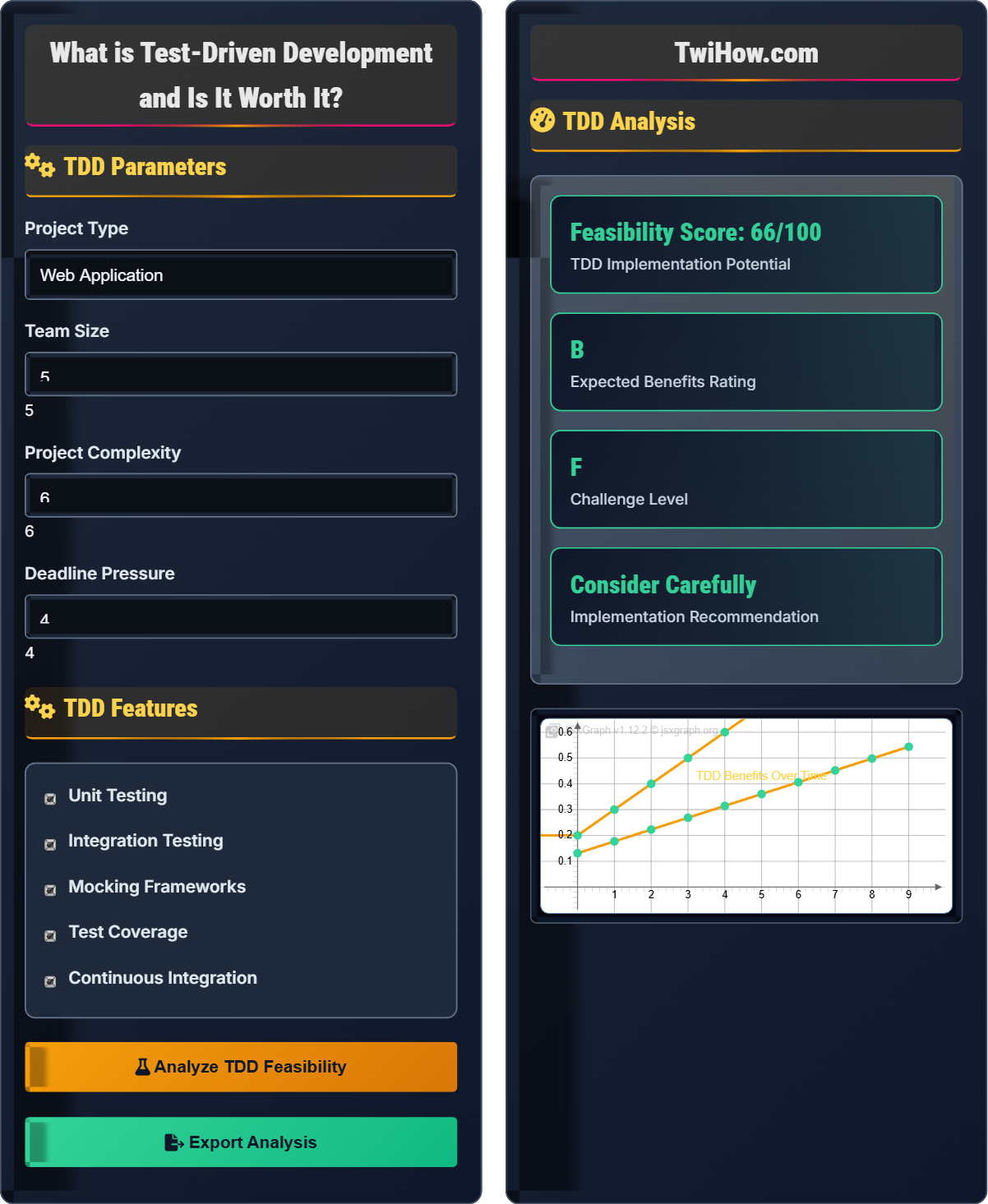
TDD Parameters
TDD Features
TDD Analysis
| Phase | Activity | Time | Benefit |
|---|---|---|---|
| Red | Write failing test | 20% | Clarifies requirements |
| Green | Implement to pass | 30% | Meets requirements |
| Refactor | Improve design | 50% | Enhances quality |
Test-Driven Development Explained
Test-Driven Development (TDD) is a software development approach where tests are written before the actual code. The process follows a simple, repetitive cycle: write a failing test, implement code to make it pass, then refactor while maintaining test coverage.
The TDD cycle consists of three main phases:
Where:
- Red: Write a failing test that describes the desired functionality
- Green: Write minimal code to make the test pass
- Refactor: Improve code quality while keeping tests passing
Key benefits of Test-Driven Development:
- Improved Design: Code becomes more modular and testable
- Reduced Bugs: Catch issues early in the development cycle
- Documentation: Tests serve as living documentation
- Confidence: Safe refactoring with regression protection
- Focus: Clear direction on what needs to be implemented
- Quality: Higher code coverage and better architecture
- Learning Curve: Initial slowdown as developers adapt
- Time Investment: Additional time spent writing tests
- Complexity: Difficult to test certain types of code
- Team Adoption: Requires cultural shift in development teams
- False Positives: Tests that pass but don't verify behavior
- Maintenance: Tests need to be updated alongside code
TDD Fundamentals
TDD, Red-Green-Refactor, Unit Testing, Test Coverage, Mocking, Stubbing, CI/CD.
Quality = (Tests Written Before Code) × (Code Coverage) × (Refactoring Frequency)
Where Quality = software reliability and maintainability.
- Write test first
- Only write enough code to pass
- Refactor constantly
Implementation Patterns
Arrange-Act-Assert, AAA, Given-When-Then, Mocking, Dependency Injection.
- Write failing test
- Implement minimal solution
- Verify test passes
- Refactor code
- Run tests again
- Repeat cycle
- Keep tests fast
- Test one behavior per test
- Use descriptive test names
- Mock external dependencies
TDD Learning Quiz
What is the correct order of the TDD cycle?
The correct order of the TDD cycle is Test, Code, Refactor. This follows the Red-Green-Refactor pattern where you first write a failing test (Red), then implement code to make it pass (Green), and finally refactor the code while keeping tests passing. The answer is B) Test, Code, Refactor.
This sequence ensures that tests drive the development process and verify that the code meets the specified requirements before any cleanup occurs.
The TDD cycle is fundamental to the practice. Writing tests first forces you to think about the requirements and expected behavior before implementation. This clarifies your understanding and provides a clear goal for your implementation efforts.
Red Phase: Writing a failing test
Green Phase: Making the test pass
Refactor Phase: Improving code quality
• Always write test first
• Only write code to make tests pass
• Refactor with confidence
• Start with simple tests
• Keep tests focused
• Use descriptive names
• Writing code before tests
Explain the main benefits of Test-Driven Development and how they contribute to software quality.
Improved Design: TDD forces developers to think about interfaces and dependencies before implementation, leading to better-architected code with loose coupling and high cohesion.
Reduced Bugs: By writing tests first, developers think through edge cases and requirements more thoroughly, catching issues early in the development process.
Living Documentation: Tests serve as executable documentation that explains how code should behave, staying up-to-date with the actual implementation.
Safe Refactoring: A comprehensive test suite provides confidence when making code changes, ensuring that existing functionality isn't broken.
Focus and Clarity: Writing tests first clarifies what needs to be built and provides a clear goal for implementation efforts.
Regression Prevention: Tests catch bugs that might be introduced when adding new features or modifying existing code.
Development Speed: While initially slower, TDD can accelerate development over time by reducing debugging time and increasing confidence in changes.
These benefits collectively contribute to higher quality software that is easier to maintain and extend.
The benefits of TDD compound over time. Initially, the investment in writing tests may seem to slow development, but the long-term gains in maintainability, reliability, and developer confidence often outweigh the initial overhead. The key is that quality is built into the process rather than added afterward.
Coupling: Degree of interdependence between modules
Cohesion: How related elements are grouped together
Regression: Previously working functionality that breaks
• Tests should be fast and reliable
• Focus on behavior, not implementation
• Keep tests independent
• Use mocking to isolate units
• Write tests that are easy to read
• Test edge cases systematically
• Testing implementation details
• Not maintaining test quality
• Writing tests that are too brittle
A development team wants to implement TDD for a new payment processing module. Describe the step-by-step approach they should take, including challenges they might face and how to overcome them.
Step 1 - Preparation: Train the team on TDD principles and set up testing frameworks. Choose appropriate tools for the technology stack (JUnit for Java, pytest for Python, etc.).
Step 2 - Define Requirements: Create clear acceptance criteria for the payment processing module. Break down requirements into testable units.
Step 3 - Start Simple: Begin with basic functionality like validating credit card numbers. Write a failing test for card validation, implement minimal code to pass, then refactor.
Step 4 - Build Incrementally: Add more complex features like processing payments, handling errors, and integrating with payment gateways following the TDD cycle.
Step 5 - Mock External Services: Use mocking frameworks to simulate payment gateway responses during testing.
Step 6 - Integration Testing: Once unit tests pass, write integration tests to verify the entire payment flow works correctly.
Challenges and Solutions:
Initial Slowdown: Expect reduced velocity initially. Communicate long-term benefits to stakeholders.
Complex Dependencies: Use dependency injection and mocking to isolate units for testing.
Team Resistance: Start with willing volunteers, demonstrate benefits, and gradually expand adoption.
External API Testing: Create test doubles for payment gateway APIs to avoid real transaction costs during testing.
Implementing TDD in a real-world scenario requires careful planning and gradual adoption. Payment processing is an excellent example because it has clear requirements, multiple edge cases, and external dependencies that require mocking. The key is to start simple and build complexity gradually while maintaining the TDD discipline.
Acceptance Criteria: Conditions that must be met for user stories
Test Double: Generic term for test replacements
Dependency Injection: Providing dependencies externally
• Start with simple tests
• Mock external dependencies
• Focus on business value
• Use test-driven design for interfaces
• Write tests for error conditions
• Implement continuous integration
• Trying to test everything at once
• Not mocking external dependencies
• Writing tests that are too complex
Explain why mocking is important in TDD and provide an example of how to properly mock a database dependency in a unit test.
Why Mocking is Important: Mocking allows developers to isolate the unit being tested by replacing dependencies with controlled substitutes. This ensures that tests are fast, deterministic, and focused on the specific unit's behavior rather than its dependencies.
Benefits of Mocking:
Speed: Tests run faster without database connections
Reliability: Tests aren't affected by external service outages
Control: Simulate various scenarios including error conditions
Isolation: Test only the code under test
Example Scenario: Testing a user service that retrieves user data from a database.
Without Mocking: Test would connect to a real database, requiring test data setup and potentially failing due to network issues.
With Mocking: Create a mock database repository that simulates database behavior. The test verifies that the user service calls the repository correctly and processes the returned data appropriately.
Best Practices: Mock at the interface level, verify interactions rather than implementation details, and use dependency injection to make mocking easier. Only mock external dependencies, not internal collaborators when possible.
Proper mocking enables thorough testing while maintaining the benefits of fast, reliable unit tests.
Mocking is essential for effective TDD because it allows developers to write focused, fast tests that verify the behavior of individual units. Without mocking, tests become integration tests that are slower and more brittle. The key is to mock external dependencies while testing internal logic thoroughly.
Mock: Simulated object that verifies interactions
Stub: Provides canned responses
Dependency Injection: Providing dependencies externally
• Mock external dependencies only
• Verify interactions, not implementation
• Keep mocks simple
• Use mocking frameworks like Mockito or pytest-mock
• Create test data builders for complex objects
• Verify method calls and parameters
• Mocking internal collaborators
• Testing implementation details
• Not verifying mock interactions
Which of the following is the most significant challenge when adopting TDD in an existing codebase?
The most significant challenge when adopting TDD in an existing codebase is the lack of testable design in existing code. Legacy code is often tightly coupled, making it difficult to write isolated unit tests. The code may not follow dependency injection patterns, have tight coupling between components, or have side effects that make testing difficult. The answer is B) Lack of testable design in existing code.
To address this challenge, teams often need to gradually refactor code to make it more testable, which can be a significant undertaking. This is why TDD is much easier to adopt in greenfield projects.
Legacy code often wasn't written with testing in mind, making it difficult to isolate units for testing. The tight coupling and complex dependencies make it challenging to write the isolated tests that TDD requires. This is why TDD is most effective when adopted from the beginning of a project.
Legacy Code: Existing code without tests
Tight Coupling: Strong dependencies between components
Refactoring: Improving code without changing behavior
• Start with new code first
• Refactor gradually
• Focus on critical paths
• Add tests to bug fixes first
• Use seam injection techniques
• Implement testing hooks
• Trying to retrofit TDD to all legacy code
• Not investing in proper refactoring
• Expecting immediate results
FAQ
Q: How much time should I spend on testing versus actual coding in TDD?
A: The time split in TDD varies by experience and project, but a common guideline is 40-60% of development time spent on testing activities. This includes writing tests, running tests, and refactoring.
New to TDD: You might spend 60-70% on testing initially as you learn the rhythm and patterns. This is normal and the time investment pays off in reduced debugging time later.
Experienced with TDD: The split might be closer to 40-50% as you become more efficient at writing tests and implementing code.
It's important to note: The goal isn't to maximize test time but to ensure quality. Well-written tests save much more time in debugging, maintenance, and feature additions than they cost in upfront investment.
Focus on writing meaningful tests that verify business requirements rather than just achieving coverage metrics.
Q: Is TDD worth it for a small project or prototype?
A: The value of TDD depends on the project's lifecycle expectations:
Throwaway Prototypes: Probably not worth it. If the code will be discarded after experimentation, the TDD overhead might not be justified.
Proof of Concept with Potential to Evolve: Consider light testing. Even basic tests can help validate ideas and provide a foundation for future development.
Projects Likely to Grow: TDD is valuable even for small projects that may expand. The tests provide a safety net for future changes and help ensure code quality from the start.
Team Collaboration: If multiple developers will work on the project, even briefly, tests provide documentation and prevent regressions.
Key consideration: TDD isn't just about bug prevention—it's about design clarity and confidence in changes. If you anticipate any maintenance or expansion, the investment often pays dividends.
For truly disposable code, consider writing tests for the most complex or critical parts only.