What Is the Difference Between Frontend and Backend Development?
Complete development guide • Step-by-step explanations
Frontend vs Backend:
Show Comparison ToolFrontend and backend development are two distinct but complementary aspects of web application creation. Frontend development focuses on the user interface and user experience, creating everything users interact with directly. Backend development handles server-side logic, databases, and application functionality that powers the frontend. Understanding both areas is crucial for creating complete web applications.
Key differences:
- Frontend: Client-side development, user interface, visual design
- Backend: Server-side development, databases, business logic
- Technologies: Different programming languages and tools
- Responsibilities: Unique roles and skill sets
Full-stack developers combine both frontend and backend skills to create complete applications. The choice between frontend and backend often depends on personal interests, career goals, and problem-solving preferences.
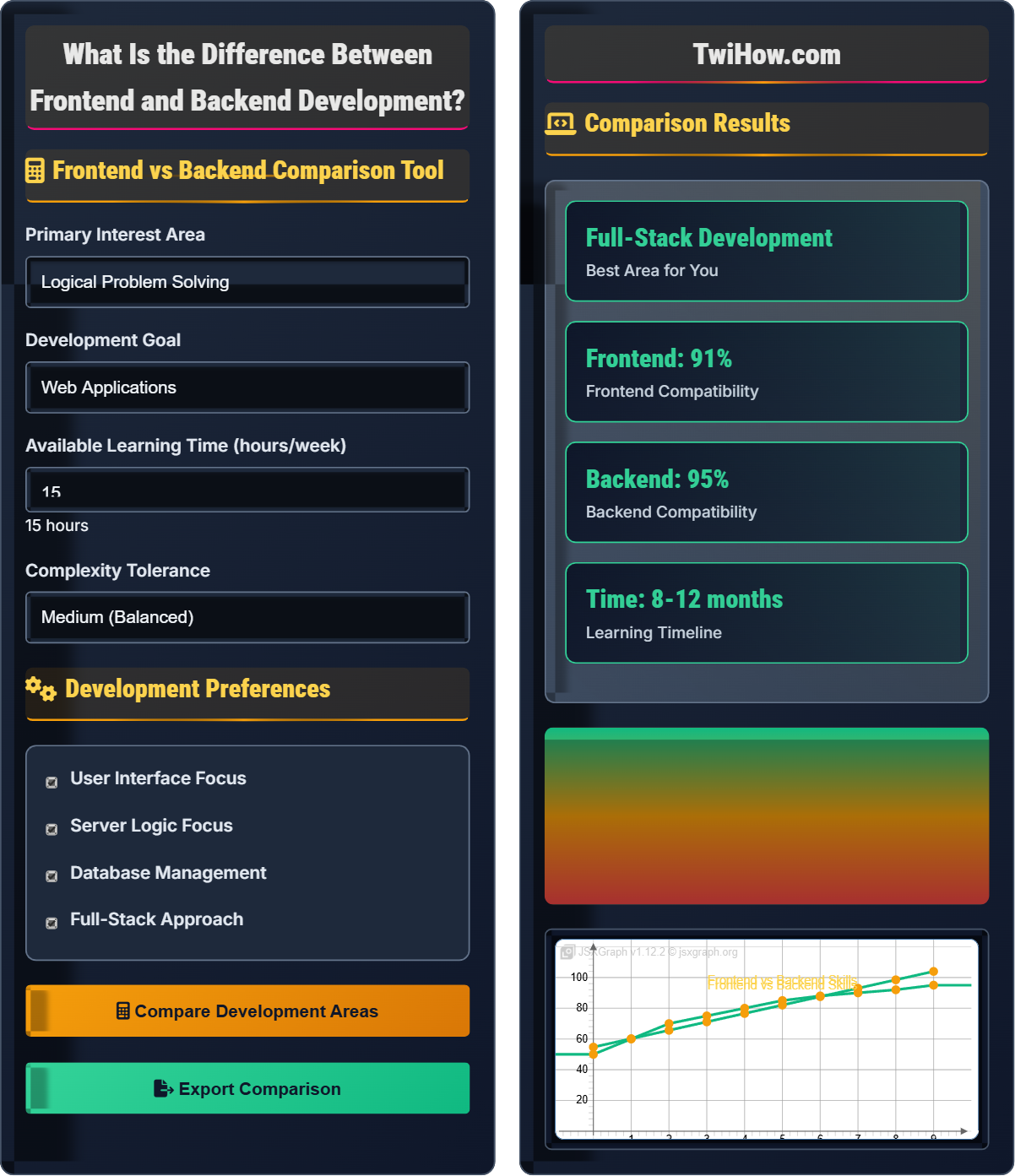
Frontend vs Backend Comparison Tool
Development Preferences
Comparison Results
Frontend vs Backend Development Explained
Frontend and backend development are two complementary aspects of web application creation. Frontend development focuses on the user interface and user experience, creating everything users interact with directly. Backend development handles server-side logic, databases, and application functionality that powers the frontend.
Application_Success = (Frontend_UX × Backend_Performance × Integration_Quality) ÷ (Development_Complexity × Time_Investment)
Where:
- Frontend_UX: User experience and interface quality
- Backend_Performance: Server-side efficiency and reliability
- Integration_Quality: How well frontend and backend communicate
- Development_Complexity: Technical challenges and requirements
- Time_Investment: Time allocated to development and learning
Key technologies for each development area:
- Frontend Technologies: HTML, CSS, JavaScript, React, Vue, Angular, Bootstrap
- Backend Technologies: Node.js, Python (Django, Flask), Java, Ruby, PHP, SQL, NoSQL
- APIs: REST, GraphQL, WebSockets for communication
- Tools: Version control, package managers, development environments
- Deployment: Cloud platforms, containers, CI/CD pipelines
- Security: Authentication, authorization, data protection
- Frontend Career: UI/UX focus, visual design, user interaction
- Backend Career: System architecture, data management, server optimization
- Full-Stack Career: Complete application development
- Salary Potential: Competitive across all areas
- Job Market: High demand for all specializations
- Work Environment: Varies by company and role
Development Fundamentals
Client-server architecture, HTTP protocol, APIs, databases, user interface, server-side logic.
Success_Rate = (Frontend × Backend × Integration) ÷ (Complexity × Time)
Where each component is normalized to 0-100 scale.
- Frontend and backend must work together seamlessly
- Both areas require continuous learning
- Full-stack developers have broad market appeal
Applications
Web applications, mobile apps, enterprise software, e-commerce, social media, APIs.
- Technology companies
- Financial services
- Healthcare
- E-commerce
- Performance requirements
- Security concerns
- Scalability needs
- Team structure
Frontend vs Backend Development Quiz
What is the primary difference between frontend and backend development?
The correct answer is B) Frontend handles user interface, backend handles server logic. This is the fundamental distinction between frontend and backend development.
Frontend Development:
- Focuses on user interface and user experience
- Runs on the client-side (user's browser/device)
- Creates everything users see and interact with
- Uses HTML, CSS, JavaScript, and frameworks like React/Vue
Backend Development:
- Focuses on server-side logic and data processing
- Runs on the server-side (web servers, databases)
- Handles business logic, databases, and security
- Uses languages like Python, Java, Node.js, and databases
Option A is incorrect - it reverses the client-server relationship. Option C is subjective and incorrect. Option D is false since backend developers commonly use JavaScript (Node.js).
The answer is B) Frontend handles user interface, backend handles server logic.
This question addresses the most fundamental concept in web development. Understanding the client-server architecture is crucial for any aspiring developer. The frontend-backend distinction represents one of the most important architectural decisions in web application design. Recognizing that frontend is client-facing while backend is server-facing helps clarify the different responsibilities and skill sets required for each role.
Client-Side: Code that runs in the user's browser
Server-Side: Code that runs on the web server
HTTP Protocol: Standard for web communication between client and server
• Frontend is user-facing, backend is server-facing
• Both sides must communicate effectively
• Each has distinct technologies and responsibilities
• Think of frontend as what users see and interact with
• Think of backend as what makes the application work behind the scenes
• Both are essential for a complete application
• Confusing client-side with server-side responsibilities
• Thinking one area is more important than the other
• Not understanding how frontend and backend communicate
Compare the primary technologies used in frontend and backend development, including their purposes, advantages, and typical use cases.
Frontend Technologies:
HTML (HyperText Markup Language):
- Purpose: Creates the structure and content of web pages
- Advantages: Universal support, semantic markup, accessibility
- Use Cases: Page structure, content organization, SEO
CSS (Cascading Style Sheets):
- Purpose: Styles and layouts web pages
- Advantages: Separation of content and presentation, responsive design
- Use Cases: Visual styling, animations, responsive layouts
JavaScript:
- Purpose: Adds interactivity and dynamic behavior to web pages
- Advantages: Runs in browser, extensive ecosystem, versatile
- Use Cases: User interactions, API calls, dynamic content
Frontend Frameworks (React, Vue, Angular):
- Purpose: Simplify complex UI development and state management
- Advantages: Component-based architecture, performance optimization
- Use Cases: Single-page applications, complex user interfaces
Backend Technologies:
Server-Side Languages (Node.js, Python, Java, PHP):
- Purpose: Handle server logic, business rules, and data processing
- Advantages: Robust, scalable, extensive libraries and frameworks
- Use Cases: API development, business logic, data processing
Databases (SQL: MySQL, PostgreSQL; NoSQL: MongoDB, Redis):
- Purpose: Store, retrieve, and manage application data
- Advantages: Data persistence, querying capabilities, security
- Use Cases: User data, application state, transaction processing
APIs (REST, GraphQL):
- Purpose: Enable communication between frontend and backend
- Advantages: Standardized communication, scalability, separation of concerns
- Use Cases: Data exchange, microservices, third-party integrations
DevOps Tools (Docker, Kubernetes, CI/CD):
- Purpose: Deploy, manage, and scale backend applications
- Advantages: Consistency, automation, scalability
- Use Cases: Deployment, scaling, monitoring
Integration Points:
- Frontend communicates with backend through HTTP requests
- Backend provides data via APIs that frontend consumes
- Authentication and authorization systems span both sides
- Security considerations apply to both frontend and backend
This comprehensive comparison demonstrates the specialized nature of each development area. Frontend technologies focus on presentation and user interaction, while backend technologies handle data processing and business logic. Understanding the purpose and use cases for each technology helps developers choose the right tools for specific problems. The integration points show how these separate areas must work together to create complete applications.
API (Application Programming Interface): Interface for communication between applications
REST (Representational State Transfer): Architectural style for web APIs
Single-Page Application (SPA): Web app that loads once and updates dynamically
• Each technology serves specific purposes in web development
• Frontend and backend technologies must work together
• Choose technologies based on project requirements
• Learn the fundamentals before diving into frameworks
• Understand how frontend and backend technologies interact
• Stay updated with evolving technology landscapes
• Learning frameworks without understanding fundamentals
• Not understanding how technologies work together
• Choosing technologies based on popularity rather than fit
A startup is building a social media platform and needs to assemble a development team. They have a budget for 6 developers and need to decide how to allocate them between frontend and backend roles. The platform requires complex user interfaces, real-time messaging, and robust data management. Recommend a team structure and explain your reasoning, including the specific roles and responsibilities for each area.
Recommended Team Structure: 3 Frontend, 3 Backend Developers
Frontend Team (3 Developers):
- Lead Frontend Developer (1):
- Architect frontend applications and establish coding standards
- Implement complex UI components and ensure performance
- Coordinate with backend team on API integration
- UI/UX Specialists (2):
- Implement responsive user interfaces and design systems
- Handle real-time messaging interface and notifications
- Optimize user experience and accessibility
Backend Team (3 Developers):
- Lead Backend Developer (1):
- Design system architecture and database schemas
- Implement core business logic and security measures
- Manage deployment and infrastructure
- API/Data Specialists (2):
- Develop RESTful APIs and GraphQL endpoints
- Handle real-time messaging and notification systems
- Manage database optimization and scaling
Reasoning:
- Complex UI Requirements: Social media platforms need sophisticated user interfaces with real-time updates, requiring dedicated frontend expertise.
- Real-Time Messaging: Both frontend and backend complexity for real-time features, necessitating specialized developers on both sides.
- Robust Data Management: Social media platforms require extensive data handling, user relationships, and content management, demanding backend specialists.
- Balance: Equal distribution allows for parallel development and avoids bottlenecks between frontend and backend teams.
Collaboration Structure:
- Regular API contract meetings between frontend and backend teams
- Shared documentation for API endpoints and data structures
- Joint sprint planning to align development priorities
- Cross-functional pair programming for complex integrations
Alternative Structures:
- Full-Stack Approach: 6 full-stack developers handling both frontend and backend tasks
- Feature-Based Teams: Small cross-functional teams working on specific features
This structure ensures that both the complex user interface requirements and the robust backend systems receive adequate attention and expertise.
This problem demonstrates how business requirements influence team structure decisions. The social media platform example highlights the need for both sophisticated user interfaces and robust backend systems. The balanced approach ensures neither side becomes a bottleneck while allowing for specialized expertise in complex areas like real-time messaging. The collaboration structure shows how frontend and backend teams must work together despite being organized separately.
Real-Time Messaging: Instant communication between users without page refresh
API Contract: Agreed-upon specification for frontend-backend communication
Feature-Based Teams: Cross-functional teams focused on specific product features
• Align team structure with business requirements
• Ensure balanced expertise between frontend and backend
• Establish clear communication channels between teams
• Consider the complexity of each development area
• Plan for collaboration between frontend and backend teams
• Allow flexibility to adjust team structure as needed
• Underestimating the complexity of frontend or backend requirements
• Not planning for frontend-backend integration challenges
• Creating team structures that hinder collaboration
You're considering a career change to web development and need to decide between specializing in frontend or backend development. You enjoy visual design and user experience but also appreciate logical problem-solving and system architecture. Your strengths include attention to detail, visual thinking, and analytical skills. Design a learning path that allows you to explore both areas before making a specialization decision, including specific technologies to learn and projects to build.
6-Month Exploration Learning Path
Months 1-2: Frontend Foundation
- Technologies: HTML, CSS, JavaScript basics
- Focus: Understanding web structure and basic interactivity
- Projects:
- Personal portfolio website
- Responsive landing page
- Interactive calculator
- Learning Goals: Master the DOM, CSS layout, and basic JavaScript
Months 3-4: Backend Foundation
- Technologies: Node.js, Express.js, basic database concepts
- Focus: Server-side logic and data management
- Projects:
- Simple REST API
- Blog API with CRUD operations
- Basic authentication system
- Learning Goals: Understand HTTP, routing, and database operations
Months 5-6: Full-Stack Integration
- Technologies: React.js for frontend, continue with Node.js backend
- Focus: Connecting frontend and backend through APIs
- Projects:
- Full-stack todo application
- Simple social media clone
- Personal expense tracker
- Learning Goals: Master API integration and full application development
Self-Assessment Points:
- Month 2: Evaluate enjoyment of visual design vs. logical problem-solving
- Month 4: Assess preference for user-facing vs. system-level work
- Month 6: Decide on specialization based on interests and strengths
Decision Factors:
- If Preferring Frontend: Continue with advanced React, Vue, or Angular
- If Preferring Backend: Dive deeper into databases, system architecture
- If Enjoying Both: Consider full-stack development or specialization
Advanced Frontend Path:
- Modern frameworks (React, Vue, Angular)
- State management (Redux, Vuex)
- UI/UX design principles
- Performance optimization
Advanced Backend Path:
- Database optimization and scaling
- System architecture and design
- Security and authentication
- DevOps and deployment
Resources:
- FreeCodeCamp for comprehensive tutorials
- MDN Web Docs for reference
- YouTube channels for visual learning
- GitHub for code examples and projects
Portfolio Strategy:
- Maintain projects from both frontend and backend phases
- Showcase your learning journey and decision-making process
- Highlight projects that demonstrate your chosen specialization
This exploration approach allows for informed decision-making by experiencing both areas firsthand. The structured timeline ensures sufficient depth in each area while maintaining forward progress. The project-based learning approach provides practical experience with both frontend and backend challenges. The self-assessment points create opportunities for reflection and adjustment of the learning path. This method helps individuals make career decisions based on actual experience rather than assumptions.
Full-Stack Development: Proficiency in both frontend and backend technologies
DOM (Document Object Model): Programming interface for HTML documents
CRUD Operations: Create, Read, Update, Delete database operations
• Experience both areas before making specialization decisions
• Build projects that demonstrate your skills
• Assess interests based on actual experience
• Start with fundamentals before advanced concepts
• Build projects that interest you personally
• Document your learning journey for portfolio purposes
• Specializing too early without adequate experience
• Not building enough practical projects
• Making decisions based on assumptions rather than experience
Which trend is most significantly impacting the relationship between frontend and backend development?
The correct answer is C) The growth of serverless computing and API-first development. This trend is fundamentally changing how frontend and backend development interact.
Serverless Computing Impact:
- Frontend developers can focus more on user experience without server management
- Backend functionality is provided through cloud functions and services
- Reduced need for traditional server infrastructure management
- Pay-per-use pricing model changes cost structures
API-First Development:
- Backend teams design APIs before frontend development begins
- Frontend teams can develop against mock APIs before backend is complete
- Standardized interfaces facilitate better team coordination
- Facilitates integration with multiple frontend applications
Other Trends:
Option A is incorrect - JavaScript is growing in backend development through Node.js. Option B (microservices) does impact development but not as fundamentally as serverless/API-first approaches. Option D is incorrect - web and mobile applications continue to dominate over desktop applications.
These trends are blurring traditional boundaries between frontend and backend roles, with frontend developers taking on more backend responsibilities through cloud services and API integration.
The answer is C) The growth of serverless computing and API-first development.
This question addresses how industry trends are reshaping the traditional frontend-backend divide. Serverless computing and API-first development represent significant shifts in how applications are architected. These trends allow for more flexible team structures and change the skill sets required for both frontend and backend developers. Understanding these trends helps developers prepare for evolving job markets and technology landscapes.
Serverless Computing: Cloud computing execution model without server management
API-First Development: Designing APIs before implementing application logic
Microservices: Architectural style using small, independent services
• Stay informed about industry trends and their implications
• Adapt skill sets to emerging technologies
• Understand how trends affect both frontend and backend roles
• Follow industry publications and developer blogs
• Experiment with new technologies and approaches
• Consider how trends affect your career path
• Ignoring industry trends and their impact on development
• Not adapting to changing technology landscapes
• Focusing only on current technologies without considering future trends
FAQ
Q: Should I learn frontend or backend development first?
A: Most beginners benefit from starting with frontend development because:
Immediate Visual Feedback: You can see your code changes instantly in the browser, which is motivating for beginners.
Progressive Learning: Start with HTML (structure), then CSS (styling), then JavaScript (functionality).
Lower Barrier: No need to set up servers or databases initially.
Frontend First Benefits:
- Quick wins and motivation
- Understanding of user experience
- Foundation for full-stack development
- Portfolio pieces visible immediately
However, if you:
- Enjoy logical problem-solving and algorithms
- Are interested in data and business logic
- Want to understand how applications work internally
Then starting with backend concepts might be more engaging for you.
Ultimately, both paths lead to similar skills and career opportunities. Choose based on what interests you most initially.
Q: How much backend knowledge should a frontend developer have?
A: Modern frontend developers should have a solid understanding of backend concepts:
Essential Backend Knowledge:
- API Integration: Understanding REST and GraphQL APIs, making HTTP requests
- Data Flow: How data moves between frontend and backend
- Authentication: How login, sessions, and tokens work
- Basic Database Concepts: Understanding data structures and relationships
- Security Basics: XSS, CSRF, and other web vulnerabilities
Beneficial Knowledge:
- Basic server setup and deployment
- Environment configuration
- Understanding of backend performance considerations
- Familiarity with backend languages for debugging
Full-Stack Advantages:
- Better troubleshooting capabilities
- More comprehensive problem-solving
- Increased job market appeal
- Ability to work on complete features
The amount of backend knowledge needed depends on your role and company size. At smaller companies, broader skills are more valuable, while larger companies may have more specialized roles.