What is the Difference Between SQL and NoSQL Databases?
Complete database comparison guide • Step-by-step explanations
Database Fundamentals:
Show Database SelectorSQL (Structured Query Language) and NoSQL (Not Only SQL) databases represent two fundamentally different approaches to data storage and retrieval. SQL databases use structured, table-based schemas with defined relationships, while NoSQL databases offer flexible, schema-less data models.
SQL databases excel at structured data with complex relationships and strong consistency requirements, while NoSQL databases shine in scenarios requiring horizontal scalability, flexible schemas, and high availability.
Key database concepts:
- Relational Model: SQL databases use tables with defined relationships
- ACID Properties: Atomicity, Consistency, Isolation, Durability
- Schema Flexibility: NoSQL allows dynamic schema changes
- Scalability: Horizontal vs vertical scaling approaches
- Consistency Models: Strong vs eventual consistency
Choosing between SQL and NoSQL depends on specific application requirements, data structure, scalability needs, and consistency requirements.
Database Parameters
Database Features
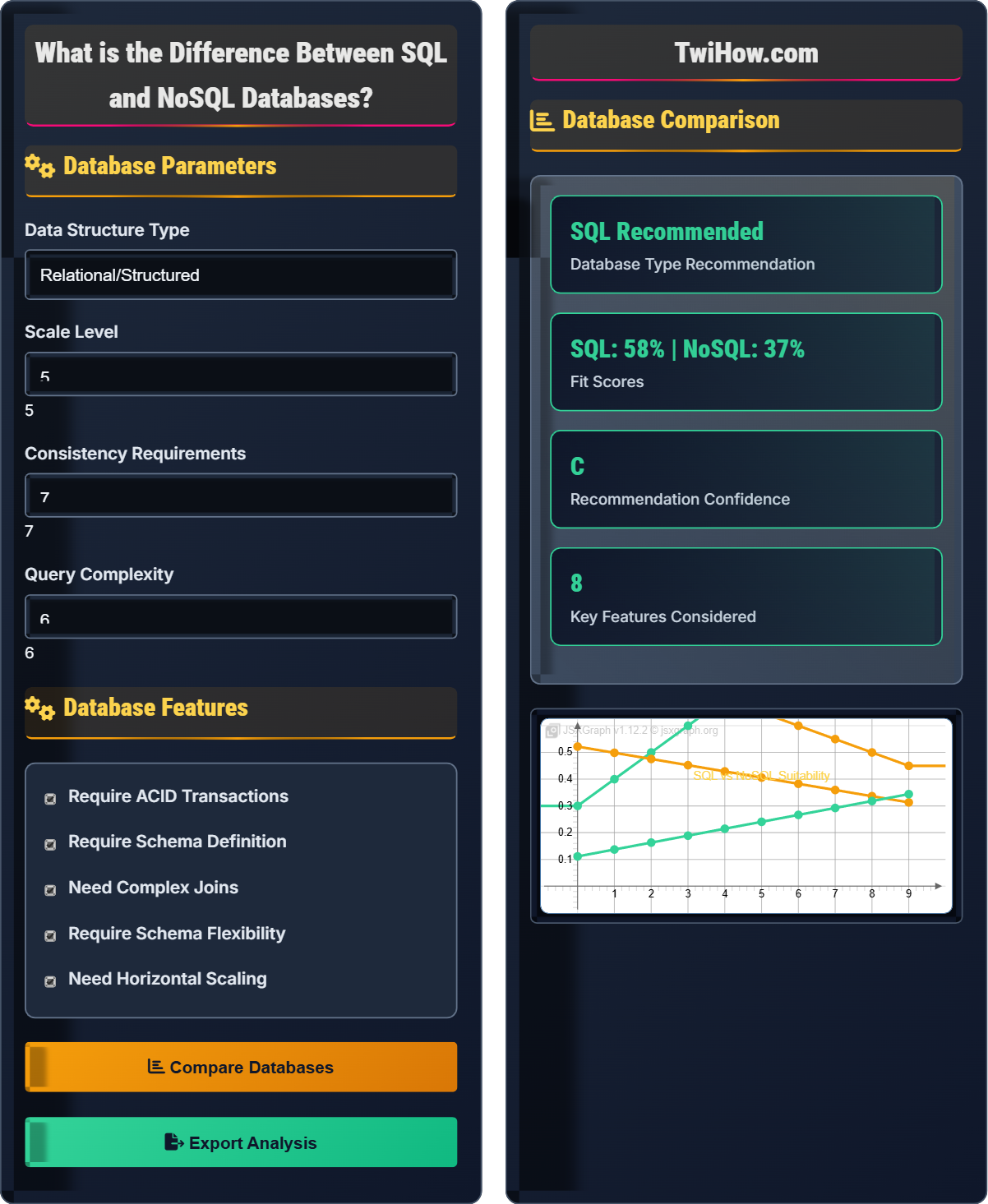
Database Comparison
| Aspect | SQL | NoSQL |
|---|---|---|
| Schema | Fixed | Flexible |
| Scalability | Vertical | Horizontal |
| Consistency | Strong | Eventual |
| Transactions | Full ACID | Limited |
| Querying | Powerful | Simple |
SQL vs NoSQL Database Comparison
SQL (Structured Query Language) and NoSQL (Not Only SQL) databases represent two fundamentally different approaches to data storage and retrieval. SQL databases use structured, table-based schemas with defined relationships, while NoSQL databases offer flexible, schema-less data models.
Understanding the fundamental differences between SQL and NoSQL databases:
Where:
- SQL Databases: Relational, structured, ACID-compliant
- NoSQL Databases: Non-relational, flexible, scalable
- ACID Properties: Atomicity, Consistency, Isolation, Durability
- CAP Theorem: Consistency, Availability, Partition Tolerance
- Scalability: Vertical (SQL) vs Horizontal (NoSQL)
Essential characteristics comparison:
- SQL: Fixed schema, joins, ACID transactions, mature ecosystem
- NoSQL: Flexible schema, no joins, eventual consistency, horizontal scaling
- Use Cases: SQL for complex queries and transactions, NoSQL for big data and real-time applications
- Examples: SQL (MySQL, PostgreSQL, Oracle), NoSQL (MongoDB, Redis, Cassandra)
- Performance: SQL optimized for complex queries, NoSQL for read/write speed
- Learning Curve: SQL has steeper learning curve but widespread knowledge
- SQL Databases: MySQL, PostgreSQL, Oracle, SQL Server, SQLite
- Document Stores: MongoDB, Couchbase, Amazon DocumentDB
- Key-Value Stores: Redis, DynamoDB, Riak, Memcached
- Columnar Databases: Cassandra, HBase, BigTable
- Graph Databases: Neo4j, Amazon Neptune, ArangoDB
- Time Series: InfluxDB, TimescaleDB, Prometheus
Database Fundamentals
SQL, NoSQL, ACID, CAP Theorem, Schema, Relationships, Indexing, Transactions.
Consistency + Availability + Partition Tolerance = 2 of 3
Where only two of three properties can be guaranteed simultaneously.
- Choose SQL for structured data
- Choose NoSQL for scalability
- Consider consistency needs
Selection Criteria
Data Structure, Scale, Consistency, Query Complexity, Team Skills, Cost.
- Analyze data requirements
- Evaluate scalability needs
- Assess consistency requirements
- Consider team expertise
- Calculate total cost
- Match database to use case
- Consider future growth
- Plan for maintenance
- Test with real data
Database Comparison Quiz
According to the CAP theorem, what is the maximum number of guarantees a distributed system can provide simultaneously?
According to the CAP theorem (Consistency, Availability, Partition Tolerance), a distributed system can only guarantee two out of the three properties simultaneously. This is a fundamental principle in distributed systems design. The answer is B) 2.
Most SQL databases prioritize Consistency and Availability (CA), while many NoSQL databases prioritize Availability and Partition Tolerance (AP).
The CAP theorem is crucial for understanding the trade-offs in distributed database design. It explains why SQL and NoSQL databases make different architectural choices. SQL databases typically sacrifice partition tolerance for strong consistency and availability, while NoSQL databases often sacrifice consistency for availability and partition tolerance.
Consistency: All nodes see same data at same time
Availability: System remains operational
Partition Tolerance: System works despite network failures
• Distributed systems must choose 2 of 3 CAP properties
• Trade-offs affect performance and reliability
• No perfect solution exists
• Understand your application's priorities
• Consider BASE model for NoSQL systems
• Evaluate consistency requirements carefully
• Assuming systems can guarantee all three properties
Explain the four ACID properties and describe how they apply to SQL databases.
Atomicity: All operations in a transaction are treated as a single unit. Either all succeed or all fail. Example: A bank transfer transaction either completes entirely or rolls back completely.
Consistency: The database remains in a valid state before and after each transaction. All constraints and rules are enforced. Example: Maintaining referential integrity between related tables.
Isolation: Concurrent transactions don't interfere with each other. Each transaction appears to execute in isolation. Example: Preventing dirty reads between concurrent transactions.
Durability: Once a transaction is committed, it remains permanent even in case of system failures. Example: Transaction data persists after power loss.
SQL databases implement these properties through locking mechanisms, transaction logs, and recovery procedures, ensuring data integrity in complex operations.
ACID properties are fundamental to SQL databases and ensure data integrity in complex, multi-user environments. They provide strong guarantees that are essential for business-critical applications where data accuracy is paramount. This is why SQL databases are preferred for financial systems and other applications requiring strict consistency.
Transaction: Sequence of database operations treated as unit
Locking: Mechanism to control concurrent access
Referential Integrity: Maintaining relationship constraints
• ACID properties ensure data integrity
• SQL databases implement all four properties
• NoSQL databases may implement subsets
• Use transactions for complex operations
• Understand isolation levels
• Consider performance implications
• Not using transactions for related operations
• Ignoring isolation level effects
• Assuming NoSQL has same guarantees
A social media company needs to store user profiles, posts, comments, and likes. The platform expects millions of users with high write/read volumes and requires horizontal scaling. Which database type would be most appropriate and why?
Recommendation: A NoSQL database would be most appropriate for this social media application.
Reasons: The application requires horizontal scaling to handle millions of users and high throughput. Social media data is semi-structured with varying schemas (different post types, user preferences, etc.). The data model involves complex relationships that can be handled more flexibly with document-based NoSQL databases.
Specific Considerations: Document stores like MongoDB can handle user profiles and posts as nested documents. Key-value stores like Redis can cache frequently accessed data. Graph databases could model complex relationships between users and content.
Trade-offs: Some consistency guarantees may be relaxed in favor of availability and partition tolerance. Eventual consistency is acceptable for most social media features.
Implementation: A polyglot persistence approach using multiple database types (MongoDB for posts, Redis for caching, Neo4j for relationships) would provide optimal performance.
Real-world applications often require evaluating multiple factors beyond just SQL vs NoSQL. For social media platforms, the primary concern is scalability and performance under high load. The flexible schema of NoSQL databases accommodates the variety of content types and user-generated data. However, hybrid approaches combining different database technologies often provide the best solution.
Polyglot Persistence: Using multiple database technologies
Horizontal Scaling: Adding more servers to distribute load
Throughput: Number of operations per unit time
• Match database to application requirements
• Consider scalability needs
• Evaluate consistency vs availability
• Prototype with both options
• Consider hybrid approaches
• Plan for data migration
• Choosing based on popularity alone
• Not considering future growth
• Ignoring operational complexity
A company has a customer database with fixed fields (name, email, phone) but also wants to store dynamic customer preferences that vary by user. Compare how SQL and NoSQL would handle this scenario and recommend the best approach.
SQL Approach: Use separate tables for fixed fields and dynamic preferences. Create a preferences table with key-value pairs or use JSON columns (in newer SQL databases like PostgreSQL). This requires ALTER TABLE operations to add new preference types.
NoSQL Approach: Store customer data as documents with both fixed fields and dynamic preference objects. New preference types can be added without schema changes. The entire customer record is stored together.
SQL Advantages: Strong consistency, ACID transactions, established tools, complex querying.
NoSQL Advantages: Schema flexibility, easier to evolve, better for variable data, simpler data access patterns.
Recommendation: For this specific use case, NoSQL would be better due to the dynamic nature of customer preferences. However, if the company needs complex reporting and analytics across customer data, a hybrid approach could be considered.
This scenario highlights the schema flexibility advantage of NoSQL databases. In SQL databases, managing variable data structures often leads to complex normalization challenges and frequent schema changes. NoSQL databases naturally accommodate this variability, making them ideal for applications with evolving data requirements.
Schema Evolution: Changing database structure over time
Normalization: Organizing data to reduce redundancy
Denormalization: Adding redundancy for performance
• Consider data volatility requirements
• Evaluate query patterns
• Plan for schema changes
• Use JSON columns in modern SQL databases
• Consider EAV patterns for SQL
• Normalize data carefully
• Creating overly complex normalized structures
• Not considering query performance
• Ignoring data consistency needs
Which scaling approach is typically associated with SQL databases?
Traditional SQL databases typically use vertical scaling (also known as scaling up), where you increase the capacity of a single server by adding more CPU, RAM, or storage. This is due to the ACID properties and complex transaction management that make horizontal scaling more challenging. The answer is B) Vertical Scaling.
While some modern SQL databases support horizontal scaling through sharding and clustering, traditional SQL databases are designed for vertical scaling. NoSQL databases are typically designed for horizontal scaling from the ground up.
Scaling approaches have significant implications for database architecture and performance. Vertical scaling is simpler to implement but has hardware limits. Horizontal scaling offers virtually unlimited capacity but introduces complexity in managing distributed data consistency. This is why the choice between SQL and NoSQL often depends on expected growth patterns.
Vertical Scaling: Increasing single server capacity
Horizontal Scaling: Adding more servers to cluster
Sharding: Partitioning data across servers
• SQL traditionally scales vertically
• NoSQL typically scales horizontally
• Consider cost implications of scaling
• Plan scaling strategy early
• Consider cloud-based solutions
• Test scaling performance
• Underestimating growth requirements
• Not planning for scaling complexity
• Ignoring cost implications
FAQ
Q: Can I use both SQL and NoSQL databases in the same application?
A: Absolutely! This approach is called polyglot persistence and is increasingly common in modern applications. You can use different database technologies for different parts of your application based on their specific requirements.
For example, you might use PostgreSQL for transactional data requiring ACID compliance (user accounts, financial records), MongoDB for content management (blog posts, user-generated content), Redis for caching and session storage, and Elasticsearch for search functionality.
This approach allows you to leverage the strengths of each database technology while addressing their respective weaknesses. However, it also increases complexity in terms of operations, monitoring, and maintenance.
Q: How do I decide which database to choose for my startup?
A: For startups, consider these key factors:
Team Expertise: Choose what your team knows well initially. SQL has more widespread knowledge and resources.
Development Speed: NoSQL can be faster for prototyping and iterating on data models.
Expected Growth: If you anticipate rapid scaling, NoSQL might be easier to scale out.
Data Nature: Structured data (finances, inventory) fits SQL well. Unstructured data (user content, logs) fits NoSQL.
Cost: Many NoSQL solutions offer free tiers, but consider operational complexity costs.
Start with what matches your team's skills and data requirements. You can always migrate later if needed, though this becomes more difficult as you grow.