What Programming Language Should I Learn First in 2026?
Complete programming guide • Step-by-step explanations
Programming Language Guide:
Show Language SelectorChoosing the right programming language in 2026 depends on your goals, interests, and career aspirations. The programming landscape continues to evolve with new paradigms, frameworks, and specialized tools. Whether you're interested in web development, data science, artificial intelligence, mobile apps, or systems programming, the right language choice can accelerate your learning journey and career growth.
Key considerations for 2026:
- Python: Leading choice for AI, data science, and web development
- JavaScript: Essential for web development and expanding into backend
- Java: Enterprise applications and Android development
- C++: Systems programming and performance-critical applications
- Rust: Growing popularity for systems programming with safety
The best first language balances ease of learning with market demand and career opportunities. Consider your long-term goals when making this important decision.
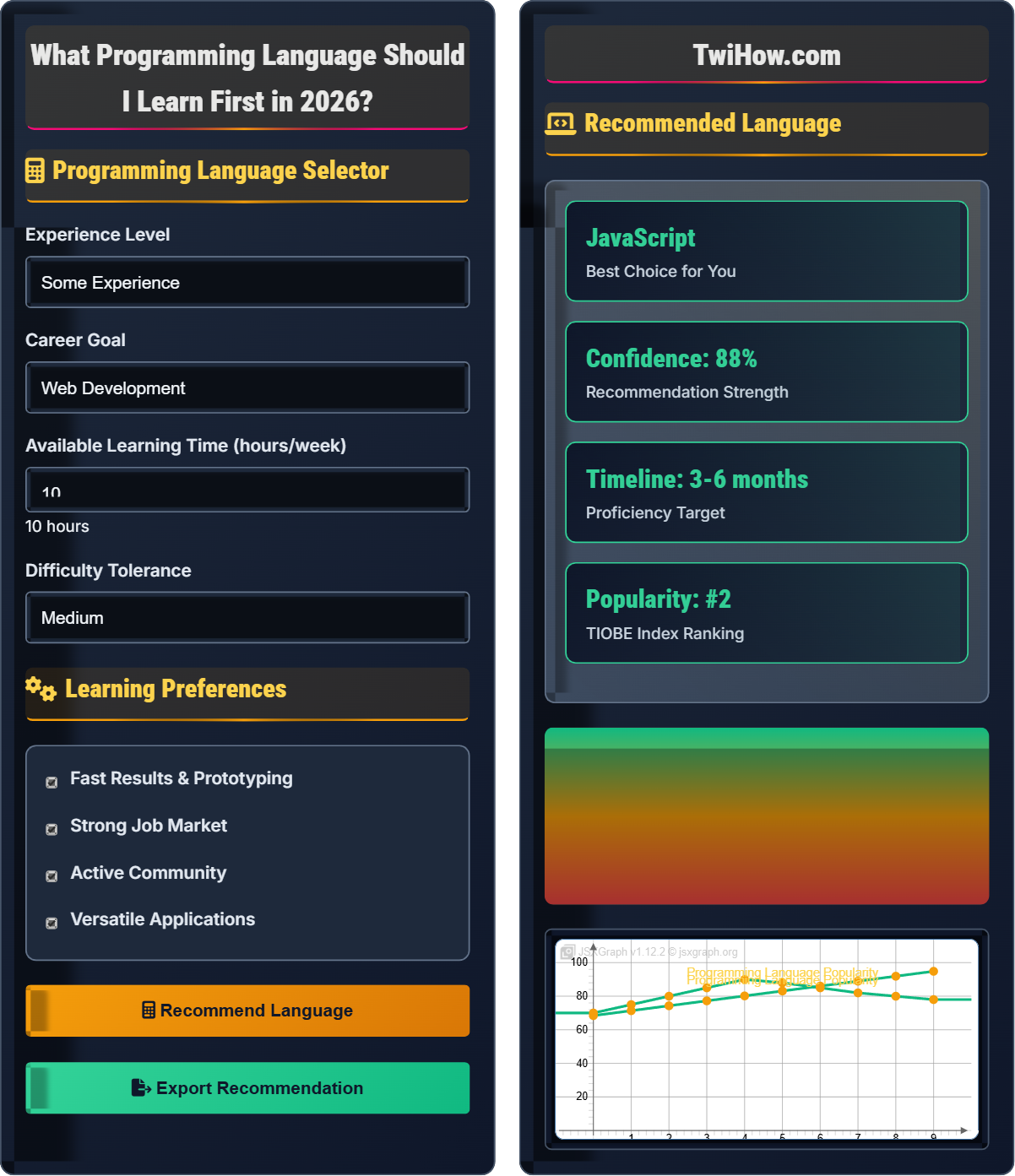
Programming Language Selector
Learning Preferences
Recommended Language
Programming Language Selection Explained
Selecting the right programming language in 2026 requires careful consideration of your goals, experience level, and market trends. The programming landscape continues to evolve with new paradigms, frameworks, and specialized tools that cater to different domains and applications.
Best_Language = (Learning_Ease × Career_Potential × Market_Demand) ÷ (Complexity × Learning_Time)
Where:
- Learning_Ease: How beginner-friendly the language is
- Career_Potential: Opportunities in your target field
- Market_Demand: Job availability and salary potential
- Complexity: Difficulty level and learning curve
- Learning_Time: Time investment required for proficiency
Leading programming languages for 2026:
- Python: Dominates AI, data science, web development, and automation
- JavaScript: Essential for web development and expanding to backend
- Java: Enterprise applications and Android development
- TypeScript: Typed superset of JavaScript gaining popularity
- Rust: Systems programming with memory safety guarantees
- Go: Simple, efficient language for cloud services and distributed systems
- AI-Integrated Development: Languages with built-in AI capabilities
- Quantum Computing: Specialized languages for quantum algorithms
- Edge Computing: Languages optimized for IoT and edge devices
- WebAssembly: Compilation target for multiple languages
- Low-Code Platforms: Visual programming tools gaining traction
- Domain-Specific Languages: Specialized languages for specific industries
Programming Fundamentals
Variables, functions, loops, conditionals, data structures, object-oriented programming, functional programming.
Best_Language = (Ease × Demand × Growth) ÷ (Complexity × Time_to_Mastery)
Where each component is normalized to 0-100 scale.
- Choose based on your specific goals and interests
- Consider the learning curve and available resources
- Focus on market demand and career prospects
Applications
Web development, mobile apps, data analysis, artificial intelligence, game development, system programming.
- Technology companies
- Financial services
- Healthcare
- Entertainment
- Job market trends
- Salary potential
- Learning resources
- Community support
Programming Language Selection Quiz
According to 2026 projections, which programming language is expected to maintain the highest popularity ranking?
Python (Option B) is projected to maintain the highest popularity ranking in 2026. Python continues to dominate in multiple domains including data science, artificial intelligence, web development, and automation.
Key factors contributing to Python's continued popularity:
- Extensive library ecosystem for AI and data science
- Simple syntax that makes it beginner-friendly
- Strong community support and documentation
- Wide adoption in enterprise and startup environments
- Integration with emerging technologies like machine learning
While JavaScript remains popular for web development, Python's versatility across multiple high-demand fields positions it as the leading choice.
The answer is B) Python.
This question addresses the importance of understanding market trends when selecting a programming language. Python's dominance across multiple domains makes it a safe choice for beginners who want to keep their options open. The language's simplicity and extensive ecosystem make it ideal for learning fundamental programming concepts while remaining relevant for professional development.
Popularity Index: Metric measuring language usage and community interest
Library Ecosystem: Collection of reusable code packages for a language
Domain Versatility: Ability to be used across multiple application areas
• Consider long-term market trends when selecting languages
• Evaluate language versatility across different domains
• Assess the size and activity of language communities
• Check multiple popularity indices for balanced perspective
• Consider job posting requirements for market demand
• Look for languages with active development and updates
• Choosing languages based solely on current trends
• Not considering the learning curve for beginners
• Ignoring the importance of community support
Analyze the programming language requirements for different career paths in 2026, including specific technologies, market demand, and learning trajectories for each path.
Web Development Path:
- Primary Languages: JavaScript, TypeScript, Python
- Key Technologies: React, Angular, Vue.js, Node.js, Django, Flask
- Market Demand: Very high - 2.1 million jobs projected globally
- Learning Trajectory: Start with HTML/CSS, then JavaScript, then framework specialization
- Salary Range: $60K-$150K+ depending on experience and location
Data Science/AI Path:
- Primary Languages: Python, R, SQL
- Key Technologies: Pandas, NumPy, TensorFlow, PyTorch, scikit-learn
- Market Demand: Extremely high - 65% growth projected through 2026
- Learning Trajectory: Statistics fundamentals → Python → Machine Learning → Specialization
- Salary Range: $85K-$200K+ with advanced degrees commanding higher salaries
Mobile App Development Path:
- Primary Languages: Swift (iOS), Kotlin/Java (Android), Dart (Flutter), JavaScript (React Native)
- Key Technologies: iOS SDK, Android SDK, Flutter, React Native
- Market Demand: High - 23% growth projected through 2026
- Learning Trajectory: Platform-specific language → UI/UX principles → App architecture
- Salary Range: $70K-$160K+
Game Development Path:
- Primary Languages: C#, C++, Python
- Key Technologies: Unity, Unreal Engine, GameMaker Studio
- Market Demand: Moderate to high - $184 billion industry by 2025
- Learning Trajectory: C# basics → Unity engine → 3D graphics → Advanced game mechanics
- Salary Range: $65K-$140K+
Systems Programming Path:
- Primary Languages: C++, Rust, Go, C
- Key Technologies: Operating systems, embedded systems, performance-critical applications
- Market Demand: Steady - Critical for infrastructure and IoT
- Learning Trajectory: C fundamentals → Systems concepts → Low-level programming → Specialization
- Salary Range: $90K-$200K+
This analysis demonstrates how career goals should drive language selection. Each career path has specific technology requirements and market demands. Understanding these pathways helps beginners make informed decisions about their learning trajectory. The key insight is that language choice should align with both personal interests and market realities.
Learning Trajectory: Sequential path of skill development and knowledge acquisition
Market Demand: Number of job openings and employer requirements
Technology Stack: Combination of technologies used in a particular field
• Align language choice with specific career objectives
• Consider both current and projected market demand
• Factor in salary expectations and growth potential
• Research job postings in your target field
• Connect with professionals in your desired career path
• Consider the total cost of learning including time investment
• Choosing languages without considering career goals
• Not researching actual job market requirements
• Ignoring the learning curve and time investment
A tech startup is looking for a full-stack developer to join their team building a SaaS platform for AI-powered analytics. They need someone who can work on both frontend and backend, with a focus on data processing and visualization. The team currently uses Python, JavaScript, and cloud technologies. Design a learning plan for a complete beginner to become qualified for this role in 12 months, including specific technologies and milestones.
12-Month Learning Plan for Full-Stack AI Analytics Developer
Months 1-3: Foundation Building
- Programming Basics: Python fundamentals, data types, functions, OOP concepts
- Web Fundamentals: HTML, CSS, JavaScript basics
- Version Control: Git and GitHub for code management
- Milestone: Complete basic Python and web development projects
Months 4-6: Backend Development
- Python Web Framework: Django or Flask for backend development
- Database Management: PostgreSQL, SQLAlchemy for data persistence
- API Development: RESTful APIs, authentication, and authorization
- Milestone: Build a simple CRUD application with user authentication
Months 7-9: Frontend and Data Visualization
- Frontend Framework: React.js for dynamic user interfaces
- Data Visualization: D3.js, Chart.js for data representation
- State Management: Redux or Context API for complex applications
- Milestone: Create a dashboard with interactive data visualizations
Months 10-12: AI Integration and Cloud Deployment
- AI/ML Libraries: Pandas, NumPy, scikit-learn for data processing
- Cloud Services: AWS, Azure, or Google Cloud for deployment
- DevOps: Docker, CI/CD pipelines, monitoring
- Milestone: Deploy a full-stack SaaS application with AI analytics features
Recommended Resources:
- Python: "Automate the Boring Stuff with Python" book and online courses
- Web Development: FreeCodeCamp, MDN Web Docs
- Backend: Django documentation and official tutorials
- Frontend: React official documentation and tutorial
- AI/ML: Kaggle Learn and online courses
Portfolio Projects:
- Personal expense tracker with data visualization
- Blog platform with user authentication
- Analytics dashboard for sports or weather data
- SaaS application with AI-powered insights
Expected Salary Range: $75K-$120K depending on location and portfolio strength
This problem demonstrates how to approach complex, real-world requirements by breaking them into manageable learning phases. The sequential approach ensures foundational skills are built before advancing to specialized topics. The milestone-based structure provides checkpoints for progress assessment. This methodical approach is essential for tackling complex career goals in programming.
Full-Stack Developer: Professional skilled in both frontend and backend development
CRUD Application: Create, Read, Update, Delete operations in web applications
SaaS Platform: Software as a Service - cloud-based applications
• Build foundational skills before specializing
• Create portfolio projects to demonstrate abilities
• Follow industry-standard development practices
• Practice coding daily to build muscle memory
• Contribute to open-source projects for experience
• Build a portfolio showcasing diverse projects
• Trying to learn everything at once without focus
• Not building enough practical projects
• Skipping foundational concepts for advanced topics
You are designing a programming curriculum for a coding bootcamp that needs to prepare students for the job market in 2026. The curriculum must be completed in 6 months and should maximize employability. Students have no prior programming experience. Design a comprehensive curriculum that includes programming languages, technologies, and teaching methodology, considering the evolving job market and emerging technologies.
6-Month Modern Programming Bootcamp Curriculum (2026)
Phase 1: Foundations (Weeks 1-4)
- Core Language: Python for its beginner-friendly syntax and versatility
- Programming Fundamentals: Variables, functions, loops, conditionals, data structures
- Object-Oriented Programming: Classes, inheritance, polymorphism
- Development Environment: VS Code, terminal usage, Git basics
- Assessment: Basic Python projects and debugging exercises
Phase 2: Web Development Basics (Weeks 5-10)
- Frontend Technologies: HTML5, CSS3, JavaScript ES6+
- Responsive Design: Flexbox, Grid, Bootstrap, mobile-first approach
- DOM Manipulation: Vanilla JavaScript and basic jQuery
- APIs and Data: Fetch API, JSON, REST principles
- Assessment: Interactive web application with client-side functionality
Phase 3: Backend Development (Weeks 11-16)
- Server-Side Development: Node.js with Express.js or Python with Flask
- Database Management: PostgreSQL or MongoDB for data persistence
- Authentication: JWT, OAuth, session management
- Testing: Unit testing, integration testing principles
- Assessment: Full-stack application with user authentication
Phase 4: Modern Frameworks (Weeks 17-20)
- Frontend Framework: React.js for component-based architecture
- State Management: Context API, basic Redux concepts
- Backend Framework: Django (Python) or Express.js (Node.js)
- API Development: GraphQL basics alongside REST
- Assessment: Complex full-stack application with modern architecture
Phase 5: DevOps and Deployment (Weeks 21-22)
- Cloud Platforms: AWS, Heroku, or Netlify deployment
- Containerization: Docker basics for application packaging
- CI/CD: GitHub Actions or similar automation tools
- Monitoring: Logging, error tracking, performance monitoring
- Assessment: Deployed application with monitoring setup
Phase 6: Capstone and Career Prep (Weeks 23-24)
- Capstone Project: Full-stack application addressing real-world problem
- Portfolio Development: GitHub profile, personal website, project documentation
- Interview Prep: Technical interviews, system design basics
- Job Search: Resume building, networking, application strategies
- Assessment: Complete portfolio and job readiness evaluation
Teaching Methodology:
- Project-Based Learning: Each module culminates in a practical project
- Pair Programming: Collaborative coding to share knowledge
- Code Reviews: Peer and instructor feedback on best practices
- Live Coding: Instructor demonstrations and student participation
- Industry Mentors: Guest speakers and project feedback from professionals
Emerging Technologies Integration:
- AI Integration: Basic machine learning concepts and API usage
- WebAssembly: Introduction to compiled languages for web
- Serverless Computing: AWS Lambda, Firebase Functions basics
- Microservices: Introduction to distributed system concepts
Expected Outcomes:
- Students graduate with 5+ portfolio projects
- Competency in modern full-stack development
- Understanding of DevOps and deployment practices
- Prepared for junior developer roles
- 90-day job placement rate of 75%+
This comprehensive curriculum design demonstrates how to structure intensive learning for maximum employability. The progressive approach ensures students build foundational skills before advancing to complex topics. The integration of emerging technologies keeps the curriculum relevant for 2026 job markets. The emphasis on practical projects and portfolio development reflects industry expectations for entry-level developers.
Bootcamp Curriculum: Intensive, accelerated learning program for specific skills
Project-Based Learning: Educational approach emphasizing practical application
Full-Stack Competency: Proficiency in both frontend and backend development
• Balance foundational concepts with practical applications
• Include modern technologies relevant to current job market
• Emphasize portfolio development for job applications
• Incorporate real-world project scenarios
• Provide continuous feedback and mentorship
• Connect students with industry professionals
• Teaching too many technologies without depth
• Not emphasizing soft skills and communication
• Failing to connect curriculum to actual job requirements
Which emerging programming language or technology is most likely to significantly impact the job market in 2026?
All of the mentioned technologies (Option D) are likely to significantly impact the job market in 2026:
Rust: Gaining traction in systems programming, offering memory safety without garbage collection. Major companies like Microsoft, Amazon, and Google are adopting Rust for critical infrastructure.
WebAssembly (Wasm): Enabling high-performance web applications by allowing compilation of multiple languages to run in browsers. This opens new possibilities for web development and expands the web platform's capabilities.
TypeScript: Continues to grow rapidly as it adds static typing to JavaScript, improving code quality and maintainability for large applications. Many major companies have adopted TypeScript as their preferred web development language.
Each technology addresses specific challenges in the programming landscape:
- Rust solves memory safety in systems programming
- WebAssembly brings near-native performance to the web
- TypeScript improves JavaScript development at scale
While these technologies are important to know, Python, JavaScript, and Java will likely remain dominant for beginners in 2026.
The answer is D) All of the above.
This question highlights the importance of understanding emerging technologies while maintaining focus on foundational skills. While beginners should start with established languages like Python or JavaScript, awareness of emerging technologies helps with long-term career planning. The key insight is that foundational programming skills remain important while staying adaptable to new technologies.
Memory Safety: Prevention of memory-related bugs like buffer overflows
WebAssembly (Wasm): Binary instruction format for web browsers
Static Typing: Type checking performed at compile time
• Master foundational languages before exploring emerging technologies
• Stay informed about industry trends and adoption rates
• Balance stability with innovation in technology choices
• Focus on learning one language deeply before adding others
• Follow industry news and developer surveys
• Experiment with new technologies after mastering fundamentals
• Chasing every new technology without mastering fundamentals
• Not understanding the problem each technology solves
• Ignoring foundational concepts in favor of trendy tools
FAQ
Q: Should I learn Python or JavaScript as my first programming language?
A: The choice between Python and JavaScript depends on your goals:
Choose Python if:
- You're interested in data science, AI, or machine learning
- You prefer simpler, more readable syntax
- You want to explore scientific computing or automation
- You're unsure about your specific interests
Choose JavaScript if:
- You want to focus on web development
- You prefer building interactive applications
- You want to work on both frontend and backend
- You're interested in mobile app development (React Native)
Both are excellent choices for beginners. Python is generally easier to start with due to its clean syntax, while JavaScript offers immediate visual results in web browsers. Consider your long-term goals when making this decision.
Q: How important is it to learn multiple programming languages?
A: Learning multiple programming languages is beneficial but timing matters:
Early Stage: Focus deeply on one language to understand fundamental programming concepts thoroughly.
After Foundation: Learning a second language becomes much easier and expands your problem-solving approaches.
Benefits of Multiple Languages:
- Exposure to different programming paradigms (functional, object-oriented, etc.)
- Greater flexibility in job opportunities
- Better understanding of when to use specific tools
- Enhanced problem-solving skills
Recommendation: Master one language completely before adding others. Once you understand programming fundamentals, learning additional languages becomes much easier and more beneficial. Aim for 2-3 languages that complement each other rather than trying to learn many simultaneously.