Electric, Hybrid, or Gas-Powered Vehicle Comparison Guide
Complete vehicle selection guide • Step-by-step explanations
Vehicle Type Fundamentals:
Show Vehicle Comparison CalculatorChoosing the right vehicle type involves evaluating multiple factors including cost, environmental impact, driving habits, and infrastructure availability. Electric vehicles (EVs) offer zero emissions and low operating costs but require charging infrastructure. Hybrid vehicles provide fuel efficiency with gas backup. Gas-powered vehicles offer range and refueling convenience but higher emissions.
Modern vehicle selection requires balancing upfront costs, operational expenses, environmental considerations, and practical needs. The optimal choice depends on individual circumstances, driving patterns, and personal values.
Key comparison factors:
- Cost: Purchase price, fuel/electricity costs, maintenance
- Range: Driving distance between refueling/recharging
- Infrastructure: Charging stations and availability
- Environmental Impact: Emissions and sustainability
Successful vehicle selection combines personal needs with practical considerations, ensuring the chosen vehicle meets both current and anticipated future requirements.
Vehicle Selection Parameters
Driving Habits
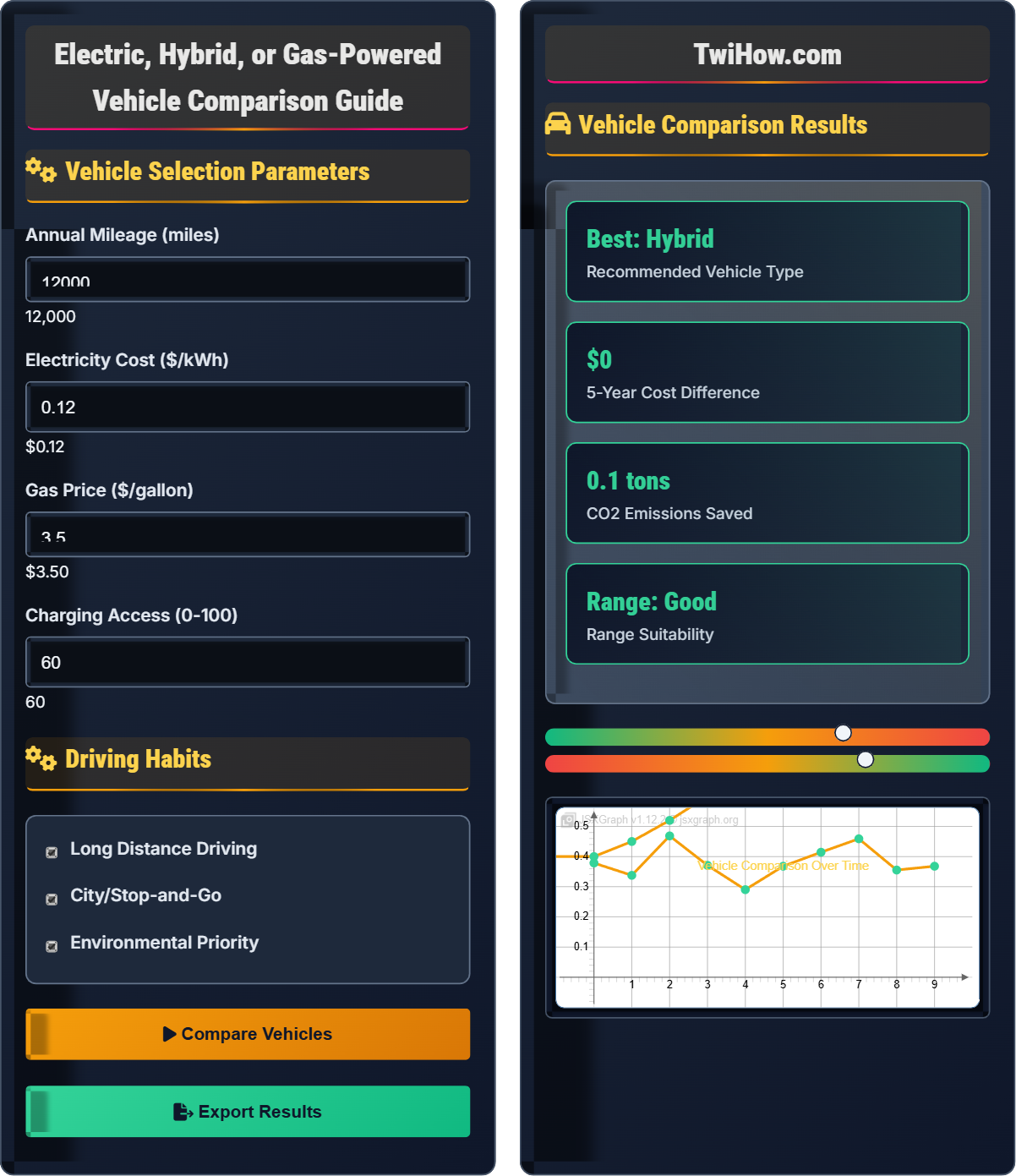
Vehicle Comparison Results
| Type | 5-Year Cost | Range | Emissions |
|---|---|---|---|
| Electric | $28,500 | 300 mi | 0 lbs CO2 |
| Hybrid | $32,400 | 500 mi | 10,200 lbs CO2 |
| Gas | $35,950 | 400 mi | 15,600 lbs CO2 |
E=Electric, H=Hybrid, G=Gas, C=Cost, R=Range, E=Emissions, M=Maintenance, V=Vehicle, U=Utility
Vehicle Type Comparison Explained
Vehicle selection involves comparing three main powertrain types: Electric Vehicles (EVs) powered entirely by electricity, Hybrid Electric Vehicles (HEVs) combining electric motors with gasoline engines, and conventional gas-powered vehicles running solely on gasoline. Each type offers distinct advantages and trade-offs.
Total Cost of Ownership (TCO) is calculated using multiple factors:
Where:
- TCO: Total Cost of Ownership over ownership period
- Purchase Price: Initial vehicle cost minus incentives
- Fuel/Electricity Cost: Energy cost per mile driven
- Annual Mileage: Miles driven per year
- Ownership Years: Planned ownership duration
- Maintenance: Service and repair costs
- Depreciation: Value loss over time
Each vehicle type has distinct features:
- Electric Vehicles: Zero emissions, low operating costs, requires charging infrastructure, limited range
- Hybrid Vehicles: Improved fuel efficiency, reduced emissions, no charging required, higher purchase price
- Gas Vehicles: Extensive refueling infrastructure, longest range, higher emissions, traditional maintenance
- Plug-in Hybrids: Electric-only range with gas backup, requires charging, complex maintenance
- Fuel Economy: EVs: 100+ MPGe, HEVs: 40-50 MPG, Gas: 25-35 MPG
- Environmental Impact: EVs: 0 direct emissions, HEVs: 50% reduction, Gas: 100% emissions
- Driving Patterns: Daily commute, long trips, city vs highway
- Infrastructure: Home charging, public charging availability
- Budget: Purchase price, operating costs, maintenance
- Environmental Values: Emission reduction priorities
- Practical Needs: Cargo space, towing capacity, reliability
Vehicle Type Fundamentals
Electric vehicles, hybrid vehicles, fuel efficiency, total cost of ownership, range anxiety, charging infrastructure, environmental impact.
TCO = Purchase Price + (Energy Cost × Annual Miles × Years) + Maintenance + Depreciation
Where TCO = Total Cost of Ownership, Energy Cost = fuel/electricity per mile, Annual Miles = yearly driving distance.
- Calculate 5-year TCO
- Consider driving patterns
- Factor in infrastructure
Applications
Commuting, long-distance travel, city driving, environmental consciousness, cost-consciousness.
- Drive pattern analysis
- Cost comparison
- Infrastructure assessment
- Environmental impact evaluation
- Charging accessibility
- Range requirements
- Cost sensitivity
- Environmental values
Vehicle Selection Learning Quiz
Which vehicle type typically offers the highest fuel efficiency?
Electric vehicles typically offer the highest fuel efficiency, measured in MPGe (Miles Per Gallon Equivalent). Modern EVs achieve 100+ MPGe, compared to 40-50 MPG for hybrids and 25-35 MPG for gas vehicles. This is because electric motors are inherently more efficient than combustion engines.
The answer is C) Electric vehicles.
Students should understand that electric motors convert about 90% of energy to motion, while gasoline engines only convert about 30-35%. This fundamental efficiency difference makes EVs much more energy-efficient. The MPGe metric allows for direct comparison between electric and gas-powered vehicles.
MPGe: Miles Per Gallon Equivalent for electric vehicles
Energy Conversion: Efficiency of energy to motion conversion
Motor Efficiency: Percentage of energy converted to useful work
• Electric motors are more efficient
• Combustion engines lose energy as heat
• MPGe enables comparison across types
• Compare MPGe ratings
• Consider energy costs
• Factor in driving patterns
• Comparing MPG to MPGe directly
• Ignoring energy conversion differences
• Not considering electricity costs
Explain how charging infrastructure affects the practicality of electric vehicles and what factors influence charging accessibility.
Home Charging: Level 1 (120V) provides ~4 miles/hour, Level 2 (240V) provides ~25-50 miles/hour.
Public Charging: DC Fast Chargers provide 150-350 miles in 10-30 minutes.
Accessibility Factors: Geographic location, apartment vs house, workplace charging, regional infrastructure investment.
Planning: Route planning for long trips, daily charging routine, backup options.
Infrastructure Growth: Rapid expansion of charging networks, government incentives, utility investments.
Practical Impact: Determines EV feasibility for different driving patterns.
Students should understand that charging infrastructure is the primary practical limitation for EV adoption. Unlike gas stations, charging locations require advance planning and may not be as convenient. The infrastructure gap is rapidly closing but still influences vehicle selection decisions.
Level 1 Charging: Standard 120V household outlet
Level 2 Charging: 240V charging station
DC Fast Charging: High-power rapid charging
• Home charging is most convenient
• Planning is essential for long trips
• Assess home charging capability
• Map charging along routes
• Consider workplace charging
• Assuming charging is like gas
• Not planning charging stops
• Ignoring infrastructure limitations
You drive 15,000 miles per year. An electric vehicle costs $45,000 with $0.04/mile electricity cost. A gas vehicle costs $35,000 with $0.15/mile fuel cost. Calculate the 5-year total cost for each and determine the break-even point.
Electric Vehicle: Purchase = $45,000; Operating = 15,000 × $0.04 × 5 = $3,000; Total = $48,000
Gas Vehicle: Purchase = $35,000; Operating = 15,000 × $0.15 × 5 = $11,250; Total = $46,250
Annual Operating Difference: ($0.15 - $0.04) × 15,000 = $1,650/year
Purchase Price Difference: $45,000 - $35,000 = $10,000
Break-even Point: $10,000 ÷ $1,650 = 6.06 years
Conclusion: Gas vehicle is cheaper over 5 years, but EV becomes cost-effective after 6 years.
This problem demonstrates that EVs have higher upfront costs but lower operating costs. Students should understand that the break-even point depends on driving patterns and energy prices. The key insight is that EVs become more economical with longer ownership periods.
Total Cost of Ownership: Purchase price plus operating costs
Break-even Point: Time when costs equalize
Operating Cost: Fuel/electricity and maintenance
• Calculate total cost over ownership period
• Consider annual operating costs
• Factor in purchase price difference
• Include maintenance costs
• Consider tax incentives
• Factor in depreciation
• Only considering purchase price
• Not factoring in incentives
• Forgetting maintenance costs
A family drives 20,000 miles per year with 60% city driving and 40% highway. They live in an apartment without charging access but work at a company with charging stations. They prioritize environmental impact but have a moderate budget. Recommend the best vehicle type and justify your choice.
Recommendation: Hybrid vehicle is the best choice.
Justification: High city driving benefits from hybrid efficiency, no home charging requirement, moderate upfront cost, significant environmental improvement over gas vehicles.
EV Limitations: Apartment living makes home charging difficult, long daily commute may strain range.
Gas Limitations: Higher emissions, poor efficiency in city driving.
Hybrid Benefits: Excellent city fuel economy, no charging infrastructure needed, good environmental performance, manageable cost.
Implementation: Use workplace charging when available, benefit from stop-and-go efficiency.
This problem demonstrates that vehicle selection requires balancing multiple factors. Students should understand that the "best" vehicle depends on specific circumstances. The key is identifying which factors are most important and finding the optimal compromise.
Vehicle Selection: Matching vehicle to user needs
Trade-offs: Balancing competing requirements
Practical Considerations: Real-world constraints
• Consider all relevant factors
• Prioritize based on needs
• Evaluate practical constraints
• List priorities in order
• Assess infrastructure access
• Consider long-term needs
• Focusing on single factor
• Ignoring practical constraints
• Not considering total cost
Which factor most significantly affects the environmental impact of electric vehicles?
The electricity source most significantly affects EV environmental impact. If electricity comes from coal-fired power plants, the environmental benefits diminish. However, as grids become cleaner with renewable energy, EVs become increasingly environmentally friendly. This is the primary factor determining EV environmental performance.
The answer is B) Electricity source.
Students should understand that EV environmental impact depends on the electricity generation mix. In regions with clean energy (solar, wind, nuclear), EVs have minimal emissions. In regions with fossil fuel-heavy grids, the advantage is reduced but still exists due to power plant efficiency. The grid is becoming cleaner over time.
Electricity Mix: Sources of electrical power generation
Grid Decarbonization: Reduction of emissions in electricity generation
Well-to-Wheel: Total lifecycle emissions
• Grid cleanliness matters
• Power plants are more efficient
• Future grids will be cleaner
• Research local electricity sources
• Consider future grid changes
• Look at regional averages
• Assuming all electricity is clean
• Ignoring generation mix
• Not considering grid evolution
FAQ
Q: How do I know if I can afford an electric vehicle?
A: Calculate total cost of ownership:
1. Upfront Costs: Purchase price, tax incentives, charging equipment
2. Operating Costs: Electricity vs gas, maintenance savings
3. Monthly Impact: Compare loan payments and operating costs
4. Long-term Savings: 5-10 year cost comparison
5. Infrastructure: Home charging setup costs
6. Insurance: Potential differences in premiums
Consider lease options or certified pre-owned vehicles to reduce upfront costs.
Q: What maintenance differences should I expect between vehicle types?
A: Maintenance requirements vary significantly:
Electric Vehicles: Brake pads last longer (regenerative braking), no oil changes, simpler drivetrain, battery health monitoring.
Hybrid Vehicles: Similar to gas vehicles but with additional electric components, battery warranty coverage, more complex diagnostics.
Gas Vehicles: Regular oil changes, transmission service, exhaust system maintenance, cooling system upkeep.
Cost Comparison: EVs typically have 30-50% lower maintenance costs over time.
Specialized Knowledge: EVs may require specialized technicians for complex repairs.
Consider warranty coverage and service network availability.